Why Brandwatch/FAQs
Frequently Asked Questions
We know our industry is a complex one and that you're probably buzzing with questions, so we've put together some answers for the most common queries we're asked.
If you'd like to know the answer to something that we've not managed to cover here, then please feel free to ask us directly.
Brandwatch is one of the world’s leading tools for monitoring, analyzing and utilizing social media conversations.
It is a paid-subscription software, and the platform is accessed through a web browser.
Brandwatch can be used for a number of purposes, some of which can be seen in our ‘Social Media Monitoring’ section of the website: Social CRM, Marketing, Research, PR and agency use.
Brands and agencies around the world use Brandwatch for more purposes than we can possibly list.
Please fill out the form or call our team on +44 1273 234 290.
All Brandwatch accounts get access to the one Brandwatch application. All our development is focused on this product and making it serve our customers better and better.
All Enterprise Brandwatch subscriptions are assigned to an Account Manager, who provides ongoing phone and email support. Initial training is free but we offer advanced training for a cost as well. We also have a dedicated support portal, which includes a large library of help documentation and videos as well as options to recommend features, report issues and contact our support team.
Our technical support team is staffed by Brandwatch developers, directly contactable by phone or email. All of our tickets are solved in lightning time and are answered with tailored responses from real people.
We offer two types of accounts – one based on data volume (how many mentions you’ll use) and one based on the number of queries you want to run. Take a look at our Pricing page for more information and please get in touch if you have further questions.
We offer unlimited user logins to any client at no extra charge. Account administrators can add users themselves.
Each client gets an Account Manager as part of the subscription. We also provide charged services for:
- Data validation (checking mentions, cleaning them, categorizing them and altering sentiment manually)
- Query definition advice and ongoing management
- Bespoke reports
- Use of API for custom reporting and data analysis
Each client is given one or more client administrator accounts, which they can use to create and manage user accounts. Users can create their own projects and queries.
Yes, many of our clients have a white labeled version of our user interface, with their own logo and colour scheme.
- Millions of sources/feeds from blogs, forums, news and other sites: 60m+ as of November 2012, growing by 2.5M per month
- This is on top of our pre-arranged direct streams from sites like Twitter and Facebook
If we’re missing a site you want to crawl, we can add it within minutes. It’s an automated process – you just give us the URL and we will add it to the system. Customers can upload lists of sites to cover too. New sites apply to all projects/brands.
On average we visit sites 3 times a day. Important sites are visited more often; every 5 or 30 minutes.
For Twitter we have a direct stream of their content so tweets typically come through within seconds or minutes.
We index all text content (blog, forums, etc.) as well as images and videos using their descriptions.
We’re able to crawl Twitter, Google+, Facebook, Flickr, YouTube, Tumblr and all other major public networks. For more information on our social network coverage, you can read this article.
We support English plus 24 other languages, including Chinese (Simplified and Traditional) and Arabic.
Each language has between 100Ks and millions of sources.
We add languages based on customer demand. There can be a fee for adding a new language; it usually can be done within a couple of months.
We’re not limited by country – Brandwatch will pick up any mention for a particular language, regardless of its location.
Our system records the location of the page too, allowing filtering by location in the query or in the application.
These numbers are inaccurate – they include several orders of magnitude of duplicates. We also aim to remove all kinds of spam. We focus on providing results of quality, not quantity.
Also, check the date range; Google’s default is all dates. Change it to last week/month and go to the last page of results for a better idea of the real volume.
Continuously: new functions are added to Brandwatch roughly every 2 weeks, often developed in response to client needs.
You don’t pay for the additional functionality and Brandwatch will be updated without you needing to do anything.
The sentiment of each mention in Brandwatch is automatically determined, though both user and paid-for analyst data validation are available too. To see how we currently approach automatic sentiment analysis, you can read our documentation on it here.
When you create a new query, we return data up to the beginning of the previous month or up to 10,000 mentions (whichever comes first).
We can also go back further to retrieve up to 3 years of data, but we may charge for this.
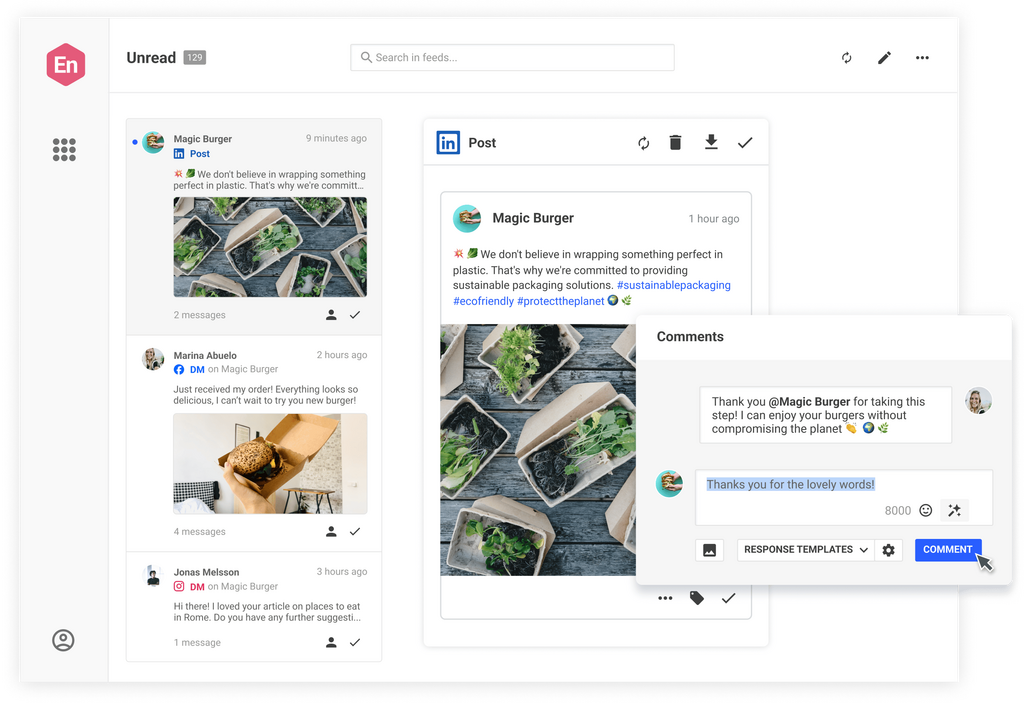
Brandwatch allows you to reply to Twitter mentions, and to publish mentions/comments to Twitter and Facebook, including posting bit.ly links. Internally, you can use workflow to share engagement across a team.
Yes, you can create any number of alerts. Alerts are fully customizable as you specify a query and any combination of filters (mozRank, location, etc.). Alert emails are sent ‘as it happens’ or once a day, week, etc. There is even the potential to set up Threshold Alerts, which will notify you when the volume of your query changes by a percentage that you determine in advance, so you can keep tabs on sudden influxes or dips in mentions.
Alerts can also be sent to multiple email addresses, even to people without a Brandwatch login.
There are 3 steps:
- We gather up all the discussions from across the web 24/7 in 25 languages.
- We process the data, stripping out spam and duplicates. We then use Natural Language Processing to find common topics and our cutting edge sentiment analysis systems attempt to determine what’s positive, neutral or negative.
- You cut and slice the data in the dashboard, depending on what you need.