As businesses mature into digital consumer intelligence, product development is something Brandwatch is asked more and more about.
How can we take the groundbreaking data and tools that are available, many of which were pioneered by marketing teams, and use them across the business? How do we apply them to problems that go beyond campaign management or content strategy, at the heart of what a business has to offer?


In this guide, you’ll hear from Brandwatch Research Analyst Alex Jones about how she’s worked on product development problem solving with some of our biggest clients. Based in New York City, Alex has been working with Brandwatch insights for almost five years. Her job involves working on a broad range of research projects, but she’s finding that product development is something that’s coming up in client requests more frequently.
“There’s still so much opportunity for companies to better use social data,” she says. “It’s about expanding social listening from ‘how many people use my hashtag’ to ‘what are consumers saying?’ ‘What are my consumers saying about this specific product?’ ‘How has conversation about this specific product changed in this specific market, specifically with regard to this brand attribute we want to benchmark against?’”
Alex is also excited about additional data sources Brandwatch has added over time that can help with product development, too.
“Now Brandwatch has grown to be so much more than social listening. Through our ongoing development, acquisitions, and mergers, we’ve literally grown our solutions out of just social media and into reviews and BuzzSumo and all these data sources. These can provide vital insight for product teams to understand every consumer touchpoint.”
Approaching product development with digital consumer intelligence
Let’s start by looking at how teams can go about approaching product development with digital consumer insights. What are the kinds of data available, and how can product teams get the most out of them?
Gathering feedback
To put it simply, digital consumer insights can provide product teams with vital feedback from end users. This feedback can come from a lot of different sources, including social media posts, forums, blogs, comments on news articles, survey responses, reviews, and more.
Alex explains how it works for one of her clients.
Building a holistic view
Alex is a big advocate for blending different kinds of data to build a more comprehensive picture of what consumers want and need.
“Overall, using multiple data sources is the way to understand how your product fully fits into your customers’ lives. It comes down to having that holistic view,” she says. “Your products are the part of your business that touch consumers most, and you need that mix of solicited and unsolicited insight to be able to understand how they’re interacting, thinking, and feeling with regard to those products.”
“Social just by itself is ripe with product data. You’ve got people talking in specialist forums or community subreddits, venting about products in social posts or blogs, and those who are trying to reach out via your official social channels. We also have access to review sites where people are there to share feedback on what they love and hate. Getting this real consumer sentiment across the customer journey is invaluable to people on the ground fixing features and developing new solutions.”
The more feedback you can gather from a diverse range of sources, the more informed you’ll be on how people feel about the many aspects of your product offering. Luckily, Brandwatch Consumer Research now allows you to upload your own data so you can compare everything side-by-side. More on that later.
In practice: How-to guides for common use cases
Let’s get into some practical tips for making the most of digital consumer intelligence for product development.
How to break out product feedback across the customer journey
It’s easy to search for mentions of a specific product online. It could look as simple as creating a query like this:
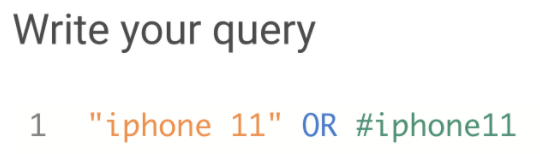
A query in Brandwatch Consumer Research can search for mentions all the way back to 2010, so you can take a look at older products as well as new releases if you wish. You can also look at how perceptions of a long-running product have changed over time.
There are very good reasons for looking at the customer journey as a whole. This includes studying input from people considering buying an iPhone 11, all the way up to current owners advocating for others buying one. “We have so many data sources that we essentially have the whole consumer journey covered,” says Alex. “You can understand what people want before they buy the product, how they feel while they’re trying to figure out the product, and how novices and experts alike describe your product after they’ve experienced it.”
If your mission is to understand how people who’ve actually got an iPhone 11 are finding it, you’ll want to dig into those conversations specifically.
Here are some tips for segmenting conversation to find actual users of your product:
- Time frame: This is an easy one. Set the time frame of your search up from the release date onwards. This’ll mean you’ll immediately cut out any speculative or hyped up conversations about the product before consumers have got their hands on it.
- Filter: There are some easy language filters you can apply to your search that’ll mean you capture people talking about the things they own and interact with, as opposed to things owned by others. Search for people talking about “My iPhone 11” as opposed to “His iPhone 11” or “The iPhone 11” (unless that’s following the phrase “I bought” or “I got” or similar). This is a good opportunity to use Brandwatch’s machine learning-powered Custom Classifiers – you can train these to recognize when people are talking about their own items as opposed to talking about items generally, just by feeding in a few example posts with a drag-and-drop tool.
- Search for reviews: Using Brandwatch Reviews, you can simply search for the url of your product on Amazon and be able to analyze how people have rated it, from the star count through to the verbatim reviews themselves. There’s more on this later.
How to bring together all your product data in one place
Companies have access to all kinds of data, from both internal and external sources. The key to getting to that holistic view of how products are perceived by consumers (as Alex mentions above) is to bring all that data together in one place.
Brandwatch’s Data Upload API was built to do just that. It enables clients to upload any text-based data they like, so it can be analyzed alongside real-time consumer conversations in the Consumer Research platform.
Here’s how one company benefited from the Data Upload API to upload and analyze their support tickets.
How to get the most out of review data
Review data can help you understand what people love and hate about your products and their features.
Here’s a really simple example showing how this could work, from our guide to Analyzing Reviews for Impactful Insights. Analyzing Amazon reviews of a popular chewing gum reveals the aspects that consumers want improvements for.
The top entity discussed is “flavor.” Clicking into the reviews, customers claim that this product is not as flavorful and doesn’t last as long as they’d hoped.
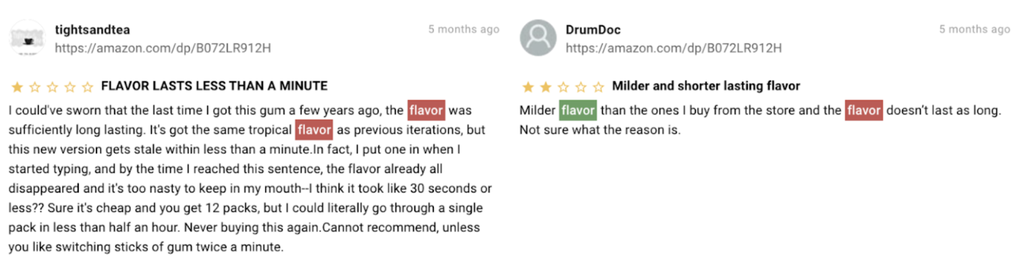
Since this is having a negative effect on star ratings, the company would be wise to invest in improving the flavor to keep customers coming back for more.
Using a tool like Brandwatch Reviews alongside Brandwatch Consumer Research can help you prioritize product fixes, ensuring that consumer concerns are addressed quickly so that future reviews (and therefore future sales) improve.
How to evaluate a soft launch using consumer insights
A soft product launch for a small group can provide a wealth of insights that will help a company understand if something’s ready to go global.
Alex explains how she worked with a tech company to evaluate how a soft launch went down in key markets using Brandwatch Consumer Research. They were already using Brandwatch insights to help them prioritize their time in regard to product improvements.
How to go beyond troubleshooting and use consumer insights to develop better solutions
Consumer insights can help product teams prioritize the improvements they make, based on the needs of end users. It can also help marketing teams understand the key strengths and weaknesses of their product offering, and create promotions accordingly. But Alex thinks there is far more potential for these kinds of insights.
“With Brandwatch we are able to peek into these problems that arise in consumers’ lives, these situations where they’re revealing unmet needs. That data is super-relevant to entire product strategies. Knowing what problems consumers are having can help you build solutions that fit those needs better than your competitors. That’s under-utilized, at least in my experience.”