After a year of in-person events being cancelled or postponed, sport is very much back.
In this report, we’ll take a look at some of the biggest events of the year through the lens of social data. We’ll cover:
- Trending sports activities in 2021
- The focus on mental health during the Summer Games
- What a major soccer finale looks like for shirt sponsors
- How conversation around the NBA has changed throughout the pandemic
- The impact of celebrities on winning online traction for Super Bowl LV ads
Trending sports activities in 2021
Using Brandwatch Consumer Research, we’re able to take a look not just at text-based mentions of different activities or topics but also at the content of images. This means we can study images published in public social posts containing people doing different sports to see how numbers have changed over time.
Looking at a list of sports that people might have taken up in the last year (primarily those that are based outside or doable at home), we noticed two activities that appeared in a lot of images posted online over the last six months, especially in relation to the six months before. Let’s dive deeper.
Dancing
“We’ve Lost Dancing” might have been a top tune throughout the pandemic, but does it actually ring true?
According to our data, images posted of people dancing have risen 17% in the first six months of 2021 compared to the six months previous to this.
We also found that towards the beginning of the pandemic people got really, really into dance tutorials.
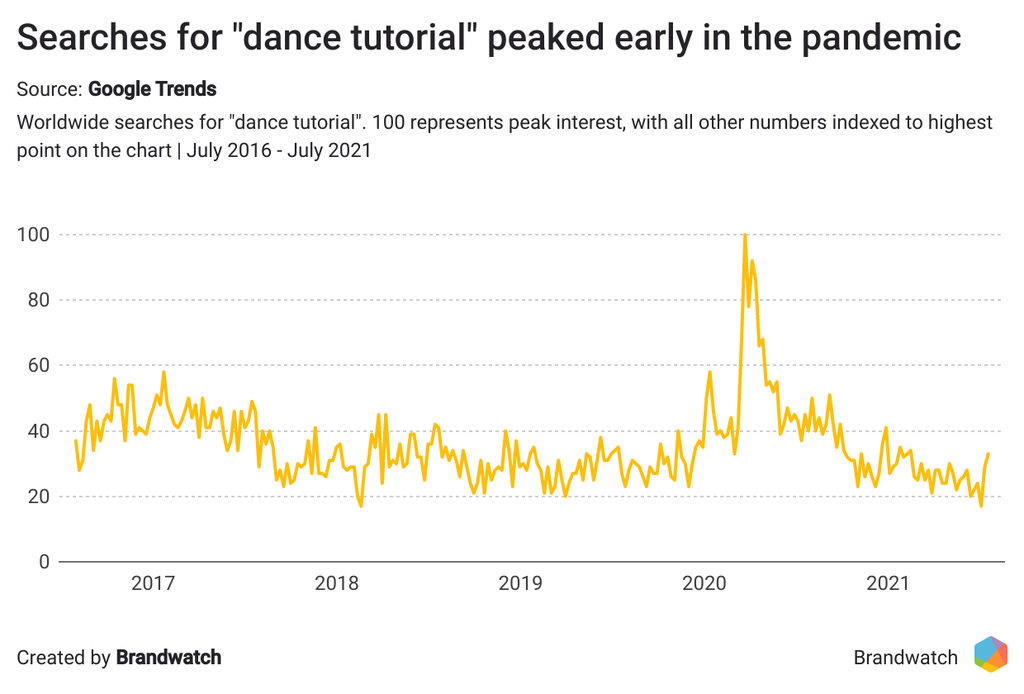
No doubt TikTok had something to do with this! With little to do but mill about at home, the temptation to learn some new moves, and perhaps to share them on the popular app, was clearly high. It doesn’t look like we lost dancing at all.
Cycling
Images of people cycling in social media posts also saw a boost in popularity in the first six months of 2021 compared to the six months before.
Looking at search data around bikes, we found that demand was particularly high at the beginning of the pandemic and has remained high (compared to previous years) since.
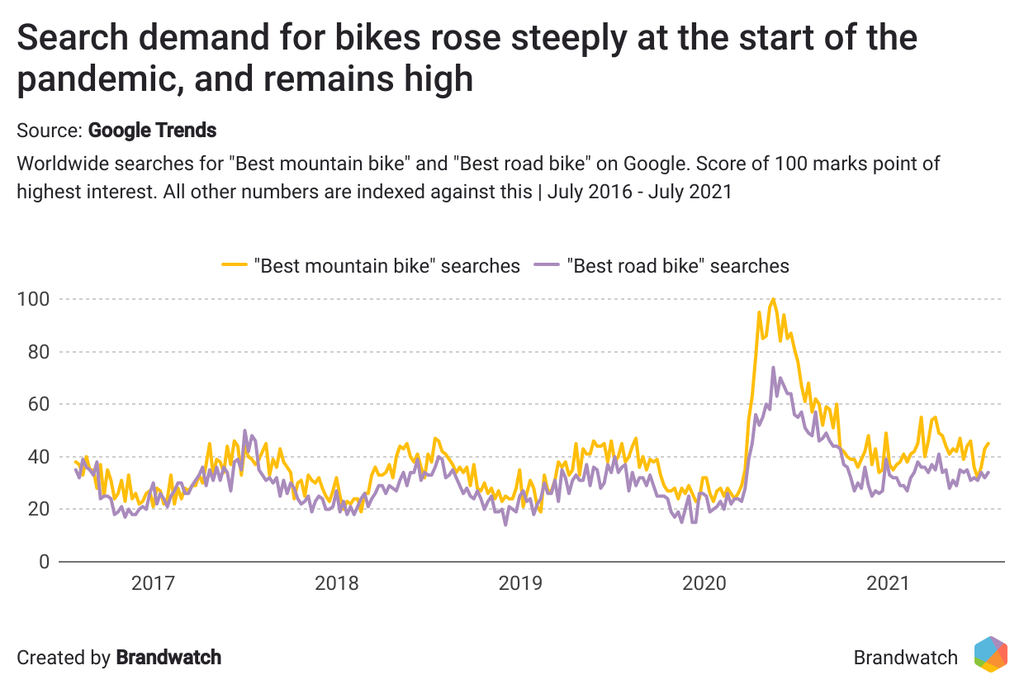
Unable to travel far but with a need for exercise and to get out and about, it’s no surprise to see cycling became more popular as the pandemic began.
And it’s good to see image posts have continued to grow around cycling – this suggests all those new bikes are still getting used.
The Summer Games and mental health
Our Social Sport Report wouldn’t be complete without some analysis of this year’s Summer Games.
While Covid-19 was the leading topic throughout, we found that conversation around the subject actually trailed off as time went on.
The second most mentioned topic, perhaps unexpectedly, was mental health. This actually drove 18% of all online conversation around the Summer Games.
Diving a little deeper, this was very much impacted by Simon Biles’ withdrawal from some of the events to focus on her mental health. Our analysis found that this conversation was primarily pushed forward by Gen Z authors, and that support shown for Biles from brands was seen in a positive light.
Throughout the pandemic, discussion around self care and mental health has grown, with no signs of slowing. The takeaway here for brands is that they should be prepared to engage with employees and customers on these subjects with authenticity and empathy.
Sponsorship performance: A tale of two shirts
Let’s turn our attention to Euro 2021 (aka Euro 2020), which ended with the dramatic England v Italy final on August 11.
We’ll leave the game analysis to the experts, but something we were very interested to analyze was how the kit sponsors fared. England kits are adorned with the Nike swoosh, while Italy’s kit is emblazoned with Puma’s logo. Both these deals are worth millions of dollars, but which sponsor got the most bang for their buck on the day of the Euro 2021 final?
One way to measure this is to look at the number of times the logos appeared in images posted on the day of the game.
Brandwatch Image Insights makes this super easy, and you can look at the data over time (down to the minute) too. When Italy was declared the winner of the tournament, the Puma logo appeared in over 700 images published in posts about the tournament in a single minute as people shared pictures of the triumphant team.
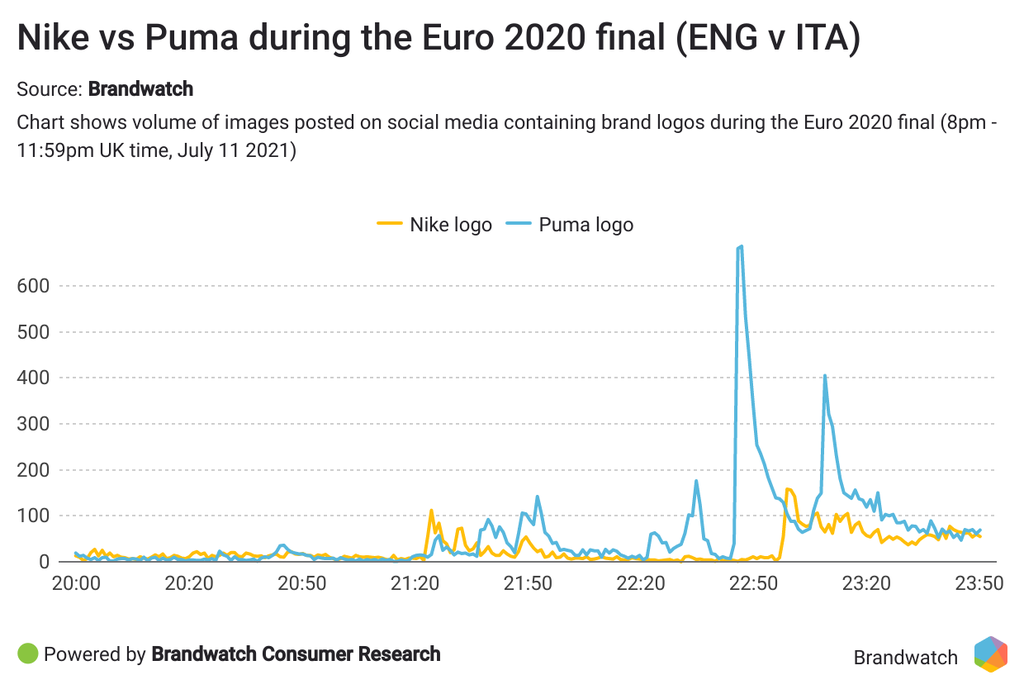
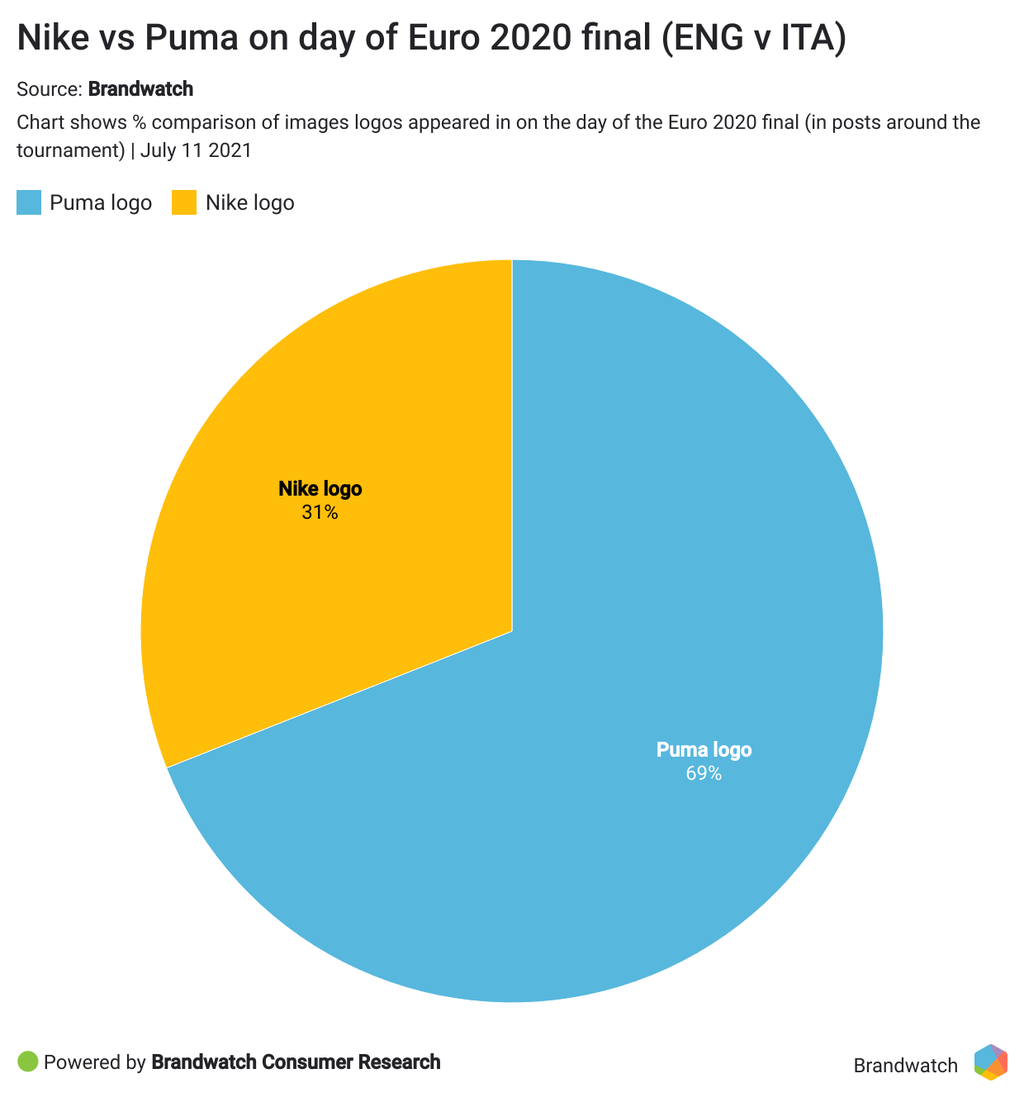
Puma also triumphed in both the total number of images the logo appeared in on the day in posts around the tournament (vs Nike), and the reach those images got online.
How does that look in monetary terms?
Puma’s sponsorship with Italy is reportedly worth $24.4 million per year, while England’s 12-year deal with Nike is reportedly worth the equivalent of $555.9 million (let’s call that $46.3 million a year). On the day of the final, Puma's logo reached 24.8 million people in those online mentions of the game and Nike's reached 6 million. Effectively, Nike pays much more than Puma for kit sponsorship and reached far less people that day.
This is, of course, a very simplistic way of looking at sponsorship measurement, and only looks at one game. But it also shows the difference that can be made when a sponsor backs a winning team.
Looking at overall images shared of the two logos on game day, we can also find the top-mentioned players that were mentioned in the accompanying text. In effect, these are the most valuable players for each sponsor on game day.
- Nike’s MVP: Jadon Sancho (2,020 mentions in text alongside images featuring Nike logo)
- Puma’s MVP: Jorginho (2,181 mentions in text alongside images featuring Puma logo)
How the NBA conversation has changed throughout the pandemic
While every industry has seen disruption since the pandemic began, major league sports have had to get particularly creative. For the NBA, that included dealing with season suspension, convening 22 teams in a “bubble” in Disney World, and players testing positive for the virus at various points.
For the public watching on across 2020 and up to mid-2021, the conversation around the NBA has been a bit of a rollercoaster ride.
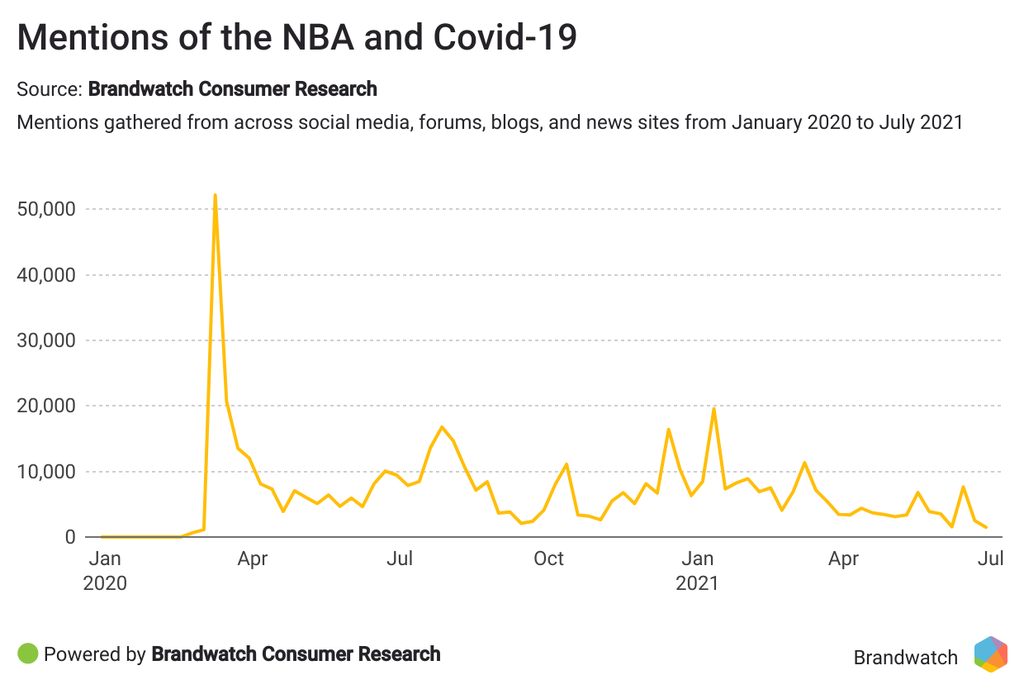
Let’s dive into some of those conversational spikes in chronological order:
- March 7 2020 - NBA warns games may be played without fans
- March 11 2020 - League suspended indefinitely after Rudy Gobert tests positive
- July 29 2020 - Zero players test positive ahead of season bubble restart
- January 12 2021 - Increased players in Covid-19 protocols, some testing positive multiple times
- March 11 2021 - Many people reflecting on the 1 year mark of the season being suspended
- May 22 2021 - LeBron James violates NBA rules by attending photoshoot
- June 16 2021 - Chris Paul enters protocol ahead of Western Conference Finals
As you can see, conversation has flitted between practical realities, like the NBA warning that games may be played without fans, and more controversial issues, like LeBron James violating NBA rules.
It’s also worth noting that conversation around the NBA and Covid has decreased over time, much like it did in relation to the Summer Games.
As the world gets “back to normal”, tracking conversation around specific sporting events and entities can help organizers gauge public sentiment around safety, games, and players. When planning large scale events, early speculation about the dangers involved is to be expected. Careful planning and safety procedures can help ensure this speculation is short-lived.
Advertising and sport: Super Bowl LV
Let’s go back to early 2021 to take a look at Super Bowl LV. While looking at the game in detail is always interesting (how the teams and players are discussed, for example), we find studying the ads is the most fascinating angle. After all, as Brandwatch’s Kellan Terry highlighted in his write up of the event earlier this year, the stakes are high.
"Advertising around the Super Bowl doesn’t come cheap, even if TV sports ratings have been down in the US during the pandemic. The price of a 30-second commercial during Super Bowl LV was around $5.5m.”
With a price tag that high, the race is on to garner the most attention from viewers. One way brands attempt to do this is by using the power of celebrity.
Looking at the ads alone (omitting The Weeknd who, as the halftime show performer, was the overall top-mentioned celeb during the Super Bowl this year), Drake was the star that drew the biggest crowd. The musician was mentioned over 66,000 times throughout the game, having featured in State Farm’s ad. In fact, at 7:20pm EST when the commercial aired, Drake featured in more than 5,700 mentions in that single minute.
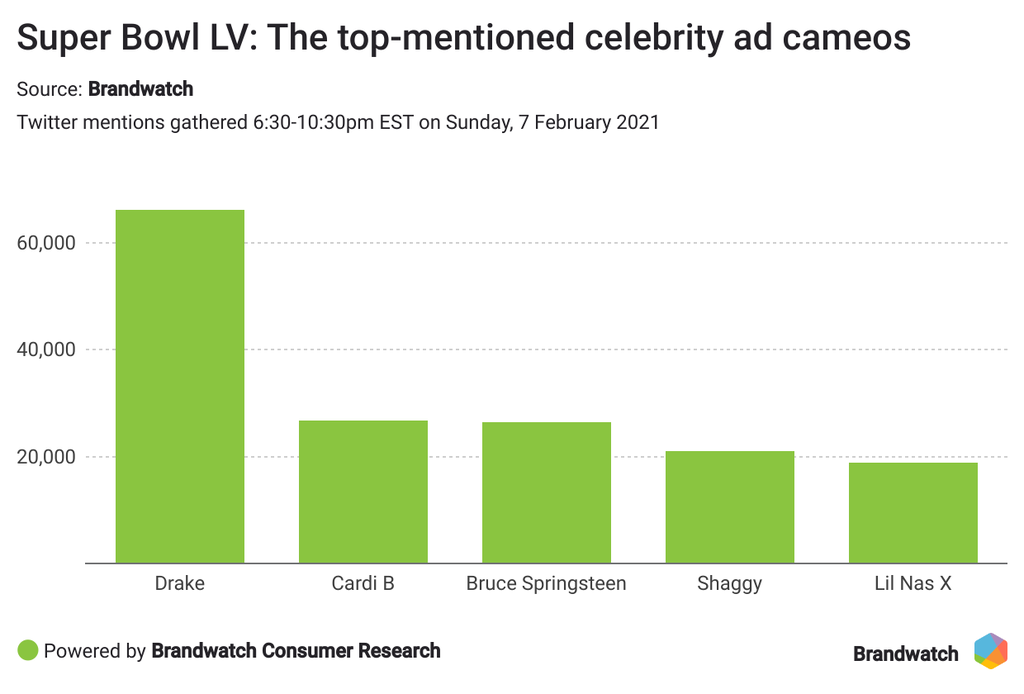
Celebrity cameos are an expensive way to garner attention, but they can be well worth it for a big event. That said, more celebrities doesn’t necessarily equal more attention.
"Some ads used a roster of stars but, while they received a fair amount of attention, the featured celebs were lost in the fray. This is a good example of how sometimes less is more. None of the ads with larger ensembles of celebrities outshined the ones with a single celeb that was just the right match for the brand.”
Learnings from sport events in 2021
You’ve got all the data, but what can brands learn from what’s happened so far in the world of sport in 2021?
- Covid-19 worries are still strong. The pandemic rolls on, and there is still concern around the safety of big events and conversation around how the rules are applied, stretched, or broken. As we’ve found above, for long-running events, speculative conversation around Covid tends to trail off as time goes on. Careful planning and safety procedures can help ensure this speculation is short lived.
- The power of celebrity. Whether it’s a celebrity fronting your ad, wearing your brand’s logo, or advocating for a cause, stars are often central to discussion around sport. With many sports stars wielding their influence to make a stand around the things they care about, supporting those stars can win brands favour.
- Consumers are trying new activities. Whether it’s dancing or cycling, consumers have been looking for things to keep them busy and active during the pandemic. As the world opens up, we could see them trying totally new activities with a newfound sense of freedom. As we’ve covered previously, activities like bouldering have started to see increased interest.