logo

Covid-19 Daily Bulletin 04/05: Homebrewing Beers and Potions

Hoppy pale ale or magical curse?

Welcome back from the weekend, and to another bulletin. Today we’re looking at a resurgence in homebrewing, lockdown conversations, and the occult.

Want these bulletins sent straight to your inbox? Subscribe below.

SUBSCRIBE

Very superstitious

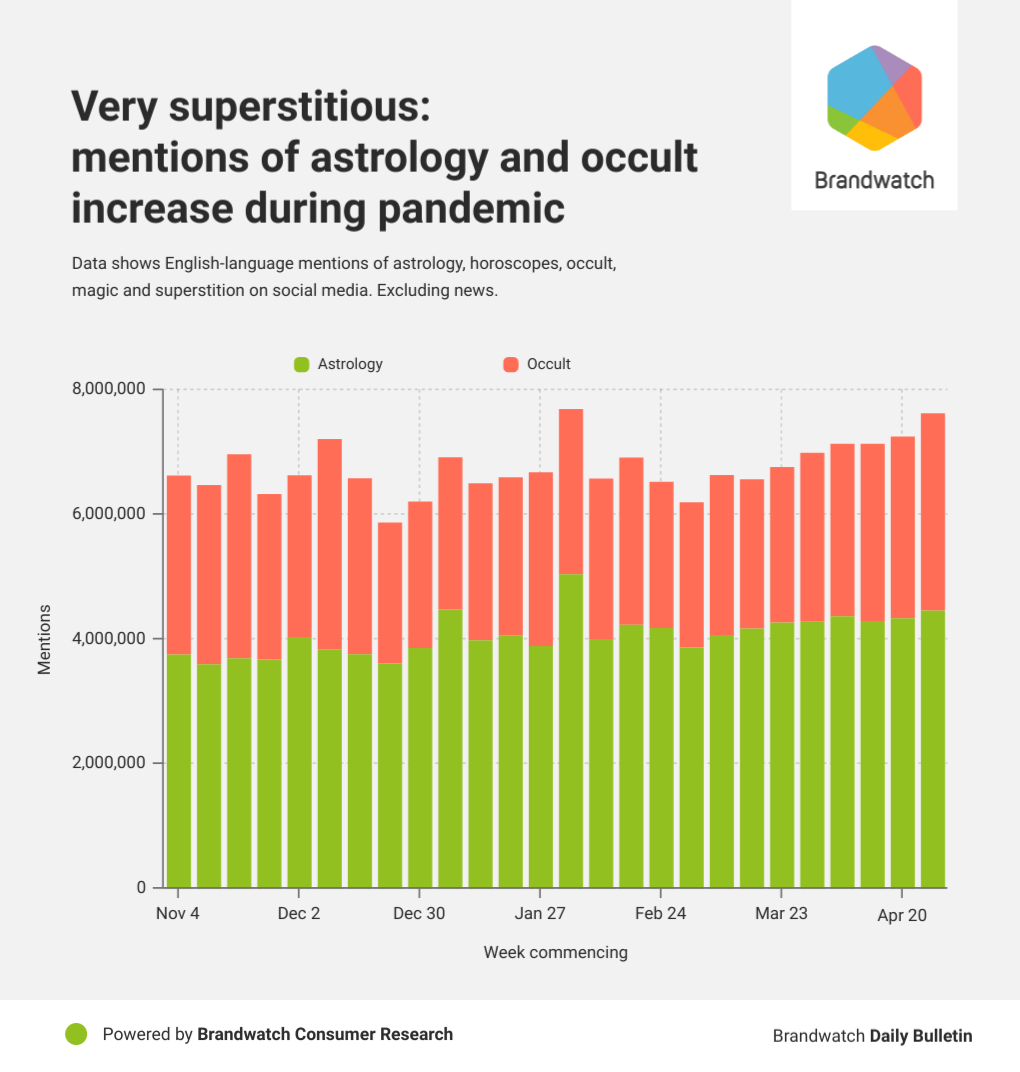
Was social’s turn to astrology and the occult written in the stars? We aren’t astrologists so we can’t say for sure, but our Consumer Research platform has found an increase in English-language discussion around these topics.

Since the start of March, more and more people have been talking about astrology and the occult online. The former has seen an average 2% increase week-on-week, while it’s been 4% for the latter. In the three weeks prior, both topics had seen their volumes fall.

We can see the weekly rhythm of astrology and occult conversations in the above chart. Mentions swell and then relent between celebrations, full moons, and high tides. For example, 178k mentions of the supermoon drove mentions up for the week of March 30.

Before February, astrology and the occult were discussed quite negatively. When examining sentiment-categorized mentions, we saw that close to 70% of mentions were categorized as negative. But in February we saw that astrology and occult conversations were turning positive, with weekly conversations accruing more positive mentions than negative.

Increases in conversation in both March and April indicate that people have used some of their free time in lockdown to learn about the mystic arts. Notably, 140k people talked about learning how to read horoscopes, while 55k discussed learning about love spells.

We also noticed that mentions of the paranormal increased 83% in March and April, compared to January and February, with 4m mentions on social media. Perhaps we’re all spending a little too much time cooped up.

This isn’t the first time we’ve seen unique subjects rise to social fame during lockdown, and we imagine we’ll see even more as time ticks away.

A little less conversation

We’re into the seventh week of this bulletin, and each week we’ve tracked how people and publishers are talking about Covid-19. Another week, another update.

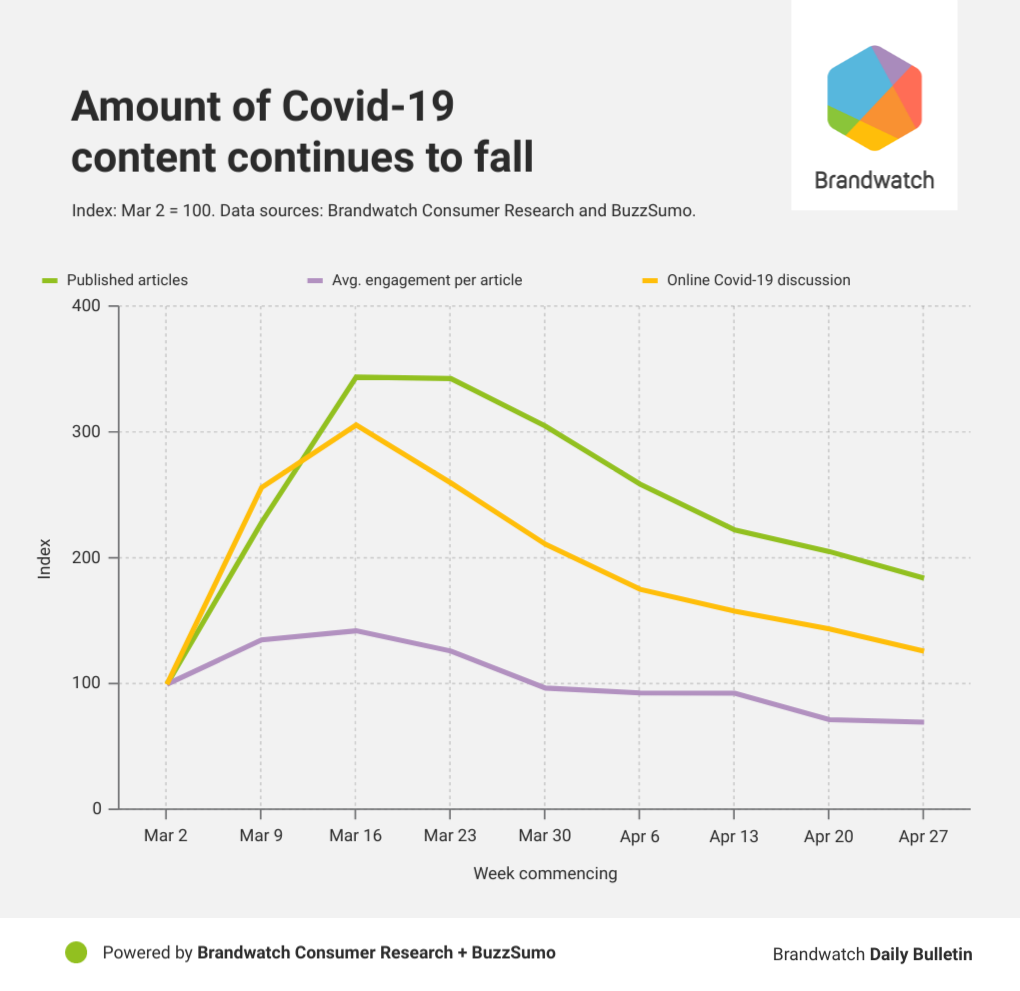
To do this analysis, we use BuzzSumo to look at how many articles about Covid-19 are published and the average number of social engagements (Reddits shares, Facebook likes, etc) that they get.

We also include the size of the general discussion around Covid-19 online using data from our Consumer Research platform. We then index all these data points to March 2 so we can make the trends comparable.

Here’s what we found.

The number of Covid-19 articles has fallen again, by 10% week-on-week. The same goes for the online discussion, which dropped by 12%. At this rate, within two weeks the number of people talking about coronavirus will be at the same level as it was at the start of March.

There’s a little bit of good news for publishers, though. Despite decreasing the number of articles they publish on Covid-19, average engagement has remained level. Although this means less engagements in real terms than the week prior, the level of content and the results produced now feels a bit more sustainable.

For the general public, this should mean less low quality content, and more articles with value that we actually want to read.

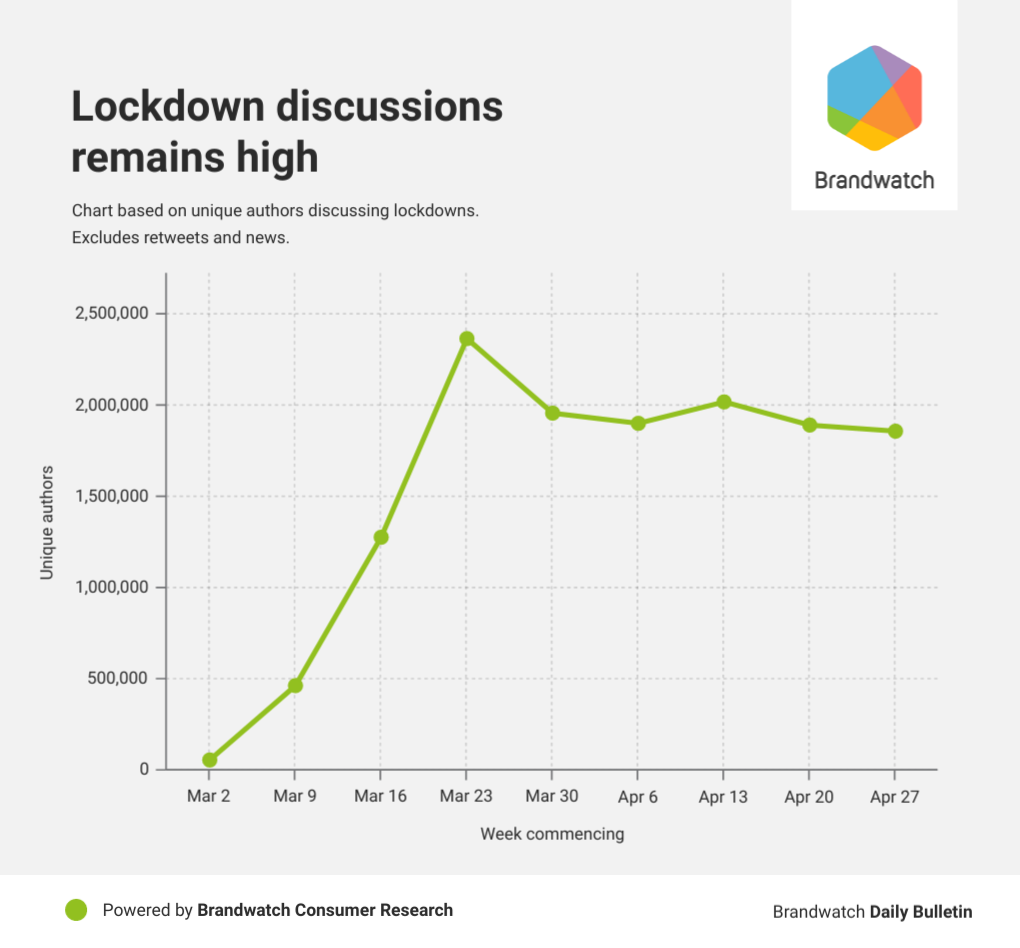
Moving away from the general Covid-19 topic, we wanted to look at the subject of lockdowns specifically.

As we can see, the number of people discussing the topic has remained fairly steady. Since peaking towards the end of March as the UK, Australia, and Germany went into lockdown, around 2m people have contributed to the conversation every week.

This shows that while we may be mentioning the virus less, its fallout is still at the forefront of our minds. For a topic that directly affects billions around the world, it’s no surprise.

Pilsners in a pandemic

The pandemic certainly hasn’t dried up interest in alcohol. We’ve previously reported on the rise of virtual drinks and pub quizzes, while our Qriously surveys have found plenty of people drinking more since Covid-19 spread worldwide.

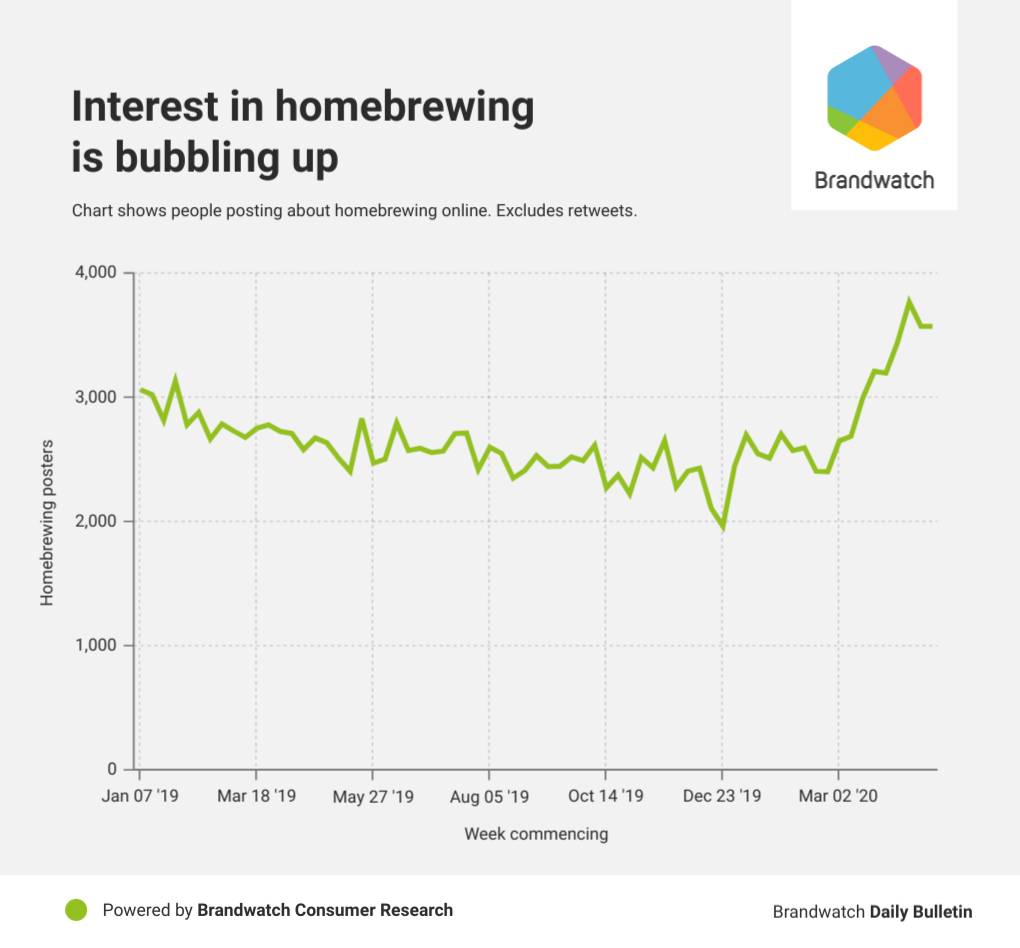
With people encouraged to stay indoors and to only get essential items, accessing alcohol has become harder and we now have time to pursue new hobbies. It’s no wonder, then, to see that people are giving homebrewing a go.

We found a big jump in online homebrew discussions starting at the beginning of March. This has yet to let off, with April seeing an increase of 19% year-on-year. This is the most the topic has been discussed since March 2017.

Just like the boom in sourdough interest, homebrewing fits in well with the situation many people find themselves in. We are spending much more time at home than usual, giving us the chance to tend to home-based projects.

With job losses the world over, homebrewing could even be the start of a new career. There’s still a demand for the product, so starting your own beer company could be a way to bring in some cash. Learning through homebrewing is a good starting point in that direction.

And for those interested, the most discussed drinks were IPAs, followed by lager, and then cider. Bottoms up.

Get more in-depth data every week

Don’t miss out on even more analysis and insights on Covid-19.

Head here to find out more and get signed up.

Thanks for reading

That’s it for today. If you found today’s bulletin interesting, get more every day bu signing up here.

Stay safe,

Brandwatch Response Team

logo
Digital Consumer Intelligence

Runtime Collective Limited (trading as Brandwatch). English company number 3898053
New York | Boston | Chicago | Austin | Toronto | Brighton | London | Copenhagen | Berlin | Stuttgart | Frankfurt | Paris | Madrid | Budapest | Sofia | Chennai | Singapore | Sydney | Melbourne

Privacy Policy

Update subscription preferences

Unsubscribe

We value your privacy

We use cookies and similar technologies to personalize ads and content (including by sharing data with Google), to measure site performance, and to improve your experience. Learn more in our cookie policy

Privacy & Safety • Terms of Service

No, take me to settings
Yes, I agree
More info.

By using our site you agree to our use of cookies —