logo

Covid-19 Daily Bulletin 14/05: Reality Hits and Fed-up Customers

The light at the end of the tunnel is getting harder to see

Welcome back. Today we’ve got a ton of survey data around lockdown measures and a return to normality. And we’re also looking at how companies are losing customers during the crisis.

If you’re not subscribed to these already, get signed up below.

SUBSCRIBE

Great expectations dashed

You can’t move for talk about when and how lockdowns should be eased. Health and safety and economics are obviously major considerations, but another is how long people will put up with current restrictions.

You’ve likely seen reports of protests in various countries calling for lockdowns to end. But do they have much support amongst the wider populace?

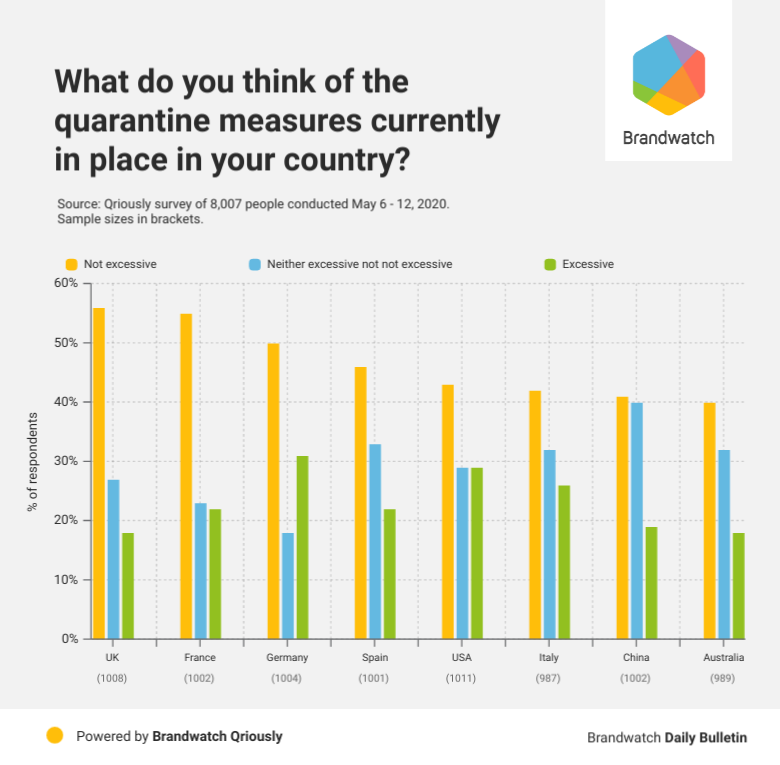
Using Qriously, we’ve been surveying thousands of adults from Australia, China, France, Germany, Italy, Spain, the UK, and the US through their smartphones and tablets. As part of that, we’ve been asking what people think of the quarantine measures in their countries.

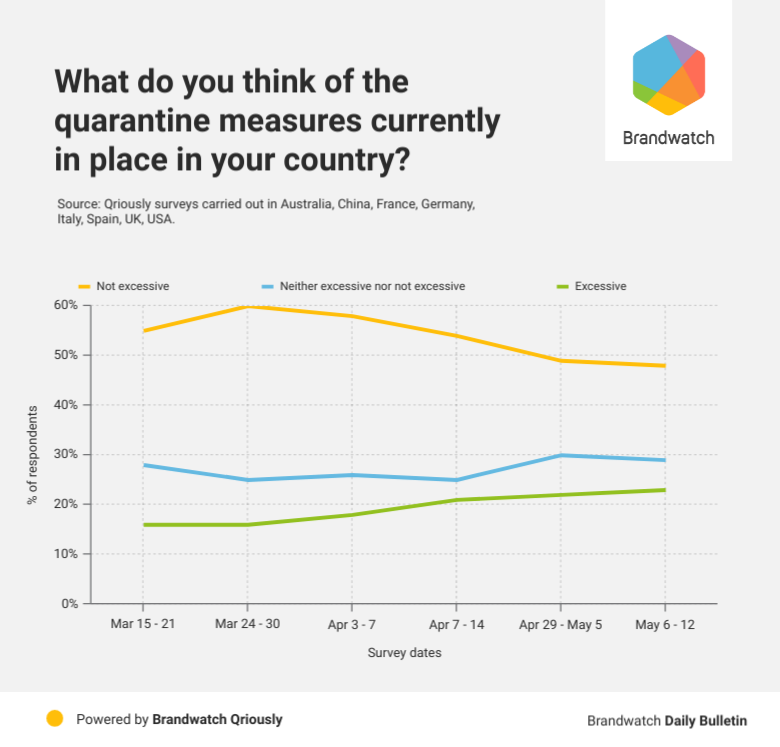
In our latest survey, 23% of respondents said measures were excessive, while 48% think the opposite. The remaining 29% said measures were neither excessive or not excessive.

People in France and the UK were the most likely to report measures as not excessive, while respondents in Germany and the US were most likely to report them as excessive.

Understandably, the picture is different for each country but, generally, people are willing to accept the measures they’re under. That said, there are signs of trouble ahead.

Looking back over previous surveys, there’s been a pronounced change. The percentage of people reporting that government measures are ‘not excessive’ has been falling. At one point it was as high as 60%, but it’s since fallen to 48%.

Meanwhile, the percentage of respondents saying measures were excessive has been rising (although not too rapidly). From a low of 16%, it’s risen to 23%.

The number of people with no opinion either way has remained steady, never going below 25% or above 30%.

If the trend of the two latest surveys continues, we could see more people finding measures excessive than not in around six weeks. But what’s causing this?

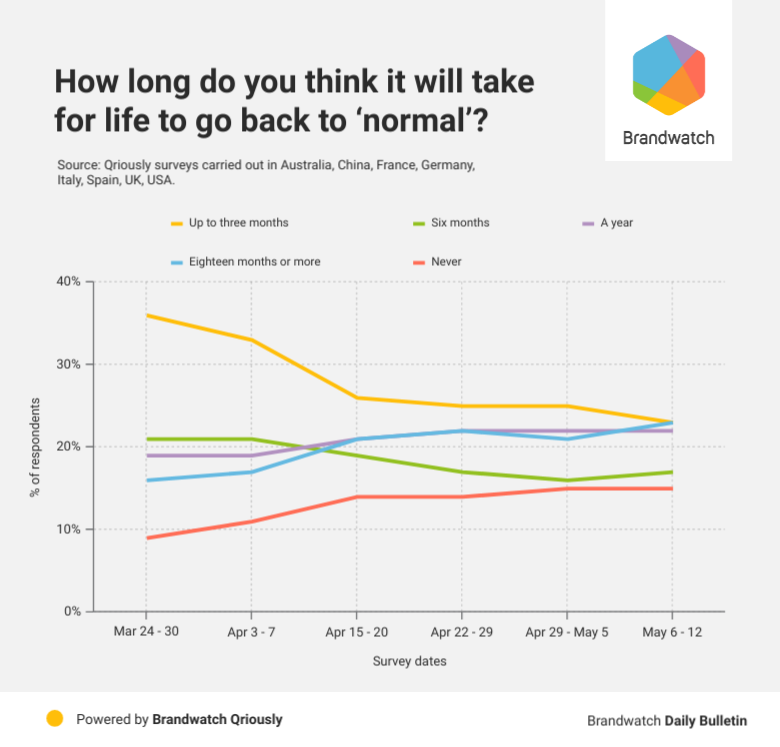
We’ve also asked respondents about when they think things will return to normal. Another trend is emerging here.

Early on in the pandemic, 36% of people thought things would be back to normal within three months. In our latest survey, that number is down to just 23%. Meanwhile, the percentage of those thinking it’ll take a year or more has risen from 35% to 45%.

We’ve also seen a steady rise in those thinking there will be no return to normal. People who chose ‘never’ made up 9% of respondents in our first survey, and 15% in our most recent one.

Clearly optimism has fallen and more people are preparing themselves to be dealing with Covid-19 and its fallout for longer than they first thought.

If that’s the case, it makes sense that more people are finding government measures excessive. It’s much easier to accept a lockdown that lasts a few months compared to one lasting over a year.

Anger bubbling around customer service

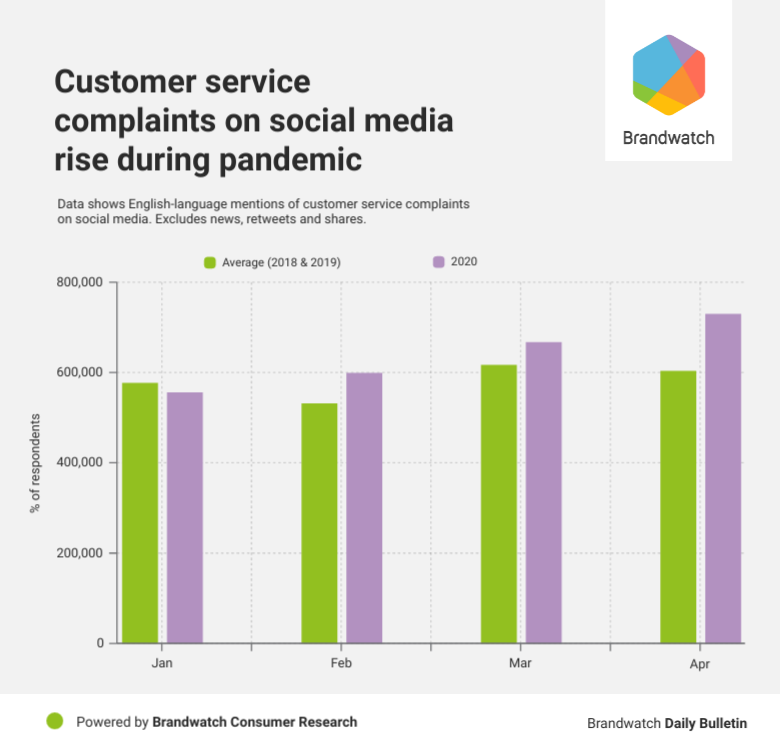
“You’ve lost yourself a customer” is one of the most scathing things someone can say to a business and, using our Consumer Research platform, we’ve seen an influx of these kinds of mentions (in English) since the outbreak began.

Thanks to lengthy waiting times, poor customer service, and a strained delivery network, it’s perhaps not a surprise.

Consumers posting about how a business had lost their custom hit 1.3m mentions across March and April, up 21% compared to January and February. Considering January is returns month, that’s not good. Mentions are also up compared to the average for 2018 and 2019.

Customer service complaints included the 22k people claiming they’d been sent the wrong item, 8k mentioning long waiting times, and, frustratingly, 5k mentioning a complete lack of contact as the reason they would never use a company again.

Delivery was also a huge driver of customer complaints — people telling businesses they’d lost a customer because of delivery was up 51% in March and April compared to January and February.

Of course, the pandemic has meant there’s been a huge amount of adaptation in a short space of time, no matter how big or small a company is. However, some consumers aren’t as forgiving as others. As long as companies are transparent about potential waits or other issues, and offer satisfactory solutions, consumers will hopefully be back soon.

Join our Covid-19 roundtable

Meet the analysts behind our weekly insights report next Friday, May 15th, and get your questions around the data and insights answered.

Register here.

Thanks for reading

If you found today’s bulletin useful, get signed up for more here.

Stay safe,

Brandwatch Response Team

logo
Digital Consumer Intelligence

Runtime Collective Limited (trading as Brandwatch). English company number 3898053
New York | Boston | Chicago | Austin | Toronto | Brighton | London | Copenhagen | Berlin | Stuttgart | Frankfurt | Paris | Madrid | Budapest | Sofia | Chennai | Singapore | Sydney | Melbourne

Privacy Policy

Update subscription preferences

Unsubscribe

We value your privacy

We use cookies and similar technologies to personalize ads and content (including by sharing data with Google), to measure site performance, and to improve your experience. Learn more in our cookie policy

Privacy & Safety • Terms of Service

No, take me to settings
Yes, I agree
More info.

By using our site you agree to our use of cookies —