logo

Covid-19 Daily Bulletin 26/05: Quality Content and Retro Pastimes

It's only a matter of time before we all buy quills.

Welcome to our first bulletin of the week after our day off yesterday. Today we’re looking at the old school activities we’ve been adopting under lockdown, and another look at how Covid-19 content is performing.

If you want these bulletins sent straight to your inbox, subscribe below.

SUBSCRIBE

Is the quality of Covid-19 content improving?

Continuing our weekly tradition, we’re taking a look at how the online Covid-19 conversation is changing, along with how content on the subject is faring.

To do this we use our Consumer Research platform to work out the size of the online Covid-19 discussion, looking at the number of unique accounts mentioning the coronavirus in a range of languages.

We then use BuzzSumo to get a count of the number of Covid-19-related articles published (in all languages), and the amount of engagement they got. In this case, engagement refers to things like social shares, likes, and comments.

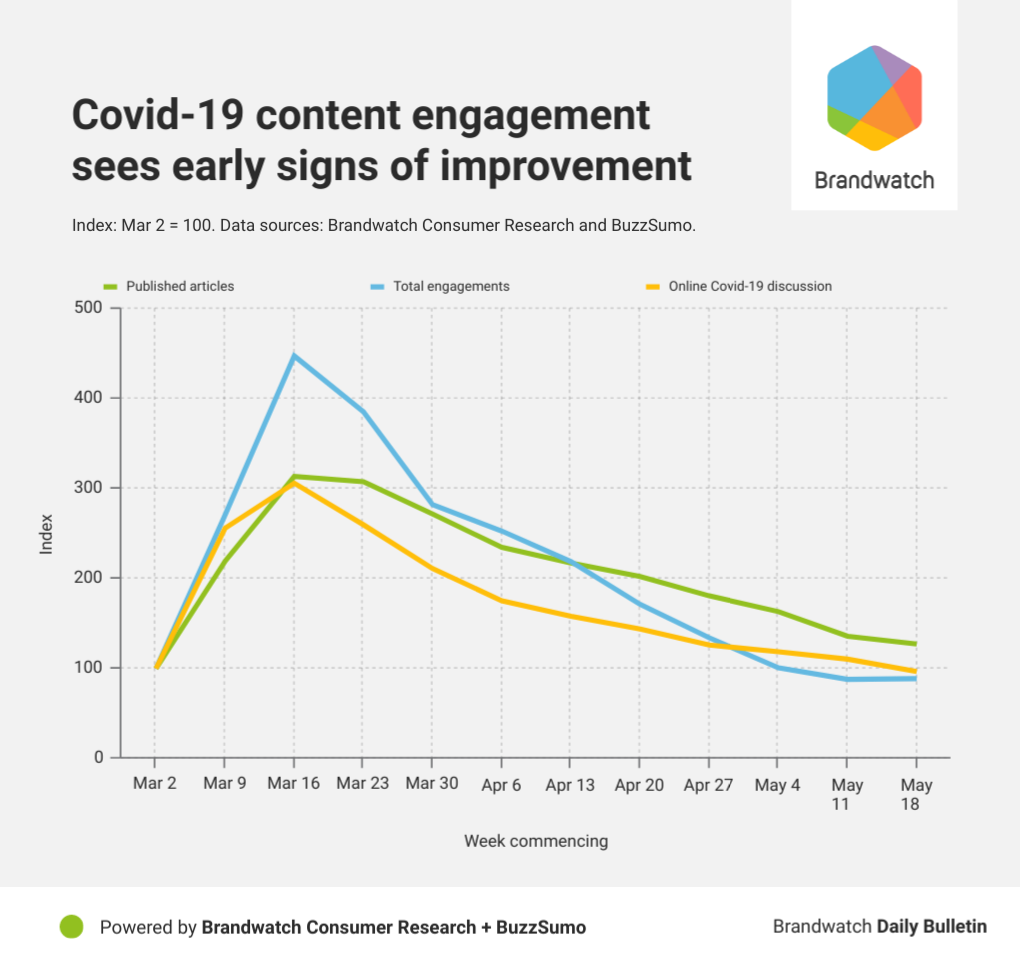
All that data is then indexed against the numbers on March 2 so trends are comparable. Here’s how things are looking with another week’s worth of data.

For the ninth time running, the size of the online Covid-19 discussion has dropped, falling another 13% this week. In total, we found 4.8m people talking about the virus. While that’s still a huge amount of discussion, the number has dropped below the mention count in the first week of March, and is far less than the 15.2m talking about Covid-19 the week of March 16.

The number of Covid-19 articles published also fell again, this week by 6% – that’s the smallest drop we’ve seen since the week of March 23. In total, last week saw 680k articles on the subject. That’s still a lot of content, but a big fall from its peak of 1.67m.

But despite another fall in total articles, we found the total number of engagements rose, albeit by just 1%. This actually represents a significant shift. In the four weeks prior, this metric dropped on average by 20% per week. Clearly something has changed.

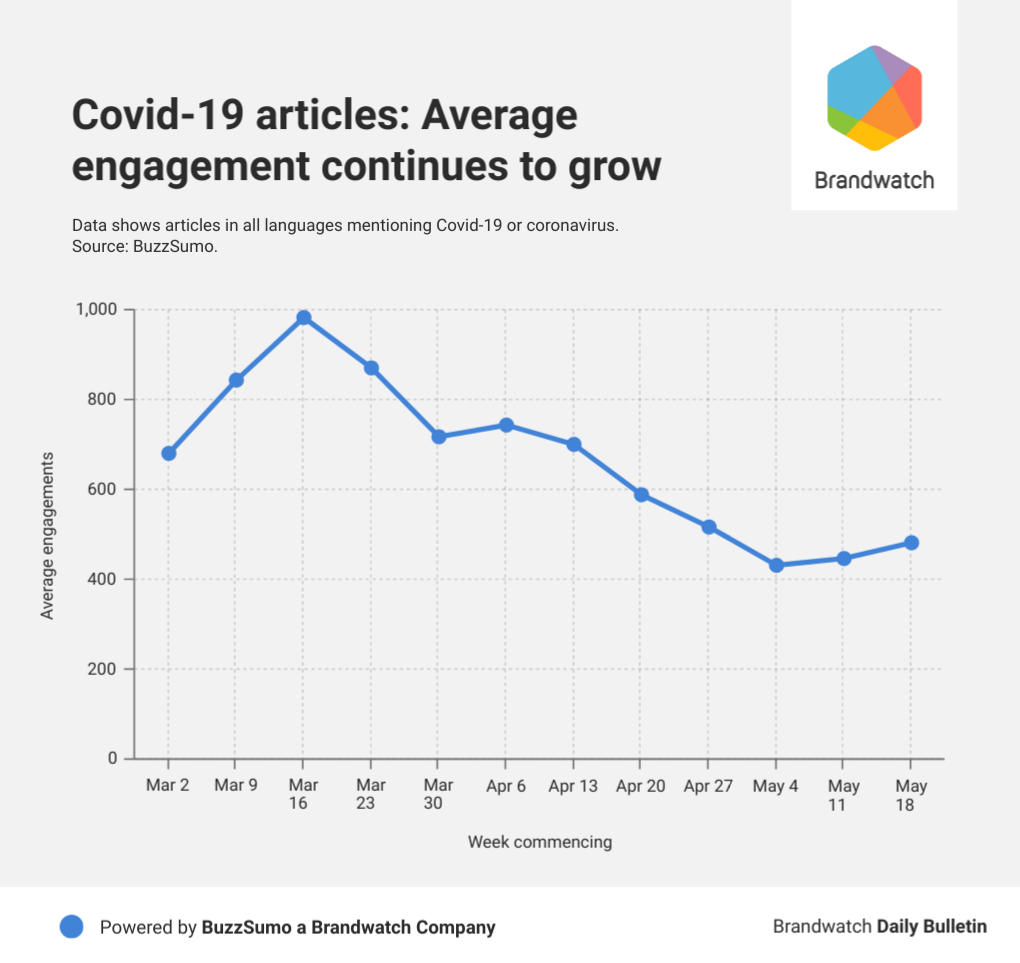
As we can see in the above chart, people are engaging more with the content that is going out. The last two weeks have seen a rise in the average engagements per article, increasing from 433 to 483 per article .

It’s a modest rise, and still way off from the 984-per-article peak we saw nine weeks back, but it’s encouraging. The content that is going out is clearly resonating better with readers. In theory that means the quality is higher, and less articles are being churned out just for the sake of it.

So what kind of content performed best last week? The top articles talk about new research around Covid-19 and advice on assessing health risks when going out, or they’re news reports about the outbreak.

With fears that fake news and disinformation is taking over social media, it’s a good sign that none of that is topping the list.

Back to the future

In recent bulletins, we’ve noticed a number of rising trends that fall into the ‘retro’ category. We wanted to find out more.

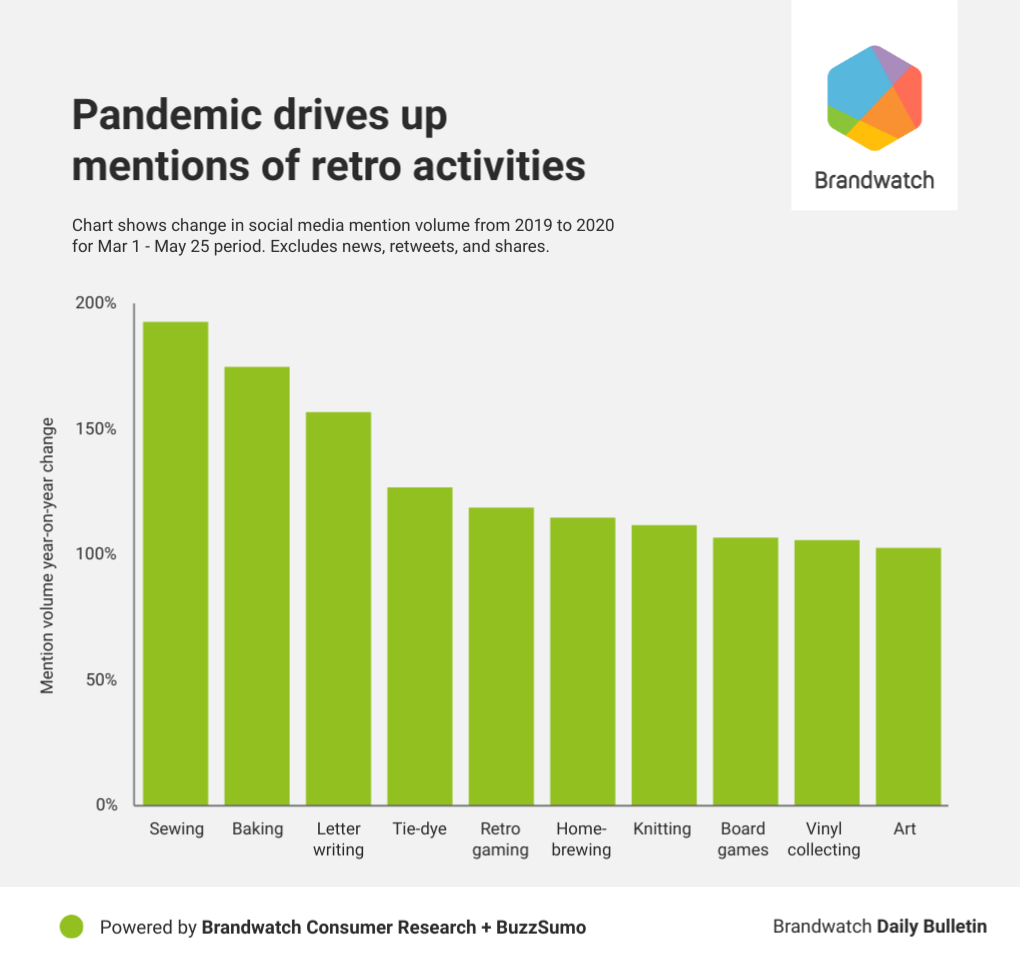
Using our Consumer Research platform, we looked at English-language mentions of different ‘retro’ activities in March, April, and May in 2019 and 2020.

Despite art being the most discussed hobby, sewing saw the largest % increase in interest. Mentions of sewing increased 193% between 2019 and 2020, while 2019 volumes were up just 60% compared to 2018. People discussing how to make your own mask and selling their own reusable masks online helped drive the huge mention increase.

Baking had the second largest % boost in interest compared to 2019. Mentions in 2020 were up 175% from the same period in 2019. Back in April we found cookies, brownies, and banana bread were the most popular items to bake.

Letter writing had the third largest % increase. In case you missed our Daily Bulletin on May 22, we learned that a huge number of people were putting pens to paper to help cope with the stress and anxiety caused by the pandemic. Mentions of letter writing increased 157% in the period we studied in 2020 compared to that period in 2019.

We also found board games have been a fun family savior during lockdown, with mentions increasing 107% year-on-year. Art has also seen a boost in mentions, up 103%.

Even with stores closed, we’ve seen a rise in people discussing buying vinyl. Mentions increased by 106% this year compared to 2019. The conversation was driven by collectors using their lockdown time to find some ultra-rare gems and discussing how Covid-19 could change the hobby forever.

And that’s just it. Lockdown is changing everything, but the question is whether these hobbies stay popular once lockdown is over. Will we see the creativity and love for all things retro last into 2021 and beyond?

Join our Covid-19 roundtable

Meet the experts behind our Covid-19 reporting and find out how important data is for getting through the crisis.

Register now.

Thanks for reading

That’s it for today. Don’t forget to subscribe to these bulletins so you don’t miss out.

Stay safe,

Brandwatch Response Team

logo
Digital Consumer Intelligence

Runtime Collective Limited (trading as Brandwatch). English company number 3898053
New York | Boston | Chicago | Austin | Toronto | Brighton | London | Copenhagen | Berlin | Stuttgart | Frankfurt | Paris | Madrid | Budapest | Sofia | Chennai | Singapore | Sydney | Melbourne

Privacy Policy

Update subscription preferences

Unsubscribe

We value your privacy

We use cookies and similar technologies to personalize ads and content (including by sharing data with Google), to measure site performance, and to improve your experience. Learn more in our cookie policy

Privacy & Safety • Terms of Service

No, take me to settings
Yes, I agree
More info.

By using our site you agree to our use of cookies —