logo

Covid-19 Daily Bulletin 08/06: City Movement and Shifting Attention

Cities are coming back to life.

Welcome back to another week of bulletins. Today we’re looking at how the online Covid-19 discussion continues to shrink, and how movement in cities continues to grow.

Don’t forget to subscribe if you want these bulletins sent straight to your inbox.

SUBSCRIBE

Covid-19 conversation dwindles again

As usual we’re kicking off another week of bulletins by looking at Covid-19 content performance and how people are discussing the topic.

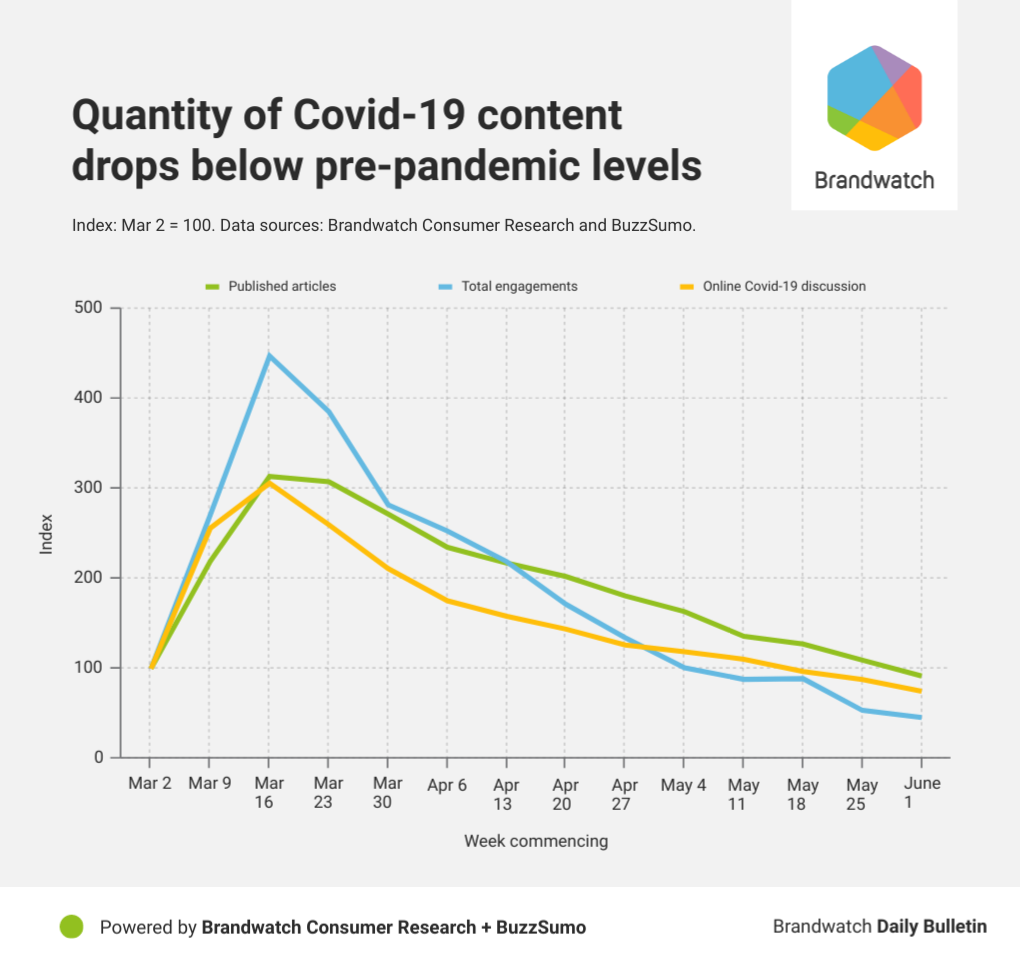
To do this, we use Brandwatch Consumer Research to look at the number of individual accounts talking about Covid-19 online across multiple languages. We refer to this as the ‘online Covid-19 discussion’.

We also use BuzzSumo to see how many articles are published on Covid-19, and the social engagements they get. This includes actions like Twitter shares and Facebook likes.

Finally, we index all the data to March 2 so we can compare each metric’s trend over time. Here’s how things look now.

For the first time, there were fewer articles published about Covid-19 than when we started our tracker (just over a week before the virus was officially declared a pandemic). In total, 491k articles were published last week, a fall of 16% on the week before.

This is reflected in the drop in total engagements. These fell by 15%, which shows that while there was less content then the week before, people were engaging with it at about the same rate.

The average number of engagements a piece got (not shown in the above chart) was 344, a 1% improvement on the previous week. But this follows a 30% drop the week before that. People’s interest in Covid-19 content is clearly way down on what we would have expected previously.

We also saw a relatively big fall in the size of the Covid-19 discussion. While 3.7m people still mentioned the virus online, that’s 15% less than the week before, or around 640k fewer people. This is the biggest fall we’ve seen in eight weeks.

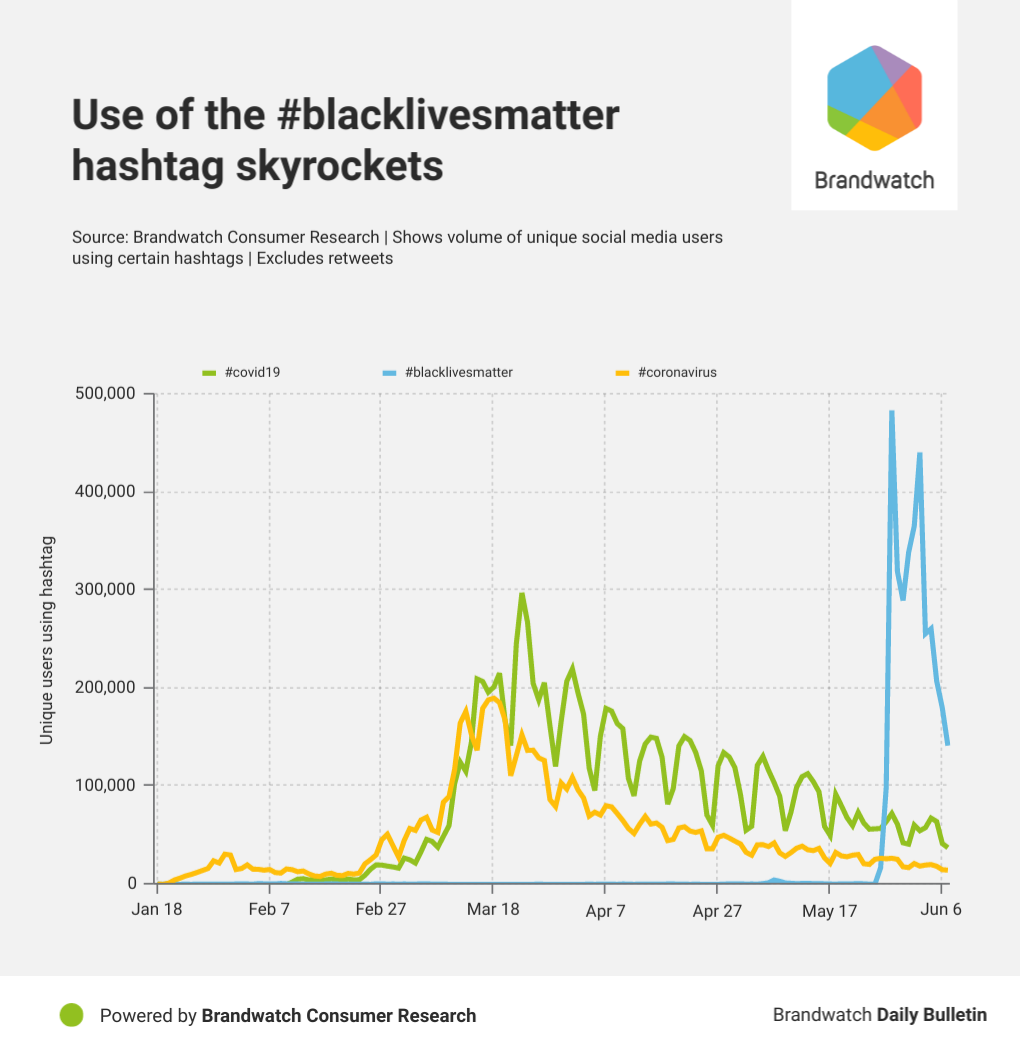
Decreases week-on-week have been the case for months, but we’re now seeing a pattern of acceleration in the drops. There are obviously many causes and effects at play, including news fatigue, and possibly the fact that there are no longer so many ‘dramatic’ announcements each week. Attention has also moved to other issues, especially as Black Lives Matter protests started in Minneapolis and spread throughout the world.

This story has captivated the globe.

The above chart shows unique authors using specific hashtags, so it only represents specific parts of these conversations. But it gives an idea of the engagement the protests have generated. At its peak on May 28, #blacklivesmatter was posted by 484k people in a single day, compared to #covid19’s peak of 298k.

City movement, revisited

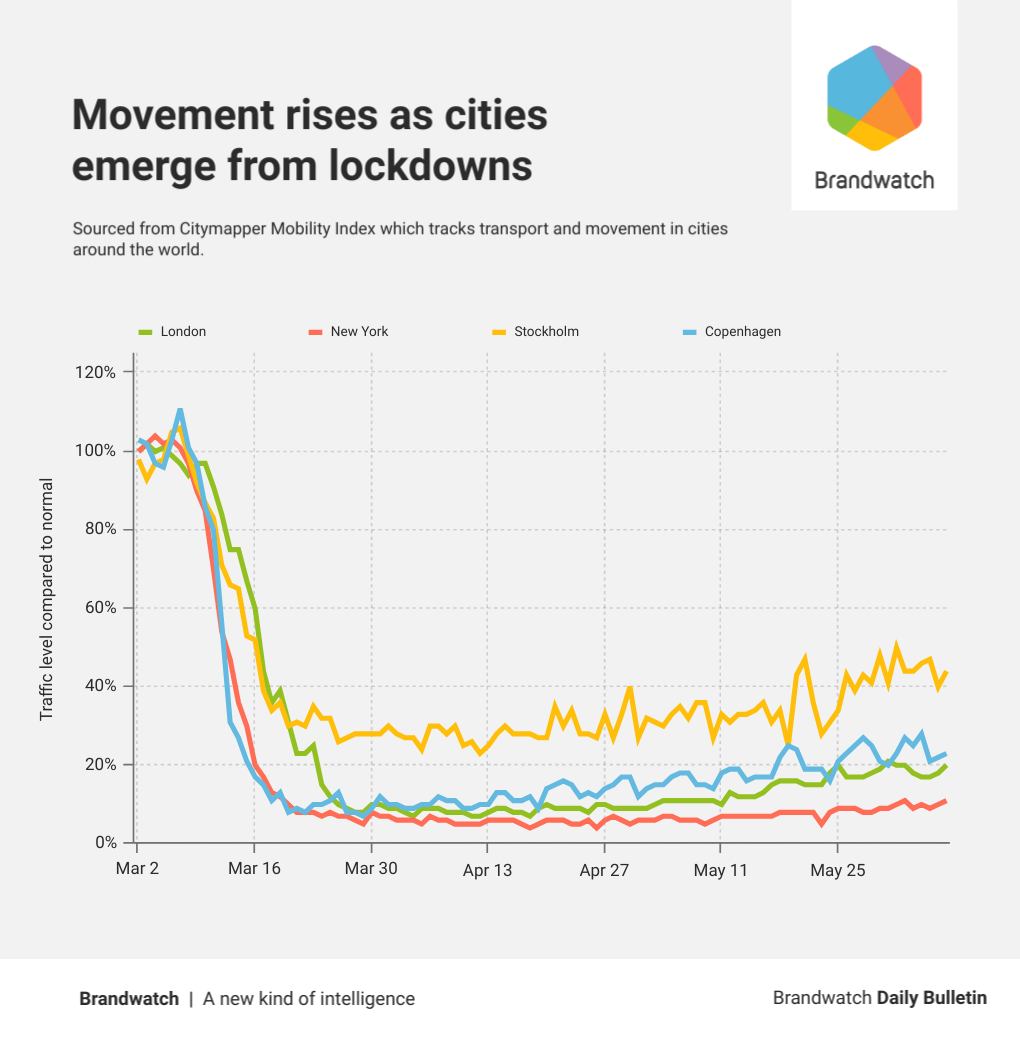
Today we’re looking back at Citymapper data to explore how movement in cities has changed as lockdown measures are lifted around the world. The data looks specifically at how busy transport links are in cities.

We’re looking at four cities that have approached the pandemic in various ways, from London’s strict lowdown measures to Stockholm’s far more flexible approach that’s based on personal responsibility for social distancing.

Initially, travel in Stockholm did slow down despite the city not having a full lockdown in place. According to the Citymapper Mobility Index, the number of people travelling around the city dropped by 70% from March 8 to April 27.

In comparison, cities that went into Lockdown, like London, New York, and Copenhagen, saw drops of 90%, 95%, and 88% respectively. This suggests that formal lockdowns were more efficient than informal encouragements at reducing people’s movement.

But, as some restrictions have been lifted, we’ve seen consumers more willing to leave their homes. Since April 27, travel in Stockholm has increased by 36%. This is in comparison to London, New York, and Copenhagen, which have seen mobility increases of 14%, 18%, and 19% respectively from April 27 to June 7.

Stockholm’s much higher movement rate could indicate that as consumers practice being out in a socially distanced world, they’re becoming more at ease with the ‘new normal’.

While movement is increasing, fear is still palpable. Using our Consumer Research platform, we found hundreds of thousands of people worried about catching Covid-19 while out and about. Since April 27, there have been 281k English-language mentions about catching the virus on public transport, while there have been 196k referencing others not wearing masks while going about their daily business.

Meanwhile, a recent survey we conducted looked at how confident consumers were in returning to public spaces. We found that people were most hesitant about events like concerts, but were more at ease with the idea of visiting beaches and stores.

The world is still taking its first steps in returning to normal, and each country will go at its own pace. For consumers within those countries, there are many concerns at play which could affect their decisions to return to different businesses in person. Brands planning for the coming months must listen closely to fears and worries and do what they can to mitigate them to get people back through their doors.

Get more in-depth data

Don’t miss out on a free, massive report on consumer trends under Covid-19.

Head here to find out more and get signed up.

Thanks for reading

If you want to get these bulletins sent straight to you, sign up here.

Stay safe,

Brandwatch Response Team

logo
Digital Consumer Intelligence

Runtime Collective Limited (trading as Brandwatch). English company number 3898053
New York | Boston | Chicago | Austin | Toronto | Brighton | London | Copenhagen | Berlin | Stuttgart | Frankfurt | Paris | Madrid | Budapest | Sofia | Chennai | Singapore | Sydney | Melbourne

Privacy Policy

Update subscription preferences

Unsubscribe

We value your privacy

We use cookies and similar technologies to personalize ads and content (including by sharing data with Google), to measure site performance, and to improve your experience. Learn more in our cookie policy

Privacy & Safety • Terms of Service

No, take me to settings
Yes, I agree
More info.

By using our site you agree to our use of cookies —