logo

Covid-19 Daily Bulletin 29/07: The Art of Convincing

Who do people trust?

Welcome to today’s bulletin. This time we’re looking at who people trust to get their Covid-19 information from.

If you’d like to get these bulletins sent straight to your inbox, subscribe below.

SUBSCRIBE

From trust to action

A huge task for governments and health agencies during the pandemic has been not only to work out the right steps to take and guidelines to implement, but to then communicate these to the public effectively. If the average person on the street is unaware of the dangers of Covid-19, or what they should do to minimize risks, a country will struggle to contain and control the virus.

Each week brings news of new outbreaks around the world, including in places where it seemed as though the virus had been brought under control. The importance of keeping people convinced about the dangers and following safety measures is not going away anytime soon.

Using our mobile survey platform Brandwatch Qriously, we decided to find out which safety measures people were adopting and what sources they trusted for Covid-19 information.

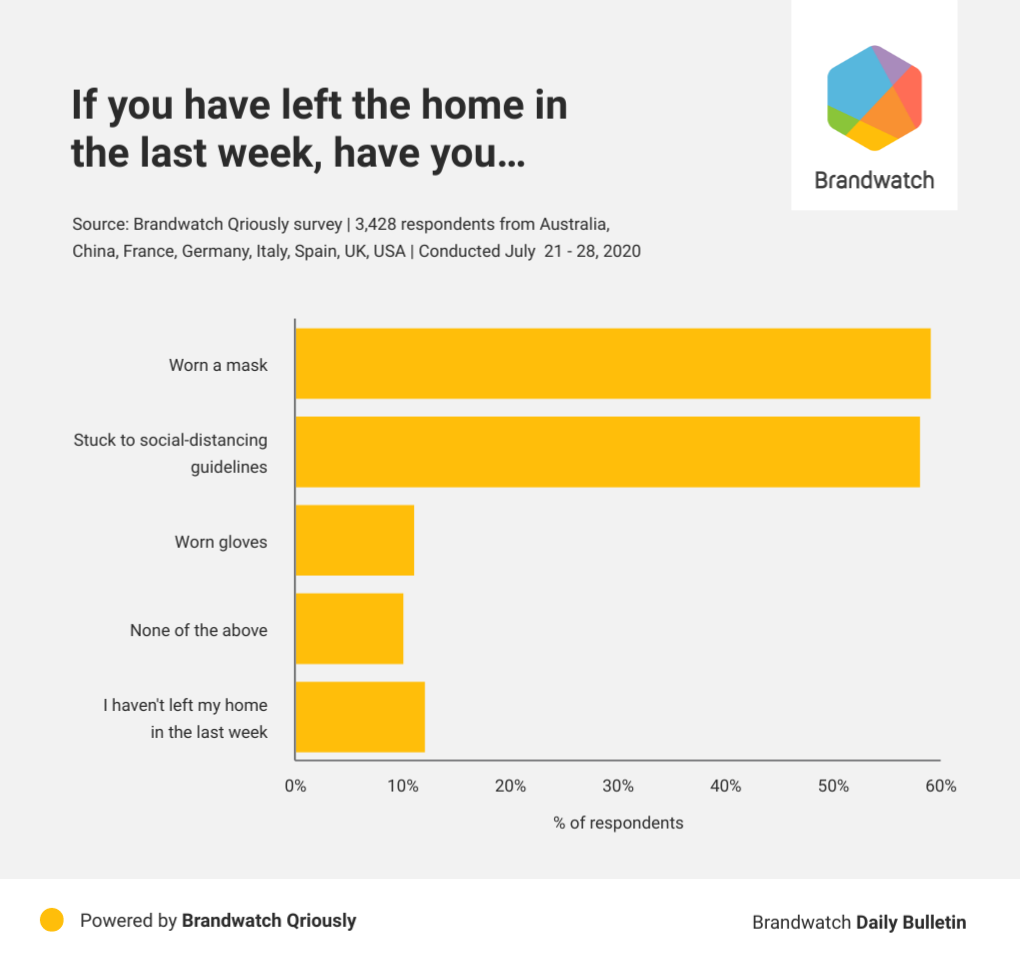
First off, here’s what we found out about safety measure adoption.

Both mask wearing and social distancing have roughly the same rate of adoption (around 60%). That’s a strong number, but still leaves a lot of people not doing one or the other.

And 10% of people aren’t doing any of the actions listed at all. That may seem like a low number, but when one person can be responsible for setting off a chain of infections it can still make a difference.

So what can be done to convince more people to keep their distance and don face masks?

There are a range of factors at play, and it’s not simply about making the information available. We’ve seen around the world how things like mask wearing have faced opposition on a political basis. That’s clearly not caused by a lack of awareness of masks, but rather on what a person believes to be true about them.

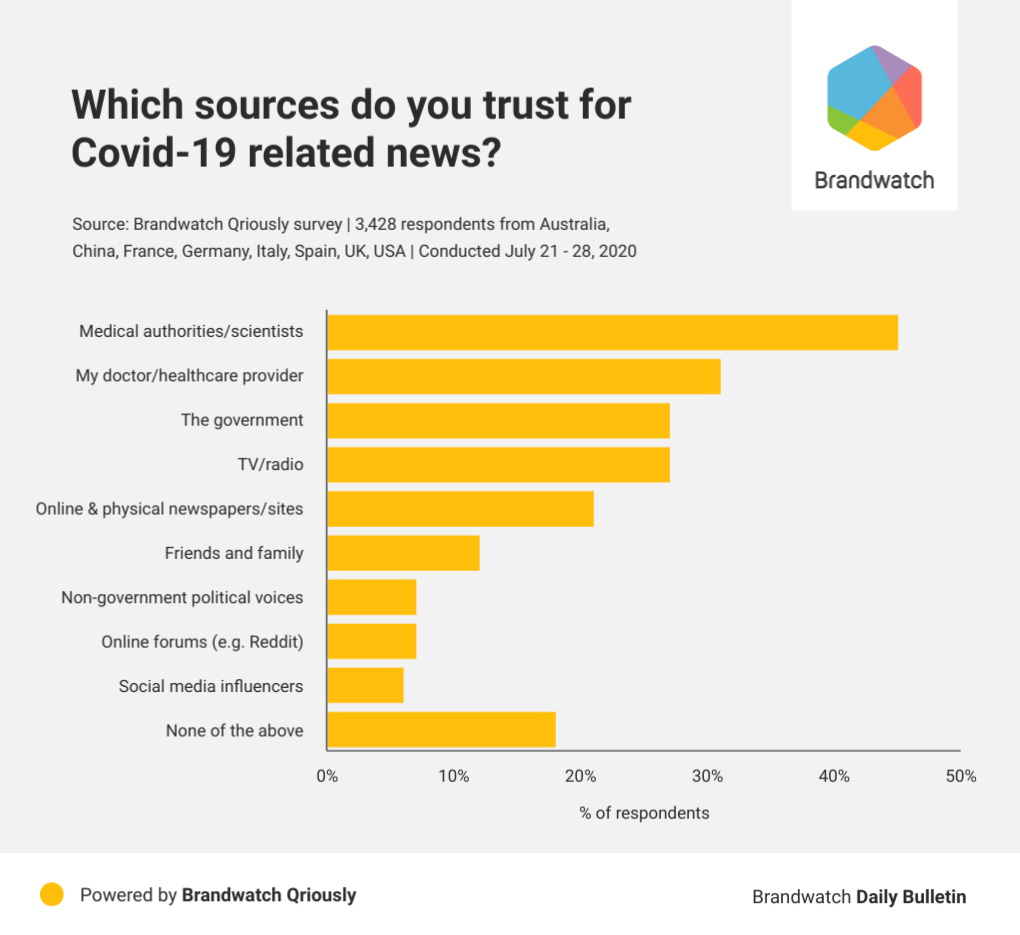
A big part of this is who we trust when we receive information. Here’s what people told us about this subject in our Qriously survey.

While trust is spread out across all sources, it’s medical authorities and scientists who are seen as the most credible. This is obviously good news as it shows a lot of people are putting their faith in experts. In the same vein, doctors and healthcare providers come second.

The government and TV/radio come in joint third with 27% of consumers trusting them as sources on Covid-19 information. This isn’t great news for government agencies who often use television and radio to promote guidance and data. Having said that, it seems like having high profile medical personnel appearing in said content with politicians could boost trust in their message.

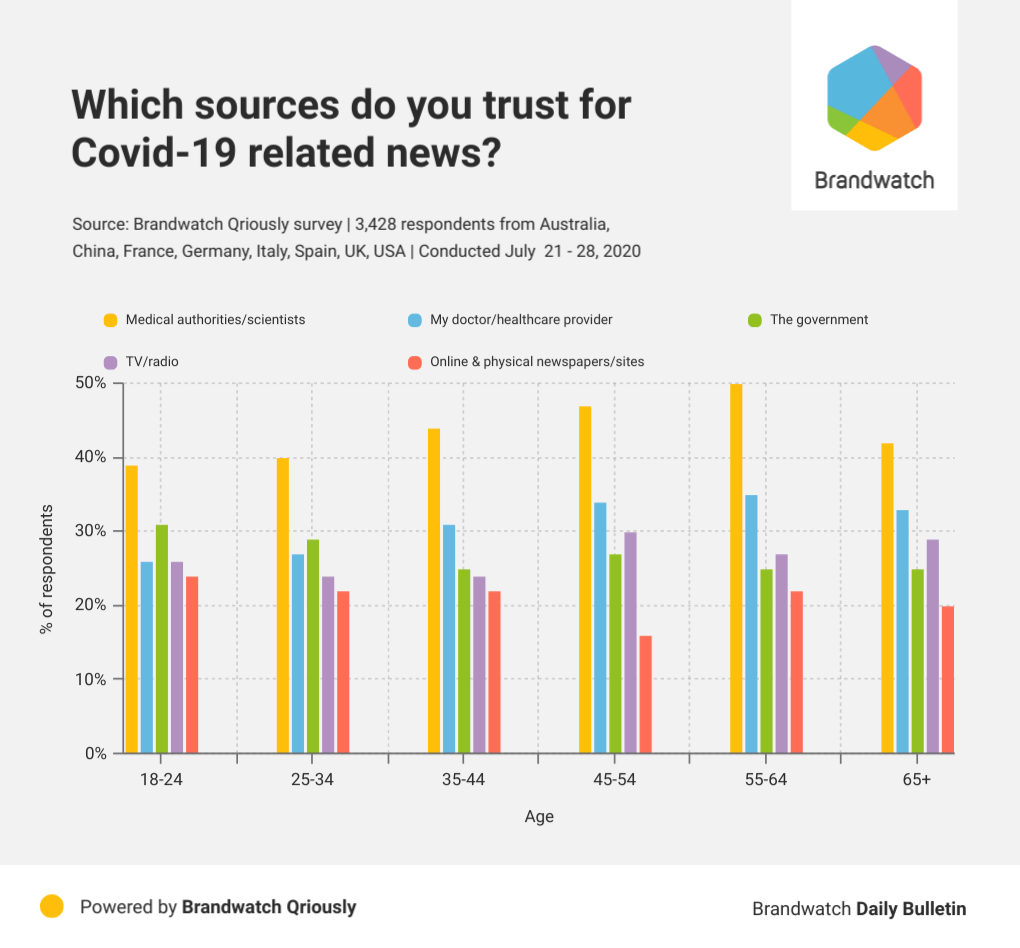
Ultimately all of these sources need to be considered in getting information and advice out there, particularly as different groups of people trust different sources more than others. Let’s take age groups for example.

All age groups had the same top five most trusted sources (except the 45-54 group, where ‘None of the above’ came fifth with 17%). This makes the task of prioritizing media/platforms for disseminating information a little easier.

That doesn’t mean differences can be ignored, though. For example, for those aged 18-34, the government is the second most trusted source – for the 45-65+ group, it’s only the 4th.

What this tells us is that to get the right information to people, a range of approaches and sources needs to be considered. Age is just one factor, but others, such as a location or education, likely have influence too.

On the other side of the coin, there’s also the concern of false and dangerous information getting out there, particularly through viral videos. One such video saw millions of views this week despite featuring a doctor who believes the government is run by reptiles and alien DNA is being used for medical treatments.

Some may be relieved that few people trust online forums and social media influencers as good sources of info around the virus, but even low percentages in a world of billions runs into the millions. What governments and medical agencies need to figure out is how to get their own advice and information to go viral, or at least how to effectively counteract false claims.

The best approach will always be a mixed one, whether it’s getting medical scientists on the radio, or healthcare providers on forums. It’ll likely always be an uphill struggle, but getting it right could save many lives and help society claw back more normality.

Get more in-depth data

Don’t miss our regular reports that go into huge detail on consumers and how Covid-19 is affecting them.

Head here to find out more and get signed up.

Thanks for reading

That’s it for today. Head here if you’d like to register for our daily bulletins.

Stay safe,

Brandwatch Response Team

logo
Digital Consumer Intelligence

Runtime Collective Limited (trading as Brandwatch). English company number 3898053
New York | Boston | Chicago | Austin | Toronto | Brighton | London | Copenhagen | Berlin | Stuttgart | Frankfurt | Paris | Madrid | Budapest | Sofia | Chennai | Singapore | Sydney | Melbourne

Privacy Policy

Update subscription preferences

Unsubscribe

We value your privacy

We use cookies and similar technologies to personalize ads and content (including by sharing data with Google), to measure site performance, and to improve your experience. Learn more in our cookie policy

Privacy & Safety • Terms of Service

No, take me to settings
Yes, I agree
More info.

By using our site you agree to our use of cookies —