logo

Covid-19 Daily Bulletin 11/08: Changing Transport

A look at how we now travel.

Welcome back. Today we’re looking at how movement in our cities has changed since the pandemic, and which modes of transport people are turning to.

Don’t want to miss our bulletins? Subscribe below.

SUBSCRIBE

Transport begins to go back to normal

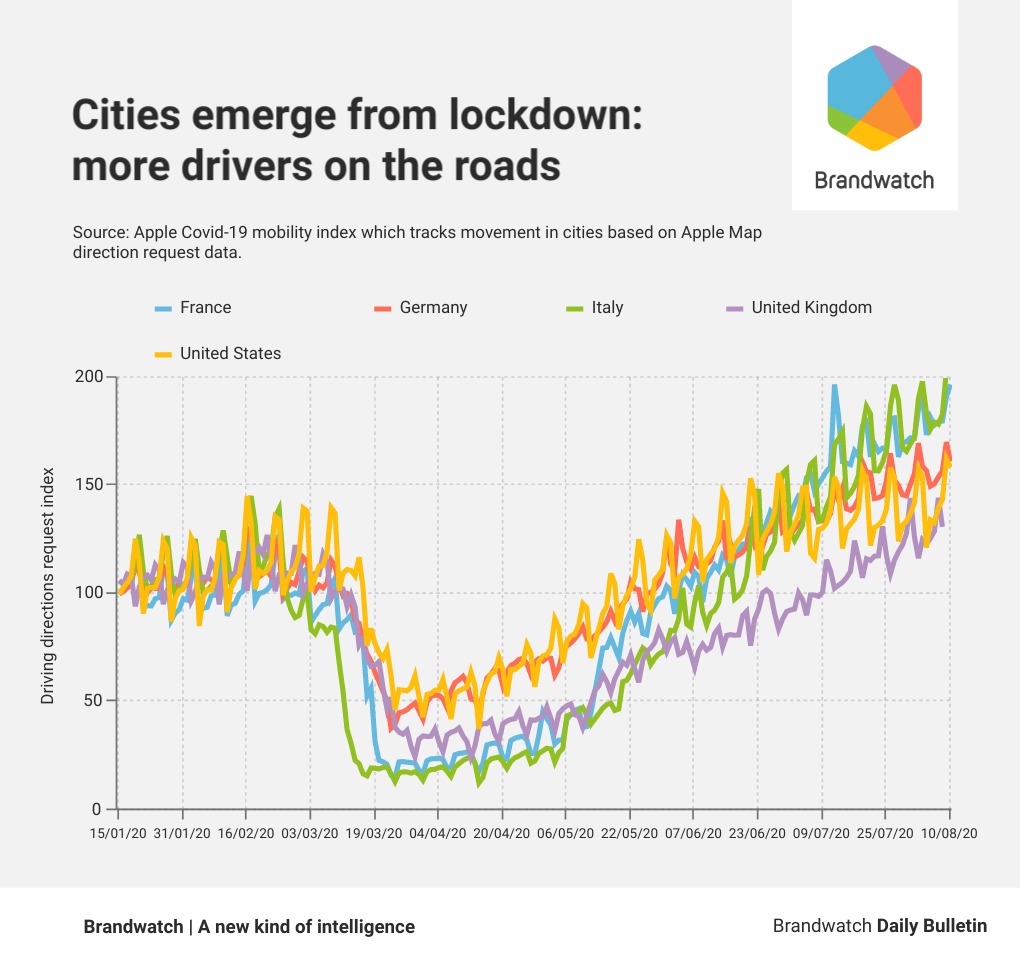
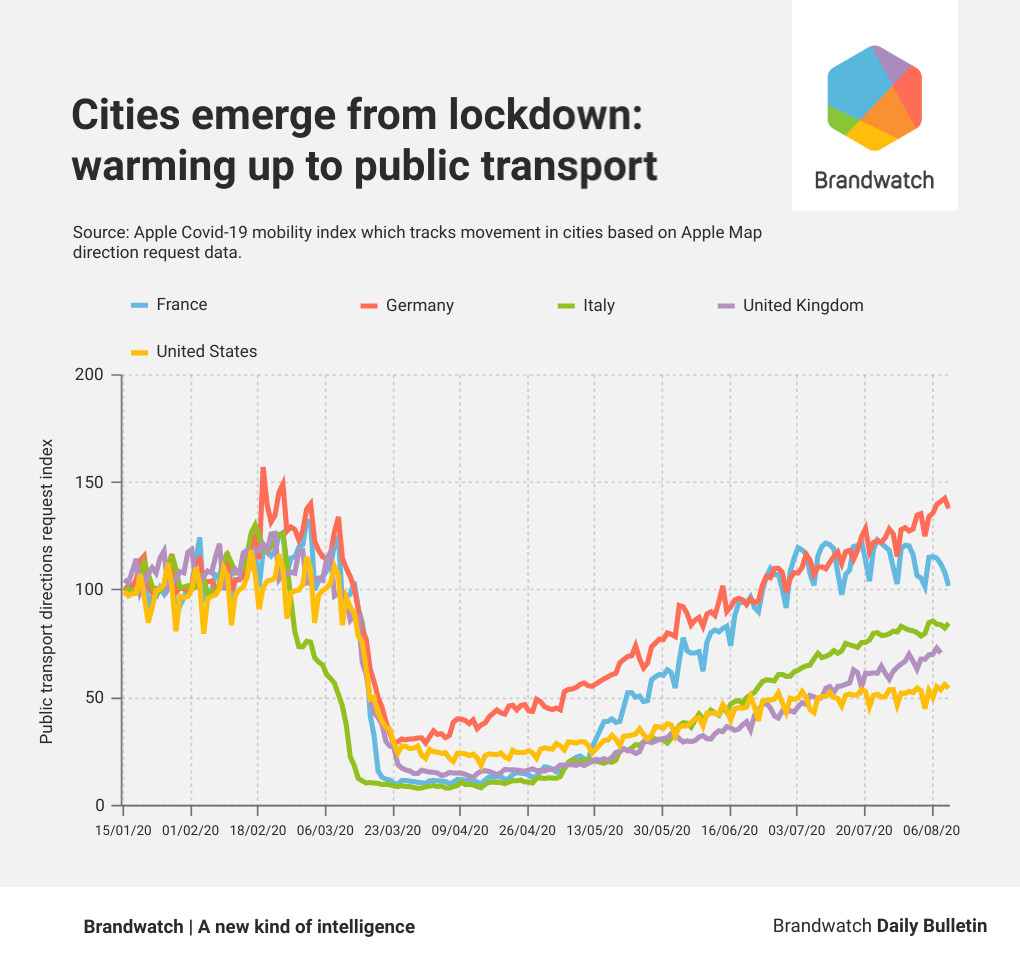
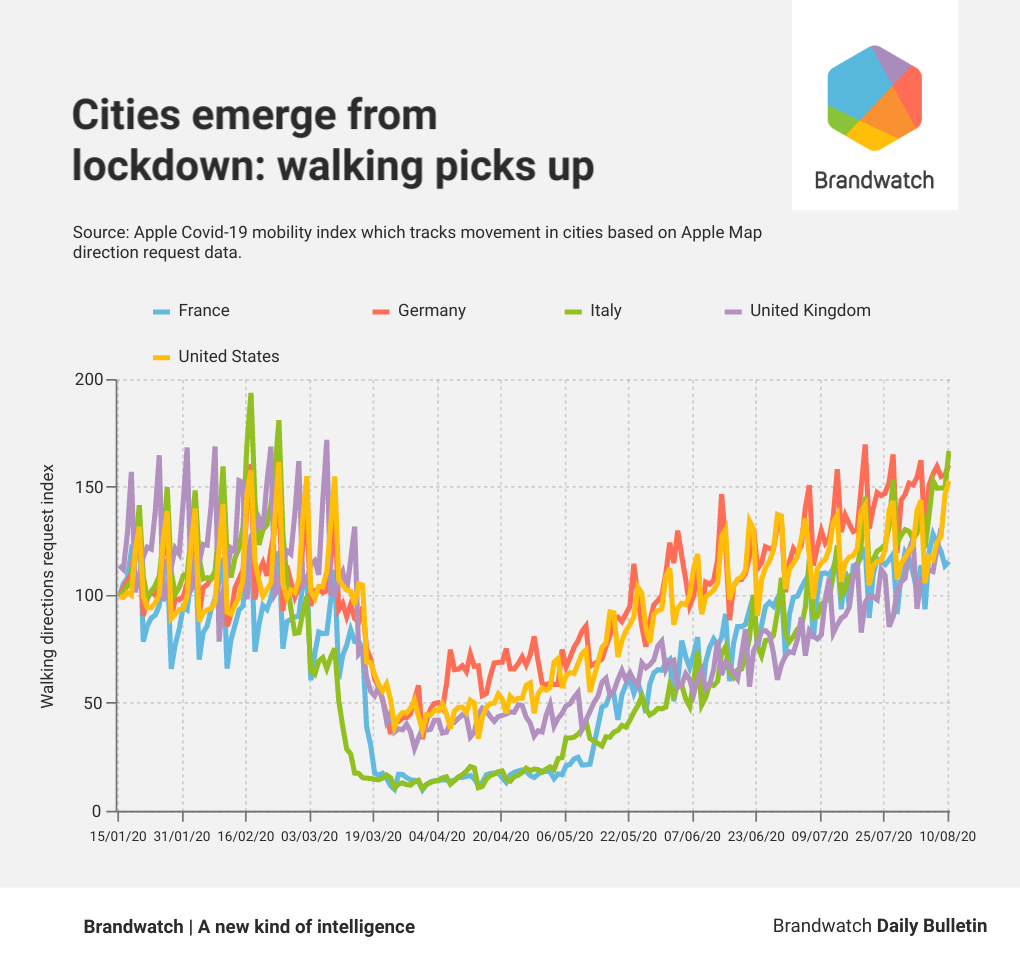
We looked at the transport behavioural patterns of France, Germany, Italy, the UK and the US, using Apple’s Covid-19 Mobility Trends Report. Based on Apple Map data, we can use it to understand how consumers have been walking, driving, and using public transport during the pandemic.

We learned that consumers are choosing walking over driving, and driving over public transport, while public transport is yet to increase to pre-pandemic levels in all but two of the countries we looked at.

Walking had the strongest growth overall.

From May 15 to August 9, 2020, the average number of people looking for walking directions in Italy increased by 119 percentage points. We also noted the same trend in France, Germany, the UK and the States, although lesser in volume.

We also found that consumers are driving more. Apple’s data revealed the average number of consumers looking for driving directions in the countries we studied increased 89 percentage points from May 15 to August 9, 2020.

Again, Italy was driving this trend. From May 15 to August 9, the percentage of people looking for directions driving in Italy increased 181 points. We noted increases in the other countries we studied, but not to this level.

Meanwhile, public transportation is still taking a hit. For Apple Maps users, we learned that the average number of people looking for directions on public transport in the countries we studied decreased by 24 percentage points from March 1 to August 9.

It’s only Germany and France who are back on board. In fact, on average, there are now more people using public transportation in Germany and France than there were in January and February.

In some countries consumers will choose the option which suits their journey, but in other countries, such as Italy, the UK, and the US, consumers will opt for personal transport.

A look at the social data

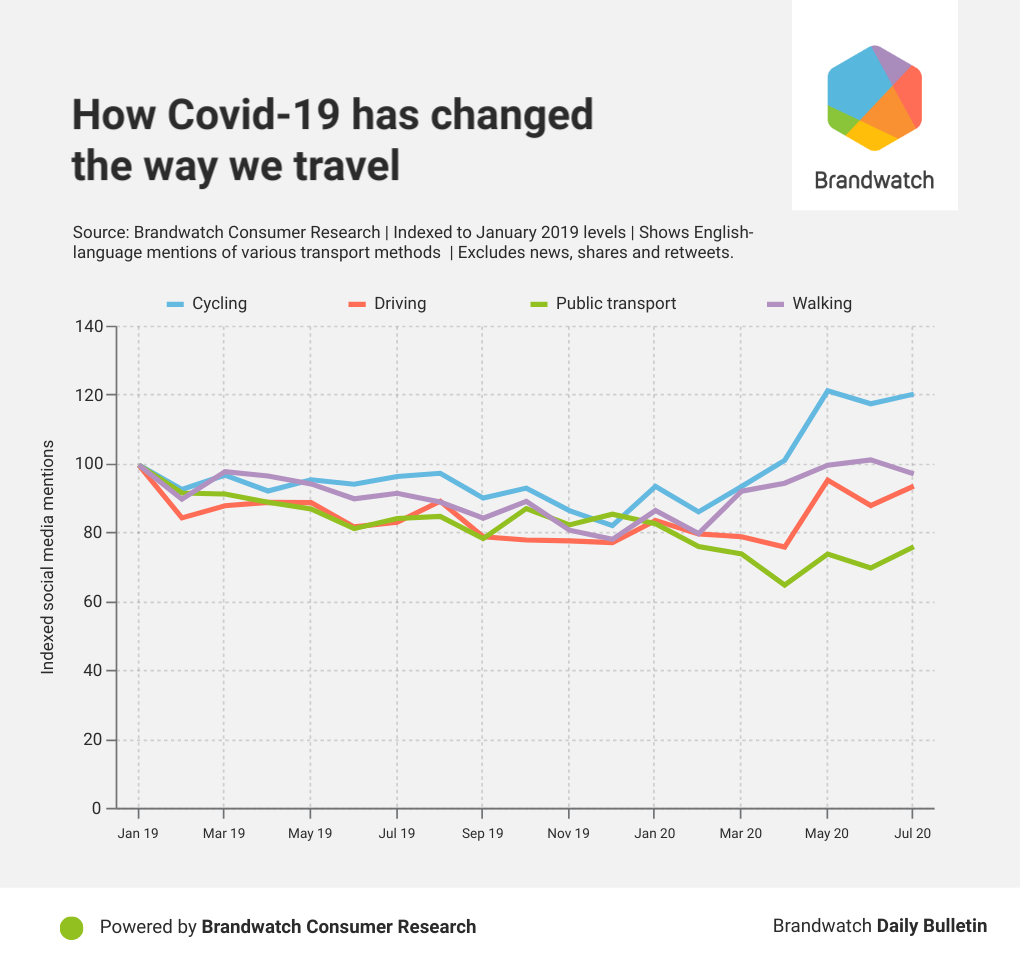
Using our Consumer Research platform, we looked at English-language mentions of people cycling, driving, or taking the bus, train, subway or tube, from January 2019 to August 9, 2020.

Cycling had the largest conversation increase of all the types of transport we looked at, with mentions increased 28% since March.

Walking and driving mentions also saw the same rise. We learned that mentions increased 71 and 36 percentage points respectively from March to July.

Interestingly, mentions of driving are only just beginning to take off — a contrast to Apple’s data. We should note that we only looked at English-language mentions, while the difference could also be explained by people not wanting to show they were driving about during a pandemic.

Meanwhile, conversation about public transportation is yet to return to normal. In July, public transport conversation was eight percentage points off of pre-pandemic levels.

These are difficult times, but understanding consumer behavioural patterns like transport, and the motivation behind them, can help us understand the nuance of the crisis, and even play a role in preventing Covid-19’s spread.

Get more in-depth data

Don’t miss our regular reports that go into huge detail on consumers and how Covid-19 is affecting them.

Head here to find out more and get signed up.

Thanks for reading

That’s it for today. If you’re not already, get subscribed to our bulletins here.

Stay safe,

Brandwatch Response Team

logo
Digital Consumer Intelligence

Runtime Collective Limited (trading as Brandwatch). English company number 3898053
New York | Boston | Chicago | Austin | Toronto | Brighton | London | Copenhagen | Berlin | Stuttgart | Frankfurt | Paris | Madrid | Budapest | Sofia | Chennai | Singapore | Sydney | Melbourne

Privacy Policy

Update subscription preferences

Unsubscribe

We value your privacy

We use cookies and similar technologies to personalize ads and content (including by sharing data with Google), to measure site performance, and to improve your experience. Learn more in our cookie policy

Privacy & Safety • Terms of Service

No, take me to settings
Yes, I agree
More info.

By using our site you agree to our use of cookies —