logo

Covid-19 Daily Bulletin 22/06: Drug Conversation and City Activity

Virus discussion has stabilized.

Welcome back after the weekend. We hope you all got some well-deserved rest. Today we’re looking at how the online Covid-19 conversation is evolving, and how cities are coming back to life.

Let’s get to it.

SUBSCRIBE

Stable but simmering

As we enter a new week, it’s time to update our data on the online Covid-19 conversation and articles published about the virus.

To do this, we use BuzzSumo to see how many articles on Covid-19 have been published, along with how many engagements these articles got. By engagements we mean actions like Facebook likes and Twitter shares.

We also use Brandwatch Consumer Research to see how many unique accounts talked about Covid-19 on social media sites, blogs, and forums. We refer to this as the online Covid-19 discussion.

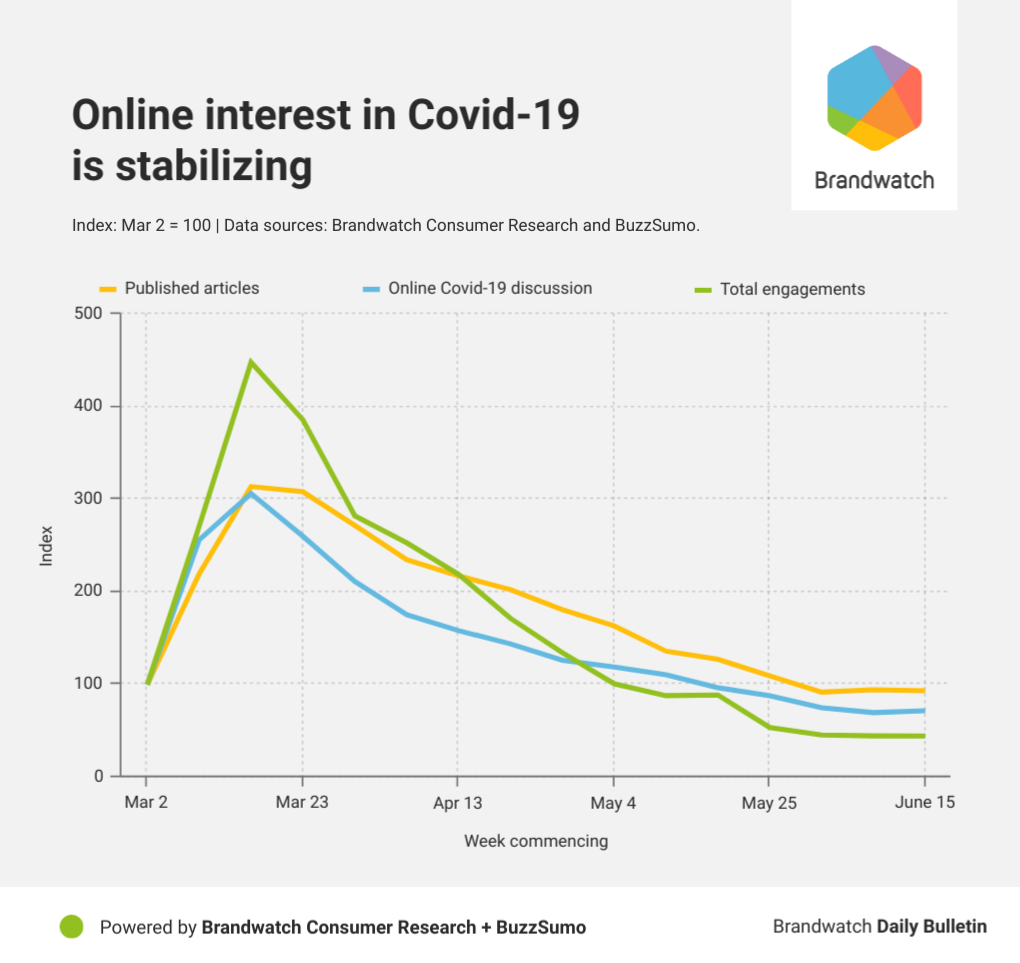
Here’s the latest data.

It looks like the metrics have stabilized over the last few weeks, with fairly rapid declines giving way to a new standard for each metric.

There was just a 1% drop in the number of Covid-19 articles, while the total amount of engagements was nearly exactly the same. This led to a 1% increase in the average amount of engagements the articles got.

There’s a bit more movement in the size of the online Covid-19 discussion. This increased by 3% – a modest amount, but the first increase this metric has seen since the week after the pandemic was officially declared on March 11.

We looked into what spurred more people to discuss the virus. While all topics fluctuate in interest from week to week, we identified three key topics that account for the increase in mentions: Donald Trump, China, and dexamethasone.

Mentions of Trump within the online Covid-19 discussion jumped by 62% week-on-week. This was mainly due to his rally in Tulsa, Oklahoma. This was his first rally since the Covid-19 outbreak began, and many were concerned the virus would spread amongst attendees, causing a spike in cases.

Meanwhile, mentions around China increased by 29% week-on-week due to a new Covid-19 outbreak in Beijing and the subsequent lockdown measures introduced there. Obviously this has fed into people’s fears of a second wave.

A lot of people were also talking about dexamethasone, a drug that has been found to significantly increase the chances of a person surviving Covid-19.

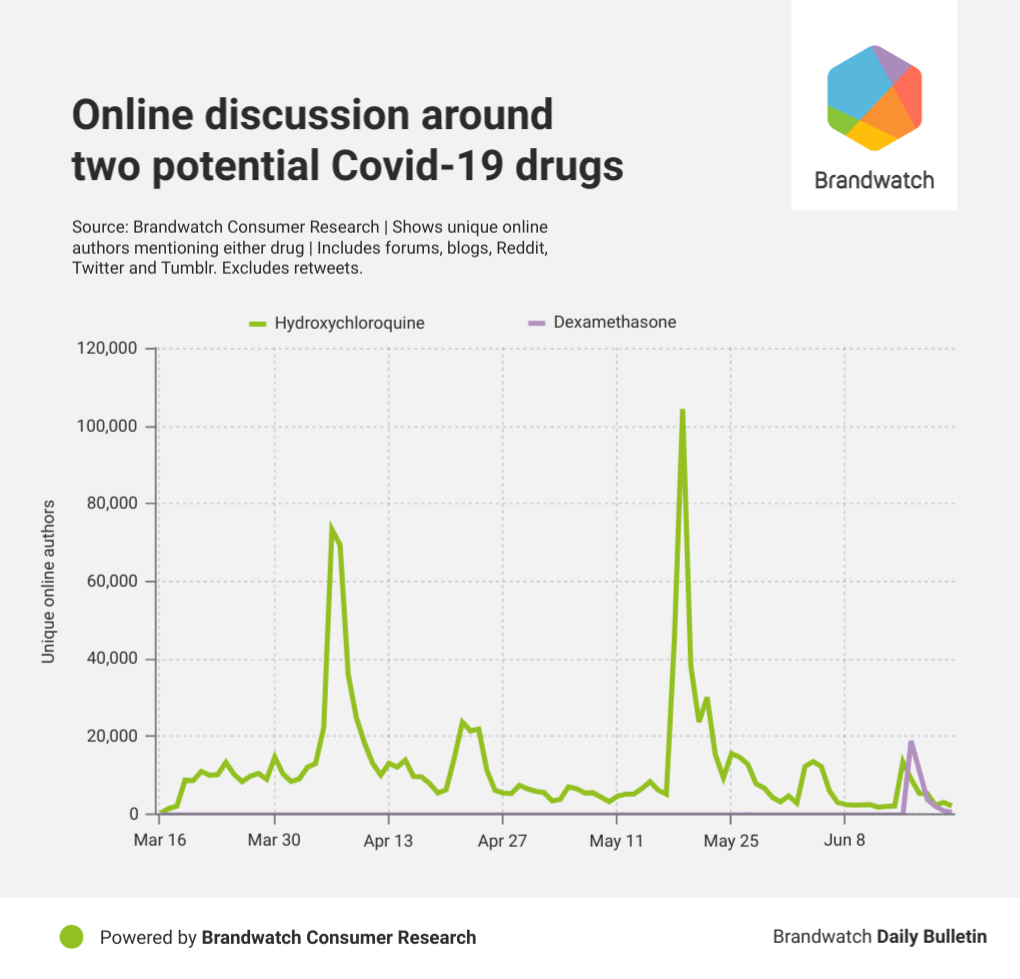
This was an incredibly good piece of news, and we wanted to see how many people talked about it compared to hydroxychloroquine. Hydroxychloroquine was touted as a treatment for Covid-19 back in April, and garnered a huge amount of attention after Donald Trump spoke about it on multiple occasions.

The attention given to hydroxychloroquine has been massive, whether it’s from people saying they want it or people criticizing its promotion without proper testing. At its peak, the drug was mentioned 105k times in a single day (this was when Trump announced he was taking it himself). Since then, the US Food and Drug Administration has revoked emergency use authorization for the drug, while UK researchers have found ‘no clinical benefit’ from hospital patients taking it.

In comparison, dexamethasone managed to garner just 19k mentions in a day at its peak. This came after experts confirmed the drug could cut the risk of death from Covid-19 for people on ventilators from 40% to 28%, and from 25% to 20% for those needing oxygen.

Right now, people are again discussing hydroxychloroquine more than dexamethasone, and conversation around the latter has all but disappeared.

City movement, revisited

Today we’re looking at Citymapper data to explore how movement in cities has developed as lockdown measures change around the world. This analysis looks specifically at the busyness of city transport links.

We’re looking at four cities which implemented varied lockdown approaches, from Paris’ strictly enforced lockdown to Stockholm’s far more flexible and informal approach which relies on people maintaining social distancing themselves.

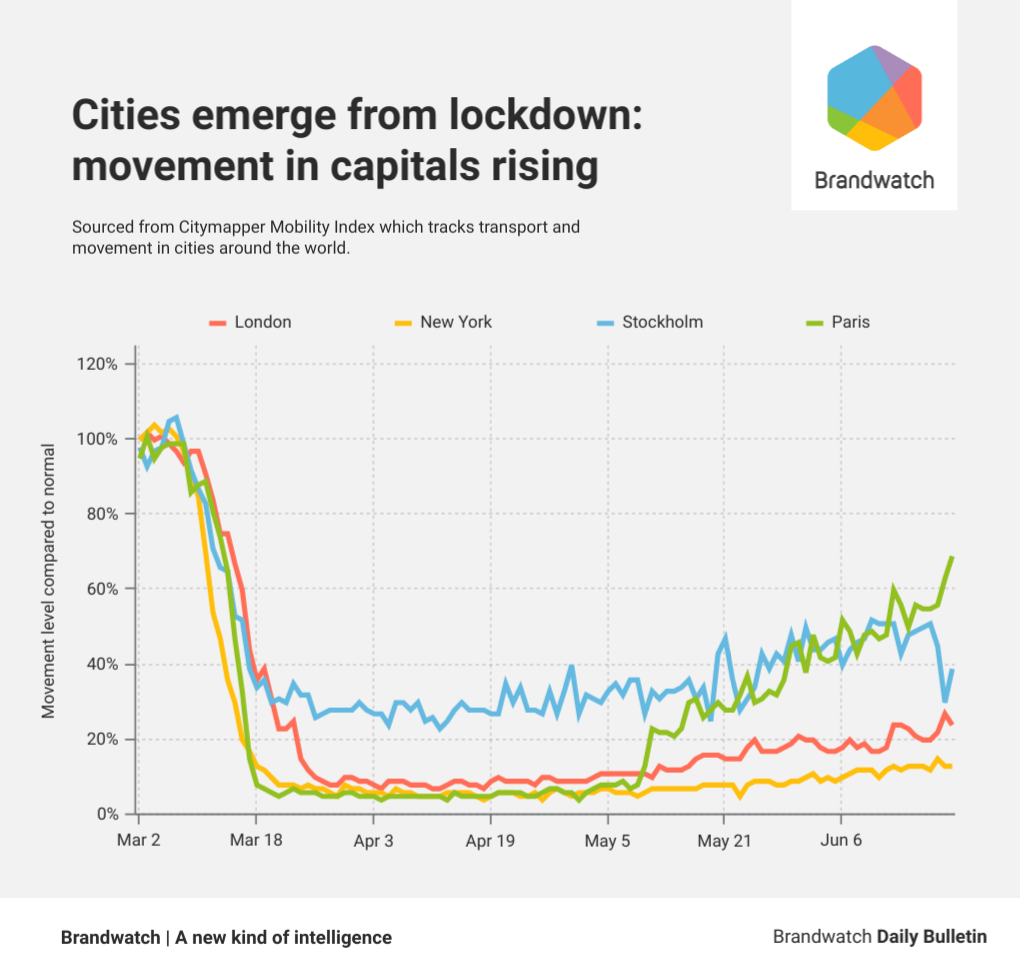
The chart shows the % of city movement compared to normal.

Early on, travel in Stockholm did slow down despite the city not having a full lockdown in place. According to the Citymapper Mobility Index, the number of people travelling around the city dropped by 70% from March 2 to April 27.

In comparison, cities that went into stricter lockdowns, like London, Paris, and New York, saw drops of 90%, 92%, and 95% respectively. This indicates, as reported in previous bulletins, that formal restrictions were more efficient at reducing people’s movement.

As some restrictions are lifted, we’ve seen people are venturing out, just a little cautiously. From April 27 to June 21, travel in Paris increased by 89%. This is in comparison to New York, London, and Stockholm, which have had mobility increases of 15%, 35% and 57% respectively when comparing April 27 to June 21.

France lifting work, education, and travel restrictions has driven Paris’ mobility up, just like England lifting work and retail restrictions helped encourage the number of Londoners getting on the move. Meanwhile, Stockholm’s steady movement could indicate that practice makes the ‘new normal’ easier to live in. Note: We believe the Stockholm activity drop this weekend was due to Midsummer celebrations, which meant schools and work were off.

These trends align with a recent Qriously survey we conducted which found that people were most hesitant about events like concerts, but were more at ease with the idea of visiting beaches and stores, as restrictions are lifted. For many, while there is trepidation, the scenes of normal daily life are starting to look safer again.

For brands preparing to reopen their doors, mitigating consumers’ fears and concerns is the key to winning back trust and loyalty.

Get more in-depth data

Don’t miss our regular report looking at how consumers are being affected by Covid-19.

Head here to find out more and get signed up.

Thanks for reading

That’s it for today. If you’d like to subscribe to these bulletins, sign up here.

Stay safe,

Brandwatch Response Team

logo
Digital Consumer Intelligence

Runtime Collective Limited (trading as Brandwatch). English company number 3898053
New York | Boston | Chicago | Austin | Toronto | Brighton | London | Copenhagen | Berlin | Stuttgart | Frankfurt | Paris | Madrid | Budapest | Sofia | Chennai | Singapore | Sydney | Melbourne

Privacy Policy

Update subscription preferences

Unsubscribe

We value your privacy

We use cookies and similar technologies to personalize ads and content (including by sharing data with Google), to measure site performance, and to improve your experience. Learn more in our cookie policy

Privacy & Safety • Terms of Service

No, take me to settings
Yes, I agree
More info.

By using our site you agree to our use of cookies —