logo

Covid-19 Daily Bulletin 30/06: Scanner Shopping and Optimism

No office, no copier.

Welcome to today’s bulletin where we’re looking at optimism around the world, and how people are snapping up printers and scanners.

Let’s get to it.

SUBSCRIBE

Electric dreams: Prints and giggles

Next up in our series of products that have seen an unexpected lockdown boost in consumer interest are printers and scanners.

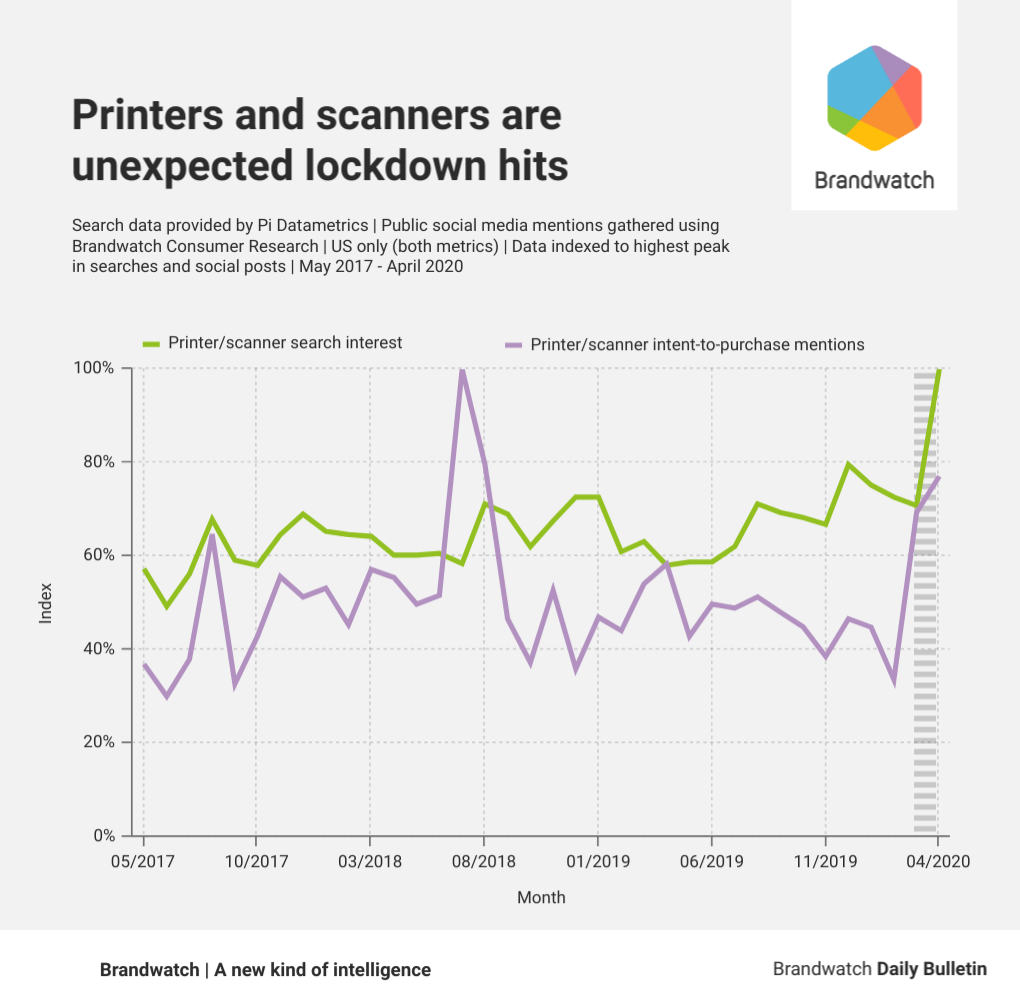
These items have seen a rise both in social media posts that include intent-to-purchase language and in Google searches.

This started out as one of the most mysterious of the trends we’re highlighting this week. While beauty/grooming products being popular while salons and barbers are closed makes sense, why are people suddenly interested in printing and scanning?

To investigate, we looked at the social media mentions we found in Consumer Research. These mentions included words that indicate the author is intending to purchase or has purchased a printer/scanner.

“Work” and “office” are prominent keywords within these conversations. With remote working becoming the norm for those usually in the office, it makes sense that they’re upgrading their equipment at home. And anyone who relied on use of a communal printer or scanner pre-outbreak (like students or library users) has recently, in theory at least, been in the market for either a printer/scanner of their own or a service that can do the job for them.

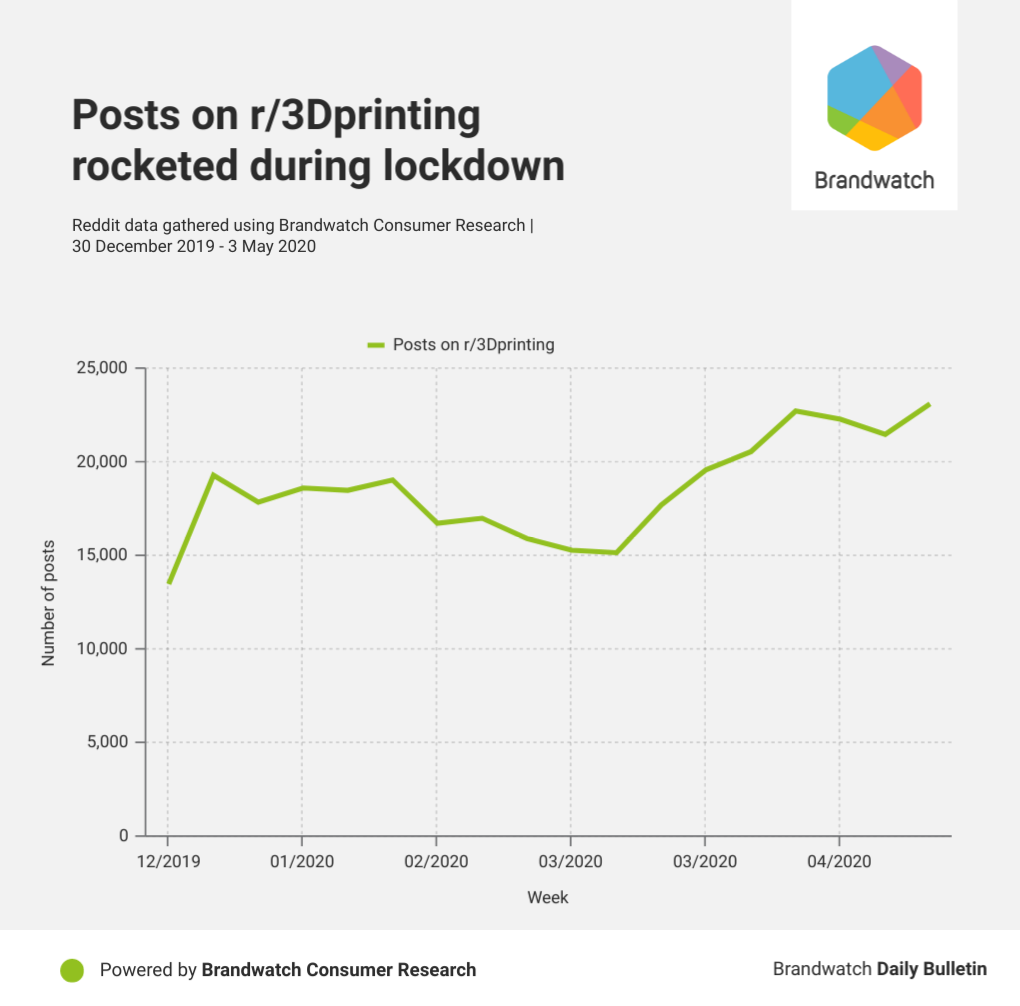
‘3D’ was also a big theme, appearing in around 15% of the printer and scanner mentions we studied. Curious, we started a new query looking at posts on r/3Dprinting. We found that the 3D printing community has been very busy during lockdown, with over 20k posts per week from enthusiasts in April.

The conversation on the subreddit is highly technical, but we found hundreds of mentions a week including words like ‘tips’, ‘advice’ or ‘recommend’. The thriving 3D printing community seems to have welcomed plenty of new people to their ranks during lockdown.

How long will optimism hold?

As we creep closer to the four month mark of the Covid-19 pandemic, we still find ourselves in a far different world to the one we remember. With no clear road to ‘normality’ in sight, we wanted to know how optimistic people were feeling about the future.

Using Brandwatch Qriously, we’ve been surveying thousands of adults from around the world through their smartphones and tablets. We asked them how optimistic they felt in terms of the outbreak on a scale of one to five, one being ‘Not at all’ and five being ‘Very’.

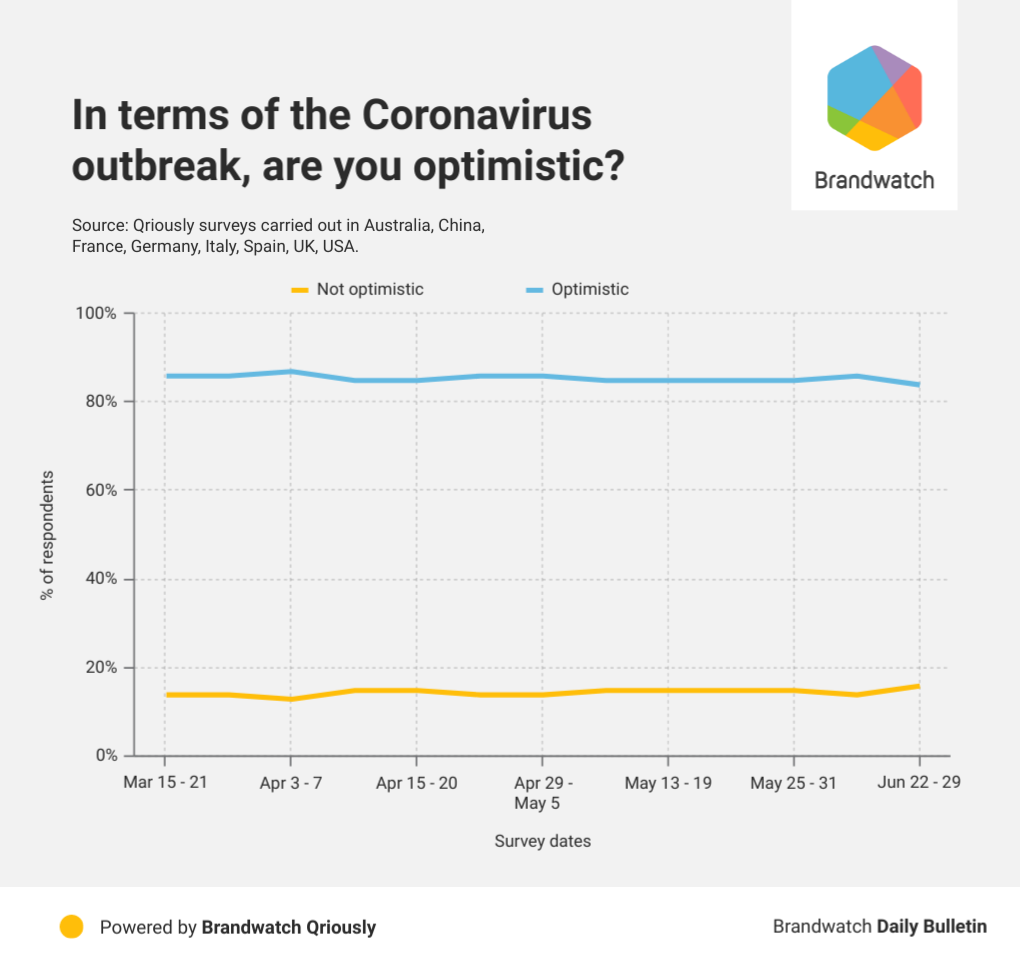
Here’s how things have looked since mid-March, comparing those who picked option one (suggesting no optimism) against the combined group of those picking two to five (suggesting at least some optimism).

Throughout our surveys the response has remained very steady. In fact, prior to our two latest surveys, numbers went unchanged for four straight weeks. Despite lockdowns, outbreaks, and a rising death toll, an average of 85% of people have felt somewhat optimistic across our entire survey period.

So far, the results have been a reflection of the hopeful human psyche, but our latest survey shows the early signs of a change. The number of people saying they felt no optimism at all reached 16%, the highest number recorded so far and the first increase in this metric we‘ve seen in five weeks.

This is just one point above the previous high, so we can’t make any strong conclusions on it just yet. But it’s important to note that the average rate hides very different pictures at a national level.

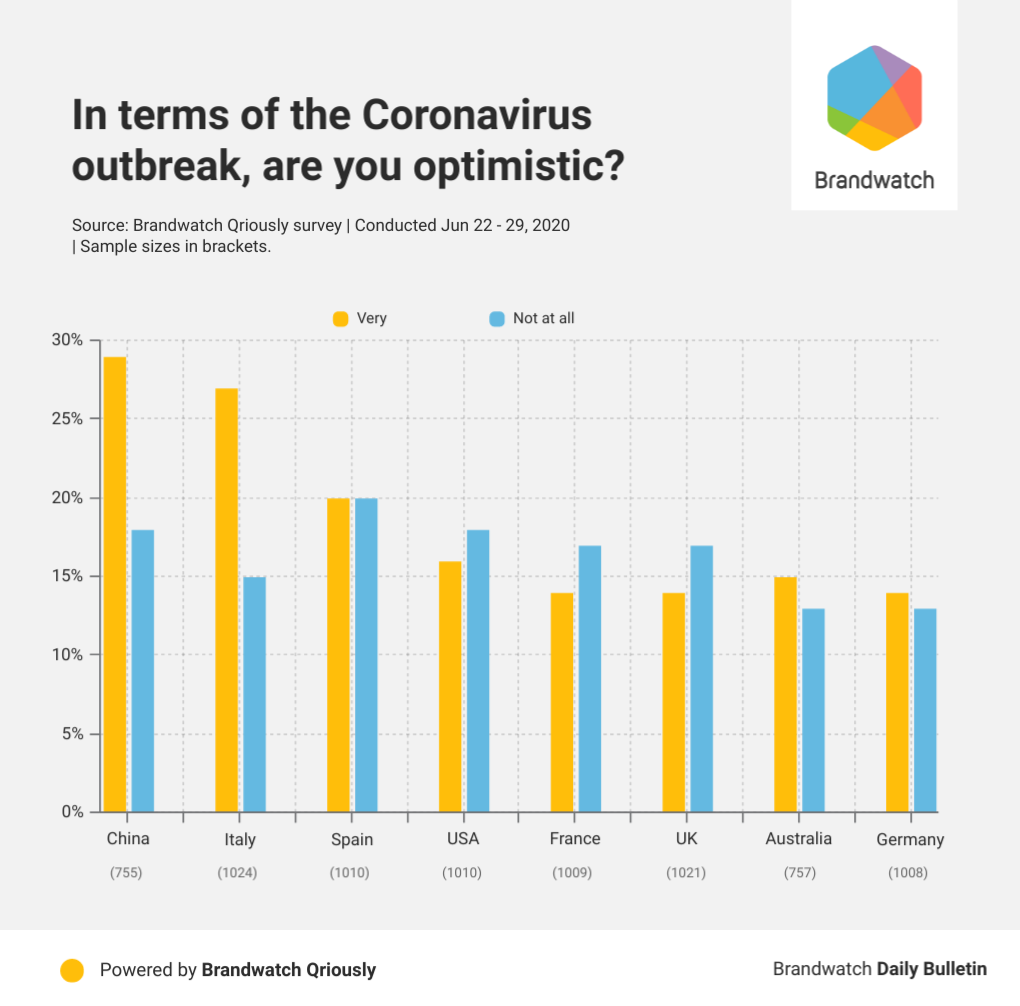
Here’s how things look in each country when comparing respondents who chose option one against those choosing option five.

In China and Italy optimism is relatively high, with 29% and 27% respectively saying they were very optimistic in regards to the outbreak. On the other hand, this number is just 14% for France and the UK.

These two countries, along with the US, also see those with no optimism outweighing those who are very optimistic. While these two groups (the very optimistic and the not optimistic) only account for around a third of respondents in these countries, the data could be a sign of a population that will struggle to keep positive as we get further down the line.

Clearly the outbreak is being viewed very differently depending on where people live. As governments now face keeping the virus under control while aiming to lift lockdowns and restart economies, could the outlook of their citizens play a role in the success of those efforts?

Get more in-depth data

Don’t miss out on our huge report looking at consumers and how their behavior has changed due to Covid-19.

Head here to find out more and get signed up.

Thanks for reading

That’s it for another bulletin. If you’d like to sign up for them yourself, head here.

Stay safe,

Brandwatch Response Team

logo
Digital Consumer Intelligence

Runtime Collective Limited (trading as Brandwatch). English company number 3898053
New York | Boston | Chicago | Austin | Toronto | Brighton | London | Copenhagen | Berlin | Stuttgart | Frankfurt | Paris | Madrid | Budapest | Sofia | Chennai | Singapore | Sydney | Melbourne

Privacy Policy

Update subscription preferences

Unsubscribe

We value your privacy

We use cookies and similar technologies to personalize ads and content (including by sharing data with Google), to measure site performance, and to improve your experience. Learn more in our cookie policy

Privacy & Safety • Terms of Service

No, take me to settings
Yes, I agree
More info.

By using our site you agree to our use of cookies —