What happens when you bring search and social together?
Search and social data signals each tell us a different part of the story. One reveals what people search for privately, the other what they choose to share publicly. Both are valuable.
Consumers move fluidly between the two as they make decisions, but brands still tend to view these signals separately. If you're only watching one, you're missing the whole picture.
A rising search trend could be mistaken for positive sentiment. Falling search interest could be mistaken for declining demand. Misreading either signal could mean chasing a short-lived trend or arriving too late to a growing opportunity.
“When social and search point to the same trend, they provide incredible confidence in the insight. When they differ, they add valuable nuance.”
In this report, we analyzed more than 564 million social media conversations alongside 4.7k search queries to show why it’s vital for brands to be looking at these signals together.
The examples we’ll share span health and wellness, automotive, food, culture, and technology. Each demonstrates how connecting search and social can help brands understand what’s changing and how to respond.
In selected examples, we also examine AI responses to see how the information people receive compares with what they search for and discuss.

When search alone can’t explain what’s changing
Consumer interest rarely sits still in health and wellness. From sleep to skincare to supplements, people are constantly discovering new products and reacting to the newest trends online.
For brands in this space, the mix of search and social is now where reputations can be won and lost. Nowhere is that more visible than in the sleep supplements category, where coverage of a recent health study sparked a surge in searches and social discussion about melatonin’s safety.
The battle of the sleep supplements across search and social
The global sleep economy is booming. Spending on sleep trackers, wearable devices, supplements, and bedding is now estimated at over $585 billion. Searches for “sleepmaxxing” (you’ll read more about the maxxing trend later in the report) recently climbed 2,6k% around the time the term was mentioned on popular TV show The Pitt and quickly spread across social.
As consumers seek a good night's sleep and recognize its importance to our well-being, they’re exploring different ways to get more meaningful rest.
Search data shows melatonin’s dominance, then a dramatic shift
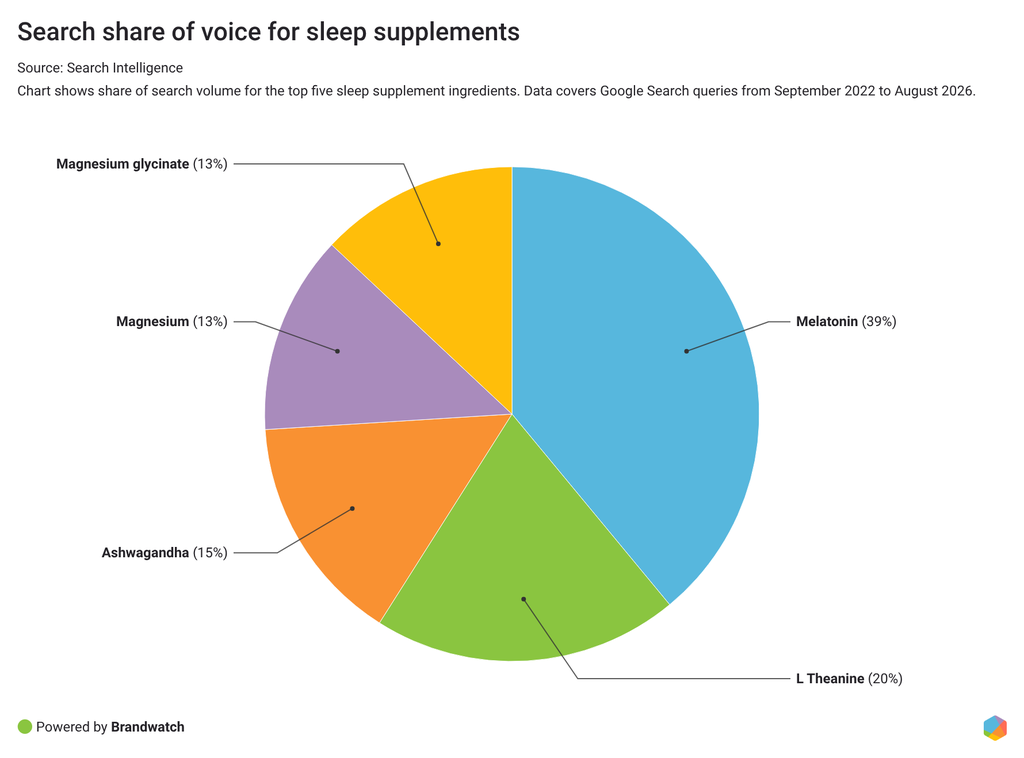
Supplements have long been favored as sleep aids, with melatonin dominating search volume for the category since September 2022.
But when we look at how search volumes shifted over time, we see a large spike for melatonin (blue bar) in November 2025, followed by a sharp fall in the following month. At the same time, magnesium glycinate (yellow bar) begins to climb, and in February 2026, it overtakes melatonin’s search volume for the first time in the period shown.
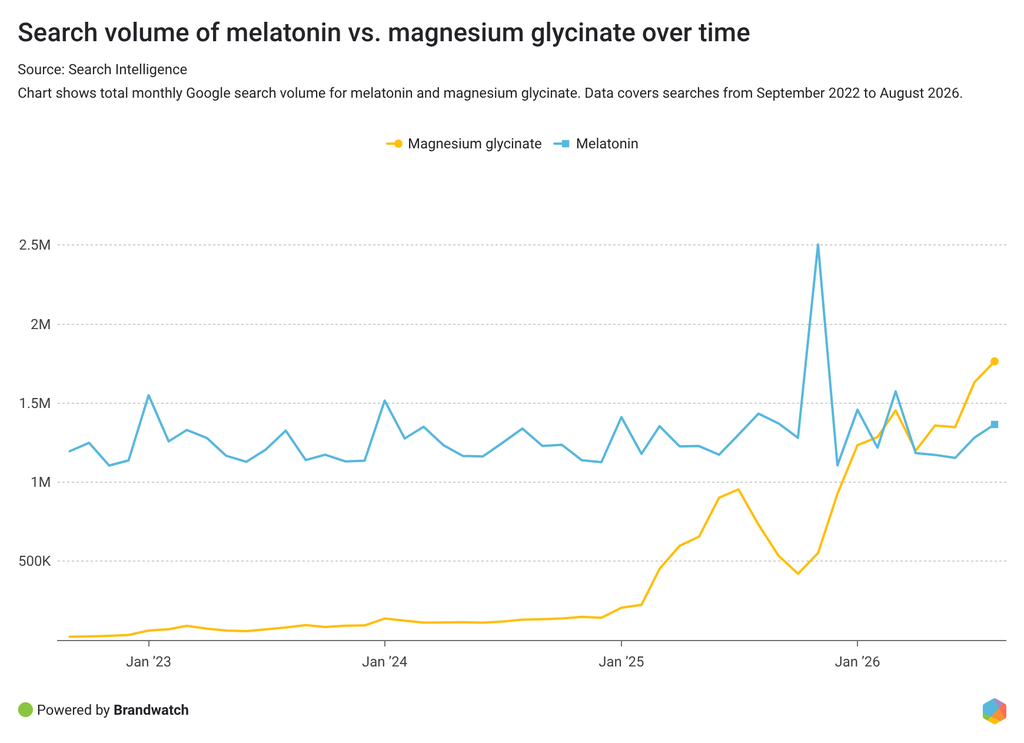
The search data was telling us that interest was shifting, but it couldn’t tell us the full story.
Social reveals health concerns surrounding melatonin’s search crash
To understand the sudden shift, we turned to social media.
Social media mention volumes showed melatonin outpacing magnesium glycinate, with a huge spike in November 2025 coinciding with the changes in search volumes.
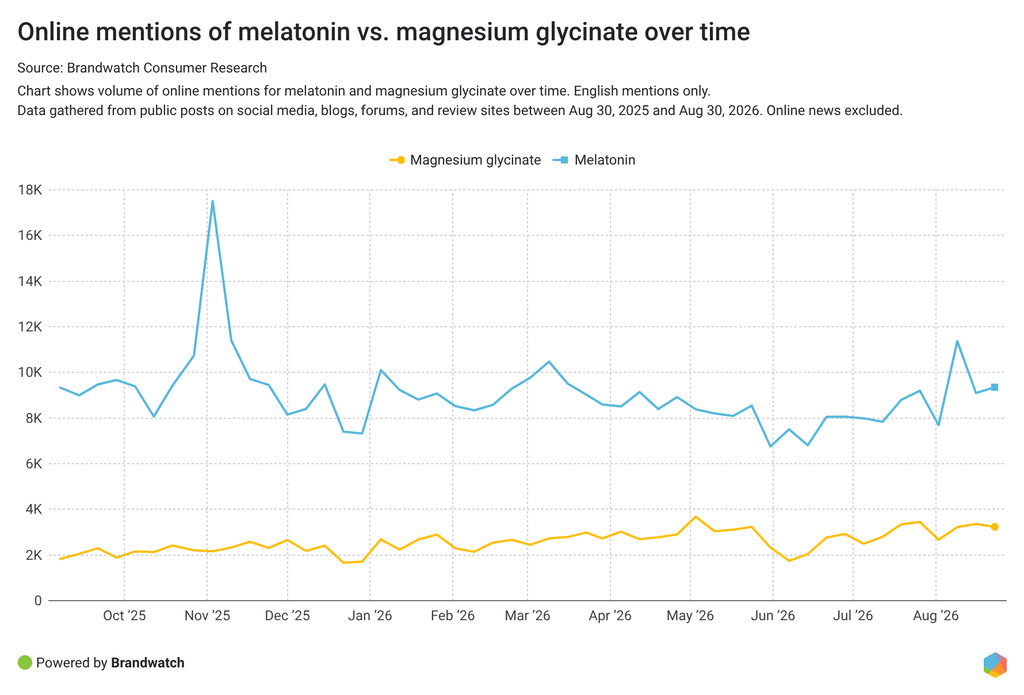
This peak occurred in early November, reaching more than 17k mentions of melatonin. The surge was primarily driven by news coverage and social media amplification around a study from the American Heart Association suggesting there may be a link between melatonin use and an increased risk of heart failure.
This made search data clearer. The November spike coincided with a surge in discussion about melatonin’s safety. Social media provided context that search volumes alone couldn't, showing how health concerns were shaping the conversation.
"Spot it, then explain it. If a theme is growing or a query spikes in search, take it into social and news to find out what's driving it."
Social shows magnesium glycinate's positive momentum
While melatonin fell, magnesium glycinate’s story unfolded differently. Search data showed a steady climb through early 2026, peaking in August. Social mirrored that pattern with a gradual increase.
But social added something search alone couldn’t: sentiment and perceptions surrounding these products. On social, people reported positive experiences, with one poster exclaiming: "I slept for 8 hours but woke up feeling like I’d been sleeping for 8 days. I even remembered my dreams in 4K for the first time ever."
Another said they “just woke up feeling like I slept for a thousand years” after taking magnesium glycinate.
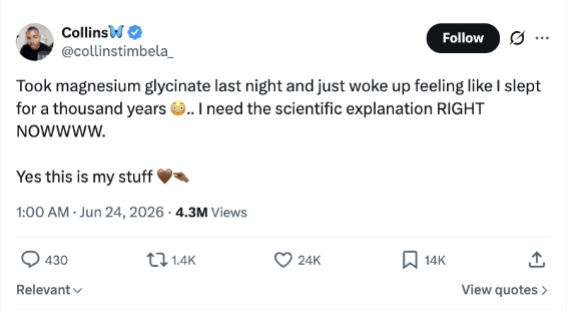
These first-person accounts helped us understand the positive perceptions surrounding magnesium glycinate, with people discussing their experiences with the supplement on social.
Search and social signals show us the changing interest and the conversations around it, but there’s a third signal worth checking: what are AI platforms telling people who ask about magnesium glycinate?
LLMs emphasize different benefits from those discussed on social
We analyzed over 1k responses to prompts about the benefits of magnesium glycinate. Bone support and cardiometabolic support emerged as the two leading themes across AI responses.
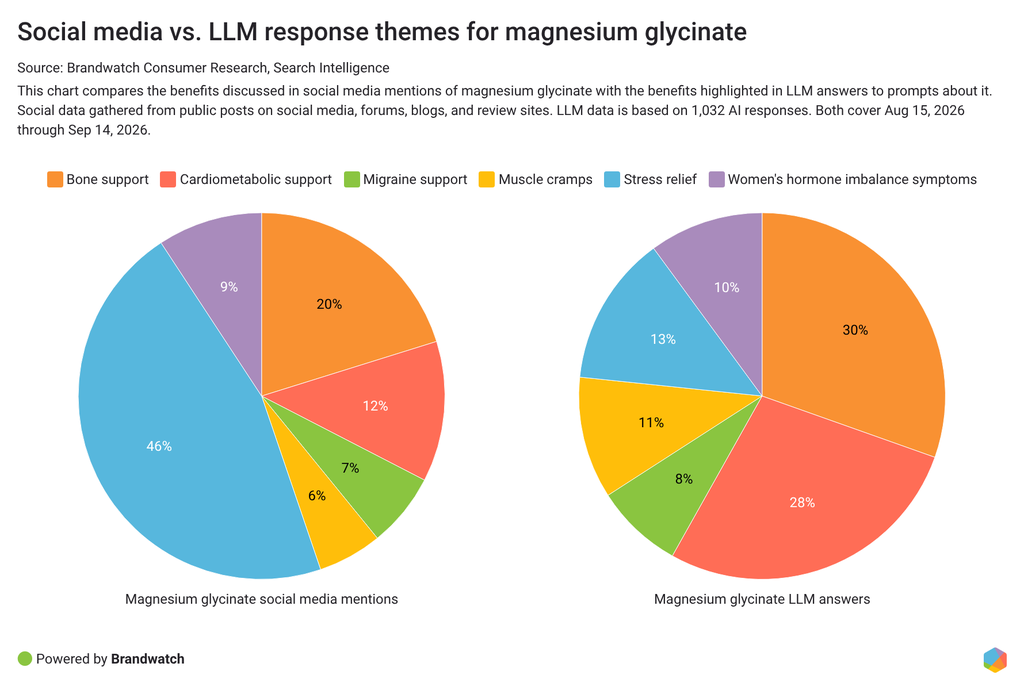
This is different from the benefits discussed on social, where stress relief took nearly half the share of voice. AI platforms were highlighting a different mix of benefits from those most prominent in the social discussion.
For healthcare and pharmaceutical organizations, this gap matters. The benefits consumers discuss may differ from the benefits AI platforms highlight when asked.
Monitoring all three signals, Google searches, online conversations, and LLMs’ responses shows you what people ask about, what they discuss, and how AI platforms answer, helping you identify questions or information gaps that need attention.
Brand takeaways
- Search can flag a shift, while social helps explain it. Social conversations help explain the shift in search behavior due to melatonin health concerns, while consumers sharing positive experiences help explain why search interest is being pulled toward magnesium glycinate.
- AI adds another layer of insight. LLMs place much greater emphasis on bone support and cardiometabolic support than social conversations do, while social conversations are much more heavily focused on stress relief. What consumers are being told by AI platforms and what they're telling each other are different, and that’s easy to miss if you're only monitoring one signal.
- Each signal reveals a different part of the story. Search shows a change, social explains why, and AI reveals how the topic is being represented when people ask about it. For brands, the value lies in bringing these perspectives together.
What you can do next
When you see a search trend shift quickly, locate the cause before you act. Melatonin’s social spike and search crash traced back to a single study that was made visible on social media. Set up alerts for new research in your sector and track the conversation around it. This gives you early visibility and the chance to respond to concerns while the story is still forming.
How to distinguish a viral moment from a lasting trend
Food trends can emerge and disappear in the blink of an eye. For every fresh sourdough loaf there’s a box of discarded cronuts.
The pace of change can make it difficult for brands to judge the strength and longevity of a trend. Move slowly and competitors get there first; lean too hard into a fleeting trend, and you've turned an opportunity into a liability.
We looked at matcha and Dubai chocolate to explore a question brands face whenever a food trend takes off: is this a trend worth backing, or a moment that will be gone before our campaign launches?
Dubai chocolate vs. matcha: Unwrapping two different kinds of popularity
Dubai chocolate won the world’s attention in 2025, peaking across social media discussions that summer as the “Dubai chocolate matcha Labubu Crumbl cookie” meme took aim at multiple internet trends.
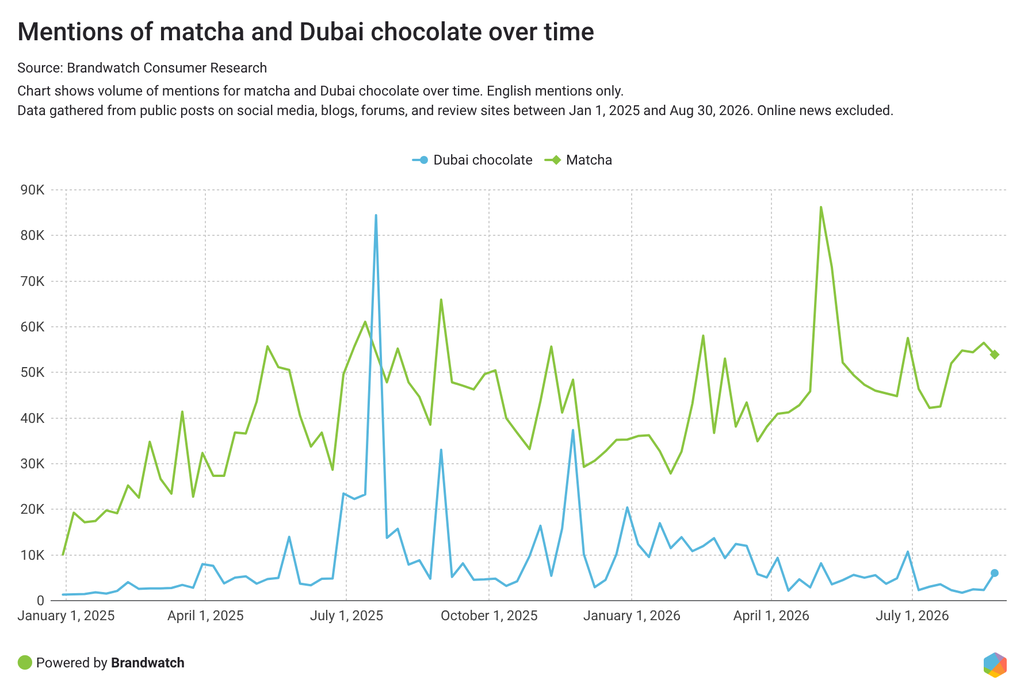
But while Dubai chocolate had its viral moment, matcha has maintained steady momentum as an "always-on" trend – and the numbers prove it.
From January 2025 to August 2026, matcha generated 3.6 million social mentions, outpacing Dubai chocolate’s 753k. That sustained conversation makes it a stronger candidate for lasting relevance. But volume alone isn't enough to establish staying power.
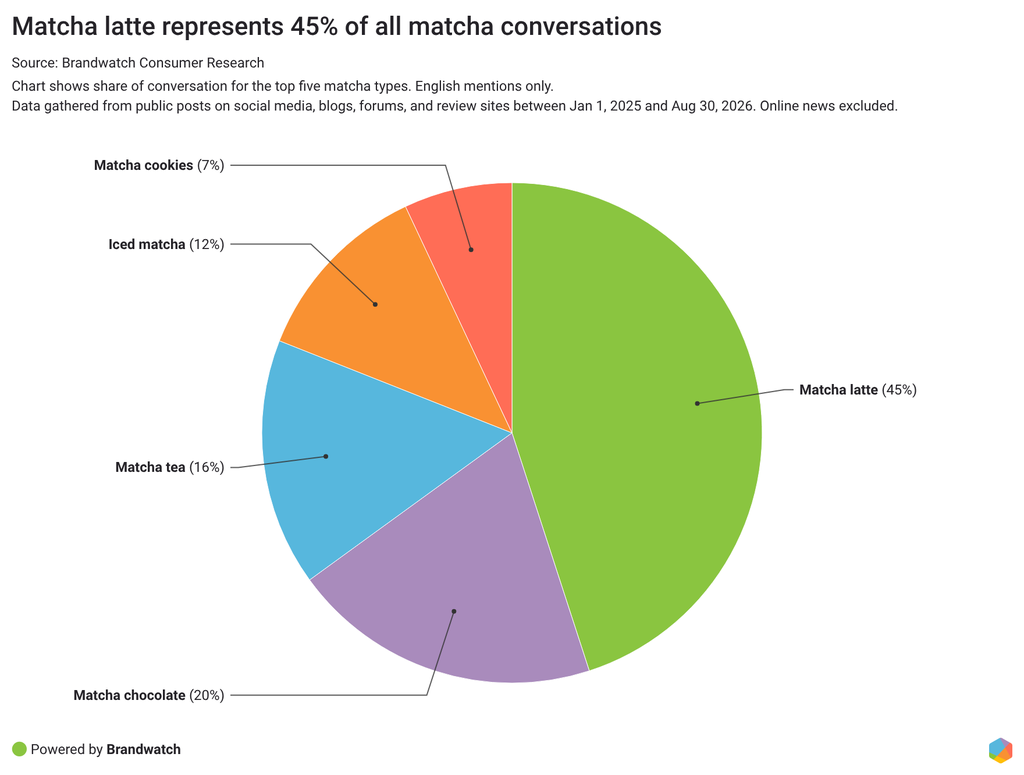
To investigate this further, we looked at the foods and drinks people associate with matcha. Lattes dominate the conversation, ahead of matcha chocolate, matcha tea, and iced matcha. The connection to coffee culture helps explain how matcha has found a place in people’s routines, beyond the novelty of being a trending ingredient. When people buy a coffee, they know matcha is on the menu.
Search confirms matcha's “always-on” status
If social shows us what’s being said about matcha and Dubai chocolate, then search adds an extra layer of insight about consumer demand.
We looked at US and UK Google search volumes from January 2025 to August 2026 to establish the scale of interest in each trend.
Matcha attracted the largest share of search interest across the period by some distance – and the shape of that interest tells you as much as the volume.
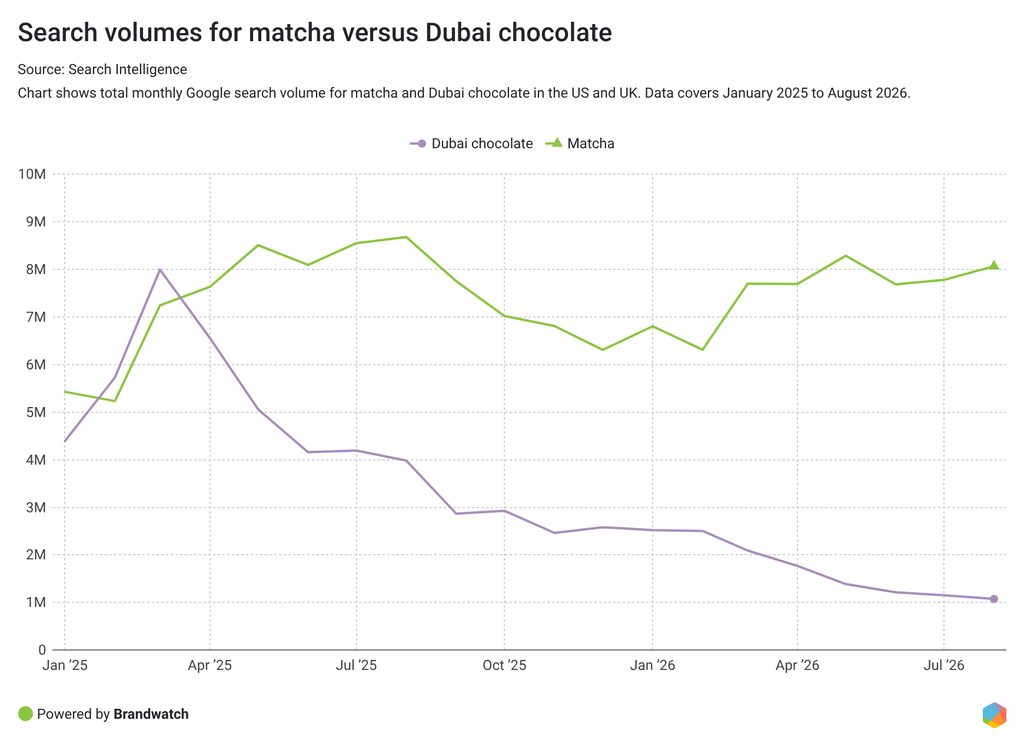
Dubai chocolate's search curve follows a familiar pattern: a sharp spike driven by viral attention, followed by a return to low volume searches. Once the meme cycle moved on, so did the searches.
Matcha's curve looks completely different. It doesn't spike as dramatically, but it doesn't drop off either. It stays consistent. That kind of search behavior, steady and resistant to a boom-and-bust pattern, is one of the stronger signals that something has moved beyond novelty and into routine.
For brands, that distinction matters more than peak volume. Dubai chocolate may have generated more buzz at its highest point, but matcha is the trend that's still showing up in people's searches.
Brand takeaways
- Viral and always-on trends require different approaches. A brand chasing every meme-driven spike risks burning resources on moments that won't last, while overlooking the steadier story that's shaping long-term category behavior.
- Volume is a starting point, not a conclusion. Matcha’s dominance in search and social is significant, but what makes it a stronger investment signal is where that conversation shows up: in daily routines and coffee shop menus.
- Search can show you a spike, but social shows you the context behind it and whether there’s a pattern. For brands trying to make resourcing decisions around trends, that distinction is the difference between a calculated bet and a costly one.
“See it, then validate it. If you see a conversation suddenly taking off on social, check search to see whether demand is really moving, or if it's a blip.”
What you can do next
Is a trend still showing in search months after its peak? Is it appearing in social conversations connected to routine and non-seasonal moments? If you can answer both these questions with a “yes” then you have a trend worthy of bigger investment (for example, a permanent menu addition featuring a popular food ingredient). Regularly checking both search and social can help you separate the viral moments from long-term consumer habits.
What declining search volume won’t tell you
Buying a car is one of the biggest purchasing decisions consumers can make. Before getting the keys, people rely on their own research: they search, read reviews, and ask questions on forums and social communities.
But the arrival of AI search platforms has added a new tool into the mix – and it's changing where some of those questions get asked.
Related to the automotive sector, US and UK Google search interest for terms like “best car,” “best family car,” and “best SUV” have experienced a steady decline since September 2024.
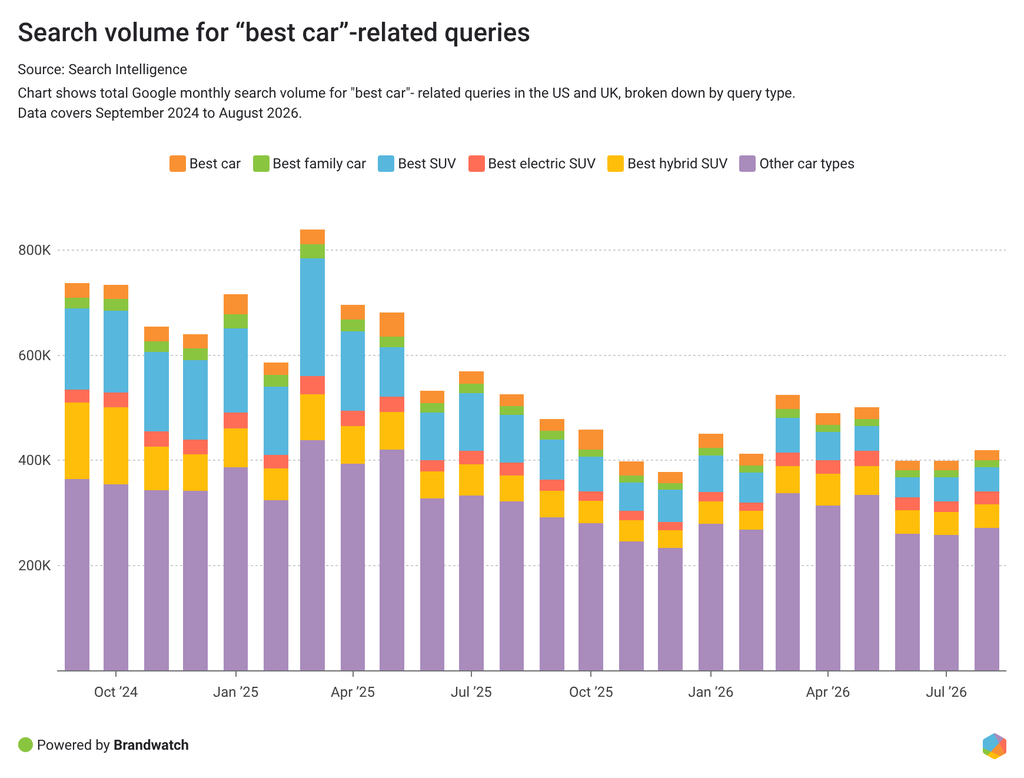
For a brand tracking search alone, the decline in “best car” queries could look like cooling demand (in fact, new car registrations are trending upward globally). But buyers are increasingly taking these questions to LLMs, where they can get tailored answers without piecing together information from multiple sources.
Who shows up when people ask AI about cars (and what’s driving that visibility?)
Using search intelligence, we tracked over 350 “best car” (and variations of) prompts across five different LLMs to see which brands were surfaced in the answers.
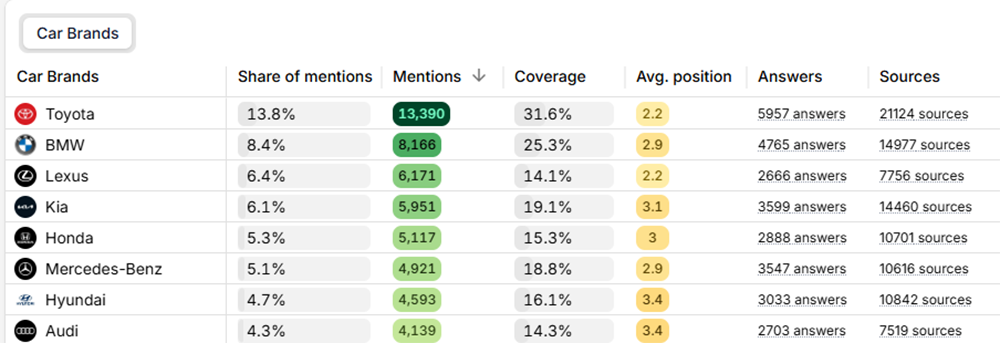
Toyota leads with a 13.8% share of mentions, appearing in almost 6,000 answers. LLM sentiment for the Japanese manufacturer from these responses scores 90% positive, with praise for reliability, fuel economy, and value for money.
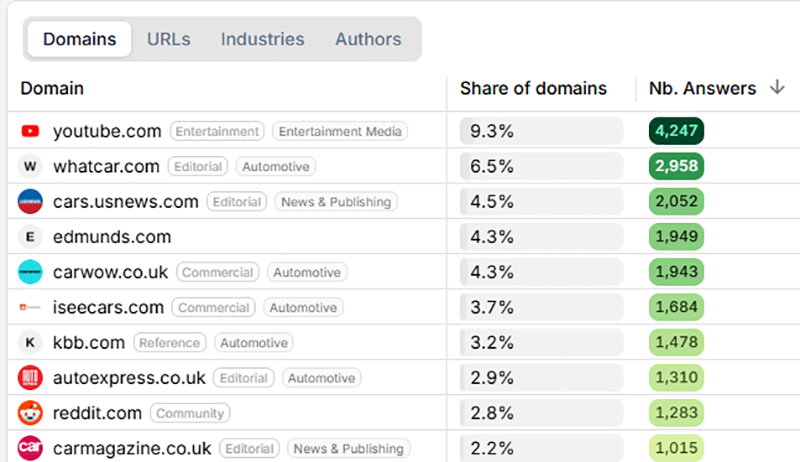
Of the sources cited by the LLMs, Toyota’s own website drove just 135 answers compared to YouTube’s 4k answers. The video site’s community of enthusiasts helped it top the share of cited domains, followed by a number of trusted editorial brands like What Car? and Auto Express. The most cited authors – Darren Moss, Ryan Birch, and Mario Christou – appear in almost 3k LLM responses combined.
The pattern is consistent: the sources shaping buyer answers weren't the carmakers themselves, but YouTube creators, editorial brands, and individual journalists. The coverage, reviews, and community conversation a brand earns have become the raw material for the answers its customers receive.
The broader lesson for brands in any sector: figure out where your community is most active and most vocal, because that's the content ecosystem your AI visibility will be built on.
“Social media isn't just a channel for reaching consumers directly. It's part of the raw material that shapes what AI says about your brand when a buyer asks.”
What social adds to the picture
We analyzed 251 million online mentions relating to the automotive industry. Overall mention volume grew 91% year over year, with close to nine million mentions expressing active buying intent.
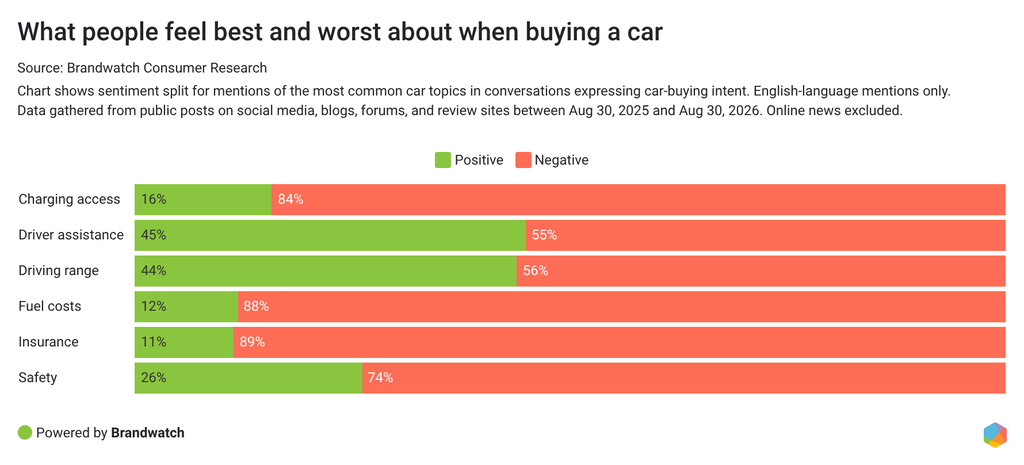
Fuel costs led buying-intent conversations, followed by insurance and safety. Most discussion of these issues was negative, while driver assistance and driving range attracted the highest shares of positive mentions, at 45% and 44% respectively.
These aren't abstract concerns. They're the exact questions buyers are increasingly taking straight to LLMs.
Brand takeaways
- LLM visibility is becoming as strategically important as search ranking. Tracking which brands appear in AI responses, how they're characterized, and which sources are driving those responses is no longer optional.
- Your brand’s AI visibility depends on more than owned content. LLMs draw heavily on third-party sources, like YouTube creators, journalists, and enthusiast communities. Your presence and reputation in those spaces have a direct effect on how AI represents you to buyers.
- Social media also helps shape AI visibility. The buying-intent discussions, reviews, and community recommendations happening across social platforms feed into the information ecosystem that LLMs learn from. By monitoring and participating in these conversations, brands can manage their reputation and help shape how they appear in AI answers.
What you can do next
Test how AI answers the questions consumers are asking. Take the concerns driving social conversation (in this case fuel costs, insurance, driving range, and safety) and run them as prompts across several LLMs. Check whether your brand appears, how it’s described, and whether the details are accurate. Where answers are missing or outdated, you’ve found a gap that content can fill. From there, get that information to the reviewers, creators, and platforms that LLMs trust to reference.
The risk of mistaking interest for acceptance
Interest in AI has grown rapidly since ChatGPT's public release in November 2022. Search volume for AI-related terms rose 2.4k%, driven largely by queries about tools such as ChatGPT and Google Gemini.
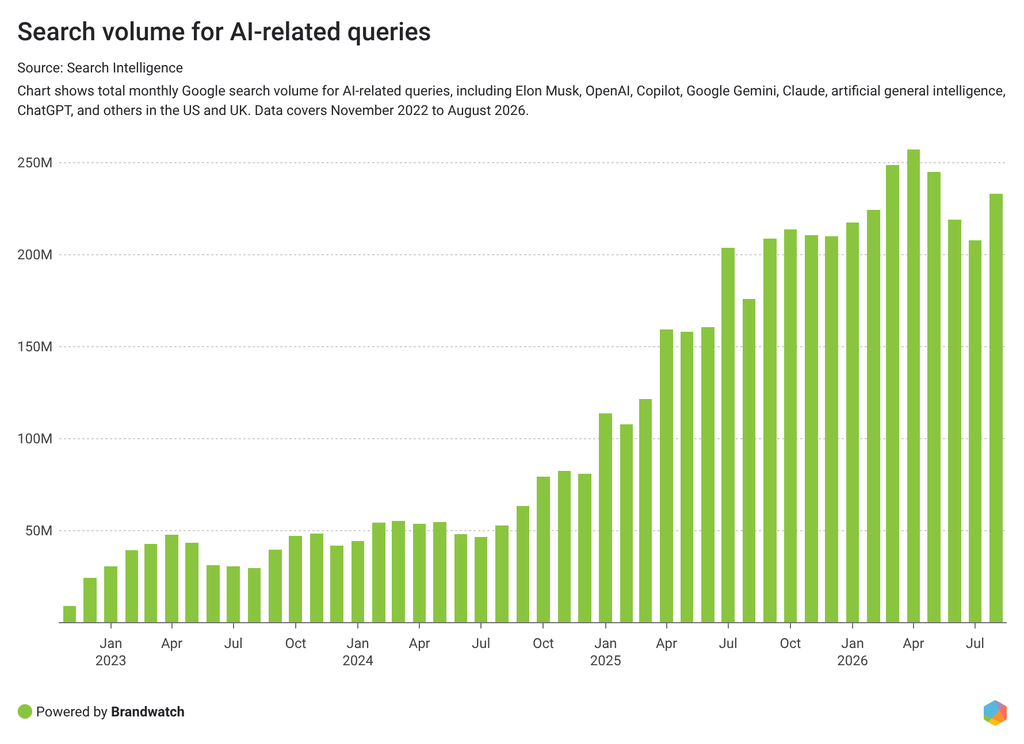
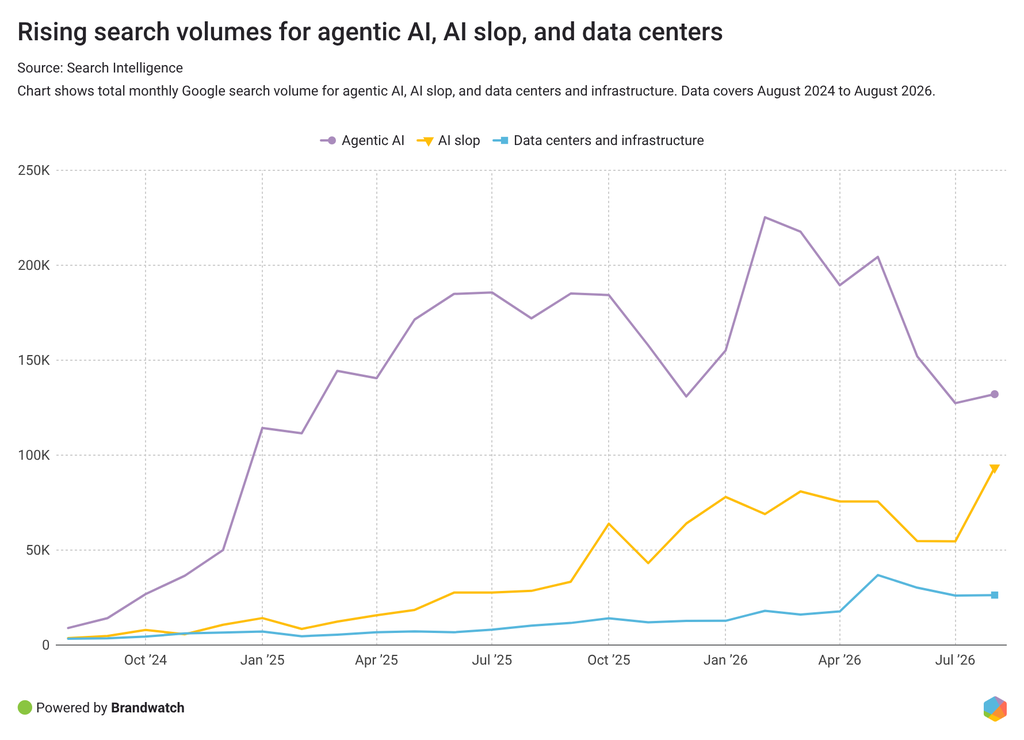
But rising search interest raises an important question for brands: are people searching because they see value in the technology, or because they're worried about its impact? We examined three fast-growing topics within AI conversation – AI slop, data centers, and agentic AI – to find out.
AI slop
“AI slop” attracted 537k searches from January to August 2026, with 272% growth compared to the same period in 2025. Searches for "what is AI slop" grew 12.8k% between 2024 and 2025, then a further 460% in 2026. The scale of that search growth tells you this has become a cultural reference point.
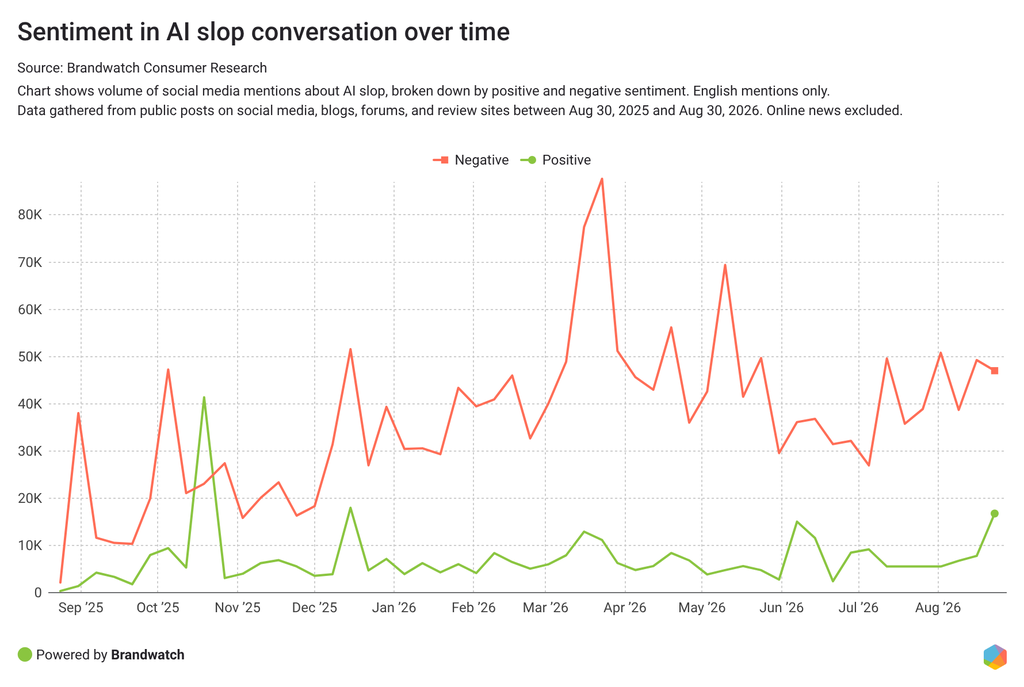
On social, the picture is more specific. Close to 84% of AI slop mentions were classified as negative, which is expected for a pejorative term like this. What's more telling is the shape of it over time: negative sentiment spiked in March 2026, then settled at a persistently elevated baseline for the rest of the year. And it's translating into concrete behavior. We tracked 11.4k mentions of canceled subscriptions and uninstalled apps attributed to AI slop, up 1.9k% year over year.
One person wrote: "I just cancelled my annual renewal, because most of what's in the pipeline is AI slop. I'm not paying to see fake people." Another said they'd uninstalled and gone to a competitor: "Too much AI slop that can't be turned off."
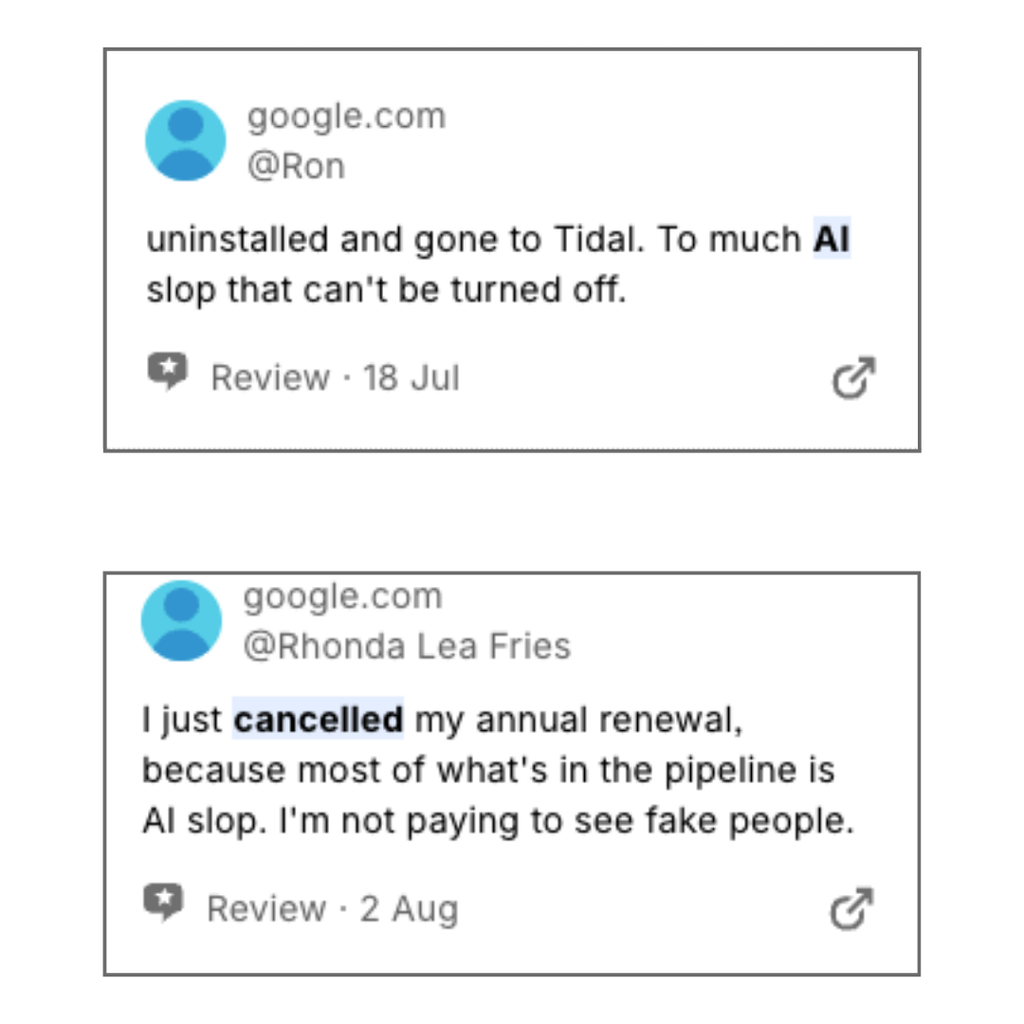
Not everyone feels this way. Some welcome AI-generated content as creative experimentation. One X comment read: "Yes AI slop, but I like seeing what creative stuff people come up with." But these voices are a small minority. Across the broader conversation, people's frustration tends to center on feeling like they have no choice, and receiving nothing of value.
Data centers
On the search chart above, you’ll see that data centers barely register – it’s a flat line at the bottom throughout the period. On social, it's a different story entirely, surging to over 400,000 mentions in a single month in May 2026, completely overtaking social interest in agentic AI and AI slop.
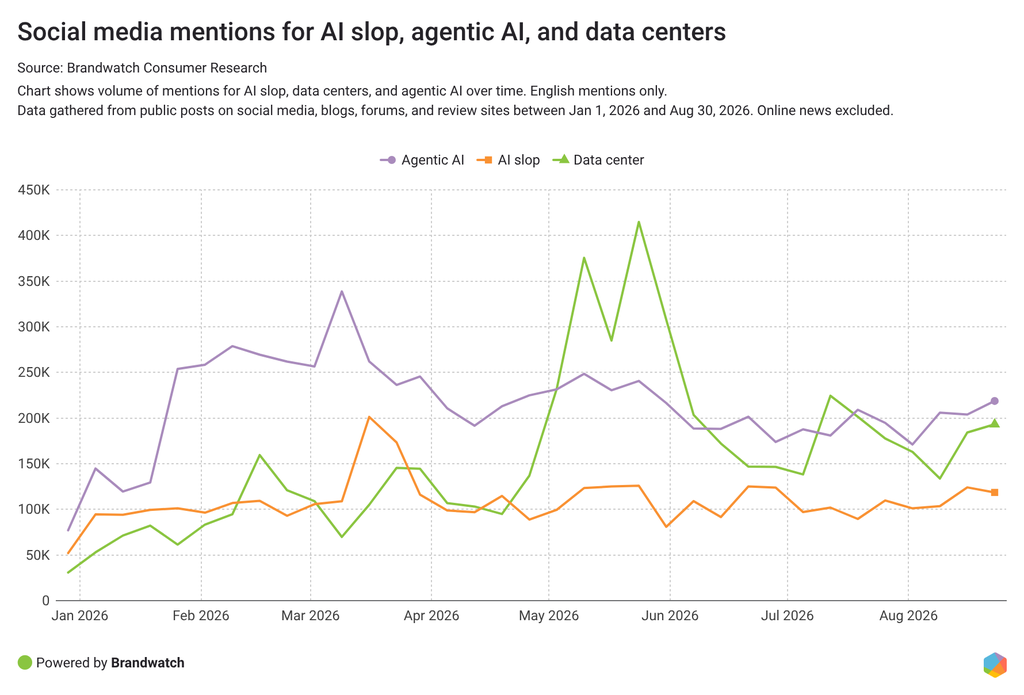
Anger makes up 930.6k mentions, or 50% of all emotion-categorized conversation, followed by fear (16.7%) and sadness (15.4%). These are largely community conversations: people affected locally by construction, noise, and environmental impact.
“When a conversation grows at this scale in local communities, it brings scrutiny that goes well beyond your products. Teams need to be monitoring their industry's broader impact across channels, not just mentions of their brand.”
Agentic AI
Both search and social interest in agentic AI have seen strong growth. Social helps show how people feel about it, and what they're talking about using it for. Agentic AI attracted 11.4 million mentions, up 14% year over year. “Learning” led the use cases with 207k mentions (up 88%), followed by “shopping” at 74k mentions (up 37%). “Personal assistant” mentions grew 231%, the steepest increase of any category.
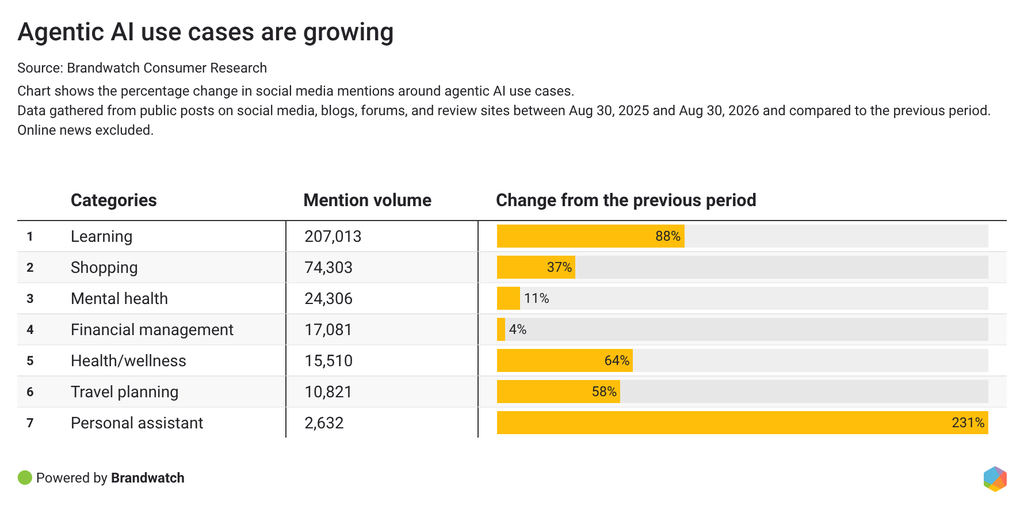
Both AI slop and agentic AI are growing fast in search. The social conversation tells you what people are saying about them and why.
Brand takeaways
- Search growth alone doesn't tell you what's driving it. AI slop and agentic AI are both fast-growing search topics. One reflects dissatisfaction, the other curiosity. Adding in the social layer gives you the context to really understand each trend.
- Some conversations don't show up in search at all. Data centers barely register as a search topic but generate hundreds of thousands of social mentions driven by community-level concern. Brands monitoring only search would miss it entirely.
- Sustained negativity is a different problem to a single spike. The AI slop sentiment chart doesn't show a moment that has passed. It shows an elevated baseline that persisted for months, and it's having a real impact on consumer behavior.
- The AI slop backlash applies to any brand introducing AI features. People don't object to AI by default. They object to feeling like they have no choice, or to receiving nothing of value. Before launching any AI initiative, ask: what problem does this solve, what control do humans retain, and what happens if they don't want it?
What you can do next
Search for the terms people are using in your sector, track the sentiment on social, and monitor whether that sentiment is spiking or settling into a persistent pattern. Mapping out both signals will tell you whether you're building toward acceptance or walking into a backlash that was already visible in the data.
How search and social can help you understand cultural impact
It started with looksmaxxing, the trend of optimizing your appearance through grooming, fitness, skincare, and even cosmetic procedures. The concept caught on, and it's since become the blueprint for an entire genre of self-optimization trends online.
But search and social data seem to show two different stories.
Search volumes show interest in maxxing has peaked and is now cooling off, down 12.7% in August 2026 (from July 2026) and 55.7% over three months.
Meanwhile, social media tells a different story: mentions have grown and there is sustained interest.
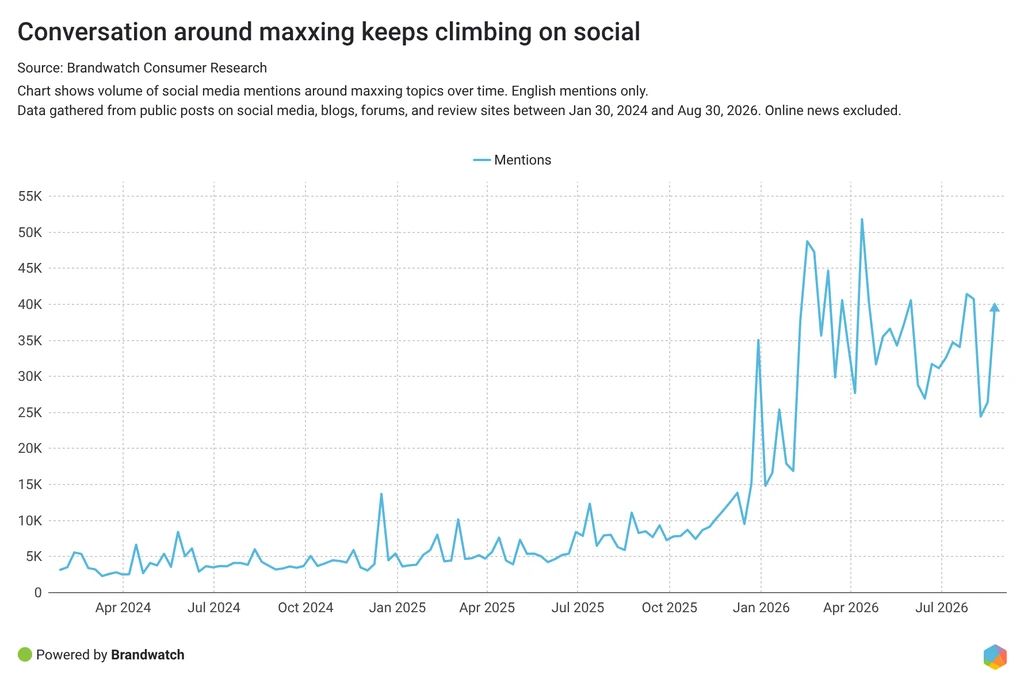
The momentum is still building online, even as searches for maxxing terms slow down.
How cultural relevance appears across channels
Looksmaxxing remains by far the biggest maxxing topic on social – mentions are up 807% year over year, with the single largest increase in volume of any category we tracked. It’s spawned dozens of micro-maxxing trends – and some of them are now growing even faster by comparison:
- Tanmaxxing is up 1.5k%
- Whimsymaxxing is up 917%
- Funmaxxing is up 618%
Maxxing trends are increasingly going mainstream. We mentioned earlier in the report that a mention of “sleepmaxxing” on TV show The Pitt sent searches and social interest soaring.
The latest maxxing iteration worth spotlighting is whimsymaxxing, which stands for dressing up everyday items in colors, beads, stickers, and other decor to add some joy to your routine.
Whimsymaxxing looks like bedazzled face masks, diamond stickers on coffee mugs, or gemstones on cakes. The trend hit peak visibility when Kylie Jenner posted her jewel-encrusted birthday cake, sending social media into a frenzy.
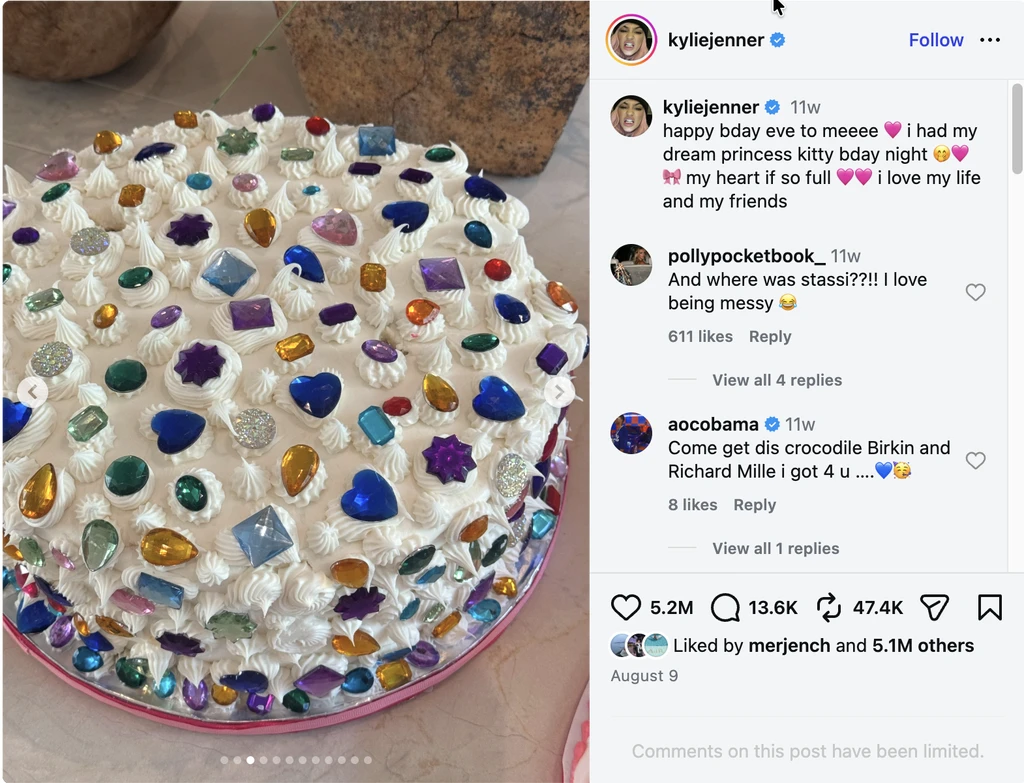
From phone cases to jerseys and faces, consumers are finding creative ways to sprinkle happiness around their homes – and brands are joining in, too.
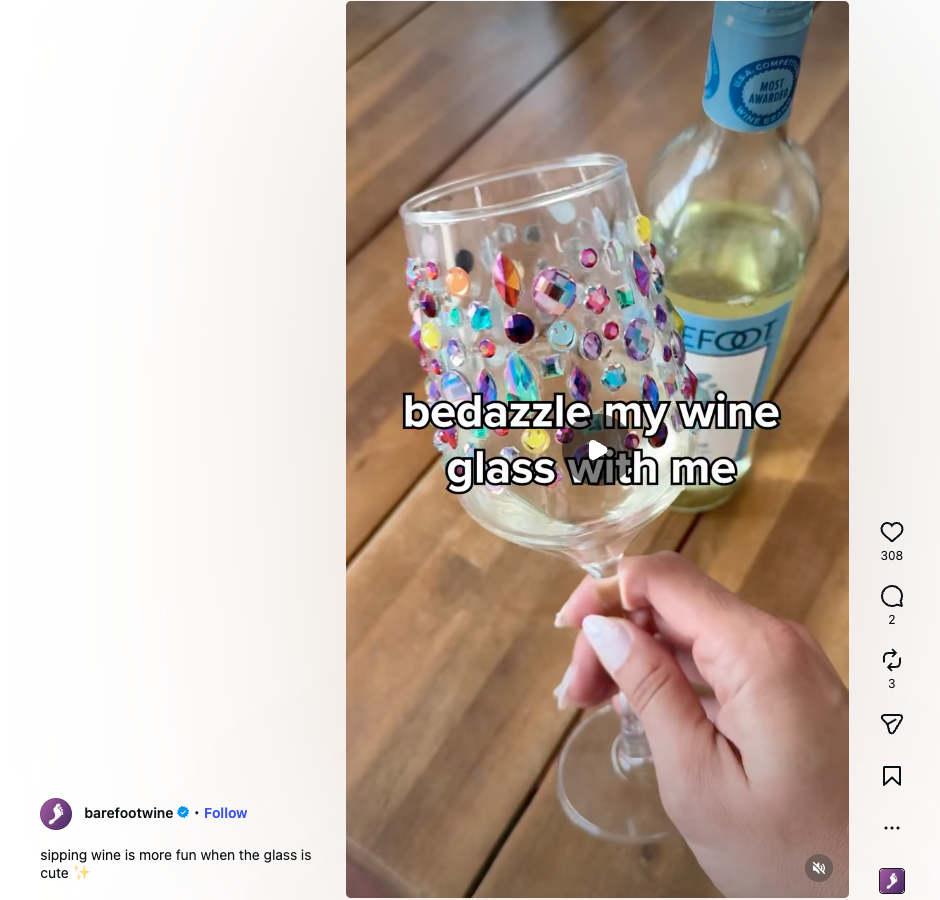
This widespread popularity has created new consumer interest for whimsymaxxing items. Rhinestone and bedazzling suppliers are cashing in.
The maxxing trend is a nice example of how cultural relevance grows and flows across channels. In this case, a social trend (looksmaxxing) turned into search interest as people looked to understand its meaning. The trend augmented across social and TV (see whimsymaxxing and sleepmaxxing) and created new consumer interest in products (whether they’re sleep supplements or rhinestones).
That’s not to say that these trends are always positive or risk-free for brands to get involved in. There is widespread backlash around looksmaxxing centered on the problematic subculture that pursues physical “perfection.” The environmental implications of whimsymaxxing are also highlighted by authors using the term landfillmaxxing. And the health risks involved in tanmaxxing (like intentionally skipping sunscreen and maximizing exposure to UV light) can’t be ignored.
Brand takeaways
- Look across channels to understand cultural relevance. Falling search interest in a particular term like looksmaxxing doesn’t mean it isn’t having a huge impact on culture – TV shows, consumers, journalists, and influencers could be sharing and adapting the original trend. One channel never tells the full story.
- Adapt your search analysis as trends become mainstream. If whimsymaxxing content is trending, you best believe there’ll be people searching for – and buying – rhinestones. Make sure your search analysis goes beyond tracking trending keywords in your industry and accounts for commercial implications.
- Don’t confuse growth with fit. Tanmaxxing shows why a fast-growing trend may still be a poor match for your brand’s values or reputation.
What you can do next
Track popular search terms and social conversations in your industry to spot emerging behaviors or interests, ensuring that you adapt your monitoring across channels as trends evolve and change. Document the language and communities driving them and share emerging opportunities with social and creative teams. Even if you don't jump on a maxxing trend immediately, you should be aware of them in case your brand gets pulled into a risky conversation or an opportunity presents itself.
Five questions to ask of your search and social data
The stories in this report each started with a simple question about a data signal. Here are five worth asking of your own data.
- What’s changed in either your search or social data? Start with a shift in volume. Look for a spike in searches, a drop in mentions, or a swing in sentiment. Compare the pattern to your other data source over the same period to look for clues as to why.
- Is this a passing moment or a lasting trend? Track both signals beyond the initial spike. This helps you assess whether attention is fading, becoming part of everyday routines, or evolving into something new.
- What’s driving attention? With a change located, now look at the questions and terms people search for alongside social media discussion. Does this coincide with a specific event or even a single social media post? This can help you uncover what’s behind a change.
- Where is your share of voice different across search and social? Put your share of voice data side by side and look for gaps. Are you winning attention on social but missing from search, or showing up in search without generating much conversation? These differences can point to opportunities you wouldn’t spot by looking at either channel alone.
- What are LLMs saying about your brand? Test out the questions and themes emerging in search and social to see which brands and sources AI chatbots cite. Track these answers against what people discuss about your brand to understand where AI reinforces your story or introduces a narrative you don't want.
Recap: The State of Search and Social Media 2027
From sleep supplements to car buying, food trends, and AI, brands need to be watching both search and social media to avoid missing the biggest trends shaping their sectors.
“Lean on search for what people need or fear in a given moment. Lean on social for how people want to be seen and with whom they want to belong.”
LLM visibility is emerging as a valuable new layer, too. As people take their questions straight to chatbots, tracking brand mentions and sentiment inside AI answers reveals who's being recommended, and why.
In 2027, marketers and comms professionals need to be thinking about how they connect search, social, and AI as one continuous conversation. From there they'll be able to monitor trends as they form and before they peak – and turn them into brand opportunities.
The story isn't search versus social. Consumer insight now lives across search, social, and AI. The brands that continue measuring these separately will increasingly misunderstand what consumers are asking, discussing, and being told.
Methodology
This report draws on data from 564.61 million social media posts and 4,678 search prompts analyzed Brandwatch Consumer Research and Trajaan from August 2025 to September 2026.
Where relevant, we also analyzed historical data going back to September 2022 to provide context and identify longer-term shifts. For charts, we’ve listed the specific date range of the data collected.
In charts displaying sentiment, neutral mentions were excluded, so percentages reflect only positive and negative mentions.
Our research combined industry-specific queries with broader tracking of social media behavior and public perception. For automotive research, we drew on responses from 918 LLM prompts run across Gemini 3 Flash Lite, Google AI Overview, Google AI Mode, GPT-5.4 mini, and Claude Haiku 4.5.
For magnesium glycinate research, we drew on responses from 130 LLM prompts run across Gemini 3 Flash Lite, Grok 4.1 Fast, Google AI Overview, Google AI Mode, GPT-5.4 mini, Sonar, and Claude Haiku 4.5.
Published on November 3rd, 2026