logo

Covid-19 Daily Bulletin 23/04: Earth Day, Supplies, and Education

People discuss a greener future, while people continue to have issues getting the products they need

It’s Thursday already, and today we’re looking at higher education inequality, product supplies, and Earth Day.

Don’t forget to subscribe to our bulletins if you haven’t already. Just click the button below.

Let’s get to it.

SUBSCRIBE

Earth Day 2020: Thoughts for the future

Yesterday was the 50th anniversary of Earth Day, a day dedicated to supporting environmental measures to protect the planet. No small topic, we found 1m people discussing the event on social media.

But this year, conversation was focused on the pandemic and its effect on the climate crisis. To understand the conversation, we looked at English-language mentions using our Consumer Research product.

We found 23.2k people on social media discussing the effects of the coronavirus pandemic on climate change, in relation to Earth Day.

There have been reports that the pandemic could have some positive outcomes for the environment, such as some wildlife returning, and a reduction in air pollution and carbon emissions. Users wondered how we could maintain these levels, and noted dramatic change could be possible to reduce further damage to the environment.

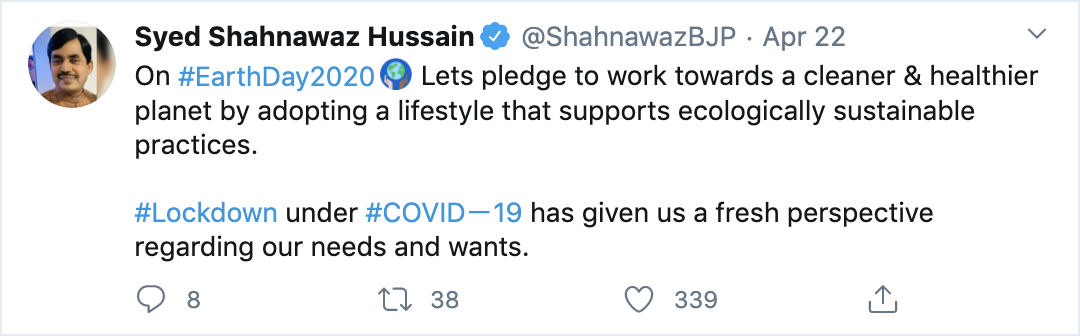
We found another 56k people discussing an alternative future, with climate issues a focus when things return to normal. Thousands of users pledged they’d do more to support the environment by examining what was really essential to their daily lives, and pushing for actionable change.

Despite the serious nature of a large chunk of the conversation, people still found time to celebrate and enjoy Earth Day.

As we’ve seen throughout this pandemic, being stuck indoors won’t stop people having fun entirely. We found 43k users chatting about virtual Earth Day activities or events they were participating in on social media.

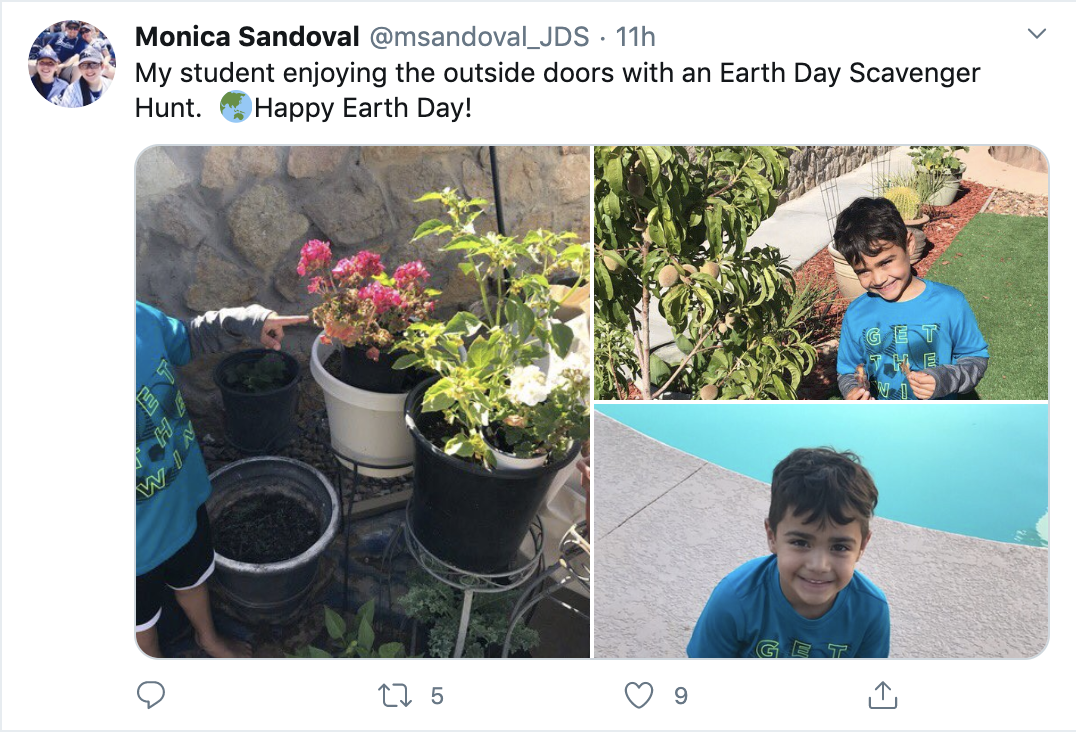
Another 8k people were talking about Billie Eilish’s livestream for Earth Day, which at the time of writing has racked up 1.5m views on Twitter. Thousands more mentioned organizing their own backyard scavenger hunts and tuning in for Earth Day’s own livestream event too.

It takes a virtual village

In just one month, spring semester vanished, classes were moved online, and students were forced to head home. At least 1,149 colleges and universities closed in the US, affecting over 14 million students, while UK universities are after a £2bn bailout from the government.

The sudden move meant conversation around online learning increased by 24,835% in March, compared to February.

Sadly, it isn’t a very happy discussion. Looking at the ratio of positive to negative mentions, the picture is bleak (14% positive, 86% negative). Negative conversation was driven by confusion, as well as a lack of support and clarity on what was needed from students.

Also among these concerns is inequality. The challenges of a chaotic home life or technical difficulties are almost impossible to overcome in a pandemic, and some will be affected more than others.

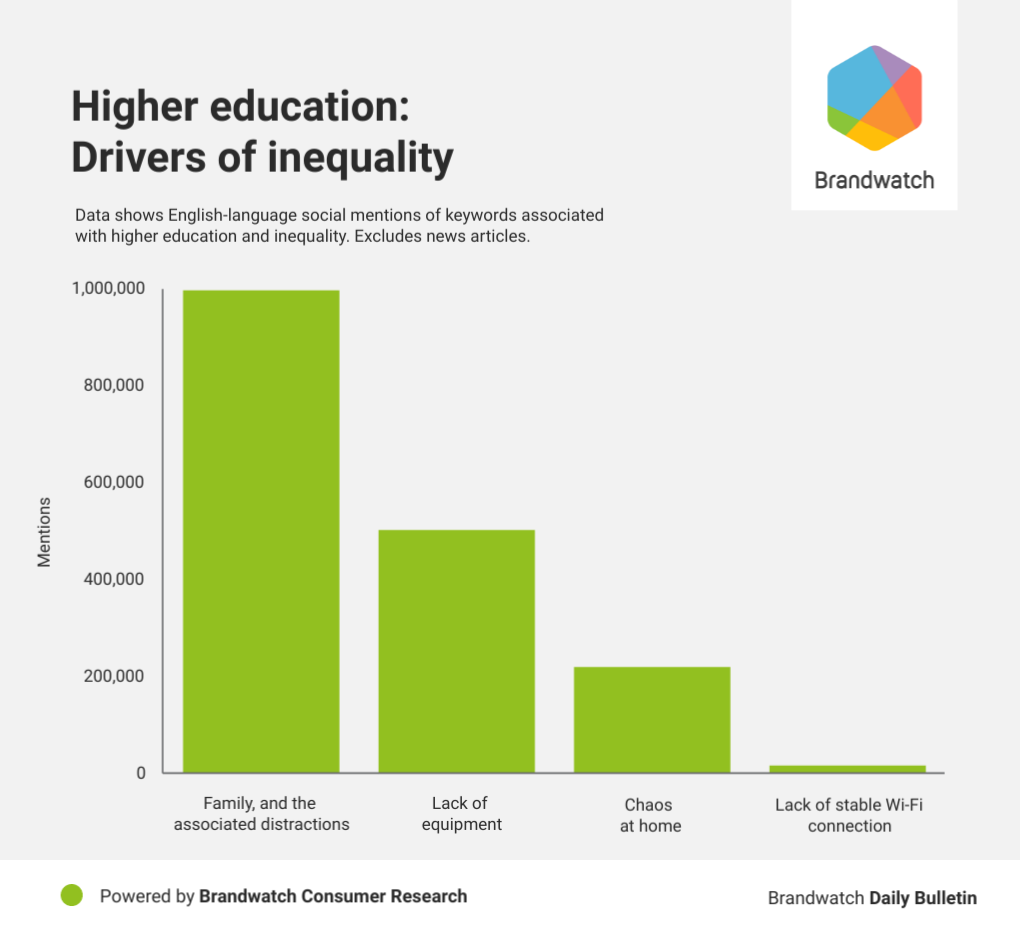
The main drivers behind inequality discussions were family, and the associated distractions like flatmates or pets (1m mentions), a lack of equipment (504k mentions), chaos in a confined home (221k mentions) and a lack of stable Wi-Fi connection (18k mentions).

Thankfully, many large internet service providers signed a pledge to support struggling Americans, including students. They’ve agreed to waive bills and cancel late fees. And, unsurprisingly, these brands are receiving a decent amount of positive mentions online.

For students, life goes on. And they’re sure making up for a lack of campus life. We found a 182% increase in unique authors mentioning virtual pub quizzes with friends (new and old) in March, while online book clubs and wine clubs are also seeing increased online interest.

For college seniors, graduation has become their future focus. Conversations around graduation in March 2020 are up 31.35% compared to March of last year. Universities have planned virtual ceremonies, while others have postponed until the situation settles.

Students really have been trying to make the most of online school and activities, especially as everything becomes clearer for them. But universities must remain mindful of the diverse needs their students can have. Enabling a strong support system will help students during the confusing transition period.

The Brandwatch incubator team have been busy crafting a Covid-19 tracker specifically for Higher Education organisations. Colleges and universities can find out more about getting free access to this here.

Product supplies improve but issues remain

Ever since the outbreak began, headlines have been dominated by stockpiling and shortages in supermarkets. Whether it was toilet paper or flour, people all over the world were struggling to get a hold of the things they needed.

Now that we’re months into the pandemic, has the situation improved or worsened? We decided to find out.

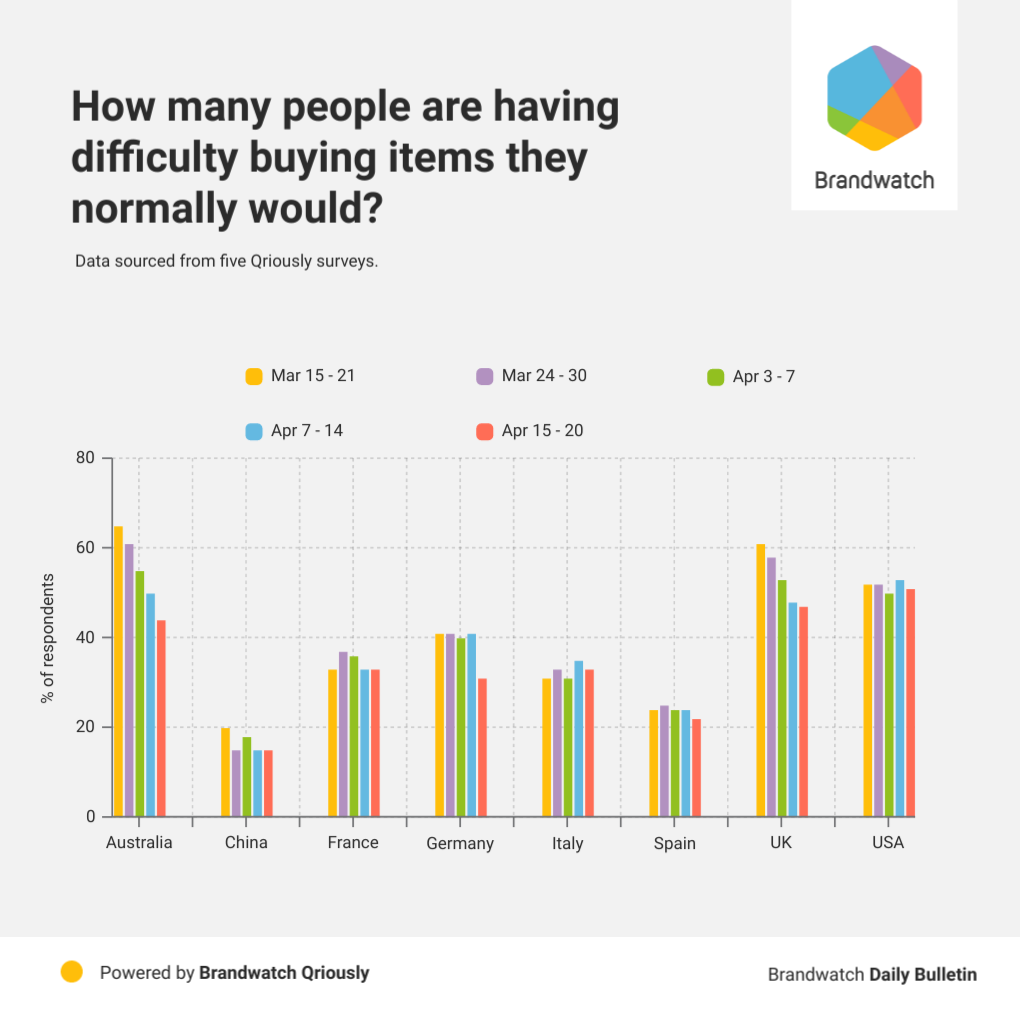
We ran a number of Qriously surveys that polled thousands of adults across Australia, China, France, Germany, Italy, Spain, the UK, and the US via their smartphones and tablets.¹ We asked them about facing challenges buying their usual products.

Here’s what they said in each survey.

Overall, the picture is positive. On average, the number of people finding it harder to get what they need dropped from 41% in our first survey to 34% in our latest. Nevertheless, that’s a third of people still facing issues getting what they need.

On a country-level, the situation varies wildly. China and Spain are on the lower end of the scale, but have seen little improvement over time. Meanwhile more people are struggling in France and Italy with purchasing issues, and they too haven’t seen much change.

For Germany, while It’s early days at the moment, after weeks of no change the country suddenly saw a drastic improvement in our latest survey, seeing a drop from 41% to 31%.

For the UK, US, and Australia, there are still significant issues. While the UK and Australia have seen strong improvements over time, their numbers are still high. Worryingly for the US, they’re now the worst affected with barely any change since the first survey.

What’s clear is that we’re not out of the woods yet. Supermarkets and suppliers seem to be making some headway, but there’s a long way to go.

Get more in-depth data

We’re doing a ton more research and analysis than what you see in the bulletins. Want to get your hands on it?

Head here to find out more and get signed up.

Thanks for reading

That’s it for today. If you want to get these bulletins yourself, head here.

Stay safe,

Brandwatch Response Team


¹ Note: All surveys are subject to a wide range of potential sources of error. On the basis of the historical record of the polls at recent general elections, there is a 9 in 10 chance that the true value of a survey result lies within 4 points of the estimates provided by this survey, and a 2 in 3 chance that they lie within 2 points.

logo
  Our Suite     Use Cases     Industries     Get started  

Runtime Collective Limited (trading as Brandwatch). English company number 3898053
New York | Boston | Chicago | Austin | Toronto | Brighton | London | Copenhagen | Berlin | Stuttgart | Frankfurt | Paris | Madrid | Budapest | Sofia | Chennai | Singapore | Sydney | Melbourne

Privacy Policy

Update subscription preferences

Unsubscribe

We value your privacy

We use cookies and similar technologies to personalize ads and content (including by sharing data with Google), to measure site performance, and to improve your experience. Learn more in our cookie policy

Privacy & Safety • Terms of Service

No, take me to settings
Yes, I agree
More info.

By using our site you agree to our use of cookies —