logo

Covid-19 Daily Bulletin 24/08: The Perils of Online Shopping

Some businesses are failing to deliver

Today we’re revisiting a topic many of us have become very familiar with in recent months.

Subscribe

Online shopping and delivery woes

When we first looked at online shopping and delivery conversation on social media in March, we learned that mentions had skyrocketed in line with increased demand. Five months on, we decided to check in.

To investigate how demand has developed and what’s driving the conversation, we used our Consumer Research platform to look at online shopping and delivery conversation from January 1 2017 to July 31 2020.

We found that, even as ordering items for delivery becomes more commonplace, problems are still rife.

More online shoppers

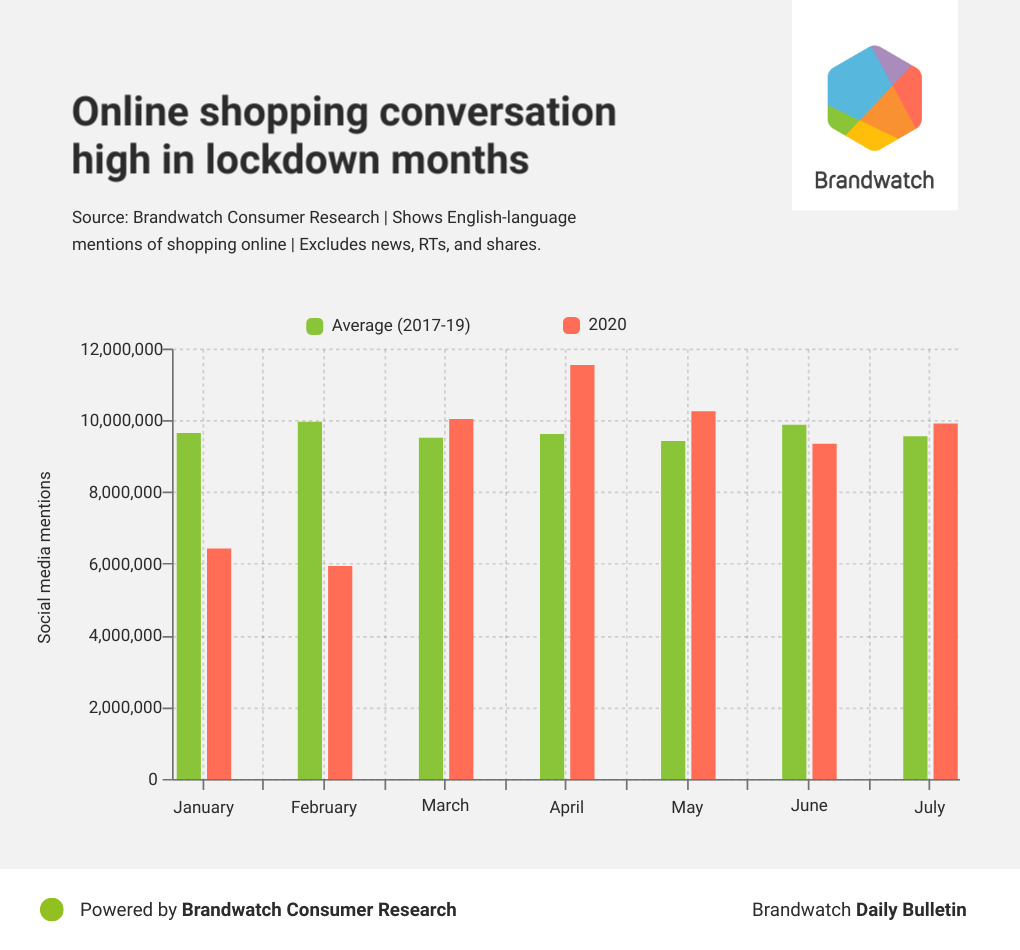
Interest in online shopping over the last few months has been higher than historic averages.

Mentions were particularly high in April and May this year compared to average numbers for those months in the last three years.

There are plenty of interesting trends to be found in this data.

For example, conversation was focused mainly on food (3m mentions – driven by both grocery and meal delivery) and clothing (2m mentions – driven by leisurewear).

We also found 437k mentions of shopping out of boredom. That’s a 51% increase when comparing the last five months to the five months prior.

Safety (4m mentions) was the main reason why consumers said they’d taken to online shopping.

But the process of ordering online is by no means totally seamless. When we looked at sentiment-segmented conversation, we noticed mentions were 60% negative from March 1 to July 31 2020. This negativity was driven by low quality goods, lack of availability of stock, and, above all, delivery issues.

Demand for delivery and boiling frustration

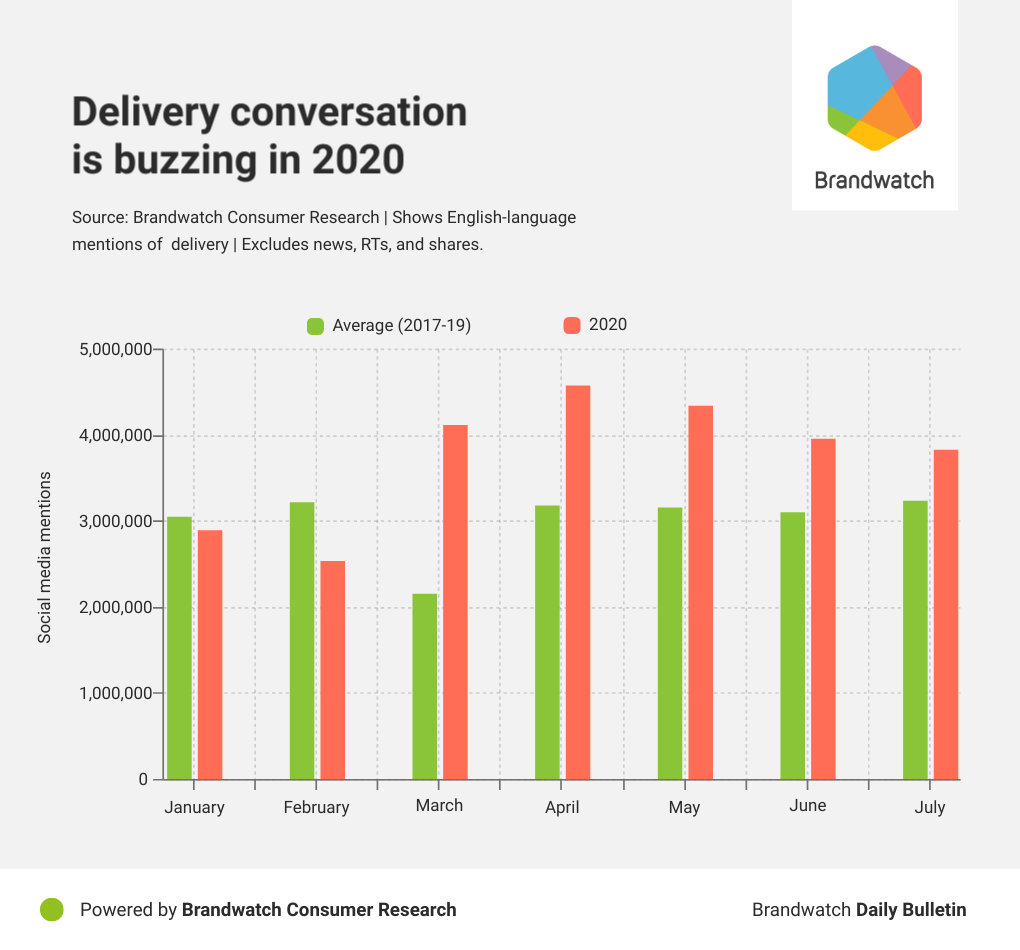
From March 1 to July 31, delivery mentions were 41% higher than in the five months prior ( – which included the holiday gift-giving period and Black Friday).

And the conversation has continued to soar well above historic averages in recent months, an indication that consumers are continuing to rely heavily on delivery options as the pandemic develops.

General delivery conversation in the English-langauge countries we studied varied, highlighting important regional nuances in preference. In the US, delivery time was a huge issue (1m mentions). But, in the UK and Australia, conversation had a lot of focus on free delivery (383k and 43k mentions respectively).

Meanwhile, uniting topics in general delivery conversation included customer service (2m mentions) and price (2m mentions).

Unexpectedly, as consumers have become more accustomed to ordering for delivery, conversation towards it has become more and more sour. Looking at sentiment-segmented conversation from March 1 to July 31, mentions were 40% negative. And, among emotion-categorized posts, 46% were classed as angry. Waiting times and missed deliveries drove this conversation.

Ongoing demand for items being delivered marks a big change for many retailers, but the scale of online complaints is enormous. For businesses to take advantage of the trend towards delivery, and to win and retain custom, they’ll need to iron out the difficulties and pay close attention to differences and changes in consumer preference.

Get more in-depth data

Don’t miss out on the final edition of our bi-weekly report looking at consumers and how their behavior has changed due to Covid-19.

Head here to find out more and get signed up.

Thanks for reading

Want to sign up for more bulletins? Head here.

Stay safe,

Brandwatch Response Team

logo
  Our Suite     Use Cases     Industries     Get started  

Runtime Collective Limited (trading as Brandwatch). English company number 3898053
New York | Boston | Chicago | Austin | Toronto | Brighton | London | Copenhagen | Berlin | Stuttgart | Frankfurt | Paris | Madrid | Budapest | Sofia | Chennai | Singapore | Sydney | Melbourne

Privacy Policy

Update subscription preferences

Unsubscribe

We value your privacy

We use cookies and similar technologies to personalize ads and content (including by sharing data with Google), to measure site performance, and to improve your experience. Learn more in our cookie policy

Privacy & Safety • Terms of Service

No, take me to settings
Yes, I agree
More info.

By using our site you agree to our use of cookies —