logo

Brandwatch Bulletin #115: Doomsday Discussions

How much do we talk about the end of the world?

22 April 2022

A quick content note, we’re looking at an at times dark topic today, so if that’s something you’d like to avoid, now’s your time to click away.

For those staying, we’re digging into the data behind how we talk about the end of the world online, and what kinds of apocalyptic events generate the most interest.

Let’s get to it.

Subscribe to the Brandwatch Bulletin

So, what do you think about the end of the world?

Generally it’s a good thing when we don’t have to think about the end of the world. But, in more tumultuous times, sometimes that’s impossible. Whether it’s Covid-19, climate change, or nuclear war, it feels like it’s harder and harder to not hear the word ‘apocalypse’ on a daily basis. This bulletin probably isn’t helping (sorry).

That said, when people spend time talking about the end of the world, they don’t always do it in a serious way.

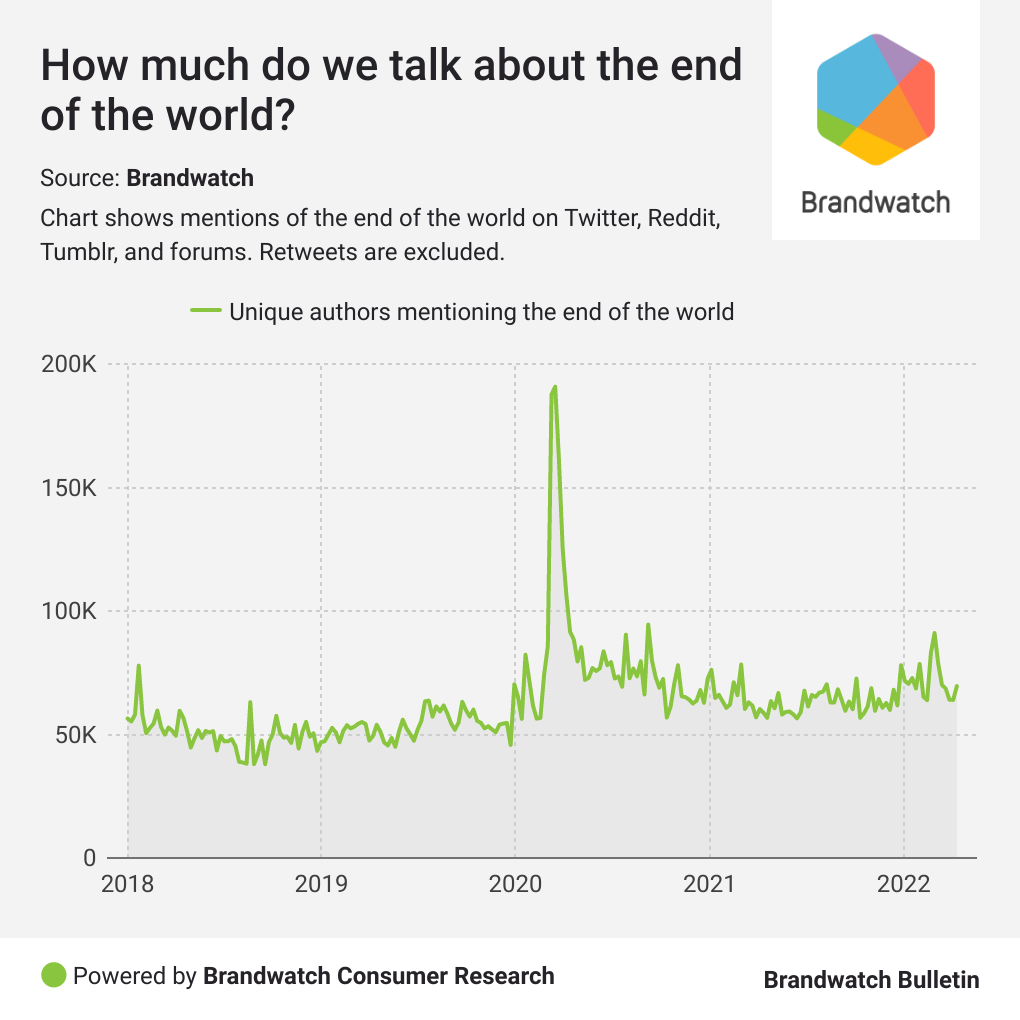
To look into this topic we created a query in Brandwatch Consumer Research to collect Twitter, Reddit, Tumblr, and forum mentions of “end of the world”, “apocalypse”, “doomsday”, and “armageddon”. Here’s how the volume of these mentions look over time.

Through most of 2018 apocalypse talk fell with a modest rise at the end of the year. Things then remained relatively stable, until a couple of jumps in the second half of 2019. These peaks and troughs had no one direct cause, with general online interest simply waxing and waning.

Then we reach 2020 and everything changes. On January 23 the The Bulletin of the Atomic Scientists set their Doomsday Clock to just 100 seconds from midnight, the closest it had ever been. (Midnight in this case is a metaphor for the end of the world. In other words, they thought we were closer than ever before to the apocalypse).

The scientists cited nuclear war and climate change as the main reasons for the shift, and this led to a short-lived increase in apocalyptical discussions online. Of course this jump was nothing compared to what was to come.

Covid-19 and apocalypse mentions began as early in 2020 and quickly ramped up. As the virus spread and we began to see the devastation it was causing, talk of the end of the world increased.

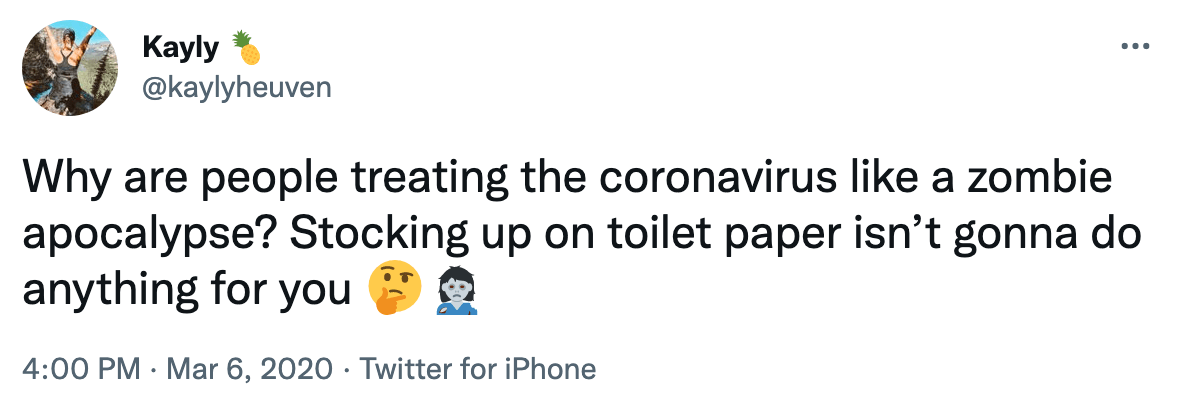
At the same time, mentions of a zombie apocalypse jumped with a lot of people making comparisons between that and the effects of Covid-19 on human behavior. Some suggested panic made people act like zombies, while others suggested people were acting like a zombie apocalypse had begun by stocking up and hiding away.

In fact, when we look further into the data, it turns out people just love talking about zombie apocalypses in general.

Fantasy and reality

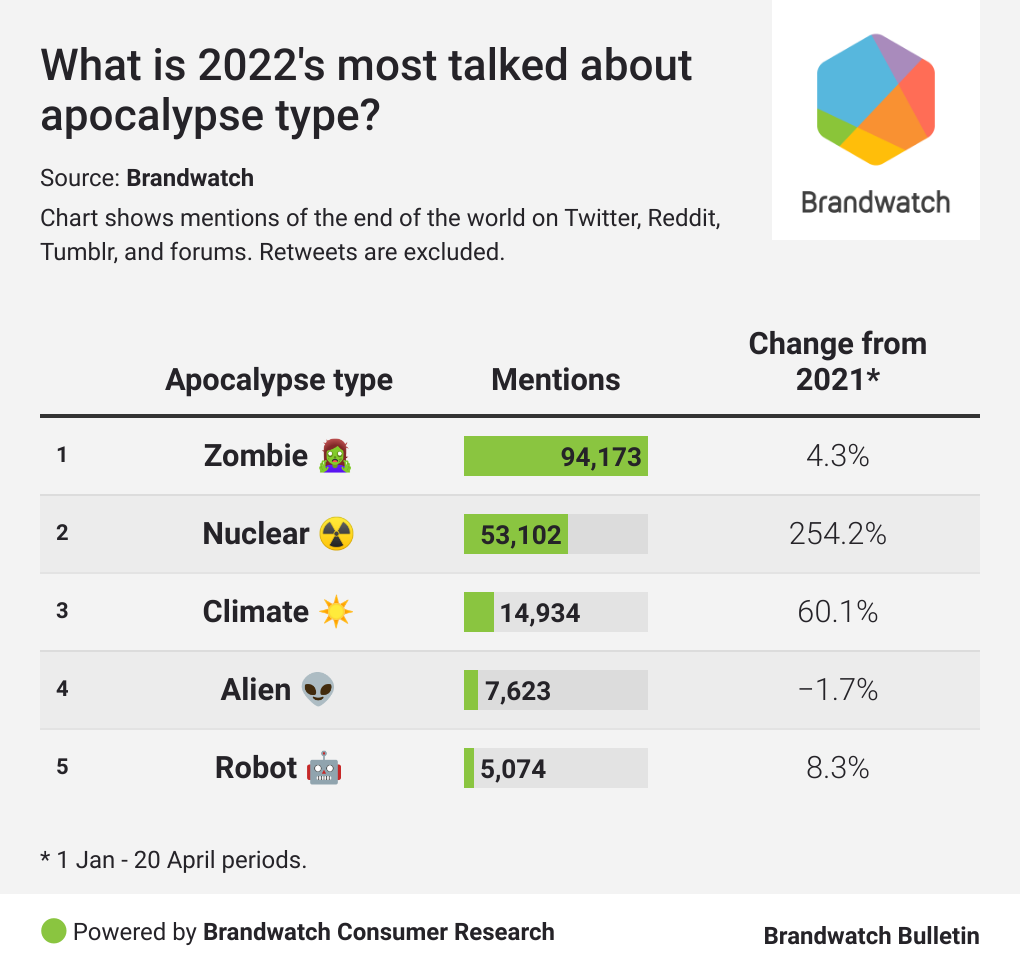
To get an idea of the types of apocalypses people are talking about online, we broke the overall discussion down into the five most-mentioned scenarios (whether they’re within the realms of possibility or not).

When it comes to discussing the end of the world, zombies attract a lot of attention. Considering the popularity of zombie TV shows, films, and video games, we shouldn’t be surprised. Haven’t we all, in our quieter, more reflective moments, gazed around the room for barricade positions and escape routes in the case of a zombie attack?

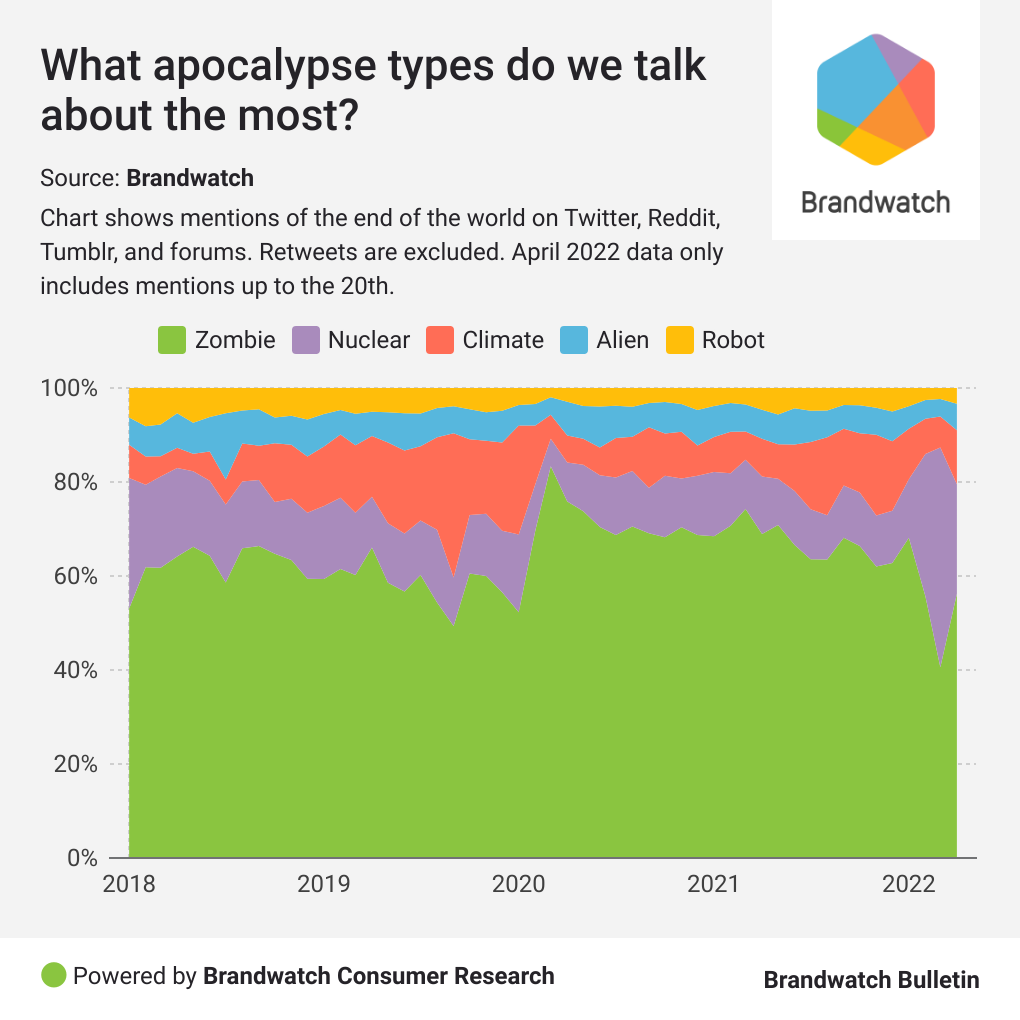
Zombies topping this list this year hasn’t just been driven by Covid-19 either. If we look back over the last four years, they’ve been way ahead consistently.

The chart makes it clear just how much the zombie apocalypse topic dominates the conversation. This may surprise some considering this event isn’t exactly realistic, while climate and nuclear apocalypses are terrifyingly possible.

When we add in the alien and robot mentions to the zombie pile we see that when we do talk about the end of the world, it’s usually in more fantastical and exaggerated terms than realistic ones. We talk about how we would act, how we think it would happen, and argue with our friends about who would survive the longest. Slightly morbid, yes, but entirely undetached from reality.

But reality does seep in every so often. In March of this year, nuclear apocalypse mentions took the top spot – the only time in our data zombies weren’t first. The conflict in Ukraine was the cause as concerns that nuclear weapons could be deployed were raised.

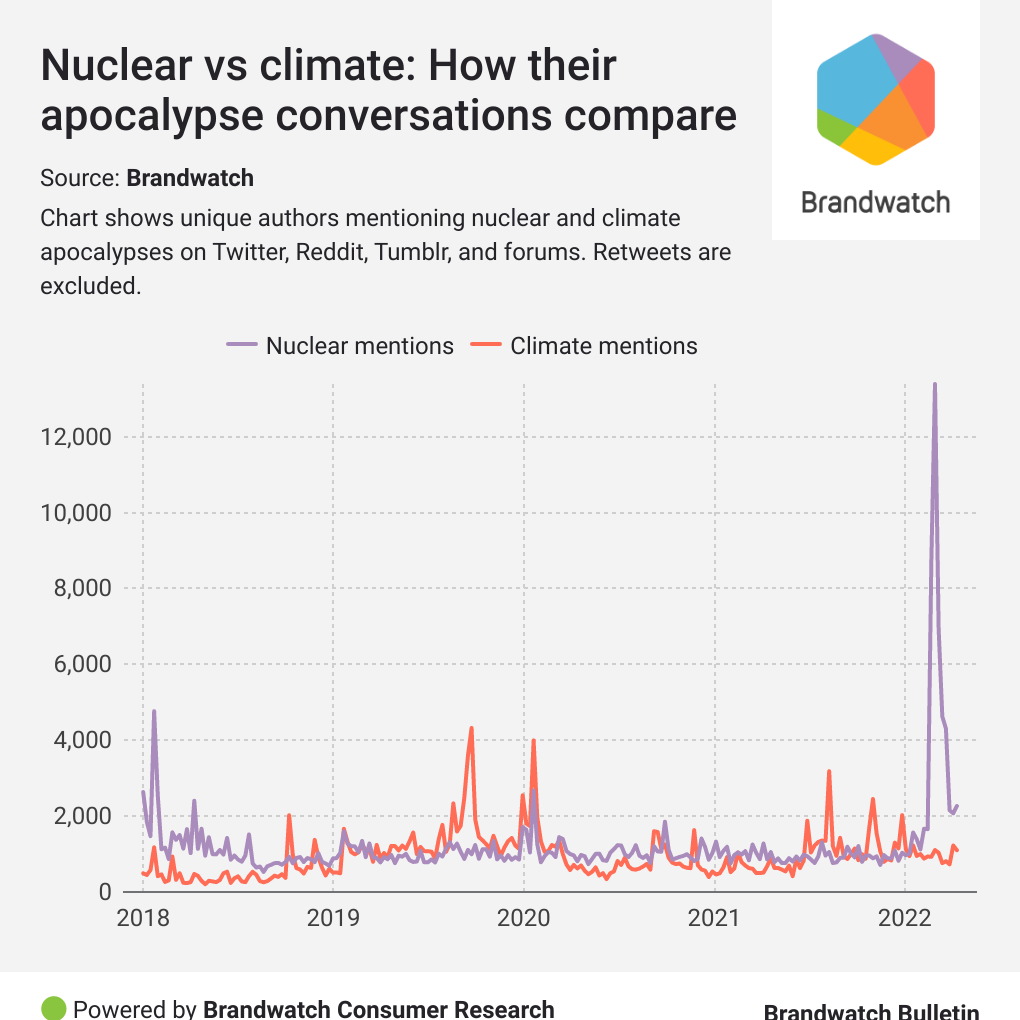
We’ve seen significant spikes in other kinds of apocalypse conversations over time too. Whether it’s from unprecedented climate events, a Greta Thunberg speech, or the annual ​​United Nations Climate Change Conference, every so often climate apocalypse mentions see a significant spike. We can see these clearer in the chart below.

Climate apocalypse mentions fluctuate far more than nuclear ones. In fact, there are only three major spikes for nuclear apocalypse discussions. These are related to Ukraine this year, and the Doomsday Clock being moved forward in 2018 and 2020.

For the climate discussions there are far more spikes, while generally interest looks to ebb and flow more too. Alongside the Doomsday Clock jumps, we can match them to the events we previously mentioned.

All in all, this shows that when people talk about nuclear and climate apocalypses, they’re less likely to be joking around or discussing fantastical scenarios. Real-life events are sparking these conversations, and they make people seriously consider the world around them.

At first this may seem rather depressing. Whether it’s zombies or nuclear war, is the fact that hundreds of thousands of people discuss the end of the world every month a worrying sign? Maybe not if we think about it in a different way.

When we voice concerns about the world being destroyed by climate change, are we not also saying we want the world as it is now to be remade to avoid that fate? As the philosopher Jakub Kowalewski explains in a 2019 paper “apocalypticism is concerned with future possibilities which presuppose a radical political change”.

In other words, all this talk of apocalypse could be seen less as an abstract fear of the end of the world, and more a call for the current state of things to be destroyed and rebuilt to avoid catastrophes that will lead to very real doomsday scenarios.

At least it makes us feel better to look at it like that anyways.

What should we cover next?

Is there a topic, trend, or industry you’d like us to feature in the Brandwatch Bulletin? We want to hear your ideas to make sure our readers are getting what they want. We may even ask to interview you if you’re involved with the topic.

Send any and all ideas to [email protected] and let’s talk.

Thanks for reading

That’s it for today, but we’ll be back next Friday. If you were forwarded this email and want in on the action, get subscribed to the Brandwatch Bulletin now.

Stay safe,

The Brandwatch Bulletin team

logo
  Our Suite     Use Cases     Industries     Get started  

Runtime Collective Limited (trading as Brandwatch). English company number 3898053
New York | Boston | Chicago | Austin | Toronto | Brighton | London | Copenhagen | Berlin | Stuttgart | Frankfurt | Paris | Madrid | Budapest | Sofia | Chennai | Singapore | Sydney | Melbourne

Privacy Policy

Update subscription preferences

Unsubscribe

We value your privacy

We use cookies and similar technologies to personalize ads and content (including by sharing data with Google), to measure site performance, and to improve your experience. Learn more in our cookie policy

Privacy & Safety • Terms of Service

No, take me to settings
Yes, I agree
More info.

By using our site you agree to our use of cookies —