logo

Brandwatch Bulletin #19: Covid-19’s Information Wars

Where information is lacking, disinformation appears.

13 November 2020

Happy Friday, everyone. Today we’re looking at how disinformation about Covid-19 rushes into the gaps research is yet to fill.

Let’s get to it.

SUBSCRIBE

Exploiting the unknown

We look for answers when things change unexpectedly. For the more innocuous questions, it’s often easy to find them. If I want to know why my cheese plant is dying, I can find answers online that will help me revive it.

Covid-19 is different. Everything about it is new, from its treatments to the processes and behaviors we’ve had to implement to tackle it.

This creates a problem. We’ve all got questions, but the answers are either not all there yet, or are evolving as we learn more. We’re left with a knowledge vacuum that can be exploited as we grasp for anything that helps us make sense of the world.

This presents a whole range of challenges for pharmaceutical companies and health organizations. Not only do they need to fight disinformation at a global level as conspiracy theories and falsities whip around the world, but the battleground is always shifting, country to country and source to source.

Speed over certainty

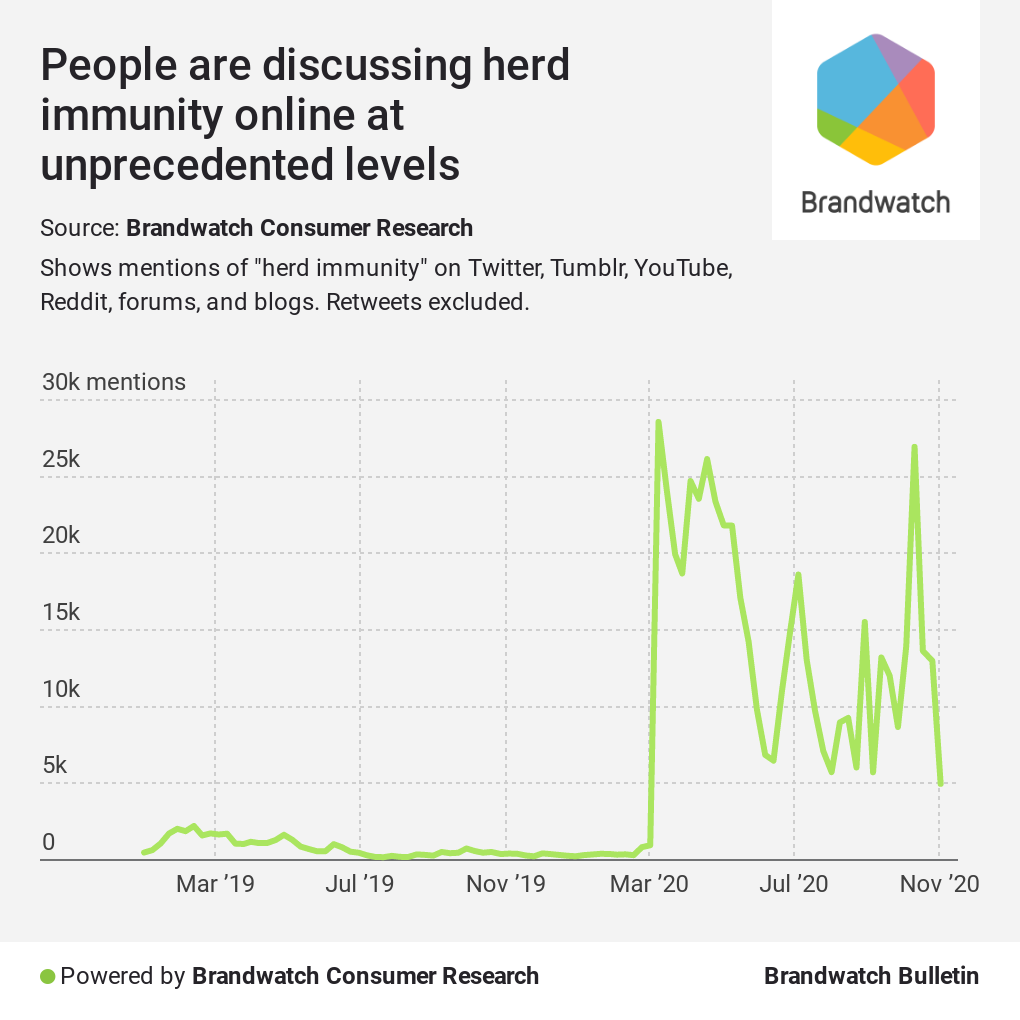
A bunch of phrases have become common parlance in 2020—think “Coronavirus,” “R number,” “social distancing.” Another big one is “herd immunity.”

Pre-pandemic, you may have heard of herd immunity in relation to vaccines. In fact, the bump in mentions in February/March 2019 referred to new measles outbreaks and the need for vaccination-induced herd immunity to stop them happening.

Then we reach March 2020 and we have tens of thousands of people talking about the topic, but often in a different form to how measles was discussed the year before.

In 2020, the conversation’s focus shifted to achieving herd immunity by allowing Covid-19 to spread until enough people caught it and developed immunity. While there was still discussion of vaccine-induced immunity, this took the backseat as people were told vaccination wouldn’t be possible for a long time.

This brought together a number of factors into a dangerous mix:

  1. A huge increase in people discussing a topic they likely knew little about
  2. The topic having a different focus to most of the research easily found online
  3. A new virus, our understanding of which is rapidly changing
  4. A lot of painful disruption that everyone wants to bring to an end as soon as possible

In other words, the chance of disinformation spreading is high—the seeds are everywhere and the ground is fertile. Science and medical experts are also always on the backfoot. They believe in giving advice and answers based on research, something that takes time to conduct. This means people with no such qualms can fill the void.

With every big development, the misinformation problem spikes again. This leads us to vaccines.

“I’m not an anti-vaxxer, but…”

Work on viable Covid-19 vaccines has been going on for months, as labs around the world race to find something that works. It’s possible that one has already achieved this goal, and there is an assumption others will soon follow suit.

All in all, it’s incredible news. But something else happened this year that could cause problems.

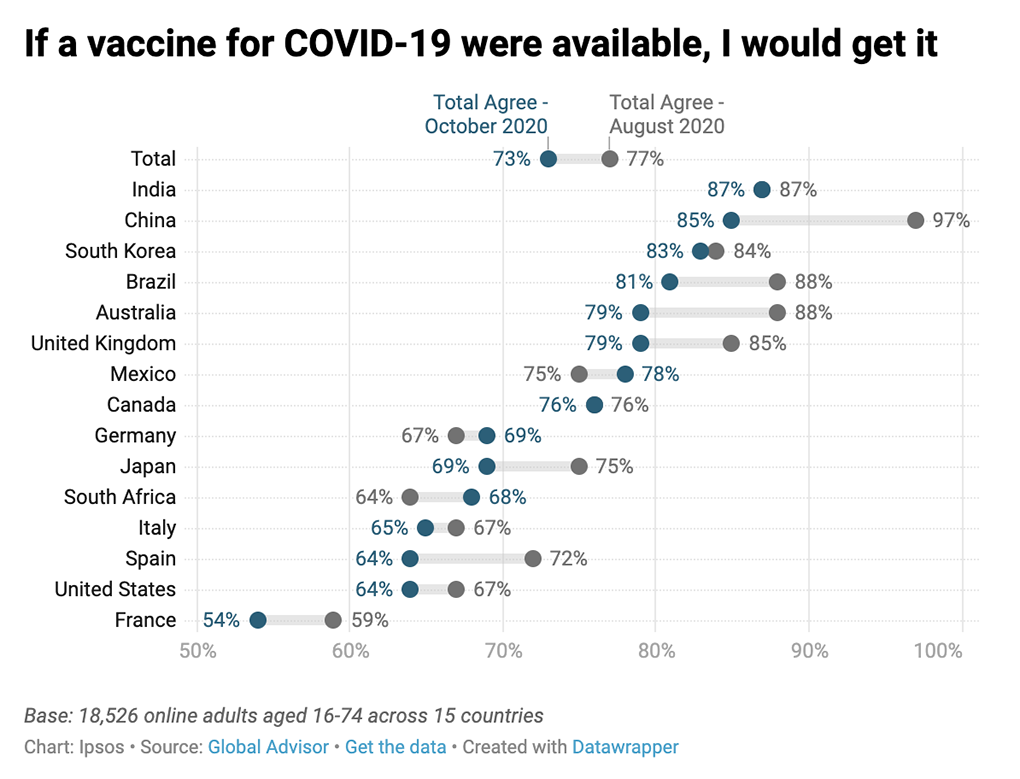
According to Global Advisor, 73% of people would get a Covid-19 vaccine if it became available now, down from 77% in August. This may not seem like a lot, but when vaccine-induced herd immunity relies on a huge section of society being vaccinated, it’s cause for concern. Another cause for concern is just how low the numbers are for countries like France, the US, and Spain.

The type of vaccine that’s been touted as a savior brings another problem. It’s an mRNA vaccine, a “whole new type of vaccine.” Although more people will have general knowledge of vaccines than herd immunity, the topics have very similar problems when it comes to the exploitation of knowledge gaps. With few influential experts and a lack of readily available research, people without the relevant knowledge are able to get a huge amount of attention.

Uncertainty around quickly-produced vaccinations gives disinformation extra bait. You can appreciate the logic of being wary of a brand new treatment. People will want to see the research, wishing to be put at ease that it’s safe. This is a healthy response. But those looking into their legitimate concerns risk being dragged into outright conspiracy when the facts are buried or unavailable.

If we couple this with the prevalence of vaccine conspiracies and skepticism, we can see the difficulty some governments may have in convincing their citizens to take a new vaccine.

We can see this happening in real-time. Some have been linking the new vaccine to Thalidomide, a medication given to pregnant women in the late 1950s and early 60s that caused thousands of birth defects. Search interest in it jumped, particularly in Europe where the product was sold, shortly after the news there was a Covid-19 vaccine that worked.

There are big and ever-moving hurdles governments and pharmaceutical companies have to overcome when it comes to communicating effectively, keeping ahead of disinformation, and reassuring the public.

Thanks for reading

That’s it for today. If you want to find out how to use Brandwatch to do your own analysis, have a chat with our team.

If you want to sign up for our future bulletins, head here.

Stay safe,

Brandwatch React Team

logo
  Our Suite     Use Cases     Industries     Get started  

Runtime Collective Limited (trading as Brandwatch). English company number 3898053
New York | Boston | Chicago | Austin | Toronto | Brighton | London | Copenhagen | Berlin | Stuttgart | Frankfurt | Paris | Madrid | Budapest | Sofia | Chennai | Singapore | Sydney | Melbourne

Privacy Policy

Update subscription preferences

Unsubscribe

We value your privacy

We use cookies and similar technologies to personalize ads and content (including by sharing data with Google), to measure site performance, and to improve your experience. Learn more in our cookie policy

Privacy & Safety • Terms of Service

No, take me to settings
Yes, I agree
More info.

By using our site you agree to our use of cookies —