logo

Brandwatch Bulletin #99: All Aboard or All at Home?

The state of public transport.

10 December 2021

Using Apple’s data on mobility trends, we take a look at public transport use around the world, and how it’s been changing.

Let’s get to it.

Subscribe to the Brandwatch Bulletin

How things look for public transport

Throughout our bulletins we’ve been looking at transport and how it’s been affected by the pandemic. The last time we looked at public transport specifically was back in July when we compared changes in four cities.

As we tumble towards the end of the year, we’re coming back to the topic, this time looking at Apple mobility trend reports and data from the Federal Transit Administration.

We want to start by giving some extra context to the data. It’s tempting to assume that if public transport direction requests have increased then public transport usage will increase just as much. But, as you’ll see as we unpick the data, that’s not the case.

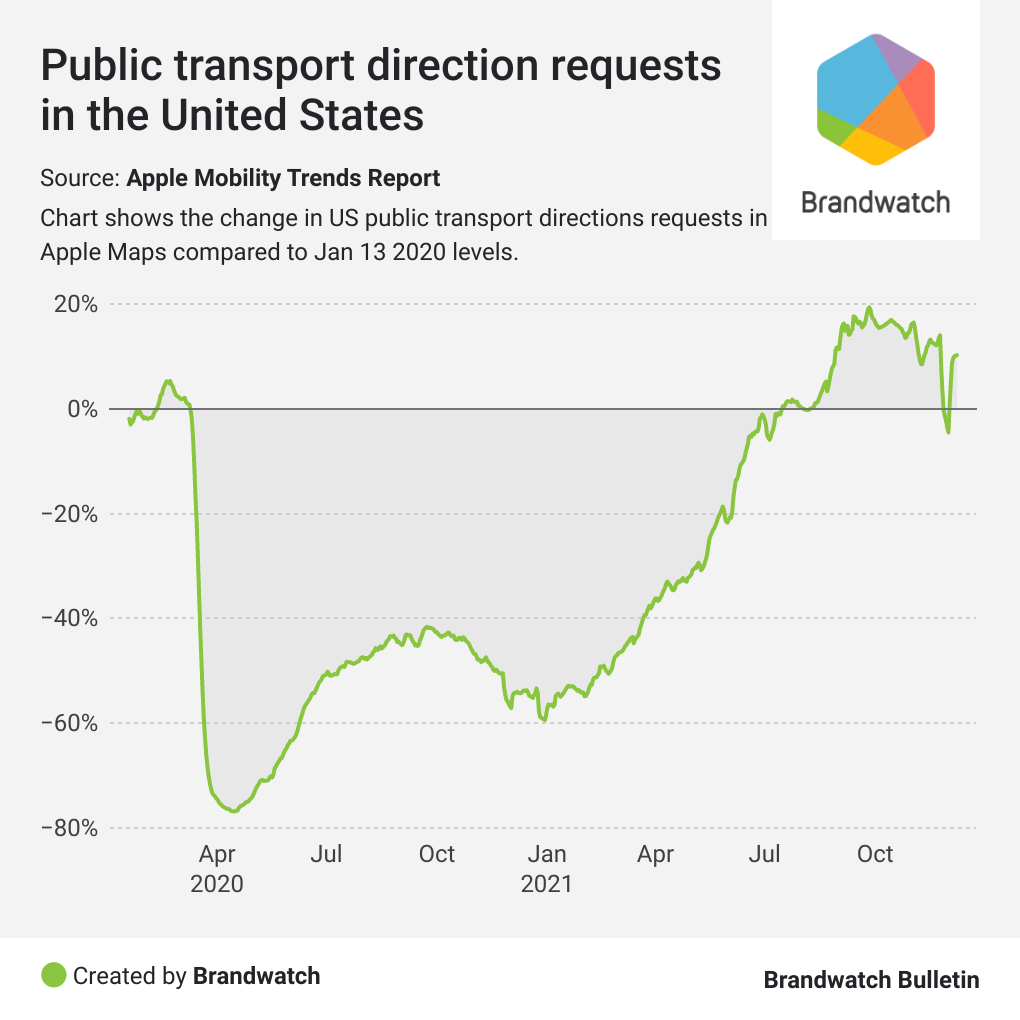
Let’s look at Apple’s data for public transport direction requests in the US from 2020 onwards.

Based on the above, you might assume public transport passenger numbers would now be back above their pre-pandemic levels.

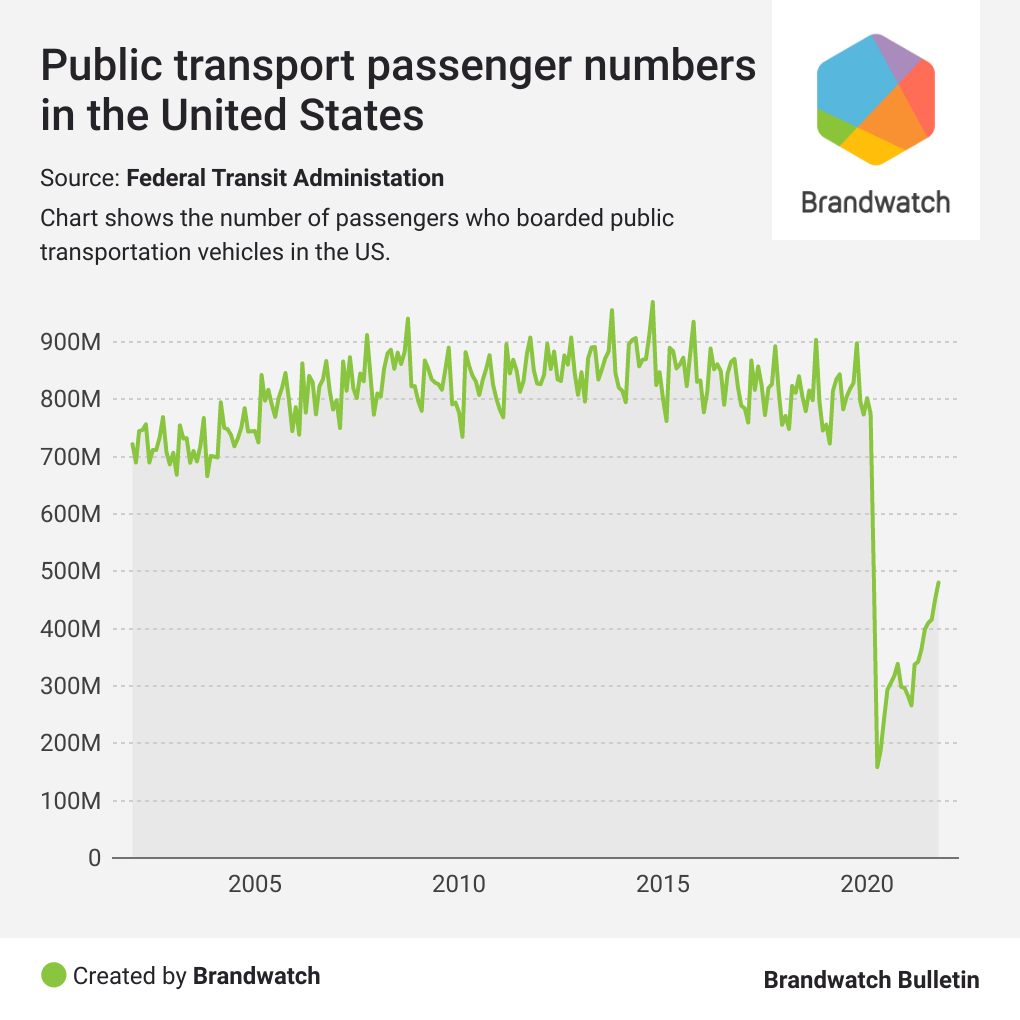
Let’s check that by looking at the actual passenger number data.

While there’s certainly been a recovery since the pandemic-induced drop off, numbers are nowhere near why they used to be. So why the discrepancy?

To answer that we have to think about why someone requests public transport directions. A veteran commuter is unlikely to, despite using public transport every day (and even if they do, many have traded their commutes for working from home). Meanwhile people who know their local area well aren’t going to need directions to get around day-to-day.

On the other hand, you’re very likely to look up public transport directions when you’re in a new place, or trying to get somewhere you’ve never been, whether that’s a restaurant in a different part of town or a sports venue on the other side of the country.

There are obviously a million other reasons, but what this suggests is that public transport direction requests are probably more aligned with tourism, entertainment, and generally getting about, than actual public transport usage.

With that in mind, let’s take a look at some of Apple’s data. A quick note, their dataset only includes public transport direction requests for 27 countries.

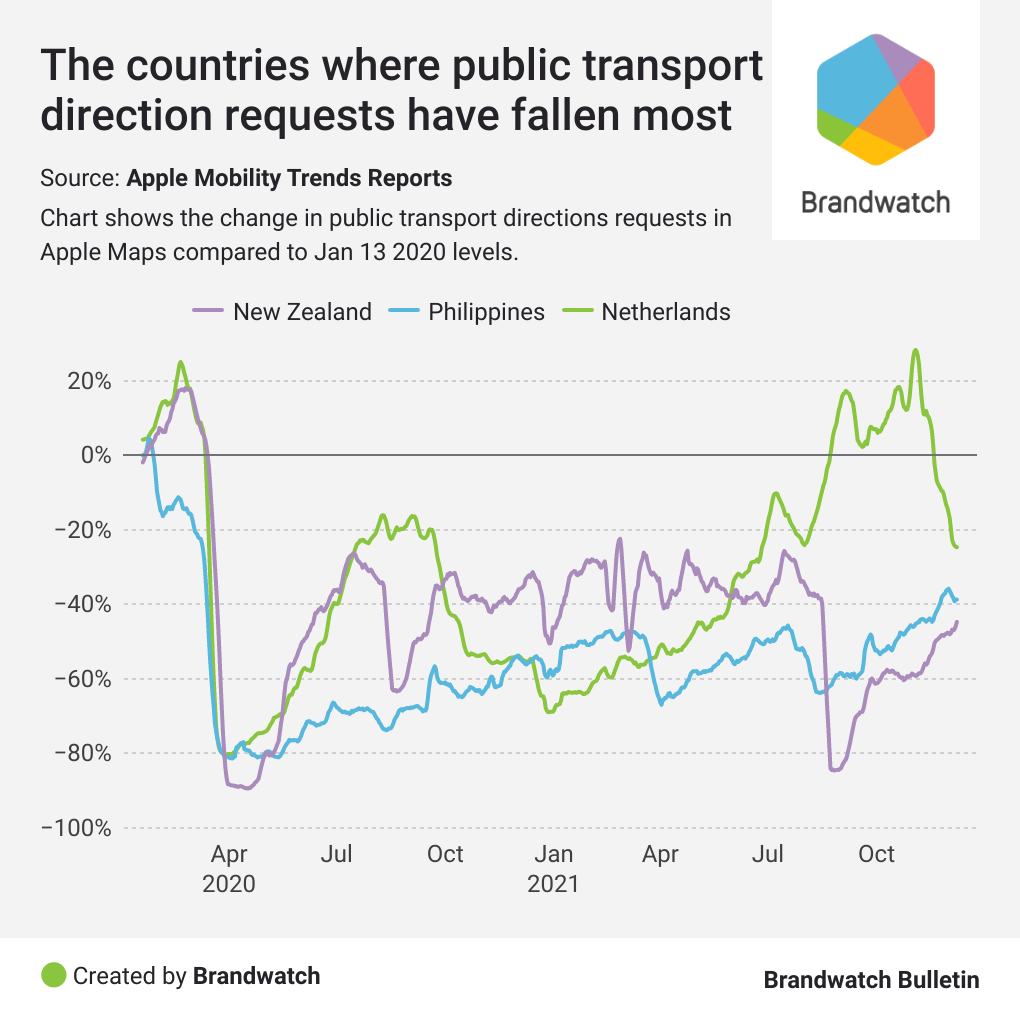
Out of the 27 countries we could analyze, New Zealand, the Philippines, and the Netherlands currently have the biggest drop in direction requests compared to January 13 2020.

The Netherlands only recently found themselves at the bottom of the list. As summer ended there, direction requests were above pre-pandemic levels for the first time since March 2020. But this was short-lived as case numbers rose and the country went back into lockdown. Since then requests have plummeted.

Meanwhile neither the Philippines nor New Zealand have seen requests return to normal levels throughout the pandemic. Both countries have enforced strict measurements to counter Covid-19 which explains this. Both countries are attempting to ease these, which explains the growing number of direction requests.

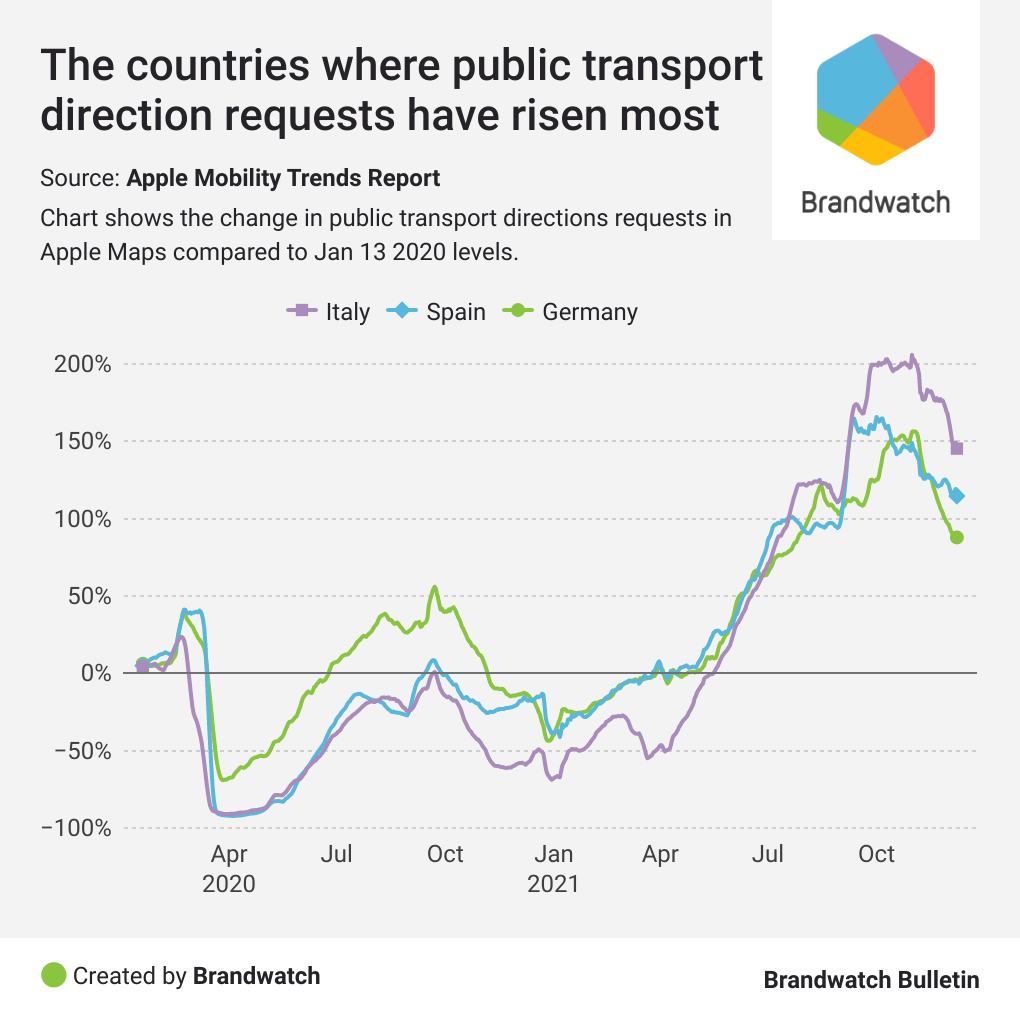
Now we turn to those at the top of the pack, and it’s a clean sweep for Europe. But we can’t help but notice the numbers seem to be on a downturn.

All three countries saw their highest levels of direction requests since the pandemic began in the latter half of 2021. Italy and Spain saw sharp jumps at the end of August which, if we’re right about the influence of tourism, suggests there were some last-minute holidays before the new school terms began.

Direction request levels in Italy remained high after this, likely helped by lighter Covid measures. Spain, where cases in the Basque regions saw other countries introduce travel restrictions on the nation, saw direction requests start to fall away. Germany saw a later jump in requests in October as three states lifted restrictions, but this didn’t last.

From November public transport direction requests have fallen consistently in all three countries. With the Omicron variant now spreading and case numbers rising in each nation, particularly in Germany, this is no surprise.

Whether requests will fall back below pre-pandemic levels is hard to say. Vaccinations can help stop this from happening, and the strong numbers each country saw in 2021 show a lot of progress can be made. Nonetheless, this data is another stark reminder that the pandemic is far from over.

What should we cover next?

Is there a topic, trend, or industry you’d like us to feature in the Brandwatch Bulletin? We want to hear your ideas to make sure our readers are getting what they want. We may even ask to interview you if you’re involved with the topic.

Send any and all ideas to [email protected] and let’s talk.

Thanks for reading

That’s it for today, but we’ll be back next Friday. If you were forwarded this email and want in on the action, get subscribed to the Brandwatch Bulletin here.

Stay safe,

The Brandwatch React team

logo
  Our Suite     Use Cases     Industries     Get started  

Runtime Collective Limited (trading as Brandwatch). English company number 3898053
New York | Boston | Chicago | Austin | Toronto | Brighton | London | Copenhagen | Berlin | Stuttgart | Frankfurt | Paris | Madrid | Budapest | Sofia | Chennai | Singapore | Sydney | Melbourne

Privacy Policy

Update subscription preferences

Unsubscribe

We value your privacy

We use cookies and similar technologies to personalize ads and content (including by sharing data with Google), to measure site performance, and to improve your experience. Learn more in our cookie policy

Privacy & Safety • Terms of Service

No, take me to settings
Yes, I agree
More info.

By using our site you agree to our use of cookies —