logo

Brandwatch Bulletin #104: The Great Egg Debate

What's your preference?

28 January 2022

From scrambled to poached, eggs are incredible versatile. But what’s the most popular way to cook eggs? We try to find out using search and social data, and see how things differ from country to country.

Let’s get to it.

Subscribe to the Brandwatch Bulletin

All your eggs in one bulletin

Humans have been eating eggs for thousands of years. From the numerous and inventive ways of cooking eggs themselves, to incorporating them into countless recipes, it would be a very different culinary world without the humble egg.

To celebrate the simple yet versatile egg, we’re going to look at a few ways people talk about cooking eggs to see what methods are used and how they differ around the world.

Let’s get the potentially controversial bit out of the way. Here are the cooking methods we’re including:

  • Baked (also known as shirred)
  • Boiled
  • Coddled
  • Fried
  • Poached
  • Scrambled

A note for the omelette lovers: We haven’t included omelettes due to the arbitrary reason that most omelettes will have extras added in. For the methods we included, the egg is good to go as it is.

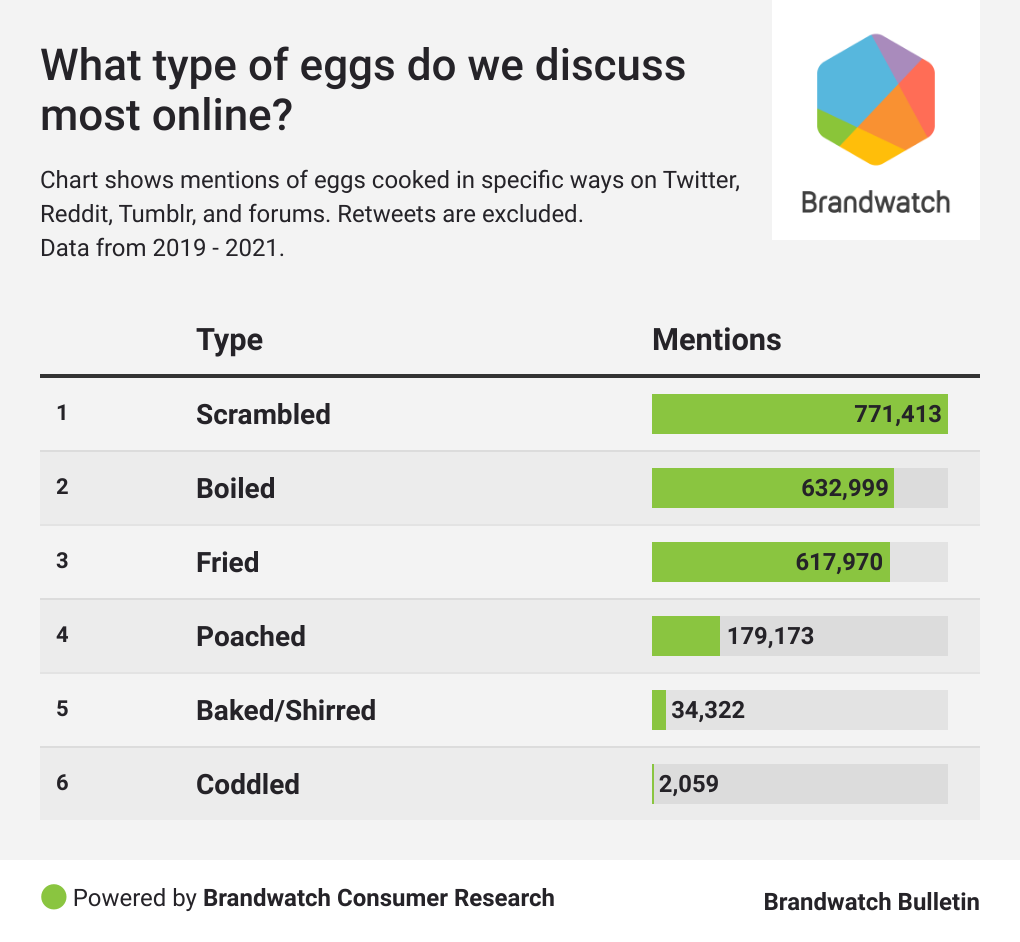
With that sorted, we’ll turn to the data. First we looked at what cooking methods are the most discussed online.

Scrambled eggs take the top spot with a healthy lead, while boiled just pips fried to second place. Coddled eggs barely get a look in, which is a shame as they’re delicious. We recommend trying them out if you’ve neglected them so far.

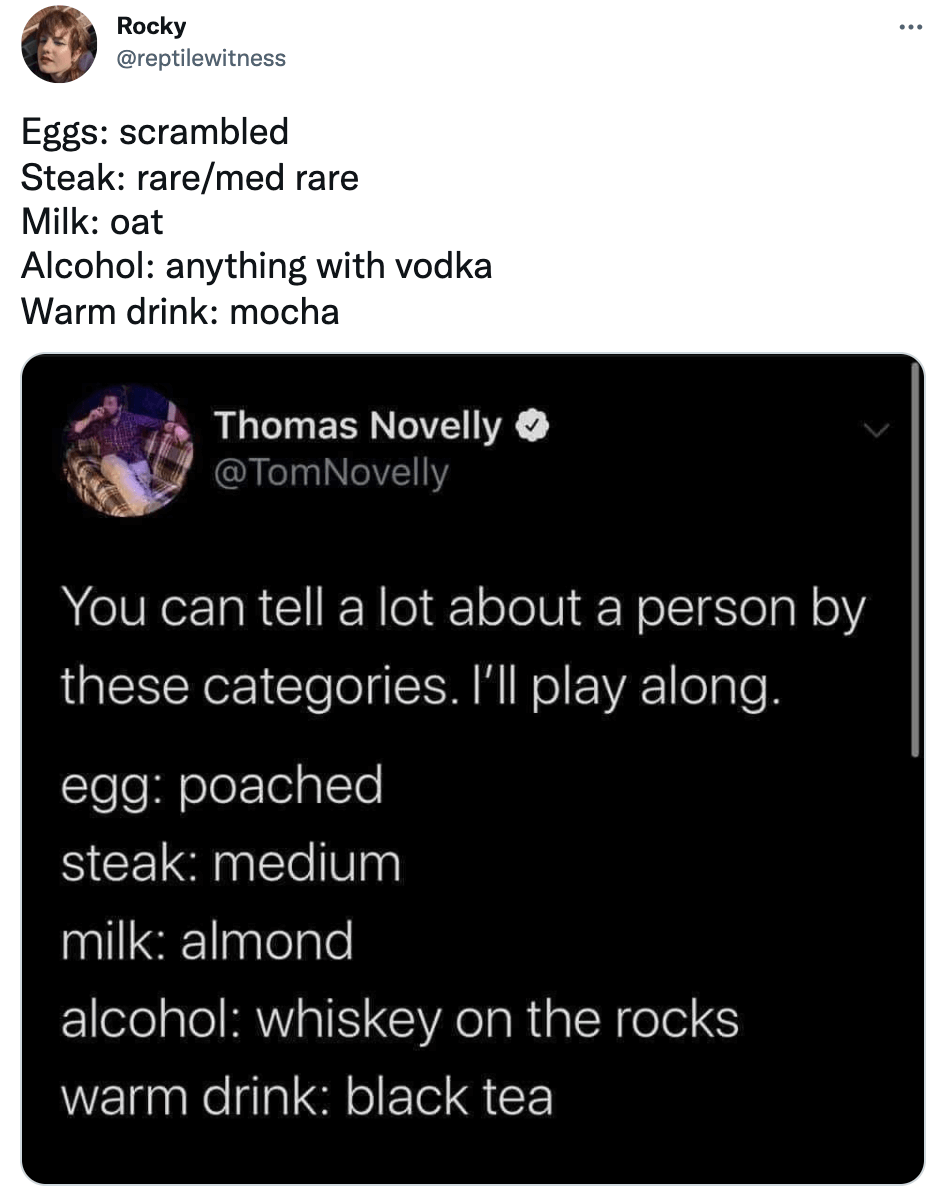
Of course, volume doesn’t necessarily mean popularity. Luckily a weirdly specific meme format can give us some more insight.

Looking specifically at people using this format, scrambled eggs were the most commonly mentioned with over 20k accounts picking them. Fried came second with 18k, while boiled came third with just over 1k.

We also used sentiment analysis to see which types were most popular. After we excluded neutral mentions, poached eggs were the most popular with 68% of mentions being positive. Boiled eggs sat at the other end with just 35% of mentions being positive. Scrambled eggs didn’t fare well either, with just 42% categorized as positive.

So there’s a bit of a mixed picture which might suggest that boiled eggs just aren’t that popular. That said, our go-to foods aren’t always about taste. Convenience plays a big role too.

It’s a boiled egg kind of world

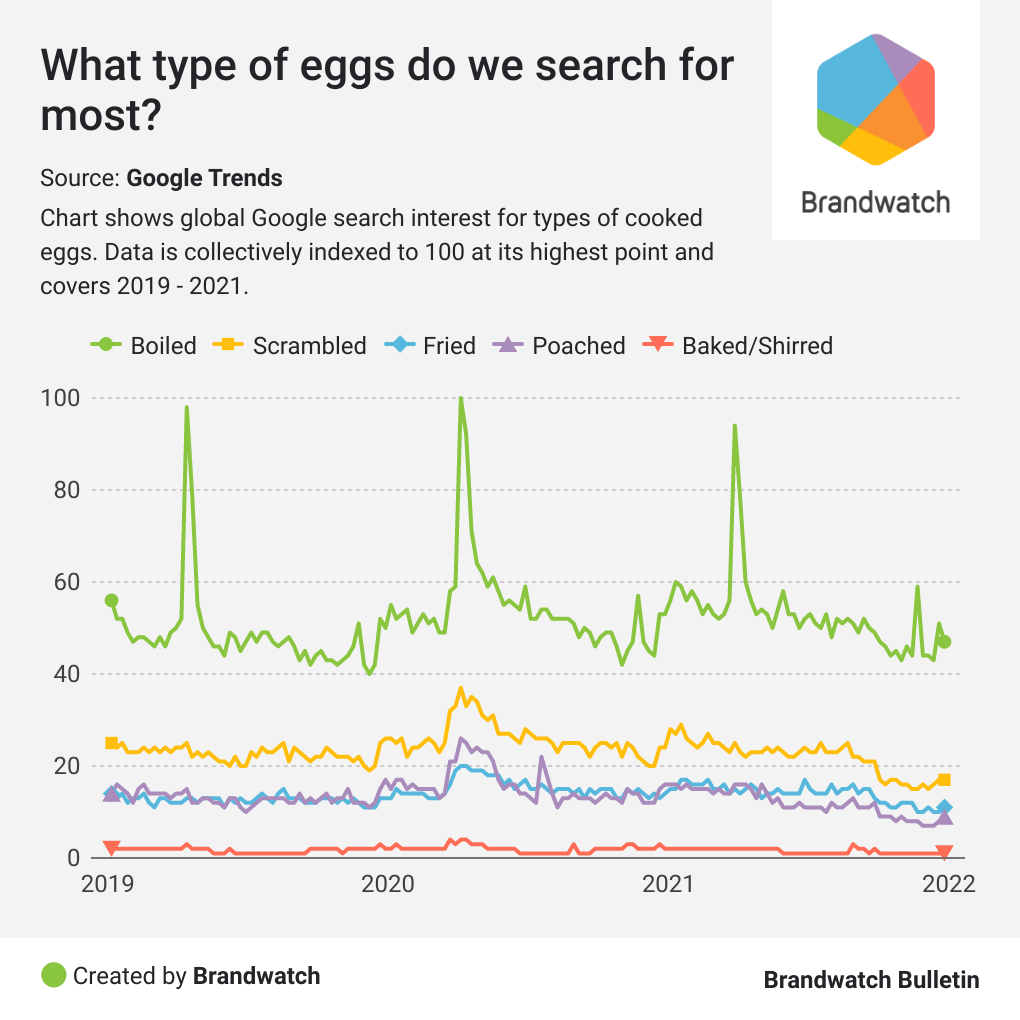
Next we turned to Google Trends to get a look at the search data around our egg types. We figured this would give us further insight into the types of eggs people are cooking. We’re making the reasonable assumption here that when people search for a type of egg cooking method, they’re looking at how to do it.

With that in mind, we can see that the two egg types that get the highest percentage of negativity on social are also the two most searched for on Google.

With data coming from all over the world we can’t be 100% sure on the reason for this. A potential one is that, with boiled and scrambled eggs being the easiest to make of the lot, people are just looking for simple and quick options and that’s helped bump up boiled and scrambled eggs over other dishes people consider to be more delicious.

There could be other considerations too, such as cost. For example, boiled eggs just need an egg, water, and heat, making them the cheapest option and the easiest to source.

Once again, the data shows a complex picture around eggs, factoring in many aspects.

Cultural tastes will also play their part. Speaking of, let’s see how egg searches differ from country to country.

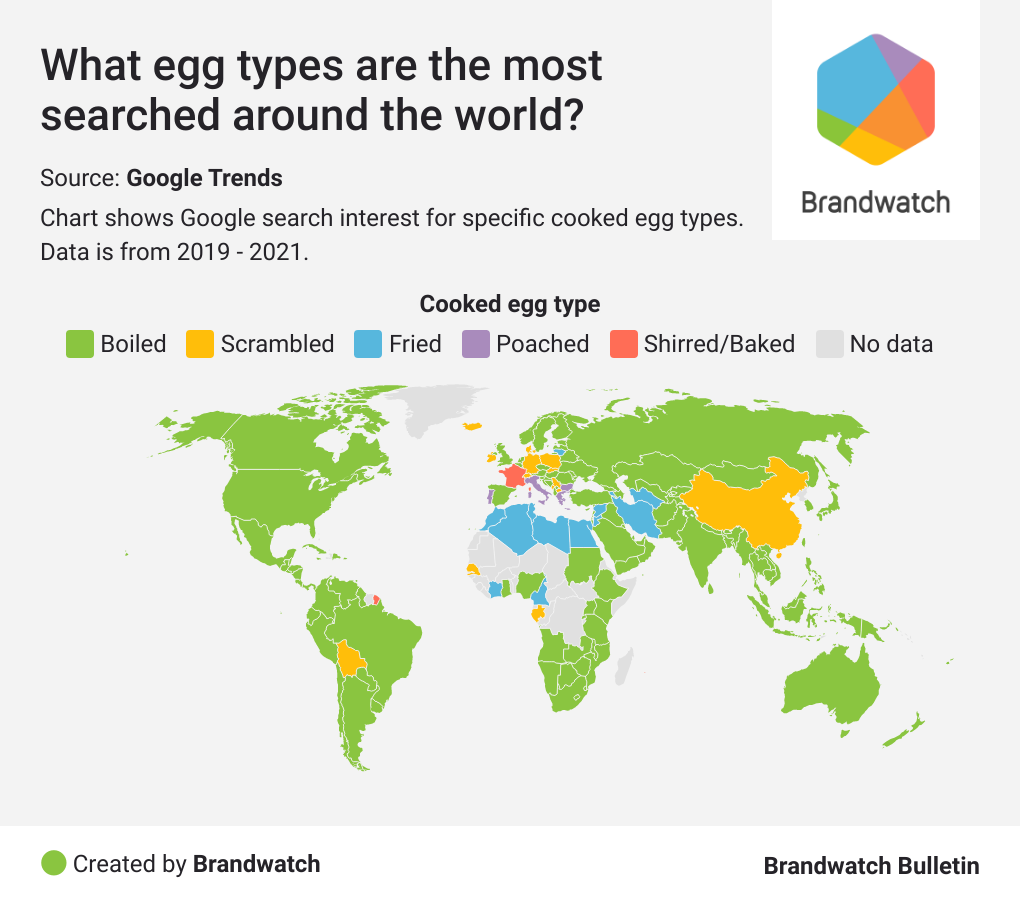
Boiled eggs reign supreme in most countries, but they haven’t conquered the planet completely. Let’s take a look at the holdouts.

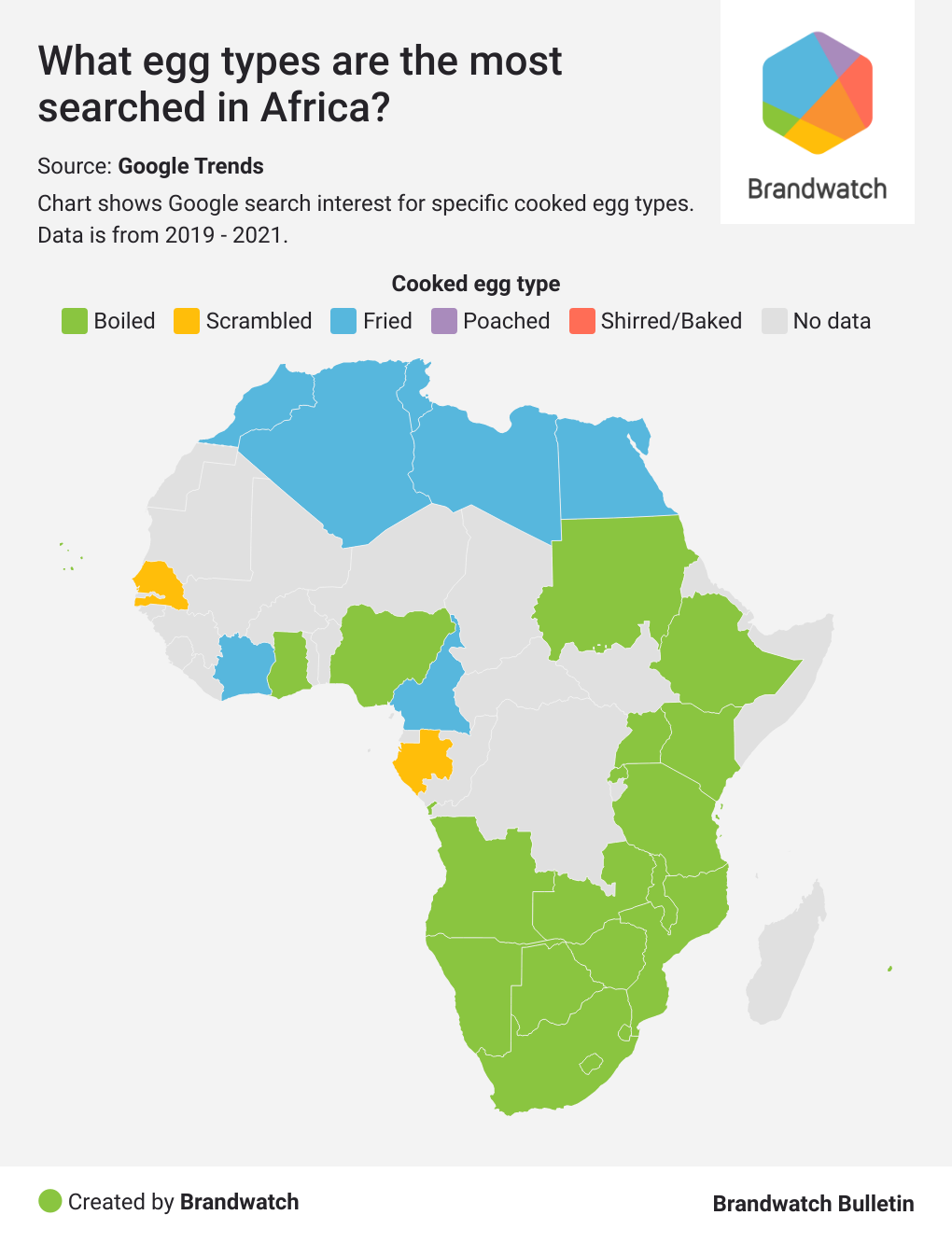
In Africa there seems to be an egg-based geographical divide. Boiled eggs are still top overall with the east and south all firmly in their camp. But North Africa stands out with fried eggs being the most searched. Over in West Africa there’s more diversity in egg choice, with boiled, fried, and scrambled jostling for first place.

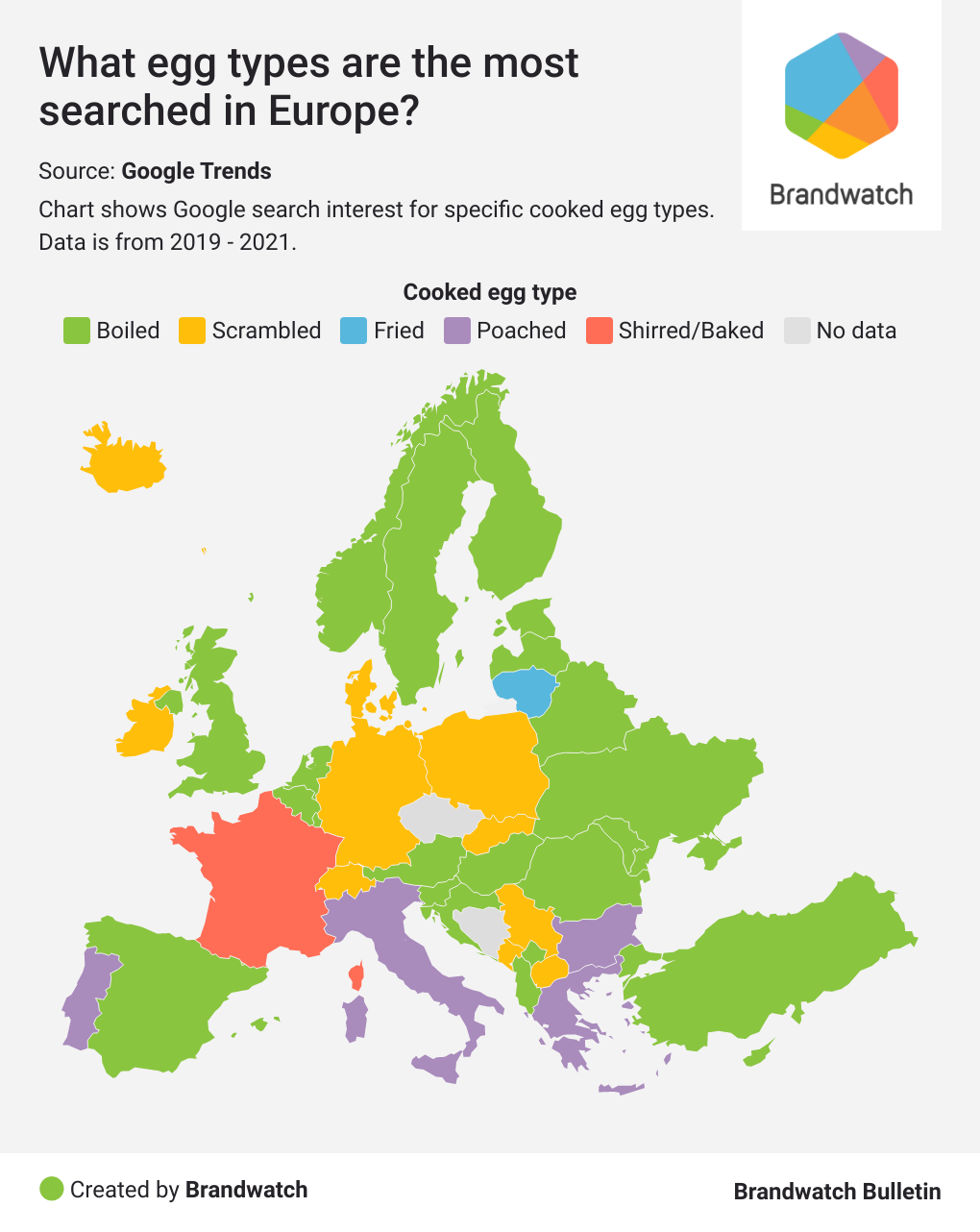
Next up: Europe.

Things are a bit more chaotic here with taste not following much of a geographical pattern, except that some of the more southern countries are big fans of poached eggs.

The most interesting of the lot is France, where baked eggs are the most searched. This isn’t just unique for Europe – France is the only country in the entire world where this is the case. The French know a thing or two about food, so maybe you should bake some eggs after you give coddling them a go.

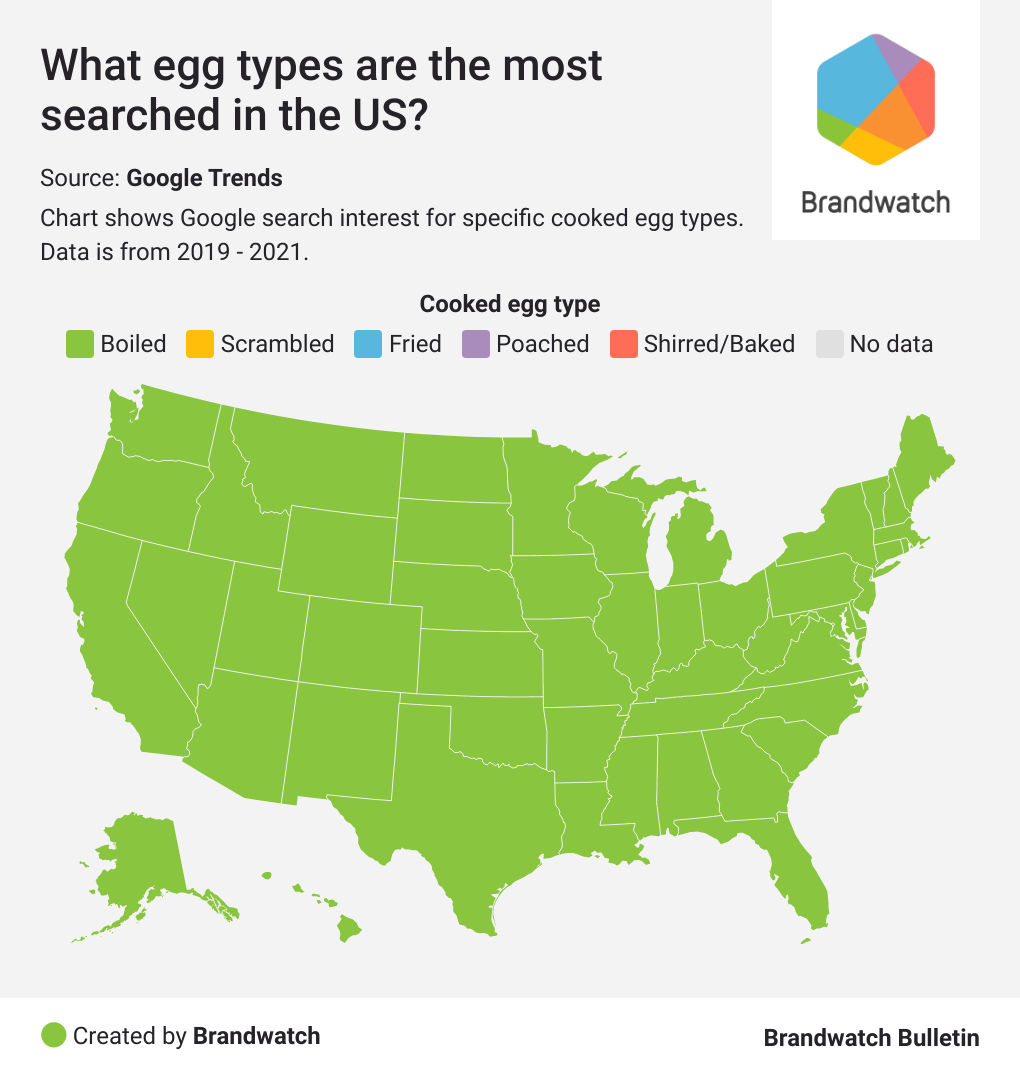
Finally we thought we’d see how egg types differed across the United States of America.

Oh.

Well, that’s a pretty rousing ‘yes’ for boiled eggs from the US. No other type even got close to taking the top spot in any state. This is one issue on which all states seem to agree.

What should we cover next?

Is there a topic, trend, or industry you’d like us to feature in the Brandwatch Bulletin? We want to hear your ideas to make sure our readers are getting what they want. We may even ask to interview you if you’re involved with the topic.

Send any and all ideas to [email protected] and let’s talk.

Thanks for reading

That’s it for today, but we’ll be back next Friday. If you were forwarded this email and want in on the action, get subscribed to the Brandwatch Bulletin now.

Stay safe,

The Brandwatch React team

logo
  Our Suite     Use Cases     Industries     Get started  

Runtime Collective Limited (trading as Brandwatch). English company number 3898053
New York | Boston | Chicago | Austin | Toronto | Brighton | London | Copenhagen | Berlin | Stuttgart | Frankfurt | Paris | Madrid | Budapest | Sofia | Chennai | Singapore | Sydney | Melbourne

Privacy Policy

Update subscription preferences

Unsubscribe

We value your privacy

We use cookies and similar technologies to personalize ads and content (including by sharing data with Google), to measure site performance, and to improve your experience. Learn more in our cookie policy

Privacy & Safety • Terms of Service

No, take me to settings
Yes, I agree
More info.

By using our site you agree to our use of cookies —