logo

Brandwatch Bulletin #106: Digital Dungeons & Dragons

From table to Twitter.

11 February 2022

Today we’re looking at the tabletop RPG Dungeons & Dragons. Nearly 50 years old, it’s attracted an enthusiastic and dedicated fanbase. In this bulletin we’re taking a look at online interest in the game and how modern technology has helped expose it to a new generation of players.

Let’s get to it.

Subscribe to the Brandwatch Bulletin

From table to Twitter

Dungeons & Dragons first inflamed people’s minds and imaginations back when it was published in 1974 but the game still has huge cultural influence. The completely analog roleplaying game, playable with just some dice, paper, and pens, has survived and thrived even with the advent of home consoles and internet gaming.

For those unfamiliar with the game, the concept is simple. Each player creates a character which is assigned various attributes around things like strength and intelligence. The person running the game, known as the Dungeon Master, leads these characters on an adventure, such as rescuing a kidnapped child from a band of goblins. Generally whenever a character makes an action they have to roll a dice to see whether they succeed or fail.

This is a very simplified explanation as anyone who has seen a rulebook will know, but essentially Dungeons & Dragons combines storytelling, improvisation, skill, and luck, and allows players to swap the real world for an entirely new one where they can be whoever they want to be.

Its popularity has waxed and waned over the years so today we’re taking a look at online interest around the game and how podcasts and streamers may push its popularity to new heights.

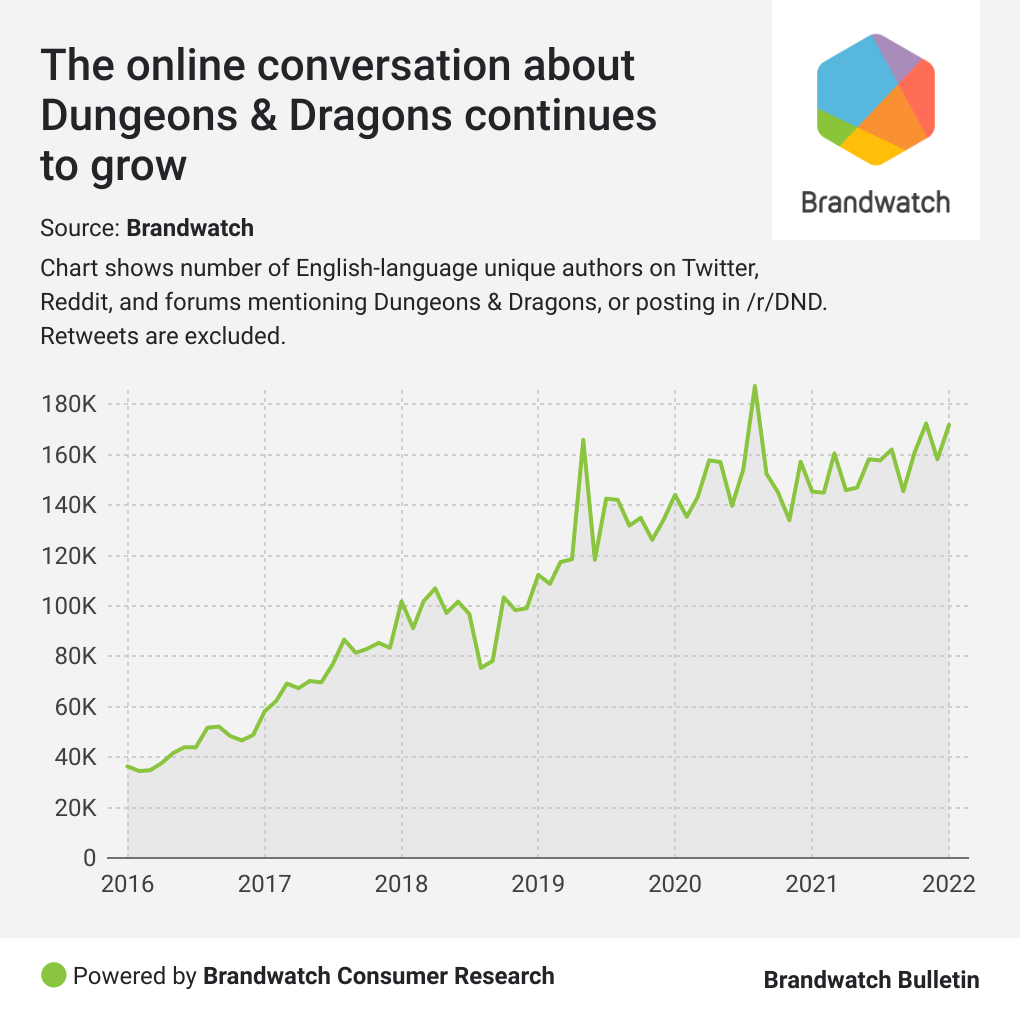
The number of people discussing Dungeons & Dragons online has been on the up for years, although growth has slowed more recently. Nevertheless, in excess of 160k people talk about the game online every week. That’s not to be sniffed at.

A big driver of this conversation comes from Reddit and the /r/DND subreddit. This forum boasts 2.6m subscribers, with January 2022 seeing over 67k posts. That’s not to mention the other subreddits dedicated to Dungeons & Dragons memes, maps, arts, and other topics.

Dungeons & Dragons has an energetic and thriving online community – one that stretches from Twitter to Reddit, and from Tumblr to Twitch (the latter of which we’ll return to later).

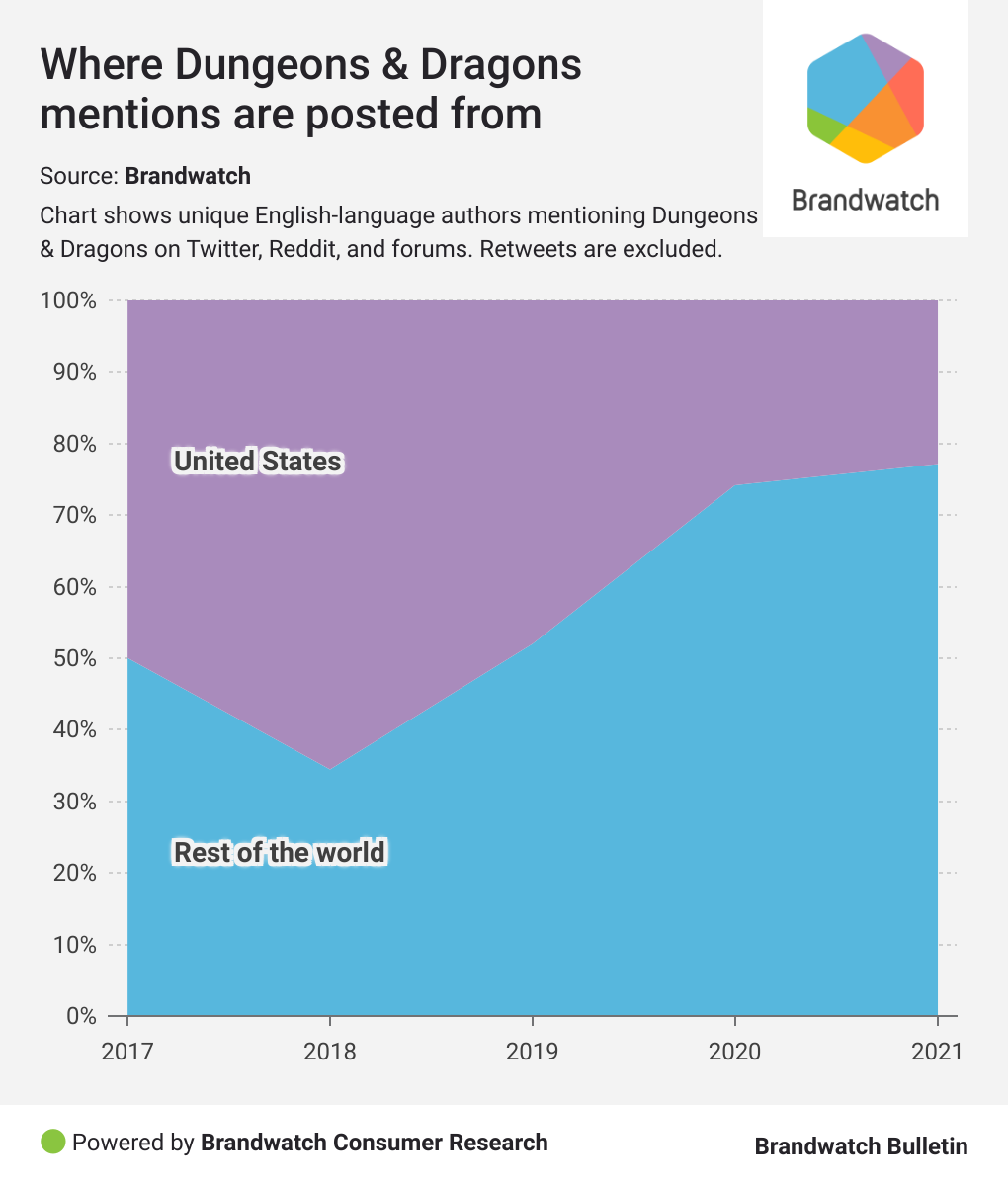
We also found something interesting when we looked at the country breakdown of the data.

Up until 2020, the United States dominated the online Dungeons & Dragons conversation. This is often the case with many topics due to the sheer size of the online English-speaking US population. But that changed from 2020 onwards with the US now only accounting for just over 20% of the conversation.

This has been caused by, as we’ve noted, the size of the conversation growing. But Americans are also just posting less about the game. In 2021, US D&D posters amounted to 207k, compared to 386k in 2019.

This means that while the US could be losing some interest in the game, its popularity is growing beyond the borders of its home country.

Sorcerous searching

Another way to assess the popularity of a topic is to look at Google search interest. This is also useful as it may show a different stage of interest. In many cases we may search for a topic to learn about it far before we ever post about it online.

With this in mind, let’s look at the search data around Dungeons & Dragons.

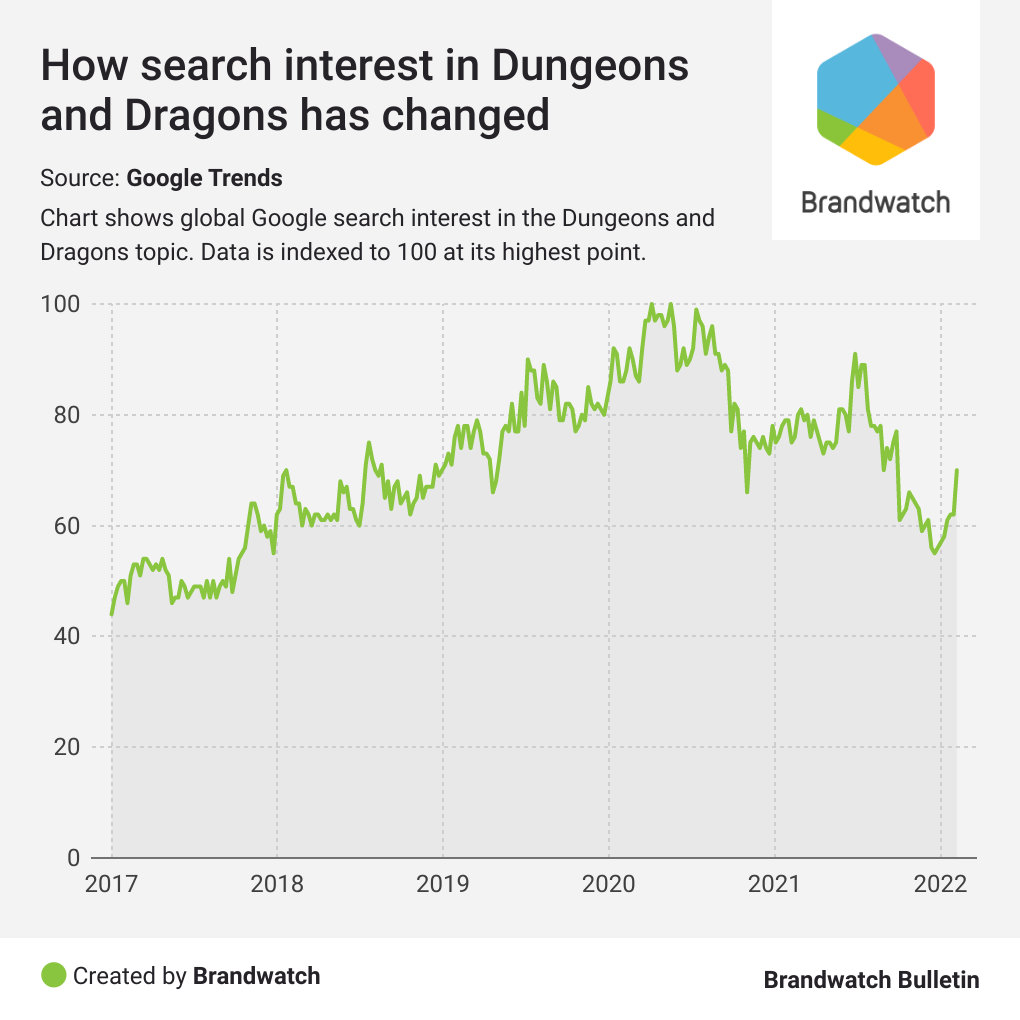
It does not take a wizard with a +5 intelligence modifier to see that this chart looks quite different to our first one. Rather than a steady rise over the years, Dungeons & Dragons search interest peaked in April 2020 as people looked for ways to get them through the pandemic.

This soon dropped off and, aside from a brief bump as a Dungeons & Dragons Magic: The Gathering expansion set was released, search interest continued to fall until this year with a sharp jump in February.

Why does the search and social data differ so much? It could be that they point to two types of interest.

A lot of search interest will be driven by people looking for information on the game and how to play, which is clear from the biggest search terms being “dnd” and “d&d”. There’s little reason for a seasoned player to be typing those terms into Google. This means a rise in search interest may indicate a rise in new or returning players.

Over on social, posts are much more about people’s games, characters, and campaigns. In other words, they’re active players. Therefore, a rise in social media interest may correlate with more players, or at least more games being played.

All this seems to point to a large increase in prospective players during the pandemic who have now turned into seasoned social media posters. While new player interest (search) may have dropped off, the February jump suggests that things could be about to turn. Let’s take a look at why.

Actual play: The critical role of Critical Role

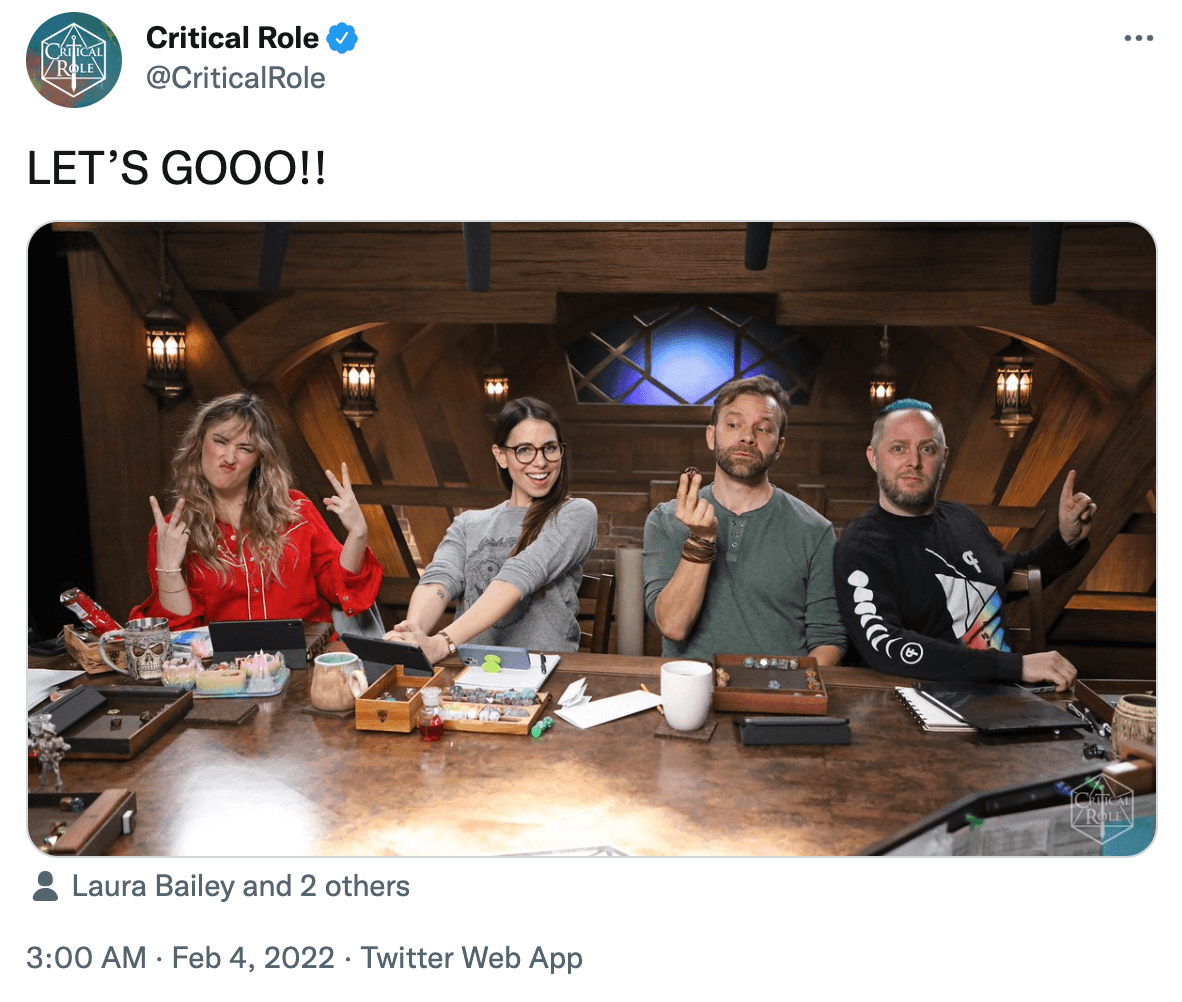
When we looked into this jump in search interest, it was clear what the cause was. On January 28, The Legend of Vox Machina premiered on Amazon Prime Video, with this series based on a long-running game of Dungeons & Dragons featured in a show called Critical Role.

Critical Role is a piece of ‘actual play’ media, which allows people to follow along with a game, whether it’s in the form of a podcast, livestream, or some other format. In this case, they had professional voice actors play the game to ratchet up the entertainment factor. Put simply, you watch or listen to people playing a game of Dungeons & Dragons.

Critical Role were by no means the first to do this, but they’re by far the most well-known example of it. On Twitch they have over 1m subscribers, while on YouTube they have 1.6m, which is three times more than the official D&D channel. In other words, the show has gone from strength to strength since it first aired in 2015.

The new TV show based on their work looks to be reinvigorating interest in the game in general, but they’ve also been key in pushing the actual play format itself. There are tons of examples now, ranging from the likes of Godsfall with high production values and expansive worldbuilding, to The Campaign Trail which satirizes the minutiae of modern British politics.

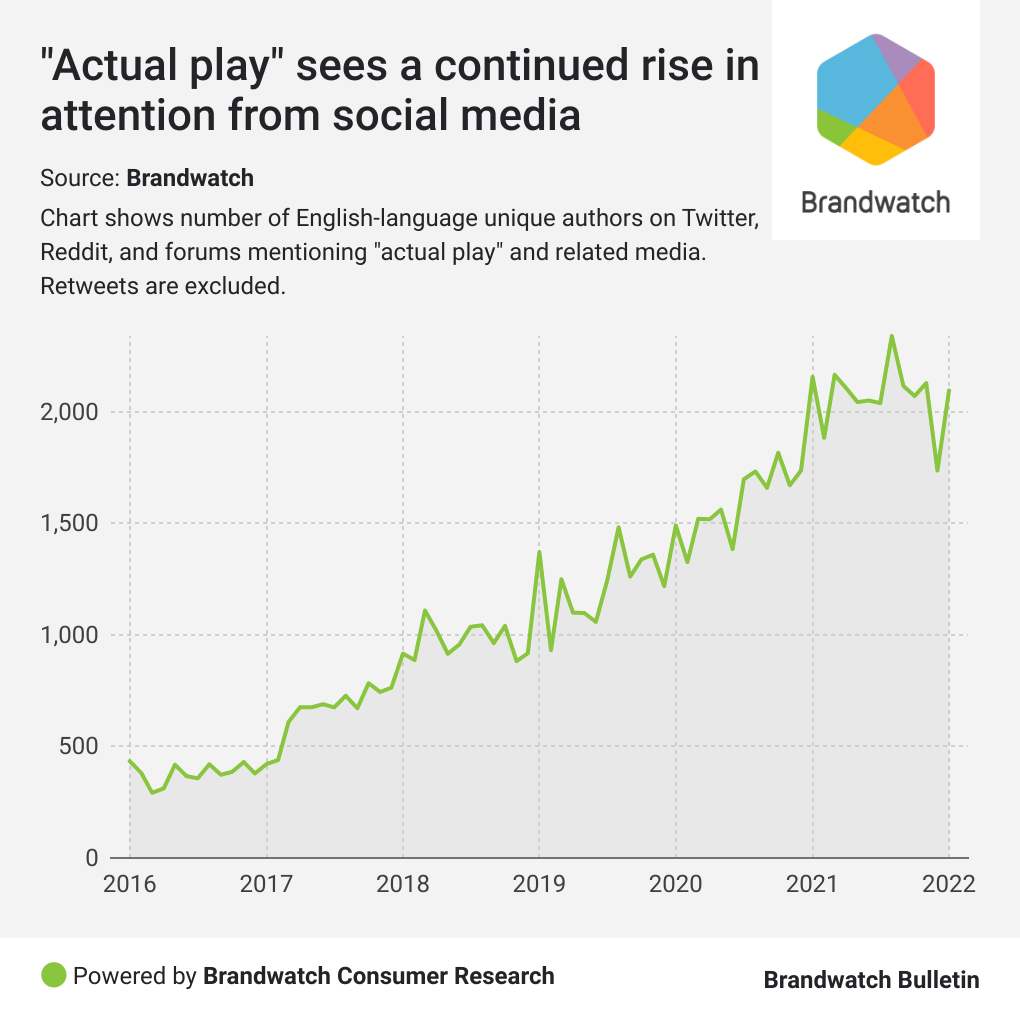
Actual play media is excellent for introducing people to the game as it not only shows how much fun players have, but also helps to demystify the mechanics of the game and makes it more accessible. Its popularity also looks to be on the rise with over 2k people talking about it each week.

With the ongoing rise of actual play, and Amazon’s new series, 2022 is set to be a strong year for the Dungeons & Dragons community. You better get your dice ready.

What should we cover next?

Is there a topic, trend, or industry you’d like us to feature in the Brandwatch Bulletin? We want to hear your ideas to make sure our readers are getting what they want. We may even ask to interview you if you’re involved with the topic.

Send any and all ideas to [email protected] and let’s talk.

Thanks for reading

That’s it for today, but we’ll be back next Friday. If you were forwarded this email and want in on the action, get subscribed to the Brandwatch Bulletin now.

Stay safe,

The Brandwatch React team

logo
  Our Suite     Use Cases     Industries     Get started  

Runtime Collective Limited (trading as Brandwatch). English company number 3898053
New York | Boston | Chicago | Austin | Toronto | Brighton | London | Copenhagen | Berlin | Stuttgart | Frankfurt | Paris | Madrid | Budapest | Sofia | Chennai | Singapore | Sydney | Melbourne

Privacy Policy

Update subscription preferences

Unsubscribe

We value your privacy

We use cookies and similar technologies to personalize ads and content (including by sharing data with Google), to measure site performance, and to improve your experience. Learn more in our cookie policy

Privacy & Safety • Terms of Service

No, take me to settings
Yes, I agree
More info.

By using our site you agree to our use of cookies —