logo

Brandwatch Bulletin #121: The State of Hybrid Working

Has it finally taken over?

10 June 2022

Welcome back to our first full length bulletin in awhile. Today we’re taking a dive into data on hybrid working, including stats on office visits.

Let’s get to it.

Subscribe to the Brandwatch Bulletin

A new world of work

The way many people work has drastically changed since the pandemic began. The rise of remote working has upended the traditional office set up, with companies still figuring out how to keep up with employee preferences.

There’s been lots of debate about working from home versus returning to the office. But as this battle goes on, a third way is increasingly gaining attention: hybrid working.

To dig into this topic we’ve teamed up with the workplace platform Robin and got our hands on their data on desk and office usage. This means we can see exactly what hybrid working looks like in reality.

What is hybrid working?

For the uninitiated, let’s start with the basics.

Hybrid working is essentially about giving employees flexibility and choice in where and how they work. Instead of working from home or in the office every day, they might come in just on Tuesdays and Wednesdays. Or maybe they set their schedule each week depending on what works for them.

This is similar to the concept of flexible working, although there’s a difference. While the terms do get used interchangeably, generally flexible working refers to the kinds of hours a person works, while hybrid working is about location. Of course in reality these two often overlap.

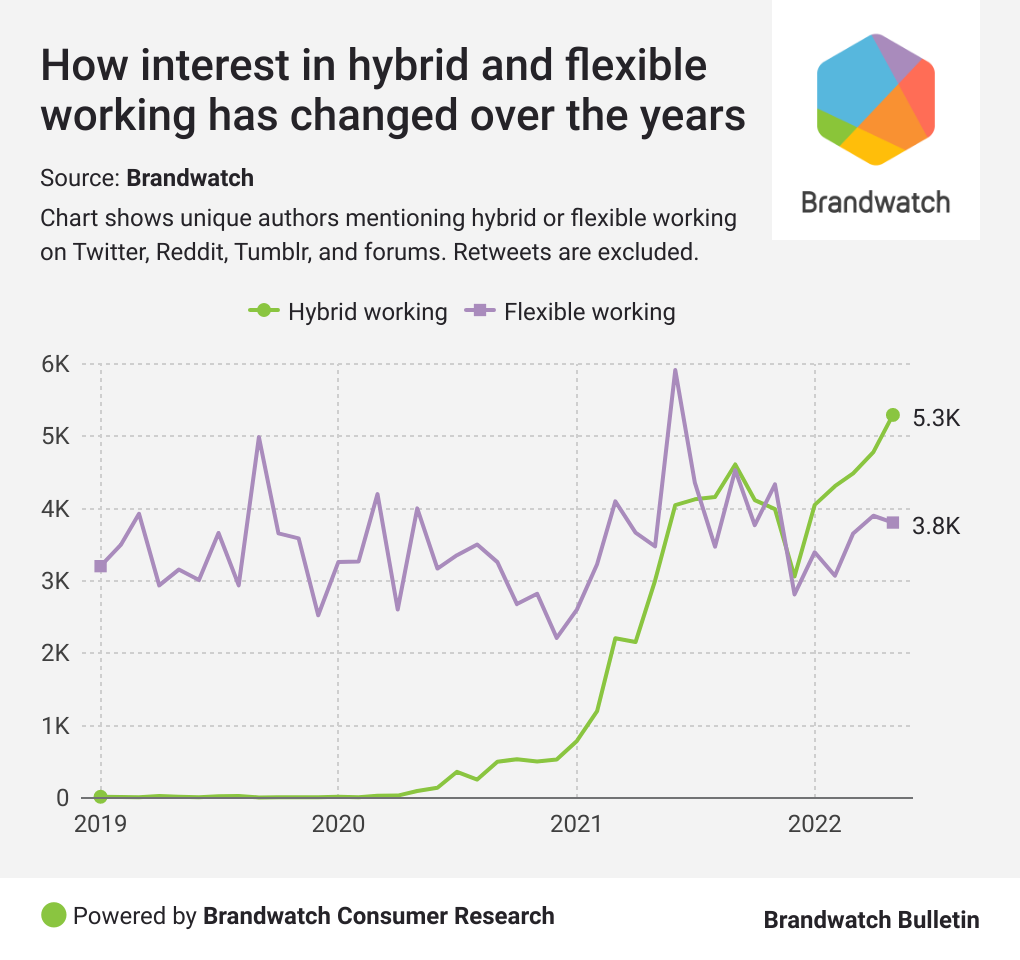
To get an idea of the interest in these two concepts, we used Brandwatch Consumer Research to find mentions of both “flexible working” and “hybrid working”. Here’s how that data looks over time.

Flexible working clearly has a longer history than hybrid working, but it no longer has the top spot in terms of online interest. Hybrid working was practically never mentioned until 2020’s pandemic hit, with mentions really shooting up in 2021

As we get further into 2022, interest in hybrid working has increased, reaching its peak in May. Flexible working has by no means disappeared, but clearly it’s hybrid working which is grabbing the most attention.

Now let’s dive into Robin’s data to see what hybrid working looks like right now.

Desk data

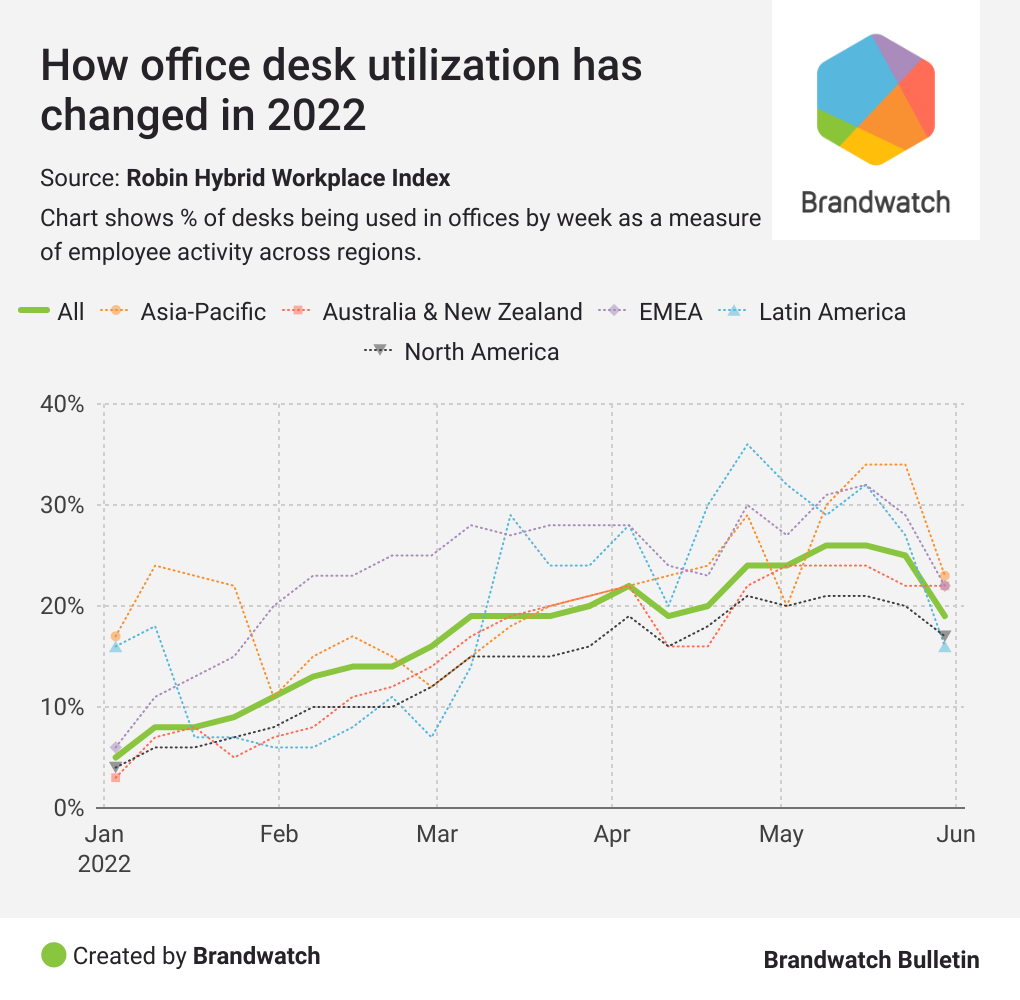
The first Robin dataset we’ll take a look at is weekly desk utilization. This will give us an idea on how many people are returning to the office.

Straight away we can see that for most of 2022, desk utilization crept up as people returned to their offices. Office desk usage peaked at 26% at the start of May and remained fairly steady until recently when levels dropped off. According to Robin, this is a result of national holidays and the start of the summer holidays.

There’s also a lot of fluctuation on the regional level. Right at the start of the year, the Asia-Pacific region was top for desk utilization, then it was EMEA, then Latin America, and now it’s Asia-Pacific again. A lot of the regions have seen sharp rises and falls throughout 2022 too.

All of this fits with the rising interest in hybrid working. Historically low desk utilization and regular changes in these levels in both directions suggests workers are deciding for themselves when to come into the office. It’s clear the idea of full time office work being the norm again is an illusion. At least for now.

Office day frequency

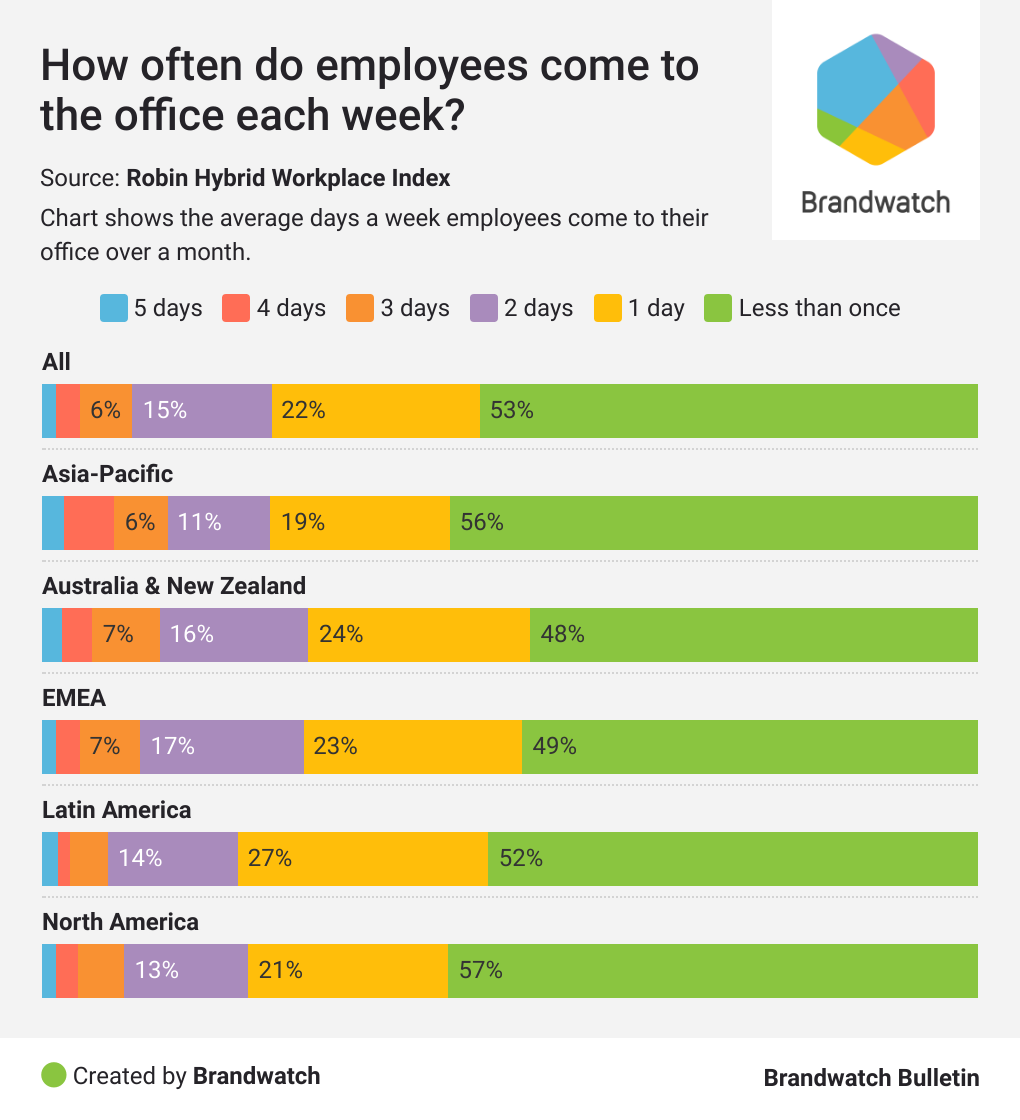
Moving on from desk utilization, let’s take a closer look at employee behavior, specifically how many days they’re spending in the office.

Again, we’re seeing data that makes it hard to imagine spending five days a week in an office used to be the unerring norm. As it stands, just 1.6% of employees spend the full week at their office, compared to the 53% who don’t even average one visit a week.

This means that only 46.7% of employees spend one or more days a week in their office, and for most that number is only 2 or 3. What this tells us is that the modern office has by no means been abandoned, but hybrid working has taken over. Levels are also relatively similar across regions, meaning this shift is well and truly global.

See you next…?

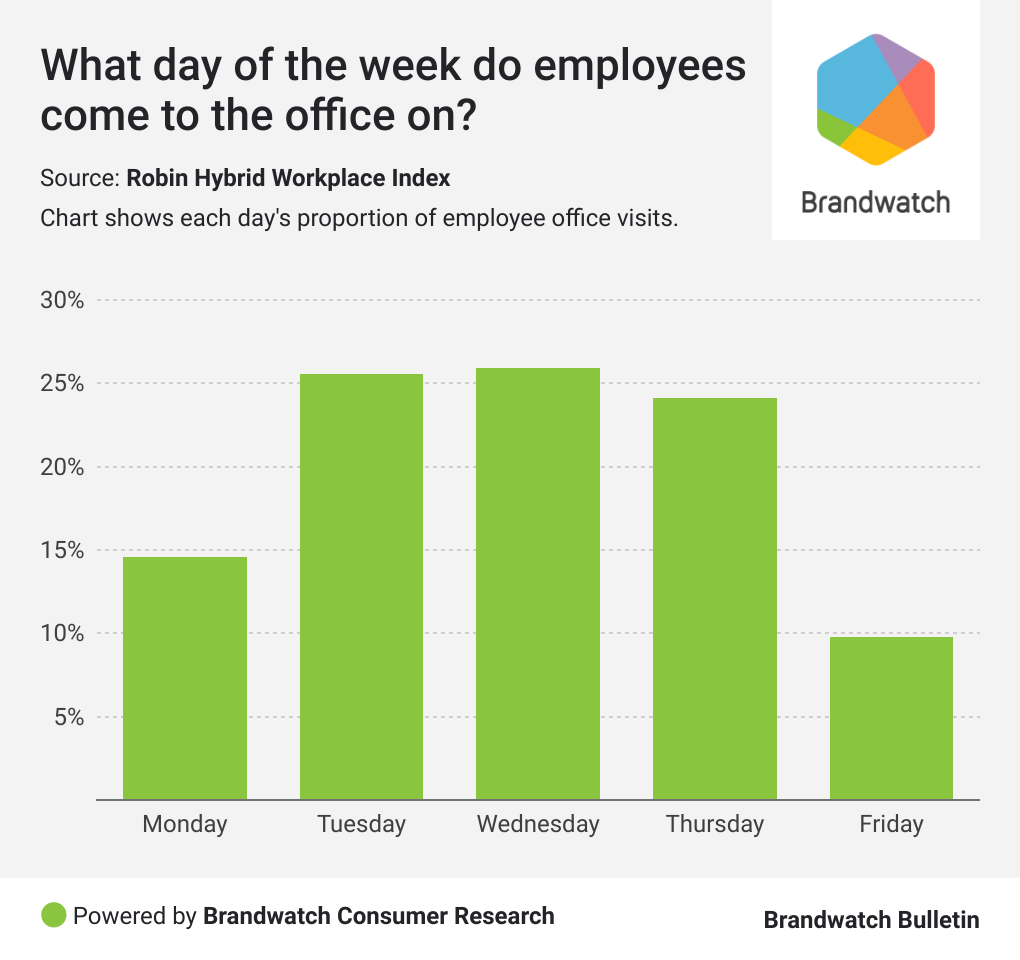
As we well know, not all days are created equal. When we look at the days people come into the office we can see that truth in the data.

Wednesday is the day you’ll find your office the busiest, with Tuesdays and Thursdays not far behind. Levels are far lower for the remaining days with Friday being the least popular. This is unlikely to surprise many, with people gearing up for, and recovering from, the weekend clearly having an effect.

But it’s not the case across all regions. For example, Robin tells us that in Latin America and Asia there’s little difference between the work days, with Monday being the most popular. These kinds of regional differences are essential to understand for companies with offices across the globe.

But what do people actually think?

Robin’s data is pretty conclusive. Hybrid working is here and in full effect, and the current picture makes it hard to imagine this will change any time soon. With this in mind, we decided to find out how people actually feel about the concept, and what the main drivers of behavior are.

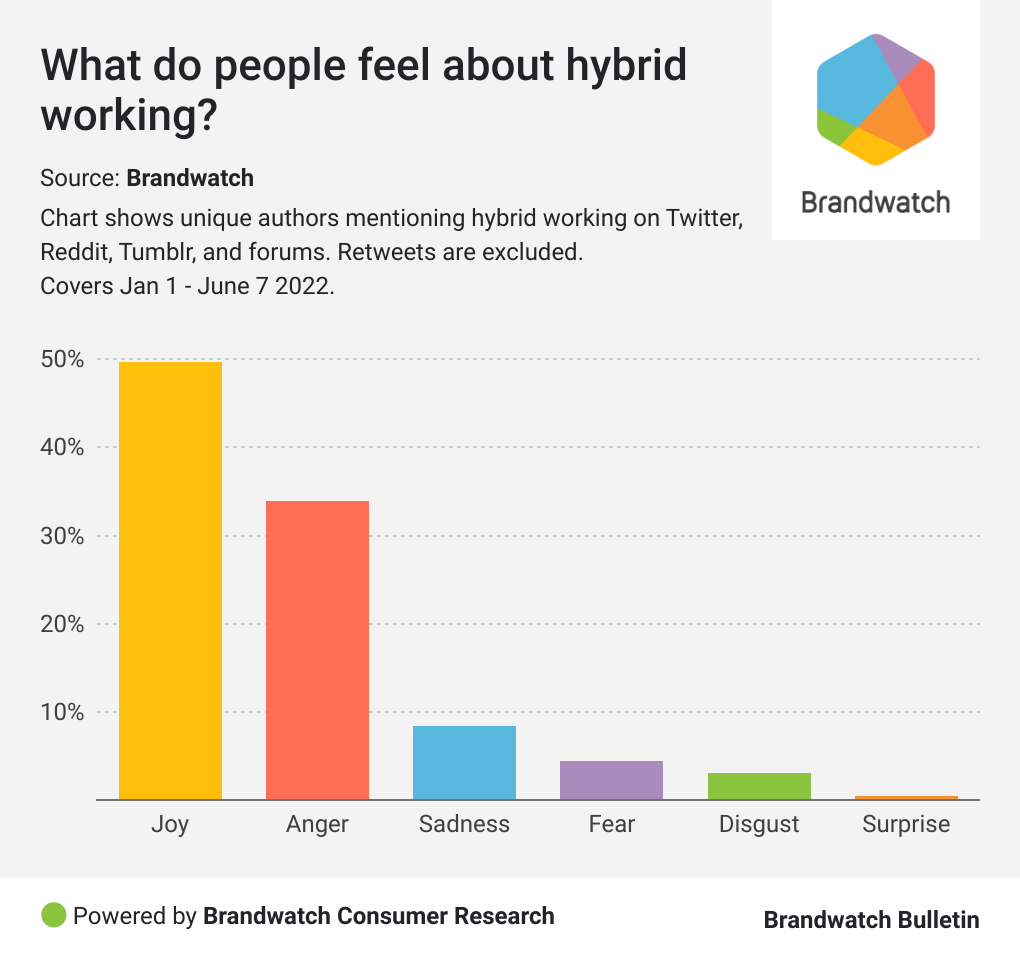
Using Brandwatch Consumer Research, we categorized 2022’s hybrid working conversation mentions to see how people really feel about the situation. Here’s the breakdown.

Nearly half of all the mentions were joyous, with many people extolling the virtues of hybrid working. There was no one dominant driver of this. Instead there were a huge array of hybrid working benefits that people talked about.

Work-life balance was one of the bigger topics, but people were also getting excited about new home equipment, improved mental health, living a greener life, saving money on commuting, and the breathing room a day at home can bring when you need it most.

The next biggest category was angry mentions, but topics aren’t as anti-hybrid working as that suggests.

Plenty of the anger was directed at there not being enough hybrid working options, companies not supporting the option properly, and defenders of the concept getting angry at its detractors. In other words, a lot of these negative mentions were in fact supportive of hybrid working.

Of course, there was still a sizeable chunk of people who were against it. One of the more common complaints was that the hybrid approach can lead to a less than satisfactory office experience for those who chose to go in.

This tells us that while the conversation is generally positive, there are still genuine issues companies need to consider. It means that for businesses who have implemented hybrid working, they need to be proactive in ensuring people on both sides of the home/office divide are happy and getting what they need to do their work.

Luckily, Robin has some advice on that very topic.

The Three Pillars of Great Hybrid Leadership

Robin’s Three Pillars of Great Hybrid Leadership report is a must-read. It includes data on the challenges hybrid workers face, what they want from their employers, and concrete advice for business leaders to get the most out of their workforce.

You can download it now, for free, right here. We strongly recommend taking a look.

What should we cover next?

Is there a topic, trend, or industry you’d like us to feature in the Brandwatch Bulletin? We want to hear your ideas to make sure our readers are getting what they want. We may even ask to interview you if you’re involved with the topic.

Send any and all ideas to [email protected] and let’s talk.

Thanks for reading

There will be no bulletin next week due to the bank holidays in the UK. Our next one will go out on 10 June. We’ll see you then.

Stay safe,

The Brandwatch Bulletin team

logo
  Our Suite     Use Cases     Industries     Get started  

Runtime Collective Limited (trading as Brandwatch). English company number 3898053
New York | Boston | Chicago | Austin | Toronto | Brighton | London | Copenhagen | Berlin | Stuttgart | Frankfurt | Paris | Madrid | Budapest | Sofia | Chennai | Singapore | Sydney | Melbourne

Privacy Policy

Update subscription preferences

Unsubscribe

We value your privacy

We use cookies and similar technologies to personalize ads and content (including by sharing data with Google), to measure site performance, and to improve your experience. Learn more in our cookie policy

Privacy & Safety • Terms of Service

No, take me to settings
Yes, I agree
More info.

By using our site you agree to our use of cookies —