logo

Covid-19 Bulletin 01/04: Conspiracies, Carers, and Comments

Watch out for more fake news.

Thanks for joining us today.

If you want our daily bulletin sent straight to your inbox, click the button below.

SUBSCRIBE

People are changing topics

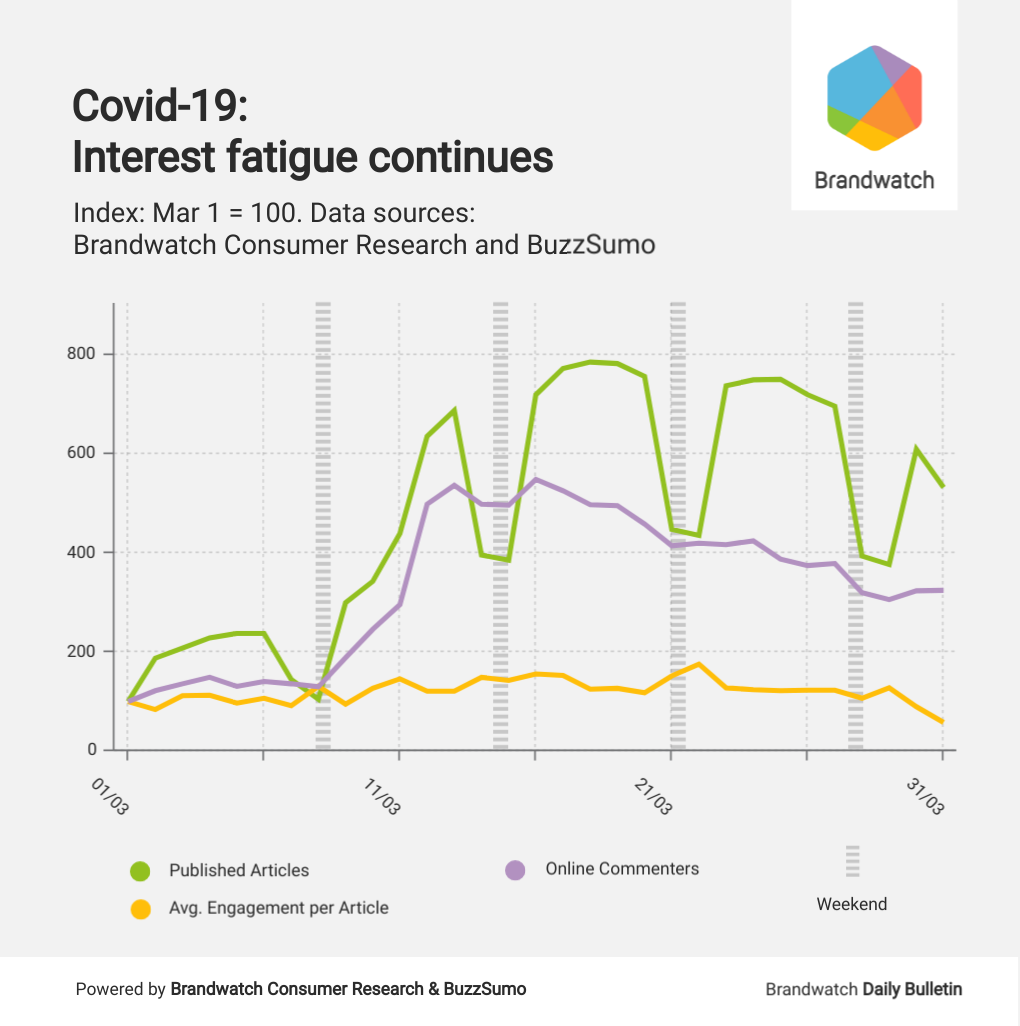
Last week we looked at whether interest in discussing or reading about Covid-19 was falling. We’ve updated the chart with another week’s worth of data to see how things have changed.

Here’s a quick explanation of the data.

Published Articles: The number of articles mentioning Covid-19 (found using BuzzSumo).
Avg. Engagement per Article: The number of engagements Covid-19 articles got divided by the number of articles.
Online Commenters: The number of unique social accounts that have mentioned Covid-19.

We can see that there’s been a big drop in published articles on the virus. This is despite the spread and threat of Covid-19 growing. The initial content explosion is clearly dying off, and it looks like publishers are starting to read the room.

The number of accounts discussing Covid-19 continued to drop, although there are early signs of this stabilizing. In the meantime, the average engagements on Covid-19 content (this includes actions such as shares and Facebook comments) has seen a sharp drop this week.

As people get to the grips with the reality of the virus in the real world, it’s possible they’re increasingly looking to the online world for escapism.

Key workers: How can you help support them?

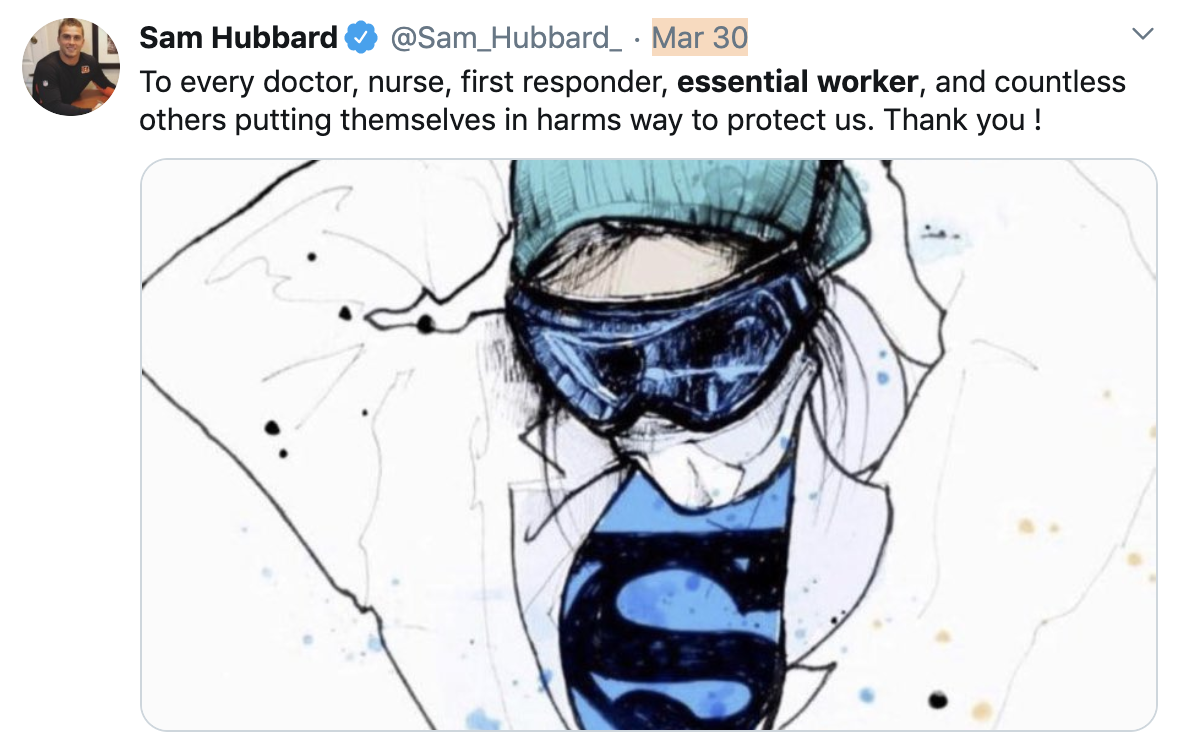
It’s been a beautiful sight to see millions of people across the world celebrating and supporting healthcare workers by clapping out of their windows, singing, and making rainbow posters.

People on social media are also taking the time to appreciate key workers (the people we need to work for medical treatment, food and deliveries). In the last two weeks, we found an incredible 28m unique English-language authors praising essential workers for their services.

It wasn’t just emergency services (6m mentions) and medical professionals (16m) feeling the love – people have been celebrating supermarket workers and couriers too.

In the last two weeks, conversation concerning roles in the food chain increased 133% to 136k mentions, while conversation concerning transport and delivery services was up 47%, reaching 349k mentions.

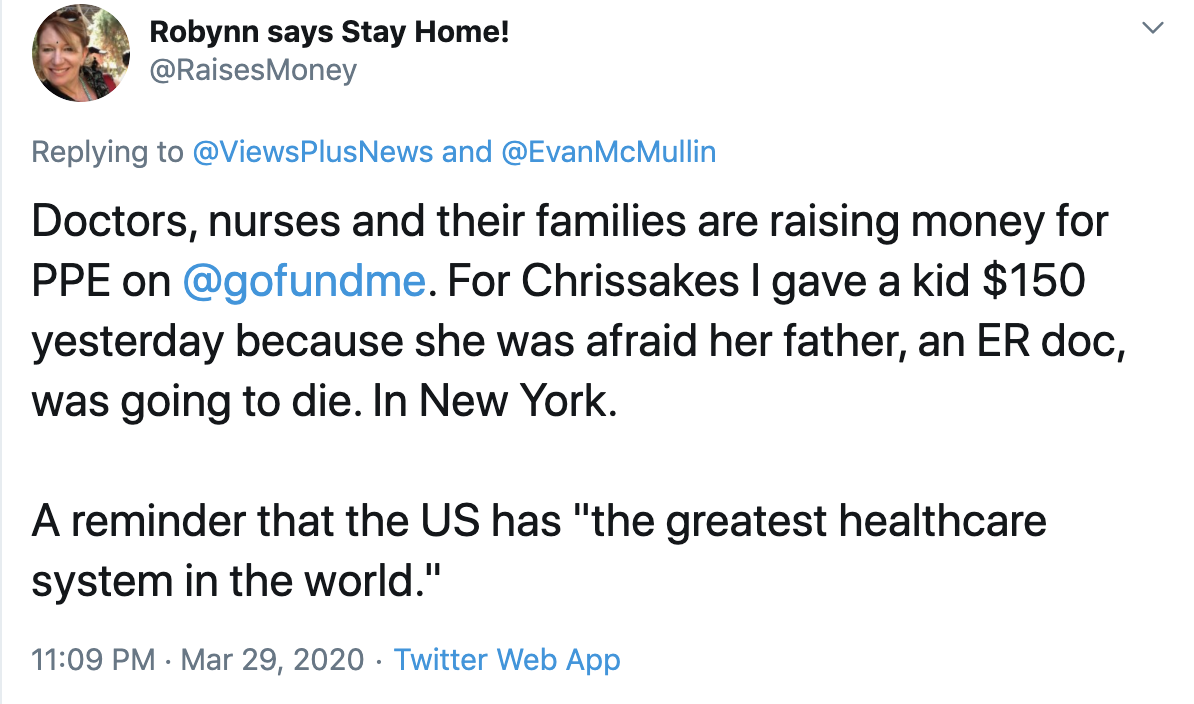
In the US, conversation surrounding key workers was focused on money, with 187k mentions. Emotion-categorized conversation revealed 34% of mentions were angry, mainly relating to a lack of compensation for frontline workers who are putting themselves at risk. Sadness was the other dominant emotion (30%), driven by people upset with the government’s apparent lack of respect for those workers.

Personal Protective Equipment (PPE), the clothing and accessories needed to protect workers from the contagious illness, was often brought up in relation to money with 44k mentions.

In the UK, the conversation around key worker roles was dominated by PPE (or a lack of it), with 24k mentions in the last 14 days. Money was less of a concern around healthcare workers, but we found a lot of conversation around how food retailers should be offering more than base pay for their key workers, with 37k mentions.

Companies can join in to support key workers. For example, UK supermarkets were struggling to keep up with demand because of panic buying, resulting in healthcare workers not being able to access the essentials they needed.

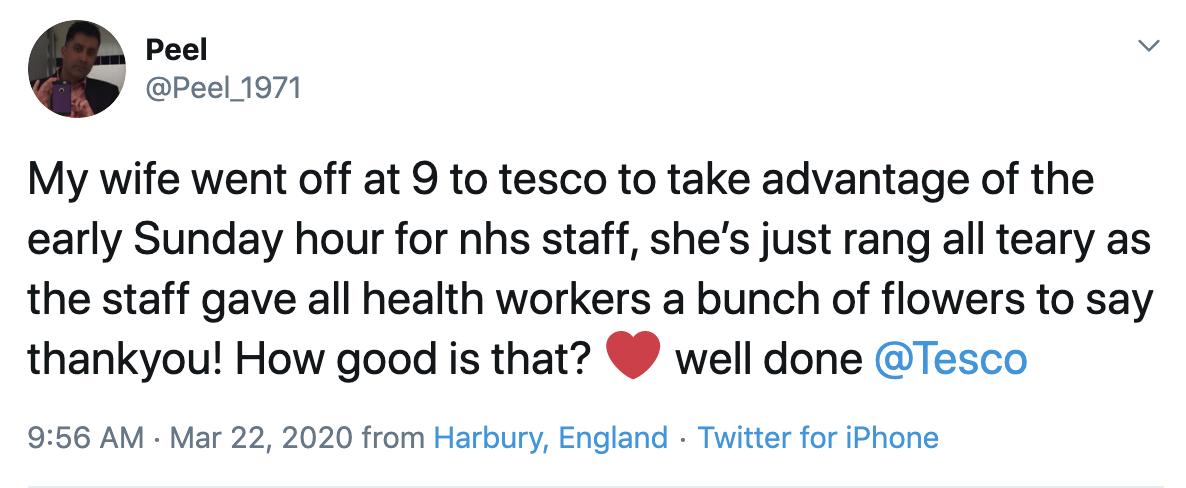
To combat this, supermarkets in the UK introduced a shopping hour at the start of the day for healthcare staff, while some US stores introduced a special hour for the elderly. The move was widely praised online with 19k positive mentions.

Companies, brands, and organisations the world over are finding ways to help those in need. If you’re in a position to do the same, it’s worth thinking about what you can offer. It really could make a big difference.

Not the time for humor

As the global death toll continues to rise, humor during the Covid-19 pandemic is changing.

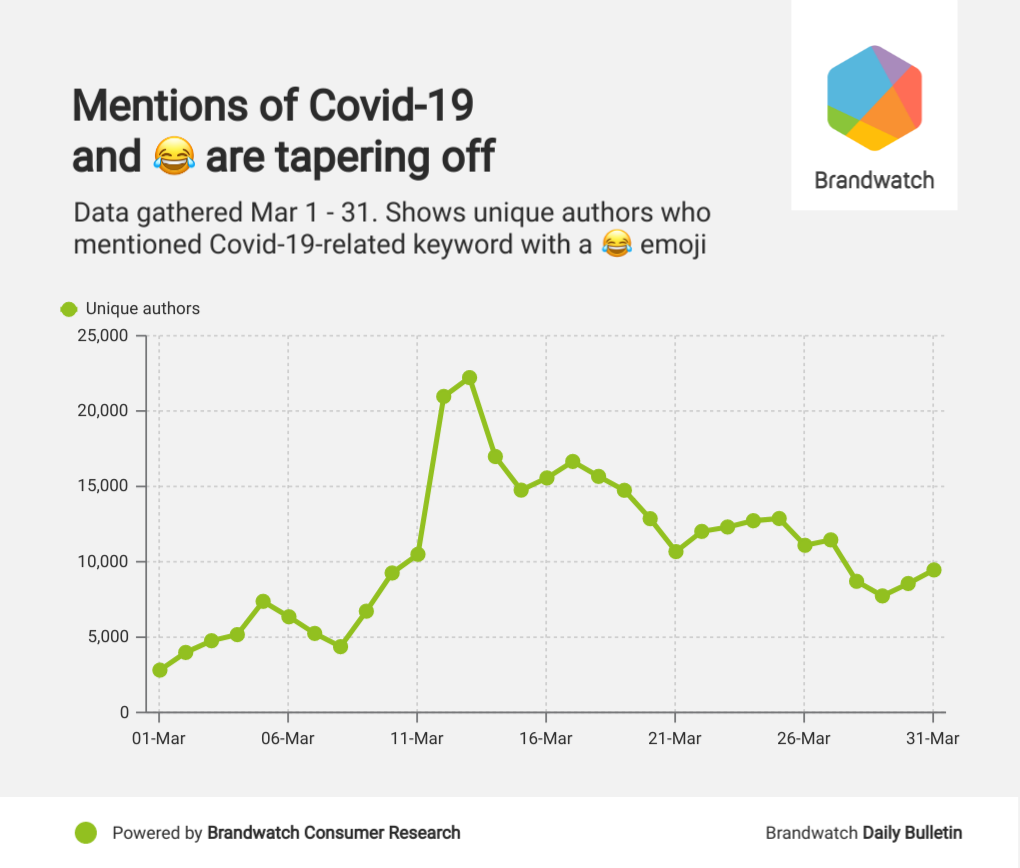
Use of the ‘tears of joy’ emoji alongside mentions of the virus is steadily falling after a dramatic peak earlier this month.

While the symptoms and effects of the virus on those suffering from it are no laughing matter, there have been some moments that have caused digital ‘laughter’.

For example, the top stories we found being shared on Twitter in March that mentioned Covid-19 and got ‘tears of joy’ emoji reactions are:

1.  A report that the Florida Police Department were offering to test meth for coronavirus for free
2. A report that the first reported coronavirus case in South Africa was actually a hangover
3. Images of people flouting social distancing rules by going to the beach
4. Paul Pogba’s ‘Dab to beat coronavirus’ tweet
5. A report that a coronavirus conference was cancelled (due to coronavirus)

All of these stories took off fairly early in the month (between 9-18 March). But jokes around Covid-19, understandably, don’t seem to be getting the same kind of traction now.

Instad jokes about ‘quarantine’ and ‘isolation’ have taken over in terms of the volumes of laughing emojis they’re receiving – people staying healthy at home appear to be going down the ‘laugh rather than cry’ route.

If you’re thinking of making a joke, or want to make people smile, you’d be better off making it about home life than any more stressful factors.

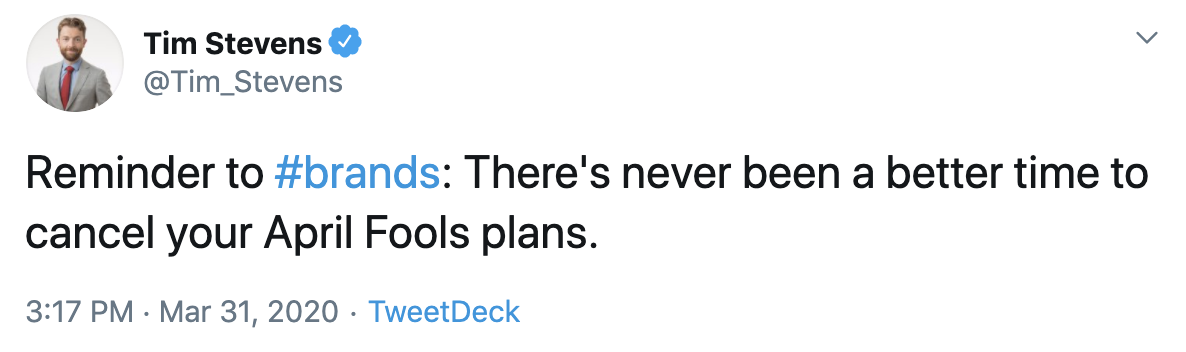
We’ve also seen a lot of talk about ‘cancelling’ April Fools’ Day, with brands who are seen to ignore this likely getting a bit of backlash.

Our advice? Leave the humor to the people.

Fact check: Fake news and your business

Brandwatch’s Fake News Week has fallen at an interesting time this year. There’s plenty to read about if it’s a subject that interests you. We’ve also gathered a lot of data around fake news and Covid-19.

For the research, we used our AI assistant Iris to tell us about increases in mentions of Covid-19 over time. It alerted us to several conspiracy theories that were driving peaks in discussion.

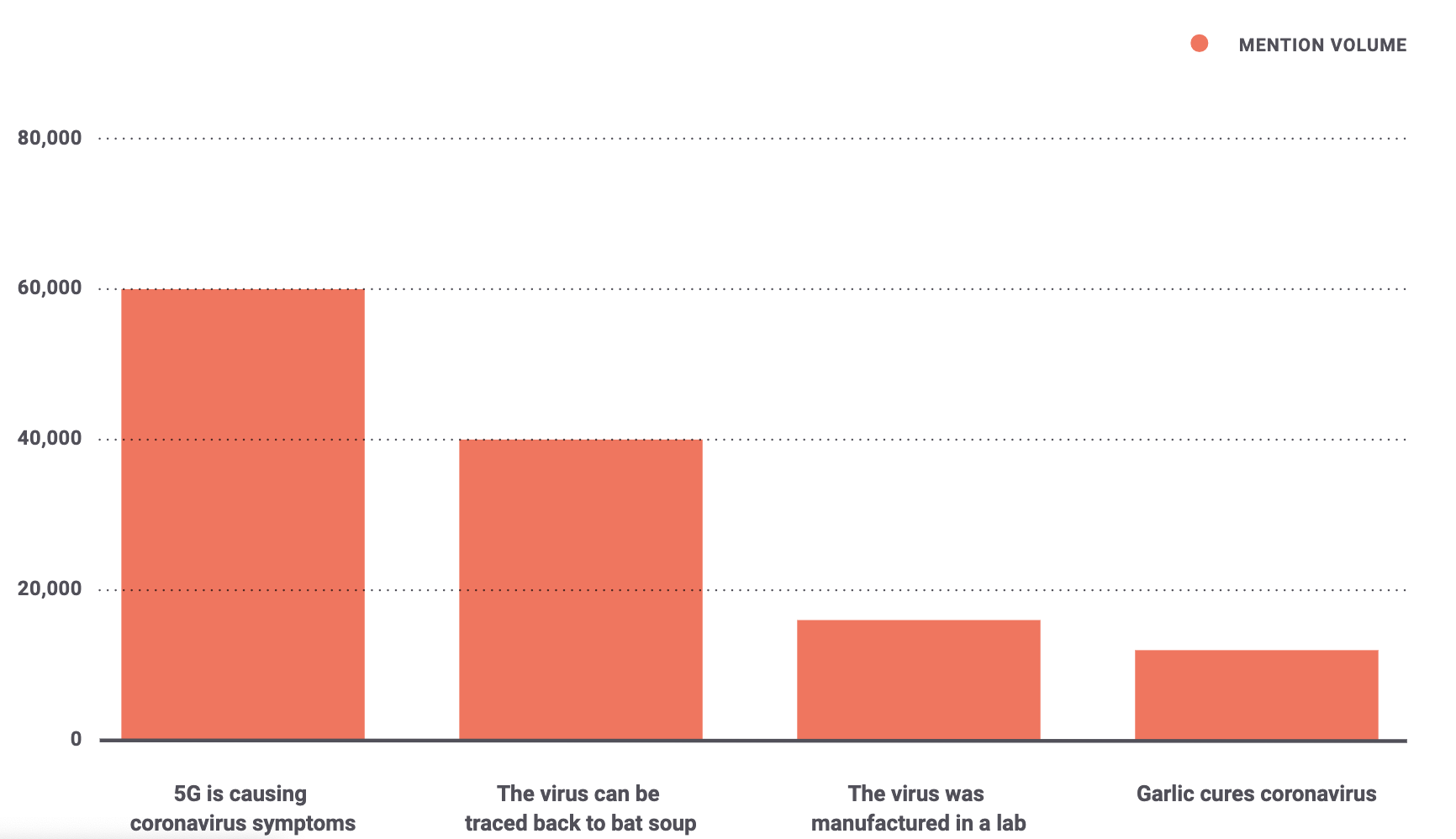
Up to March 16, 5G causing coronavirus symptoms was the strongest theory we found, garnering 60.2k mentions.

Mentions of theories around Covid-19

The second strongest was the suggestion that bat soup was linked to the initial spread of the new strain of coronavirus, with 40.8k mentions. A big driver of this was various news outlets picking up a video of a woman eating a bat and some bat soup.

While Covid-19 can live in bats, there is no proof that bat soup had anything to do with the origin of the virus. And the video that was circulating was not shot in a Wuhan restaurant this year, as some suggested, it was actually filmed in Palau, Micronesia, in 2016.

Other theories included the virus being manufactured in a lab (16k mentions), and garlic curing Covid-19 (12.5k mentions).

In times of uncertainty, fake news can quickly spiral out of control, and corrections never quite remediate the initial fire. Think twice before tapping that forward button.

Get more in-depth data

We don’t just offer this daily bulletin. If you want even deeper insights ranging across the globe, our weekly report is for you.

Head here to find out more and get signed up.

Thanks for reading

If you enjoyed today’s bulletin, make sure you don’t miss the next one.

Subscribe now.

Stay safe.

logo
  Our Suite     Use Cases     Industries     Get started  

Runtime Collective Limited (trading as Brandwatch). English company number 3898053
New York | Boston | Chicago | Austin | Toronto | Brighton | London | Copenhagen | Berlin | Stuttgart | Frankfurt | Paris | Madrid | Budapest | Sofia | Chennai | Singapore | Sydney | Melbourne

Privacy Policy

Update subscription preferences

Unsubscribe

We value your privacy

We use cookies and similar technologies to personalize ads and content (including by sharing data with Google), to measure site performance, and to improve your experience. Learn more in our cookie policy

Privacy & Safety • Terms of Service

No, take me to settings
Yes, I agree
More info.

By using our site you agree to our use of cookies —