logo

Covid-19 Daily Bulletin 09/04: Finding the positives

For some people around the world, it's not all doom and gloom.

Welcome back. As it’s the Easter weekend, our next bulletin will be with you on Tuesday, April 14. We hope you enjoy the weekend and keep your eyes peeled for the next bulletin.

If you want to get these bulletins, straight to your inbox, you can subscribe below.

Now to the data.

SUBSCRIBE

China’s citizens are optimistic about the future

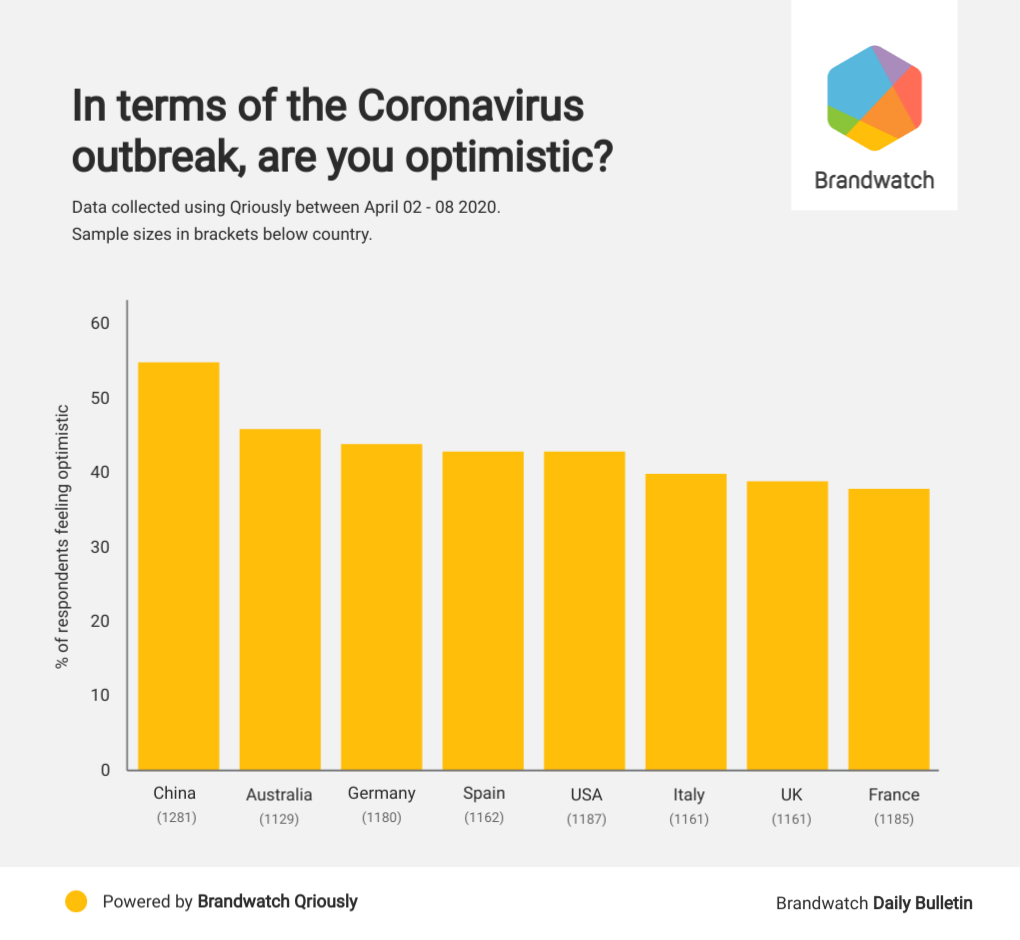
To investigate how people’s moods are changing during the Covid-19 outbreak, we ran a Qriously survey that polled 9,446 adults across China, Australia, France, Germany, Italy, Spain, the UK, and the US via their smartphones and tablets.¹

We found that, despite the current crisis, optimism was the most common feeling reported in all tracked markets bar one – the UK – where nearly half of respondents reported feeling anxious.

We can see China is out in front with 55% of respondents saying they’re optimistic. Considering the country has been fighting Covid-19 for a long time, it’s good to see they’re still hopeful for the future. The country has seen the number of cases and deaths plummet, which may explain this.

On the other hand we have respondents in Italy, the UK, and France, who are the least optimistic. This is not a huge surprise. Italy has been incredibly hard hit by Covid-19, while France and the UK have yet to reach their peaks or to see the progress China has had.

Ultimately, bar China, there is still a sense of pessimism amongst our respondents. With so far to go, this makes sense. As Covid-19 is brought under control, we can expect more people to see a light at the end of the tunnel. In the meantime, there’s still a lot of work to be done.

A return to normality

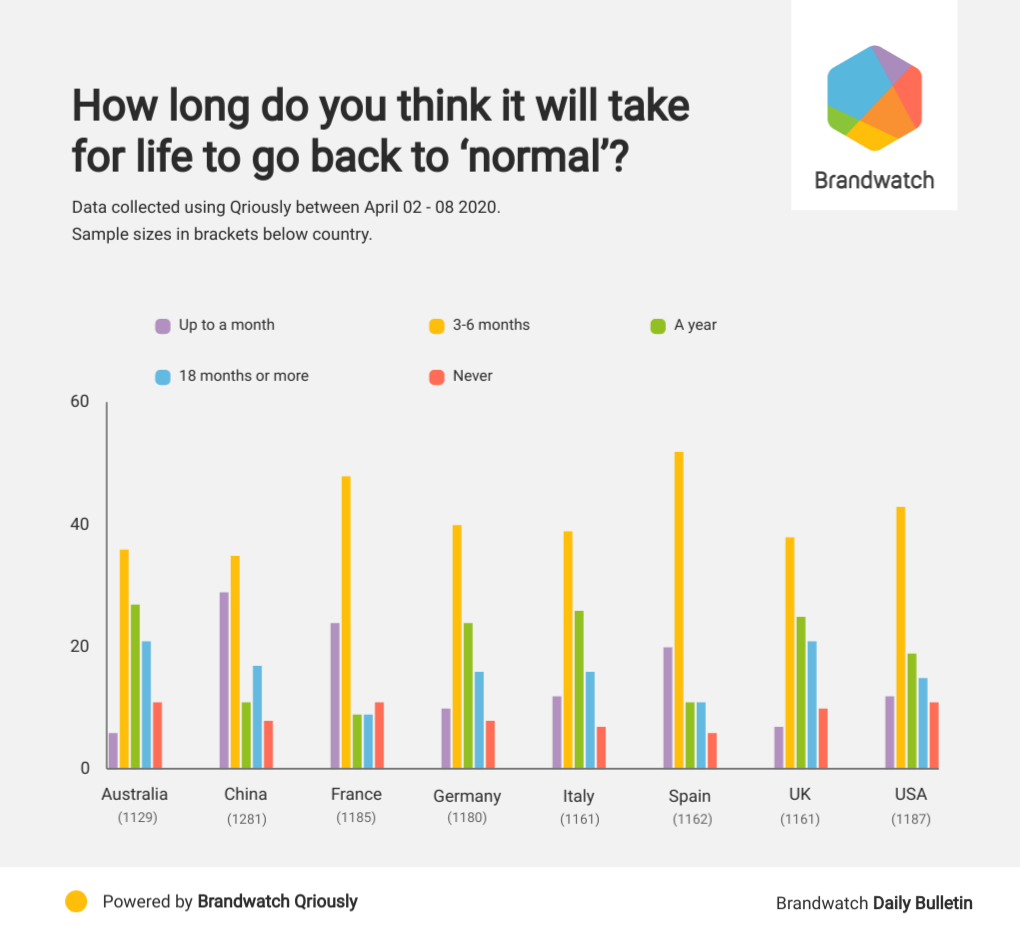
So what does optimism look like when it comes to timeframes? In the same Qriously survey, we asked respondents when they thought things would get back to normal.

This is also an important question for gauging how consumers might be planning for the future. A person will act very differently depending on whether they think the pandemic will be over in a month or over in a year.

Unsurprisingly, given their optimism levels, China had the most people expecting a return to normality within a month, at 29% of respondents.

Looking across the board, every country, no matter how optimistic, had 3-6 months as the most popular answer. On average, 41% of respondents picked this timeframe.

A lot of people around the world think it’ll be more than a year before we’re back to how things were – at least 40% of respondents from the UK, Italy, Australia, and Germany fall into this category.

Meanwhile, on average, 9% of respondents think we’ll never get back to normal. With many out of work and health systems struggling the world over, this is no surprise. Covid-19 has changed so much in such a short time, and it seems reasonable that some things will never be the same again.

Consumers celebrate brands’ Covid-19 efforts

There’s no playbook for brands under a pandemic, and many, smartly, have been cautious in their marketing. But some brands have taken positive action, and this week we released a report ranking their efforts based on the praise they received online.

Here are a few we’ve picked out.

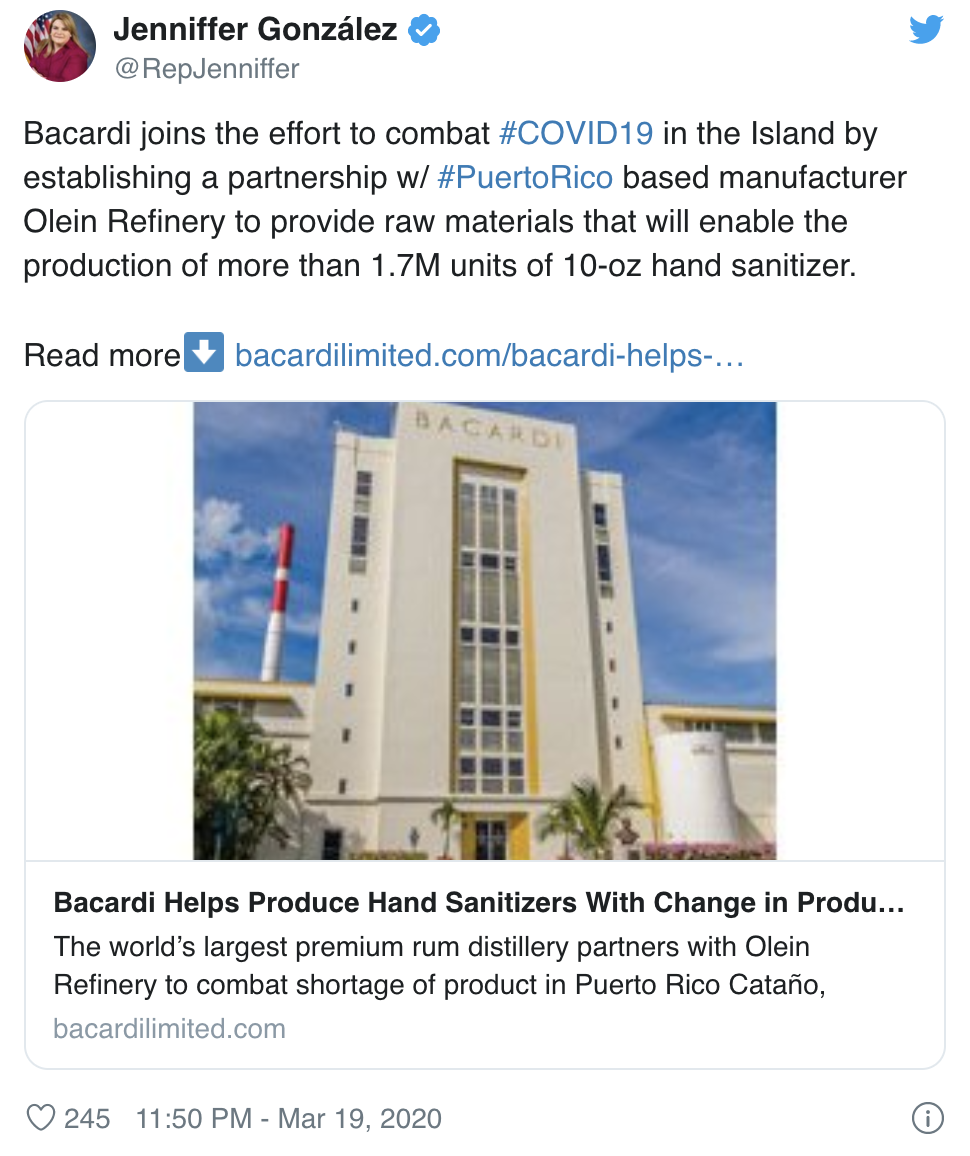
At 28th, Bacardi saw an 3410% increase in conversation around them providing raw materials to enable the production of hand sanitizer.

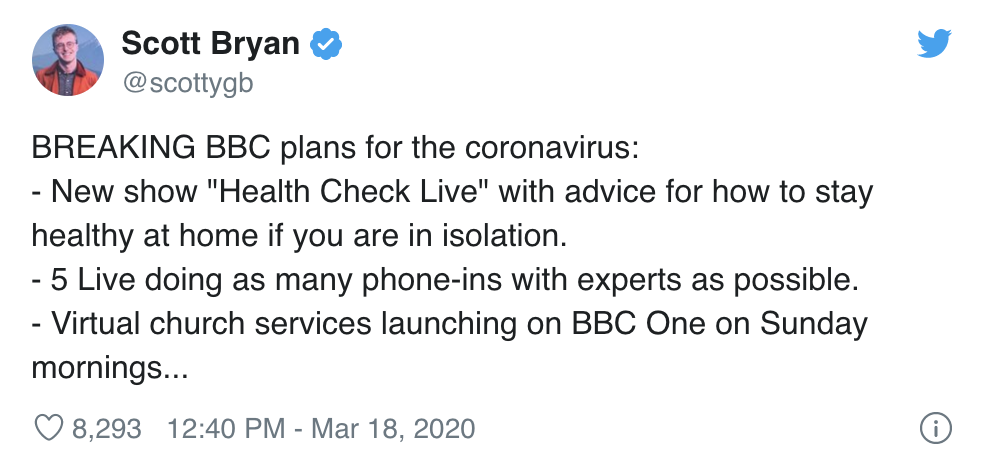
At 17th, the BBC had a conversation increase of 1176% when they announced their broadcasting schedule.

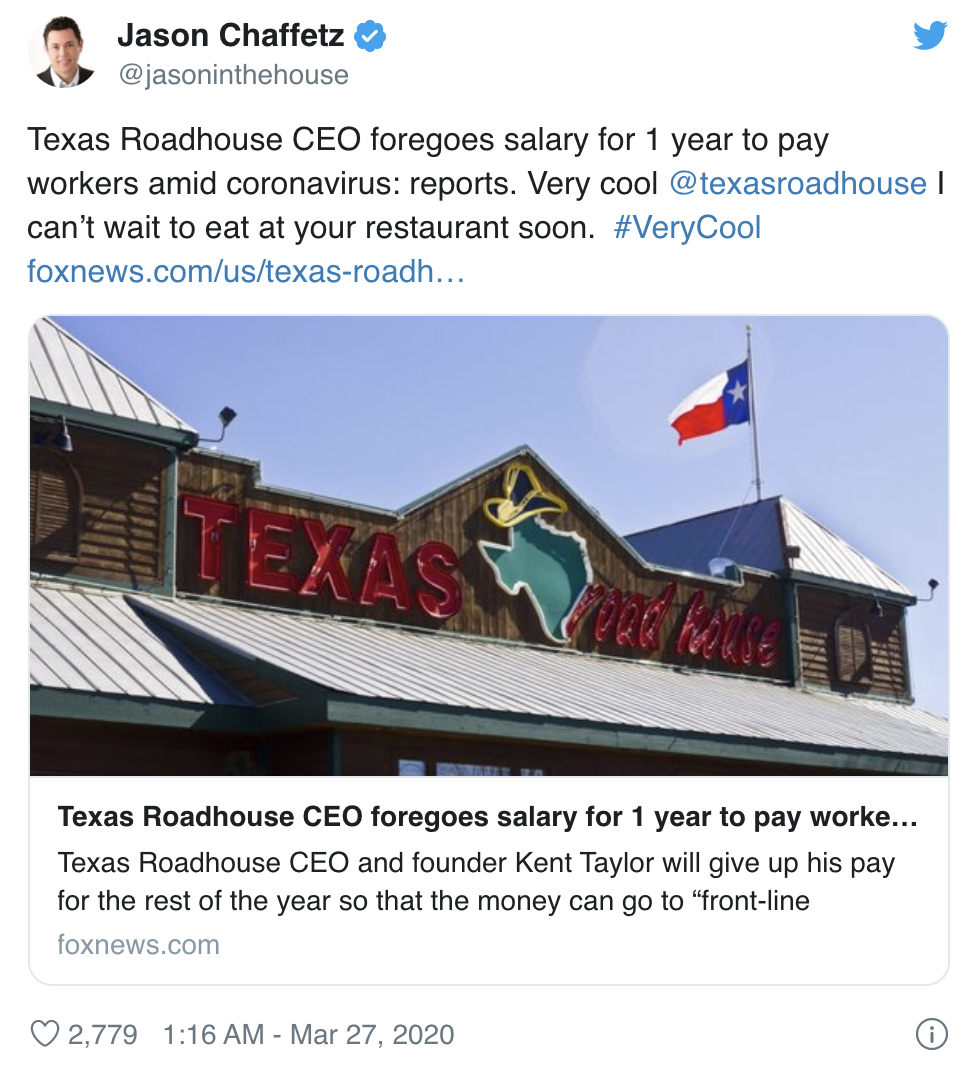
At 11th, Texas Roadhouse saw 71k mentions the day their CEO pledged to give up their salary for a year to pay frontline workers.

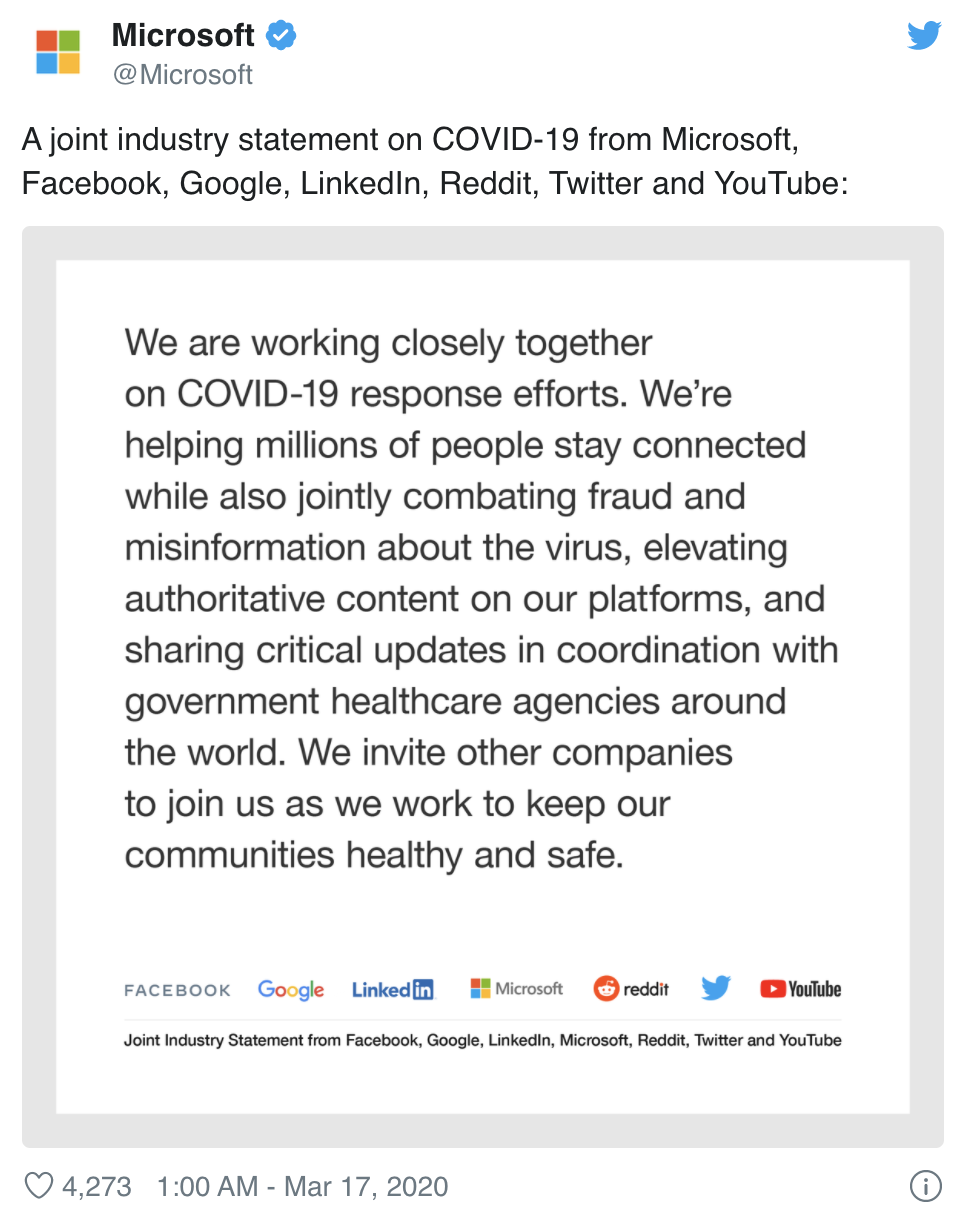
Meanwhile, a joint industry statement from Facebook, Google, LinkedIn, Microsoft, Reddit, Twitter, and YouTube secured the third spot.

The statement promises the companies will work to combat fraud and misinformation, with so many people relying on the internet for information during the crisis. It’s a great example of rival companies putting aside their differences for a common good.

In the grip of Covid-19, actions are important. Globally, people need help and support, rather than to be sold to. Companies of all stripes should take note.

Read the full report now to see which other brands made the top 30, and what they did to get there.

Missed out on yesterday’s weekly report?

Every Wednesday we send out an in-depth global Covid-19 report.

Head here to find out more and get signed up.

Thanks for reading

We’ll see you again on Tuesday. Want these bulletins sent straight to your inbox? Sign up here.

Stay safe,

Brandwatch Response Team


¹ Note: All surveys are subject to a wide range of potential sources of error. On the basis of the historical record of the polls at recent general elections, there is a 9 in 10 chance that the true value of a survey result lies within 4 points of the estimates provided by this survey, and a 2 in 3 chance that they lie within 2 points.

logo
  Our Suite     Use Cases     Industries     Get started  

Runtime Collective Limited (trading as Brandwatch). English company number 3898053
New York | Boston | Chicago | Austin | Toronto | Brighton | London | Copenhagen | Berlin | Stuttgart | Frankfurt | Paris | Madrid | Budapest | Sofia | Chennai | Singapore | Sydney | Melbourne

Privacy Policy

Update subscription preferences

Unsubscribe

We value your privacy

We use cookies and similar technologies to personalize ads and content (including by sharing data with Google), to measure site performance, and to improve your experience. Learn more in our cookie policy

Privacy & Safety • Terms of Service

No, take me to settings
Yes, I agree
More info.

By using our site you agree to our use of cookies —