The placebo effect is simple.
If patients expect a drug to work it’s more likely that it will, even if the medicine has no active ingredients. Something incidental like a drug’s price, taste or even color can dramatically boost its effect.
In 1996, Anton de Craen reviewed 12 studies and found that red painkillers are more effective than blue ones. The red color draws connotations with strength and power, making the drug more potent.
Millions of dollars are spent on painkillers every day. You’d think marketers would take advantage of an insight like this to get ahead. But, they don’t.
Only one out of seven top selling painkillers sold in the UK are red (Shotton, 2018).
This easily actionable insight isn’t utilized and it’s a massive mistake.
Advertising people who ignore research are as dangerous as generals who ignore decodes of enemy signals
Marketers still make simple mistakes every day, despite the abundance of insights available.
While that’s bad news for most marketers, it’s good news for you. It means if you learn from their mistakes, you’ll have a competitive advantage.
This guide will give you the tools you need to spot each common mistake and give you the edge over competitors.
Mistake 1: “Consumer preferences are changing.”
We often think of our consumers as irrational. Constantly changing their minds.

As soon as a new competitor enters our market we’re terrified they’ll steal loyal customers. So, marketers change campaigns and strategy to keep up to speed with ever-altering consumer preferences.
While there’s some merit to thinking like this, it largely evades a fundamental law consumers align with: The consistency principle.
The principle was first noticed in 1968 by two Canadian psychologists (Knox & Inkster). They found that gamblers are more confident their horse will win immediately after they place a bet.
Nothing about the horse or its odds has changed. But something in the consumer’s mind has.
Once we make a choice we will encounter pressures to behave consistently with that commitment (Cialdini, 1985).
Some enterprising marketers have learned ways to harness the power of this principle.
Google your favorite festival and pull up a promotional poster. There will be an important piece of information missing from the poster – the price.
Why? Because promoters have recognized that concertgoers are more likely to buy a ticket after they’ve searched for the price. The time spent searching only increases the likeliness they’ll purchase. Similar parallels are seen in movie posters or album covers.
How can social listening help you take advantage of the consistency principle?
In 2016, a video game manufacturer used Brandwatch to learn if the consistency principle affected sales.
In the run-up to a major gaming event they monitored two strands of conversation about their games:
- General discussion about the game (e.g. this game looks cool)
- Intent to purchase discussion (e.g. I want this game)
The results were fascinating. Game 1 generated more conversation. But game 2 generated more intent to purchase mentions.
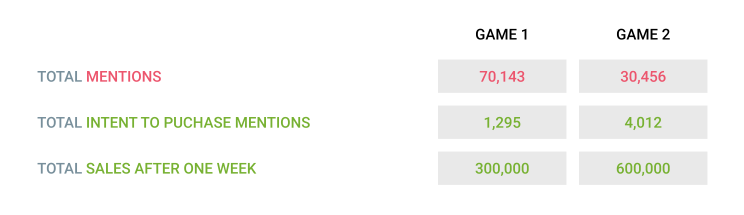
What became clear after the release was that general conversation didn’t have an effect on sales. But intent to purchase mentions, due to the consistency principle, did.
People are more likely to buy a game if they’ve already said they will.
This is an effective way to predict future sales and measure marketing activities.
Mistake 2: “Always be closing”
Okay, this is really a sales concept, but it’s regularly adopted by marketers.
Marketers believe every campaign needs clear calls to actions, next steps, and conversions.
But is this focus on closing effective? Some research suggests not.
In the 70s, a university professor sent Christmas cards to complete strangers. He expected a handful of replies, he actually received a sackful. Despite not knowing the professor, strangers went out of their way to reply (Kumz & Woolcott, 1976).
The experiment showcased the rule of reciprocation.
The rule means that we try to repay, in kind, what another person has provided us.

A seminal study in by Dennis Regan (1979) highlights this.
He placed two volunteers in an art gallery under the guise that they were rating the pieces. However, one of the subjects—let’s call him Paul—was actually Dr. Regan’s assistant. In the first instance of the experiment, Paul heads out to the vending machine and buys two cans of Coke. One for him and one for the test subject. A nice surprise treat.
In the second instance, he just buys one for himself.
Later in the experiment, Paul asks for his own favor. He’s selling raffle tickets for his local charity at 25 cents a ticket.
The study revealed, without question, that Paul was more successful selling tickets to subjects who had received an earlier favor. We’re more inclined to pay people back.
“Renegade thinkers will love this report which flips conventional wisdom like ‘always be closing’ on its sorry behind!” – Drew Neisser, Founder & CEO
How can social listening help you take advantage of the reciprocation rule?
A few years back LateRooms, an online hotel booking site, embarked on a new strategy – the ‘concierge’ service.
The social media service aimed to help anyone looking for advice about their next holiday. When a holiday-goer tweeted about food recommendations in Madrid, or free beaches in Faro, Brandwatch would immediately alert the LateRooms team.
Rather than responding with LateRooms offers (in the always be closing fashion) they responded with tips on the best spots and the hottest deals.
This had a considerable effect on consumers. Rather than ignoring LateRooms because they were being sold to, they felt indebted.
“Of all enquiries to the concierge service, a stunning 30% went on to become sales”
That’s a jaw-dropping ROI for a social strategy.
It’s a mistake to focus only on conversions in campaigns. Doing so will mean you miss out on the powerful reciprocation rule.
“Unlike a traditional sales call, social media is usually not the platform for a hard close. Just because someone is engaged in a conversation with you on Twitter or Facebook or LinkedIn doesn’t mean they’re prepared to be sold to.
More often than not, aggressive sales techniques will have the opposite effect. Brands risk alienating potential fans by being too ‘pushy’ in their messaging. Instead, brands should focus more on building community and relationships through generosity and information sharing.
Brands that are truly helpful on social media have opportunities to create real fans who then take it upon themselves to become customers.” – Mike Allton, Brand Evangelist, Agorapulse
Mistake 3: “Our consumers like choice”
You’re debating what to include in your end-of-year newsletter.
This year the team developed 30 apps (pretty impressive). You can’t agree on which to include. Eventually you decide you should include them all. After all, consumers like the choice.
Well, it’s a mistake.
To explain, let’s look at this famous research by Sheena Iyengar (2000).

She set up two tasting booths with a variety of gourmet jams. One booth had six different jams and the other had twenty-four.
Conventional wisdom says more choices are better as consumers are more likely to find a jam they like. But, Iyengar found the opposite was true.
Only 3% of consumers at the 24 variety booth bought jam. While 30% of consumers at the 6 variety booth purchased.
Iyengar had proved the power of scarcity.
Shotton, in his 2018 study, showcases that this power can have a great effect on cinema marketing.
300 consumers saw a poster for a new film and were asked how likely they were to go and watch it. Half of the participants were also told the film was closing this weekend.
Those who knew the film was ending were 36% more likely to attend.
How can social listening help you take advantage of scarcity?
Brandwatch customers have had found similar success utilizing the scarcity tactic.
Bimbo, an international baked goods company, launched a new special edition cake, the “Gansito Red Velvet”. Predominantly Bimbo’s sales came from Mexico but the company chose not to offer the special edition cake to that market.
When news of the cake launch hit Mexico, the scarcity effect kicked in for their loyal customers. In one day 5,197 Mexican customers took to Twitter demanding the cake.
Rather than releasing right away, Bimbo raised hype by playing on the scarcity principle. Using Facebook, Twitter and key influencers they released teaser content declaring that the special edition cake was on its way.
Then, on launch day, they chose to limit the distribution to only two locations, Mexico City and Guadalajara. By now the scarcity principle had taken hold and conversation online had grown by 12% month on month.
The product sold out in eight weeks, four weeks earlier than expected. The campaign reversed the negative trend of sales by generating $580,000 in revenue.
“It’s counter-intuitive, but making narrower claims can be far more effective than making the broadest claim you can.” – Doug Kessler, Creative Director & Co-founder of Velocity
Mistake 4: “Personalized marketing is more effective”
You’re scrolling through the web. An advert pops up. It contains pictures of your father, husband and brother. Underneath each picture is tagline “A holiday your whole family would love – tickets to Barcelona just $500”
You wince at first wondering (a) how they got that information and (b) what else advertisers know about you.
Many marketers assume personalized marketing is the way forward. But, new research suggests otherwise.
Richard Shotton (2018) found that 36% of consumers find personalized ads completely unacceptable.
Brandwatch revealed a torrent of consumer complaints made online about creepy personalized marketing, including messages like this:
A more effective, less risky strategy is localization.
JC Decaux (2016) revealed this after displaying two posters for broadband providers. Version one related the offer to the UK, version two based the ad on the location it was in, Charing Cross station.
The result – locally tailored activity generated a 14% higher awareness than the national message.
In a similar vein, Shotton (2018) proved the power of localization with NHS’ Give Blood campaign.
He changed ad copy from “blood stocks low across the UK please help” to “blood stocks are low in Brighton (or Bristol or Birmingham) please help”.
The change caused a 10% improvement in the cost per donation.
“True personalization doesn’t necessarily out-perform a good, solid segmentation strategy.” – Doug Kessler, Creative Director & Co-founder of Velocity
How can social listening help you take advantage of localization?
It’s not just ad agencies finding value. Large brands like Ben & Jerry’s can also benefit from using Brandwatch.
For example, the team collected a large selection of online posts suggesting the author wanted to buy ice cream. For example, “I’d love a #Ben&Jerry’s” or “desperate for a tub of cookie dough!”.
Next, they identified the location of the consumer. And finally, they compared volume of posts with weather data.
Blending these two data sets revealed a surprising correlation.
Of all the weather types, rain was most likely to encourage consumers to buy Ben & Jerry’s. The marketing team used this data to create location themed ads.
When it started raining, the online ad team dramatically increased the volume of advertisements.
The results were shocking. Ben & Jerry’s increased the optimization of their adverts led to 25% more clicks for the exact same cost as before.
For marketers, the takeaways are clear. Find localized advertising tactics that work and prioritize them ahead of personalized approaches.
Mistake 5: “We need to differentiate”
You’re in a meeting with senior executives. Your marketing director presents the tagline for your new meal subscription box, “There’s a reason why 8/10 chefs choose us”.
You love it. It uses social proof. It’s simple, honest, and effective. Who wouldn’t want to buy?
But the execs start debating. “Isn’t it a bit obvious?”, “I’ve seen this been done before”, “It’s not very innovative”, “Couldn’t you come up with something a bit different.”. Weeks past and your tagline is constantly tweaked until you end up with this. “Healthy, fresh and delicious!”
It’s clear why executives think this way. They’re constantly told to innovate, try something new. They read best sellers like “Differentiate or Die!”.
But are they right?
Cialdini (1985) argues that proven, well-test principles like social proof shouldn’t be disregarded. In his book Influence he explains how it encourages hotel guests to reuse towels.
He created two messages displayed in hotel showers. One explaining the environmental reasons behind reusing towels. The other declaring that most people in that room had reused their towel.

This small tweak emphasizing social proof boosted reuse rates by 49%.
Shotton (2018) discovered similar results in English pubs. His team convinced the pub owner to place a small sign next to a beer stating it was “The Best Selling Beer This Week!”. This boosted sales of that ale by 2.5x compared to previous weeks.
The evidence is clear – stating your popularity will increase chances of getting bought.
Yet, according to Brandwatch only 0.1% of marketing messages contain any reference to social proof.
Why marketers opt for novel strategies rather than proven formulas isn’t known. But it leaves a great opportunity for you.
Mistake 6: “Sentiment is a vanity metric”
It’s easy to disregard metrics around sentiment. After all, can a consumer’s mood really be important to a brand?
New research suggests there’s more value in consumer sentiment than people may assume.
Fred Bronner (2007) asked 1,287 participants to read through a local newspaper. He then asked them which ads they remembered.
Unlike most recall tests, he categorized the results by the readers’ mood. Those in a positive mood noticed 56% of the ads. Those in a negative mood noticed just 36%.
How can social listening help?
With Brandwatch, monitoring the sentiment of your audience is simple.
Here’s the average net sentiment for six industries:
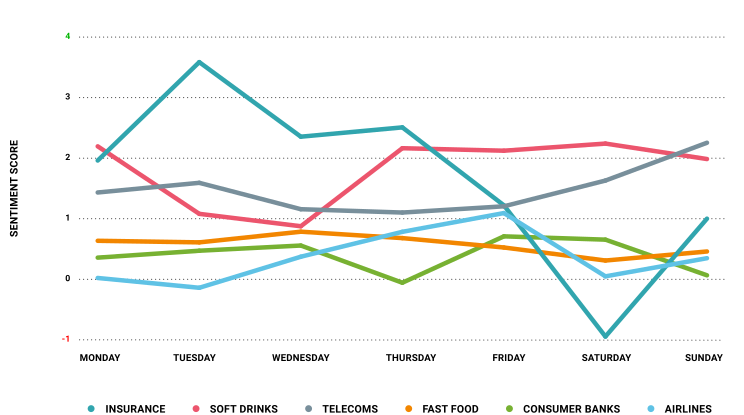
Immediately we can draw some valuable insights:
- Insurance brands should advertise on Tuesday and avoid Saturdays
- Soft drinks consumers are more unhappy at the start of the week
- Telecom providers have a more positive audience on Sunday
Here’s the same analysis for hour of day:
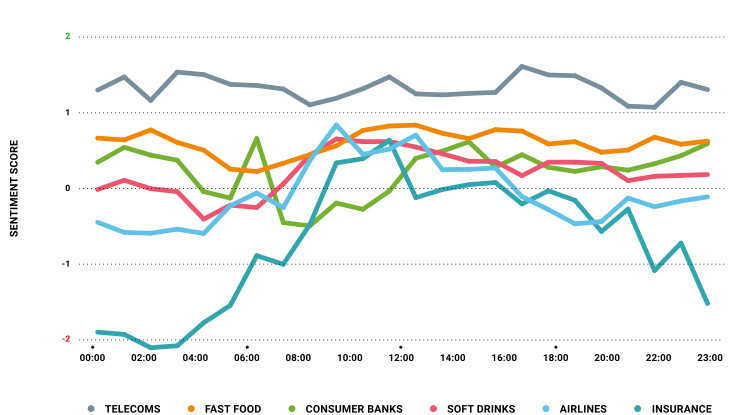
- 9am – 12pm work best for airlines
- Insurance consumers get more negative after lunch
- Banks generate negativity in the morning
If sentiment can indicate receptiveness to an ad, it should be viewed as a vital – not vanity – measure.
“Marketers who understand the impact of content on the customer experience are in the best position to drive the business outcomes that are most important to their organization” – Dennis Wakabayashi, Vice President at The Integer Group
Mistake 7: “It’s market research. It must be right”
This might sound self-defeating since this guide has advocated for more research. But, you shouldn’t take an insight at face value.
To explain why let’s look at how broadcasters pick television programs.
In the late 60s, CBS was considering debuting a new show. The title character, Mary Richards, was a single, young woman who – unlike many fictional female characters of the time – was determined to develop her career.
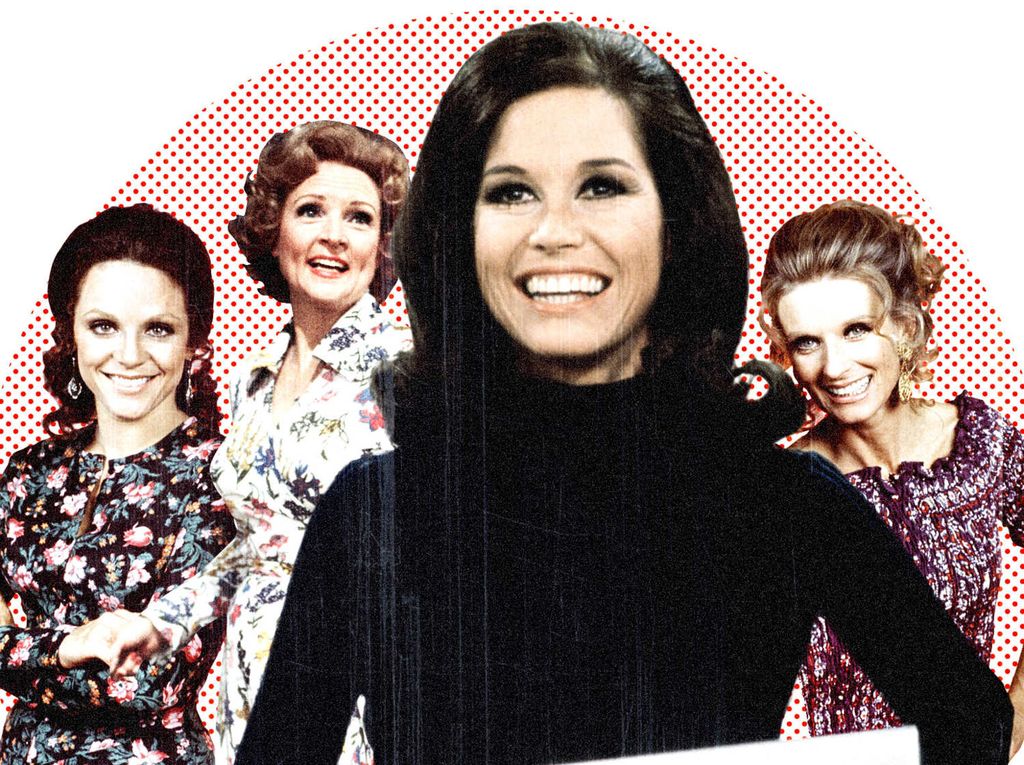
CBS ran test screenings with multiple audiences. The results were devastating. Mary was “a loser”, her neighbor was “abrasive” and many characters were “not believable” (Gladwell, 2014).
The only reason the show survived was that it was already scheduled for broadcast. The results came back too late.
According to market research viewers said they hated the show. But in reality, The Mary Tyler Moore show became insanely popular. The Writers Guild of America ranked the show No. 6 in its list of the 101 Best Written TV Series of All Time. Had that early negative data come back earlier the show might never have been given a chance at that popularity.
But it’s not just TV shows.
In 1985, Coca-Cola developed a new version of Coke.
They worked tirelessly to ensure the new Coke had a better flavor. After years of work and months of consumer testing, they’d finally done it. They found a flavor that every research group said they preferred.
That year Coke launched New Coke.
It was an unprecedented mistake. 40,000 consumers complained.
Pepsi released adverts poking fun at their failure. Within just three months the company reverted back to the old flavor.
Whether you look at broadcasters or soda manufacturers the message is clear. Don’t take research at face value.
How can social listening help?
Argos, a UK retail firm, underwent a major change in 2015.
53 stores were refitted with iPads, new layouts, and automated queuing systems.
It was a major change for the 40-year old company. But it was based on market research, so surely it would work?

Argos didn’t just trust the research. Instead, the team collected constant, real-time, unsolicited feedback from social media reactions to the changes.
Within just one week, they spotted three insights:
- Consumers in the north missed the interaction with staff
- Consumers in London raised issues with time spent queuing
- Consumers in the east wanted a place to sit
The team fixed these issues within days adding more staff up north, more queuing lines in London and more seats in the east.
“Social was crucial in providing real-time information on customer satisfaction” – James Finch, Customer and Digital Insights Manager at Argos.
Argos trusted the initial market research, but didn’t take it at face value. The team constantly monitored, listened and improved based on live consumer feedback.
“We’re planning future digital store rollouts and we’ll be using Brandwatch Analytics to track every step of the way“
“There really is no better way to improve your marketing than by researching and understanding your audience.
This guide comes from one of the best web monitoring tools on the market and it shows in all the examples and data it uses to back up these common marketing mistakes – and the best way to learn is by understanding your mistakes!” – Lilach Bullock – Content Marketing Specialist
“I’ve been in the SEO industry for more than 10 years, and in that time I’ve made and learned from many of these mistakes, as well as seen these mistakes repeated again and again by my competitors, peers, and clients. There’s no shortage of lists about marketing mistakes, but this is one of the best I’ve come across.
These mistakes are timeless, and I wish I had come across a list like this in the first year of my career in marketing.” – Pratik Dholakiya, Digital Marketing Consultant
Conclusion
As marketers, we compete in crowded markets.
We’re constantly told to reinvent our work and keep up with the speed of our consumers.
And it’s why we make mistakes.
But each mistake made leaves an opportunity for the rest. Those who prioritize reliable insights, and back up their claims with real data, will win.
At Brandwatch, we make it easier than ever for marketers to get to those insights. We gather millions of conversations every day and we can shine light on the mistakes you and your competitors are making.
To see them for yourself, get in touch and arrange a demo.
Bibliography
Brandwatch. (2015). Brandwatch: LateRooms Case Study. [online] Available at: https://www.brandwatch.com/case-studies/late-rooms-2/ [Accessed 9 Mar. 2018].
Brandwatch. (2016). Brandwatch: Argos Case Study. [online] Available at: https://www.brandwatch.com/case-studies/argos/ [Accessed 9 Mar. 2018].
Brandwatch. (2017). Brandwatch: Bimbo Case Study. [online] Available at: https://www.brandwatch.com/case-studies/bimbo/ [Accessed 9 Mar. 2018].
Brandwatch. (2017). Brandwatch: Historical Data Guide. [online] Available at: https://www.brandwatch.com/guides/product-guide-historical-data/ [Accessed 9 Mar. 2018].
Bronner, F., Bronner, J. and Faasse, J. (2007). In the mood for advertising. International Journal of Advertising, 26(3), pp.333-355.
Cialdini, R. (1985). Influence. New York: Quill.
de Craen, A., Roos, P., de Vries, A. and Kleijnen, J. (1996). Effect of colour of drugs: systematic review of perceived effect of drugs and of their effectiveness. BMJ, 313(7072), pp.1624-1626.
Gladwell, M. (2014). Blink. New York: Back Bay Books.
Imseng, D. (2016). Ugly is only skin-deep. [Place of publication not identified]: Matador.
Iyengar, S. and Lepper, M. (2000). When choice is demotivating: Can one desire too much of a good thing?. Journal of Personality and Social Psychology, 79(6), pp.995-1006.
Knox, R. and Inkster, J. (1968). Postdecision dissonance at post time. Journal of Personality and Social Psychology, 8(4, Pt.1), pp.319-323.
Kunz, P. and Woolcott, M. (1976). Season’s greetings: From my status to yours. Social Science Research, 5(3), pp.269-278.
Neff, J. (2018). Unilever Finds Social-Media Buzz Really Does Drive Sales. [online] Adage.com. Available at: http://adage.com/article/digital/unilever-social-media-buzz-drive-sales/300426/ [Accessed 9 Mar. 2018].
Regan, D. (1979). Social psychology: Some cognitive, some actually social. Contemporary Psychology, 24(10), pp.771-772.
Shotton, R. (2018). The Choice Factory. 1st ed. Harriman House LTD.