logo

Covid-19 Daily Bulletin 08/04: Drinking, Dating, and Dire Headlines

Publishers are turning away from Covid-19 content.

Welcome back to another bulletin. Today we’re looking at how Covid-19 has affected our drinking habits, what people are doing about their love lives, and how publishers are faring.

If you want to share today’s bulletin, our web version is the best link to use.

Want these bulletins straight to your inbox? Subscribe below.

SUBSCRIBE

Drinking in a pandemic

Yesterday we talked about food, so today we’re looking at how alcohol consumption has changed during the pandemic.

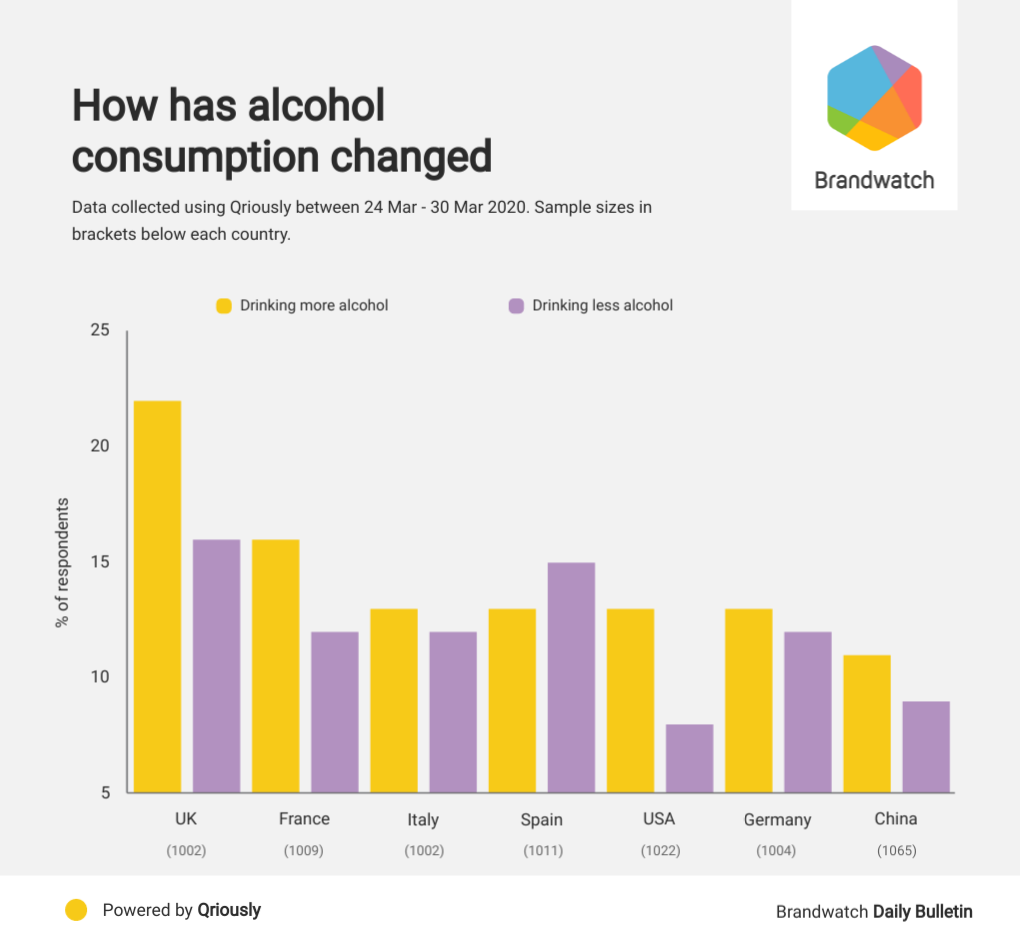
To see how things were trending, we ran a Qriously survey that polled 7,115 adults from China, France, Germany, Italy, Spain, the UK, and the US via their smartphones and tablets.¹

This is what we found.

For the most part, it’s a pretty balanced picture. Some people are drinking more, others are drinking less. But it is clear that a significant number of people have changed the amount they’re drinking.

Although some countries have gone much further one way than the other. In France, the US, and the UK, far more people have increased their alcohol consumption than those who have decreased it. It’s hard to draw conclusions as to why – each country’s stage in the quarantine, their government’s approaches, and national culture will all play their part.

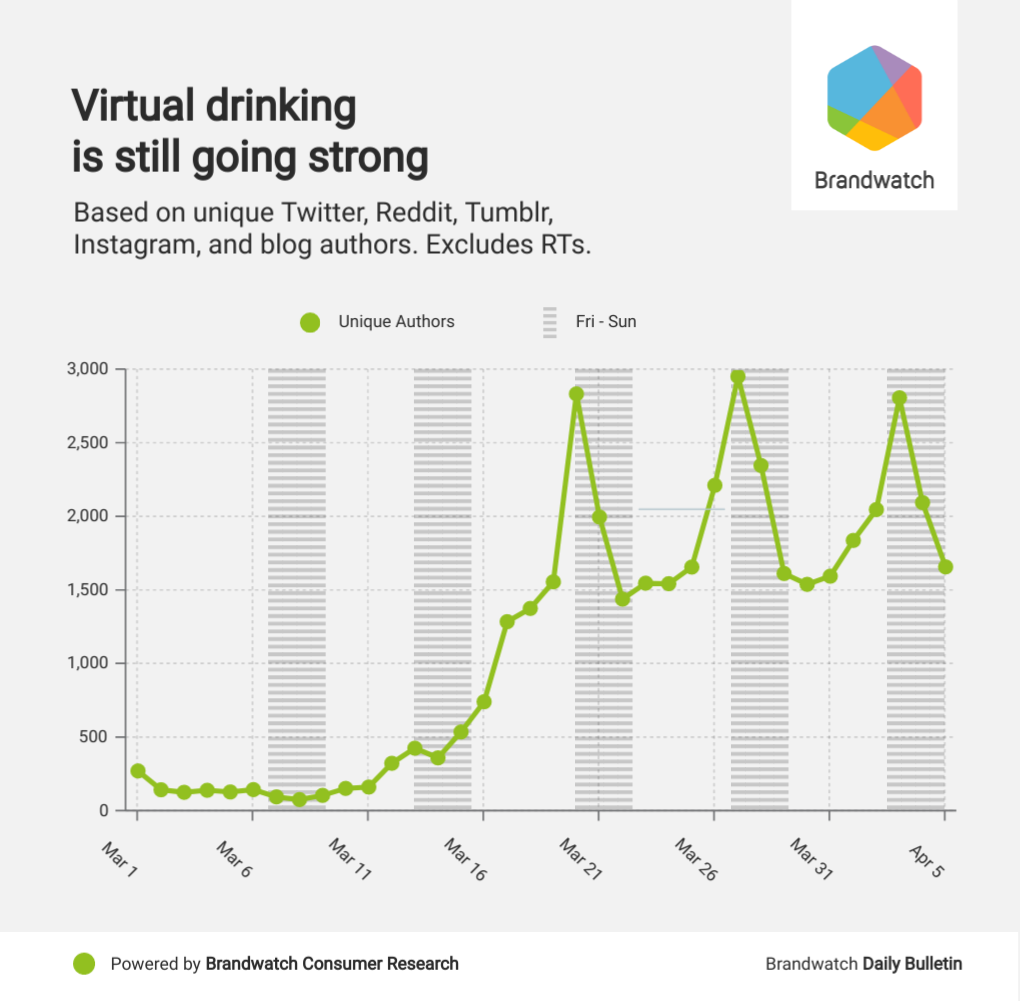
With bars and pubs closed, you might be surprised that some people are drinking more. But the explanation is pretty simple: virtual drinks.

We covered this in a previous bulletin, but we decided to look at it again with more up-to-date data.

Pre-lockdown, we all went out on a Friday night, but now we jump on video calls with a drink in hand. Although, looking at the chart, plenty are doing it midweek, too.

This is an excellent example of how our cultural habits are adjusting to a Covid-19 world. And it looks like virtual drinks are going to be around for the duration of time in which our movement is restricted – it will be interesting to see if people keep up the habit as lockdowns come to an end.

(500) days of quarantine: The changing world of dating

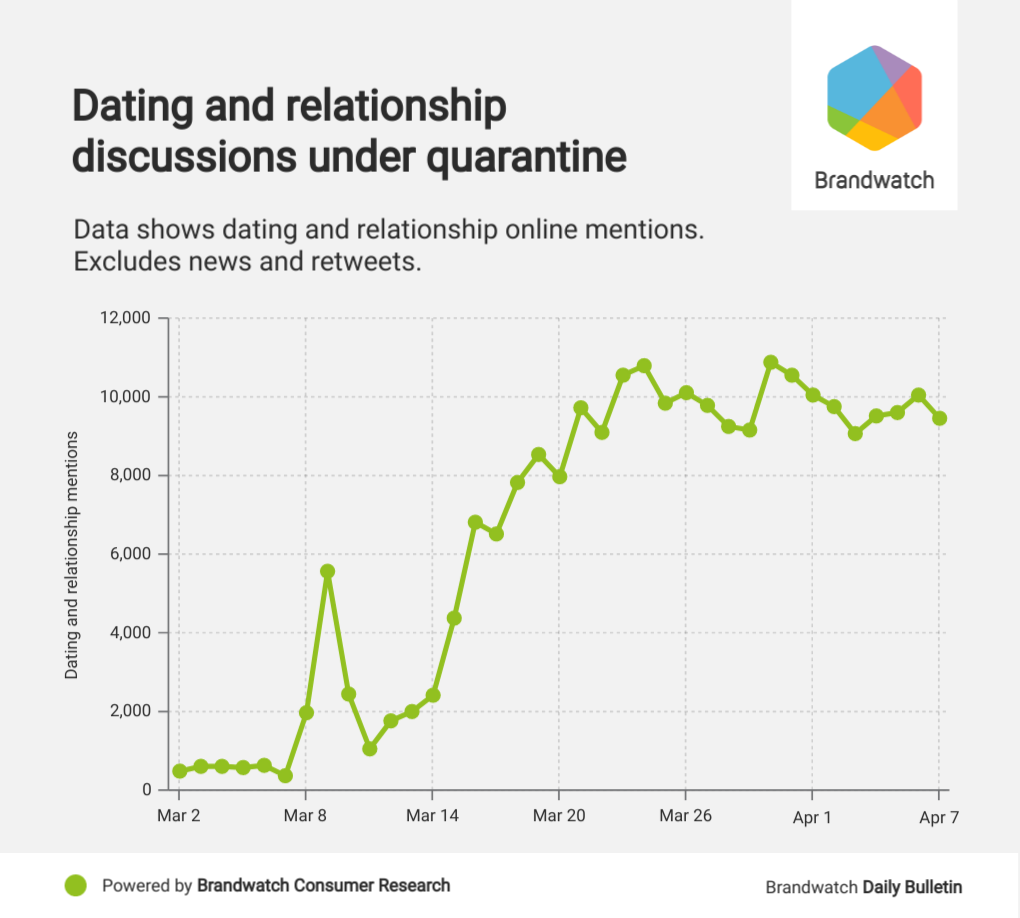
From virtual dates to quarantine partners, the world of dating is changing fast. And there’s plenty to learn from how people are talking about it – we found 673k people discussing romantic relationships in English-language online since the beginning of March.

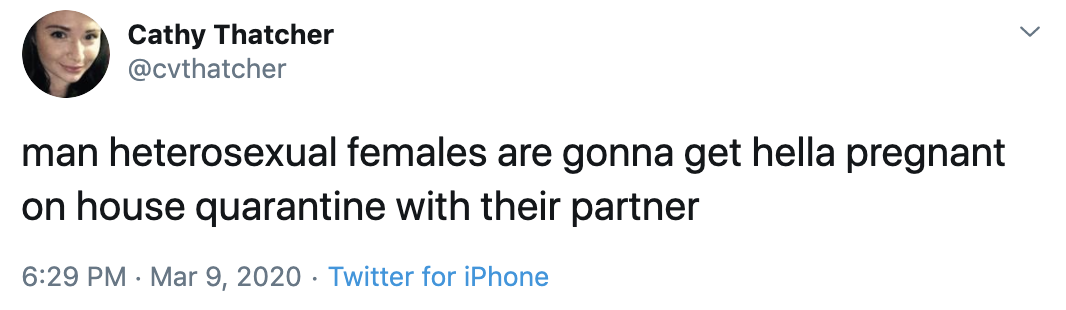
The spike we see on March 9 came was driven by anticipation of a coming lockdown. People made jokes about how relationships would play out under quarantine, though it wasn’t long before we all found out for ourselves.

Mentions of dating then skyrocketed by 728% compared to the previous two weeks, when lockdown was enforced in the UK, the US, and Canada.

As we all tried to get on with our lives indoors, people turned to video dates to keep their romantic lives going. We found 196k mentions about this, with 22k of them referring to first dates.

As an alternative to having dinner with a camera, some couples are using watch parties, a new feature on popular streaming sites where people watch TV or movies together, even though they’re (potentially hundreds of miles) apart. This topic racked up 10k mentions, the majority of which were positive.

New dating slang also emerged in isolation, such as ‘quarantine partners’ – our Consumer Research platform found 43k mentions of the phrase. It’s a term of endearment which refers to the person you’re spending lockdown with.

Just like many other issues we’ve covered in our daily bulletins, it’s heartwarming to see people coming together to make the best of a bad situation. Whether meaningful relationships can be sparked from video dinner dates, or if there’ll be a baby boom in 2020/early 2021, remains to be seen.

Publishers are cutting down on Covid-19 content

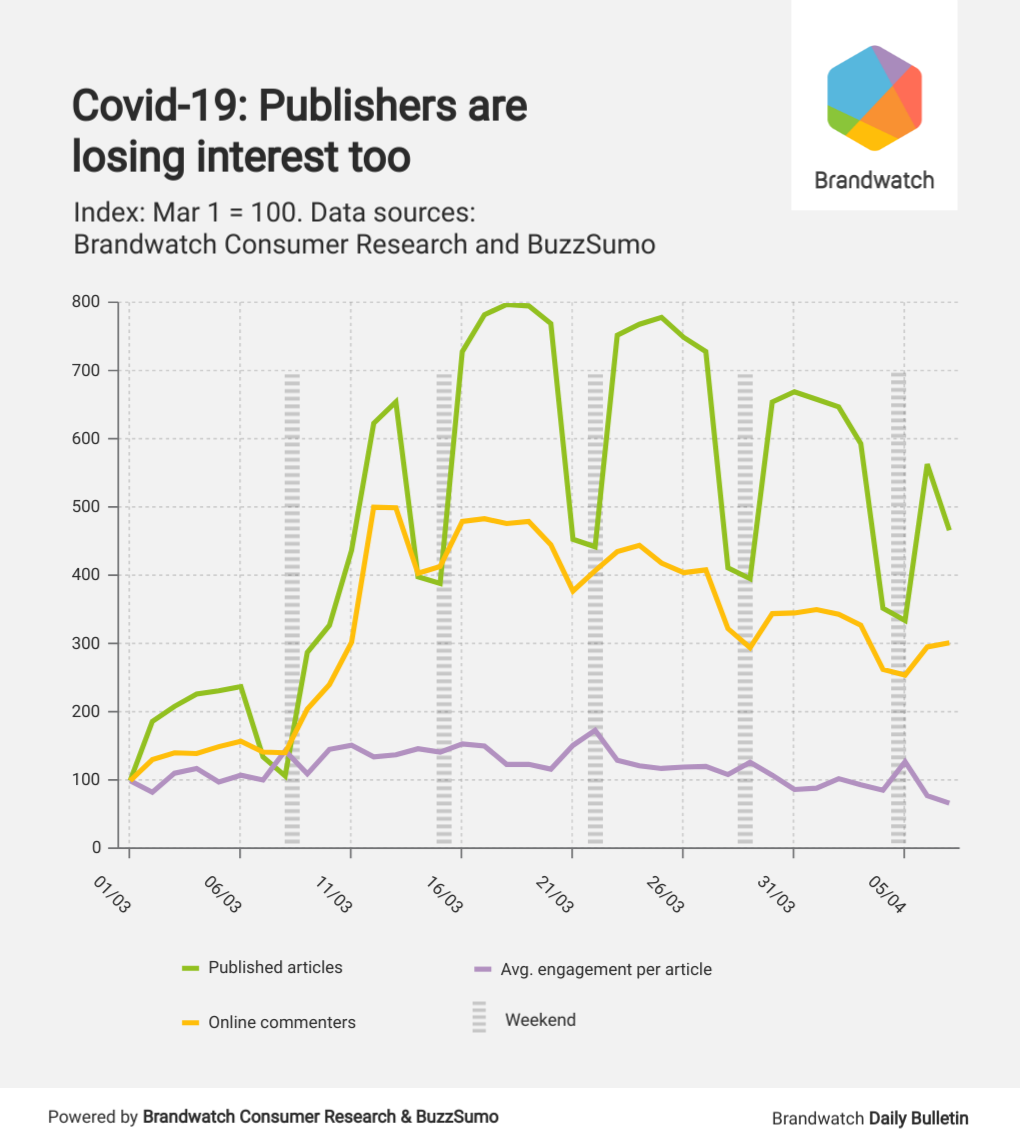
Another week, another update to our Covid-19 fatigue chart, which looks at the number of Covid-19 articles, the average number of social engagements they got, and how many people mentioned the virus online.

Here’s the latest data.

Across the board, numbers are falling – the number of articles, the average engagements they get, and the number of people posting about the virus.

People aren’t necessarily less interested in Covid-19. It’s more likely that they’re just fed up with engaging with or discussing the topic. As death tolls and infection numbers rise, this isn’t much of a surprise.

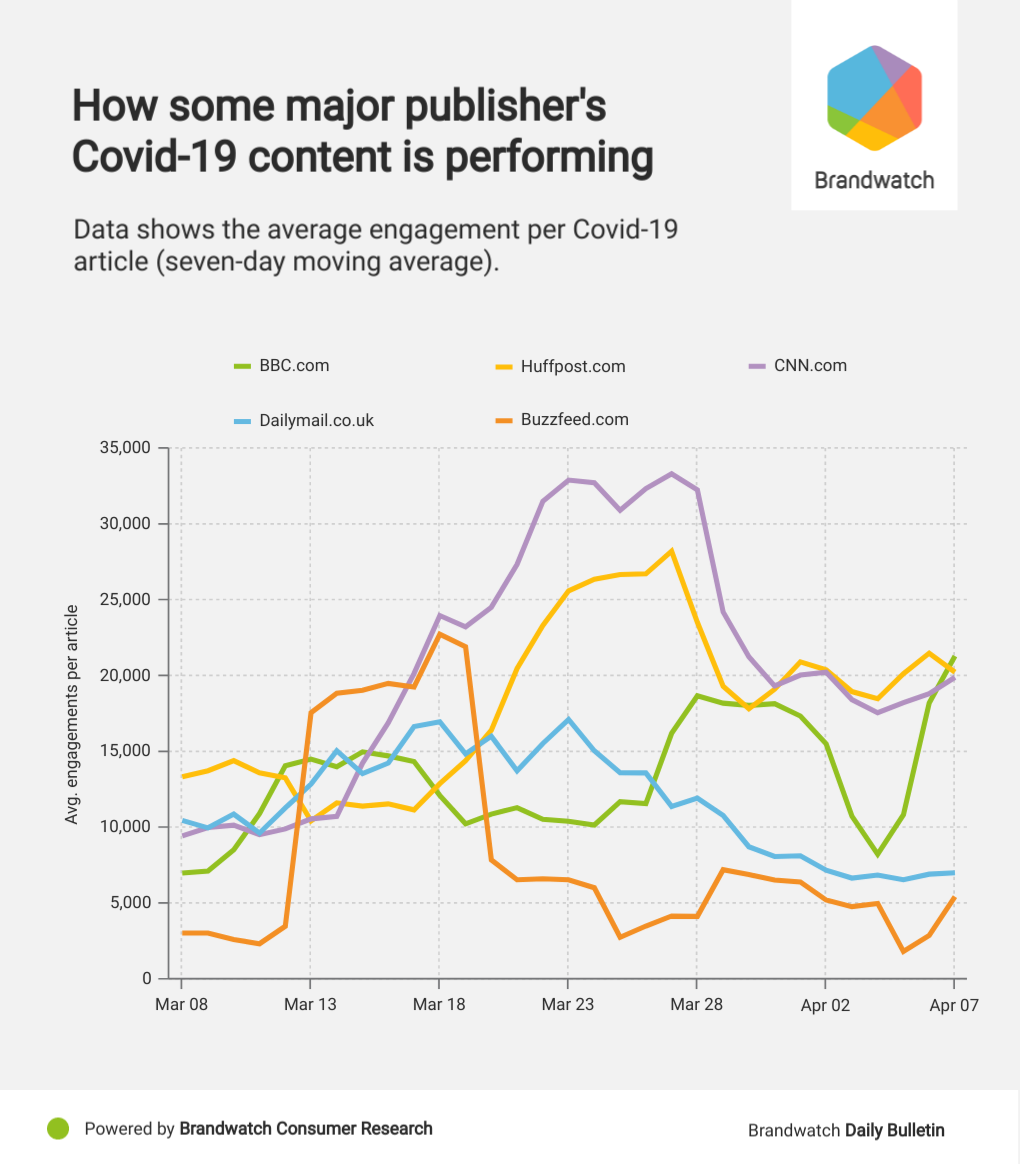
Going back to the publishers, we decided to look at five majors ones to see how they were performing individually. Using BuzzSumo, we looked at the average engagements their Covid-19 articles were getting since March.

Each publisher shows a different story. CNN quickly did well early on, but has since dropped, while the Huffington Post followed a similar trajectory but started a little later. Both seem to follow the waxing and waning interest we saw in the first chart in this section, but are still doing relatively well.

One of the more interesting trends is that of BuzzFeed. They saw their content getting a lot of engagements to start, but then they sharply dropped off and haven’t recovered.

This could show that people have turned away from lighter or more entertainment-focused sites like BuzzFeed for sites that are better known to specialize in news content. Early in March, it felt a lot easier to have a bit of fun and joke around. Then, as the situation developed, that didn’t sit so well with people.

When it comes to Covid-19, people are likely now looking for more sober and informative reporting from news outlets, a space BuzzFeed has never really filled. Although, as people try to find ways to take their minds off the virus, the site will definitely have its place.

Get more in-depth data every week

Want to see more survey data or deeper analysis into Covid-19 topics?

Head here to sign up for our weekly report.

Thanks for reading

We’re signing off for another day. If you enjoyed today’s email, be sure to forward it to others, or send them this link.

And if you’re not subscribed already, get signed up here.

logo
  Our Suite     Use Cases     Industries     Get started  

Runtime Collective Limited (trading as Brandwatch). English company number 3898053
New York | Boston | Chicago | Austin | Toronto | Brighton | London | Copenhagen | Berlin | Stuttgart | Frankfurt | Paris | Madrid | Budapest | Sofia | Chennai | Singapore | Sydney | Melbourne

Privacy Policy

Update subscription preferences

Unsubscribe

We value your privacy

We use cookies and similar technologies to personalize ads and content (including by sharing data with Google), to measure site performance, and to improve your experience. Learn more in our cookie policy

Privacy & Safety • Terms of Service

No, take me to settings
Yes, I agree
More info.

By using our site you agree to our use of cookies —