logo

Brandwatch Bulletin #137: Spilling the Tea on Tea

Go on, treat yourself to a cup.

30 September 2022

Nearly everywhere you go in the world, you’ll find a cup of tea. A diner in New York’s backstreets, a ferry crossing the Bosphorus, the heights of Mt. Everest—tea is one of the most universally-loved drinks on the planet.

It’s about time we turned our attention towards it. In this bulletin, we’ve explored the tea conversation, to see how much we really love it.

Let’s get to it.

Subscribe to the Brandwatch Bulletin

Tea, glorious tea

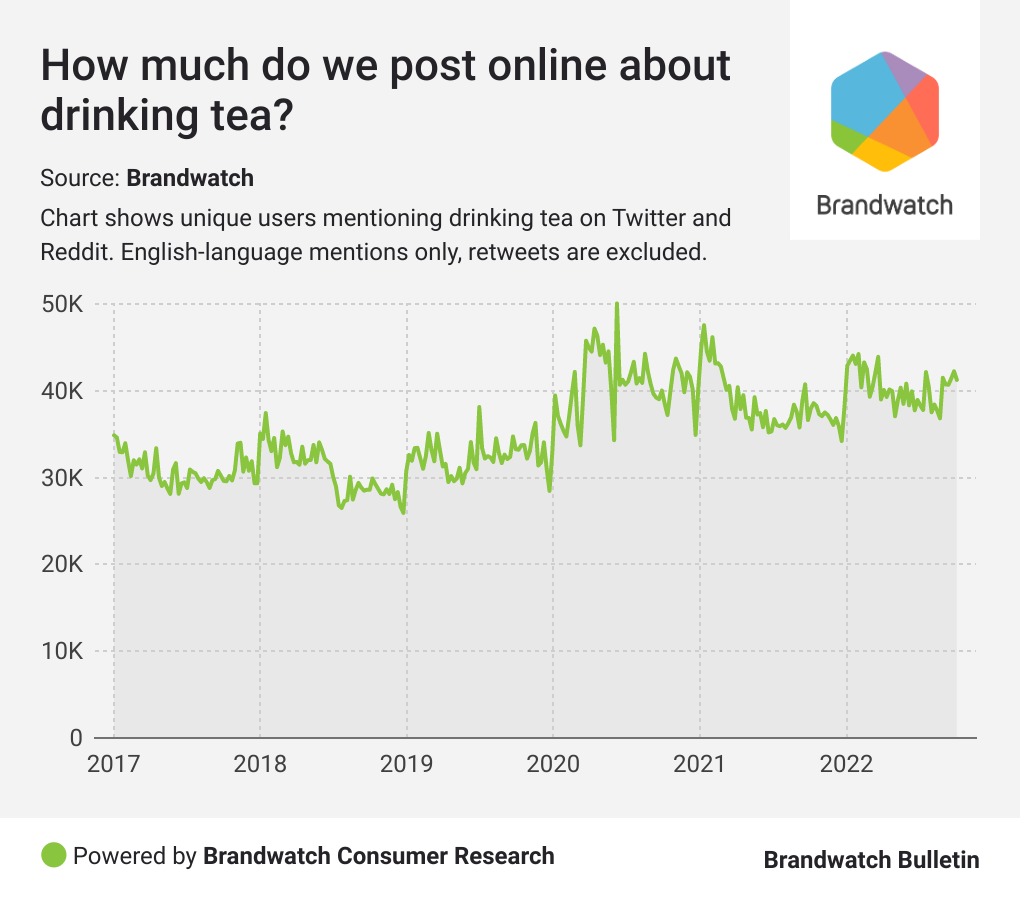
To start, we used Consumer Research to track mentions of people saying they’ve had some tea, to see how this has changed over the years.

A note: This only includes a fraction of the entire tea conversation, but we chose this specification to avoid mentions of tea as a reference to gossip. We’ll save that kind of tea for another bulletin.

We’re also only looking at English-language mentions today, so the majority of the data comes from English-speaking countries.

Here’s how the data looks.

Across 2022 so far, 40k users have talked about drinking tea every single week. That’s a lot of tea. And while these are similar levels to the same period in 2021, there’s signs tea drinking is on the rise this year. If we compare October 2022 so far to the same days in 2021, mentions are up 10%.

It’s clear the pandemic also boosted tea consumption, particularly in the early days. This jump has remained though, and it’s easy to see the difference between 2017 and the start of 2020.

Considering the comforting nature of a cup of tea, it’s no surprise more people are turning to a brew.

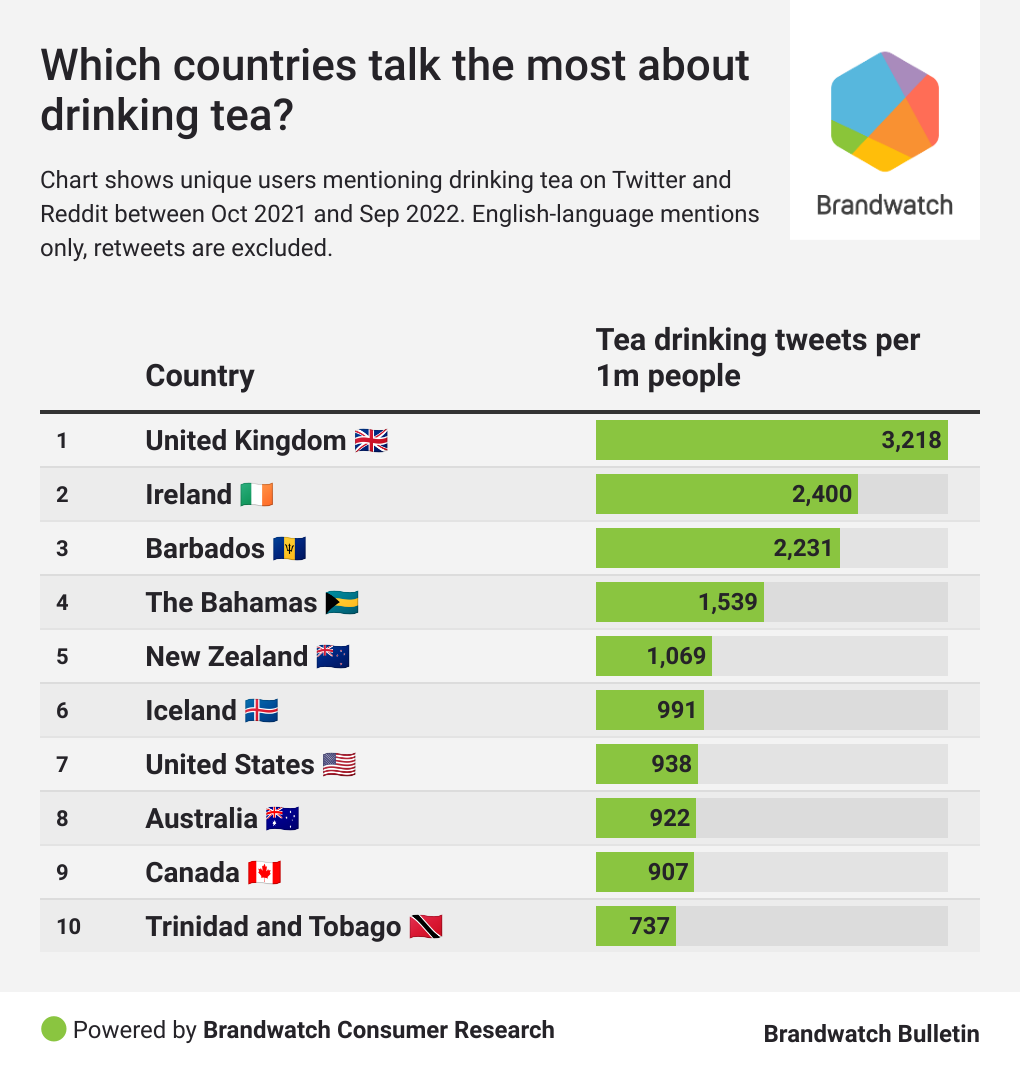
Let’s take a look at how things differ on a country-level. And remember, we’re just looking at English-language mentions here.

I think we all knew the UK would top the list. The country’s image goes hand-in-hand with a cup of tea, and Brits themselves can’t go long without one. But there is a darker side to this data.

Aside from Iceland, all of the countries on the list have been directly affected by the British Empire’s wars and colonialism. It’s possible there is a link here, but of course tea would have been drunk in many, if not all, of these places before the British arrived. We’ll leave any conclusions to the historians.

How do you take your tea emoji?

Another sign of the ubiquitousness of tea is that there’s more than one emoji for it. While the hot beverage emoji is often used for tea, there’s also:

  • Teacup without handle (this visualises a traditional cup of matcha tea)
  • Bubble tea
  • Teapot

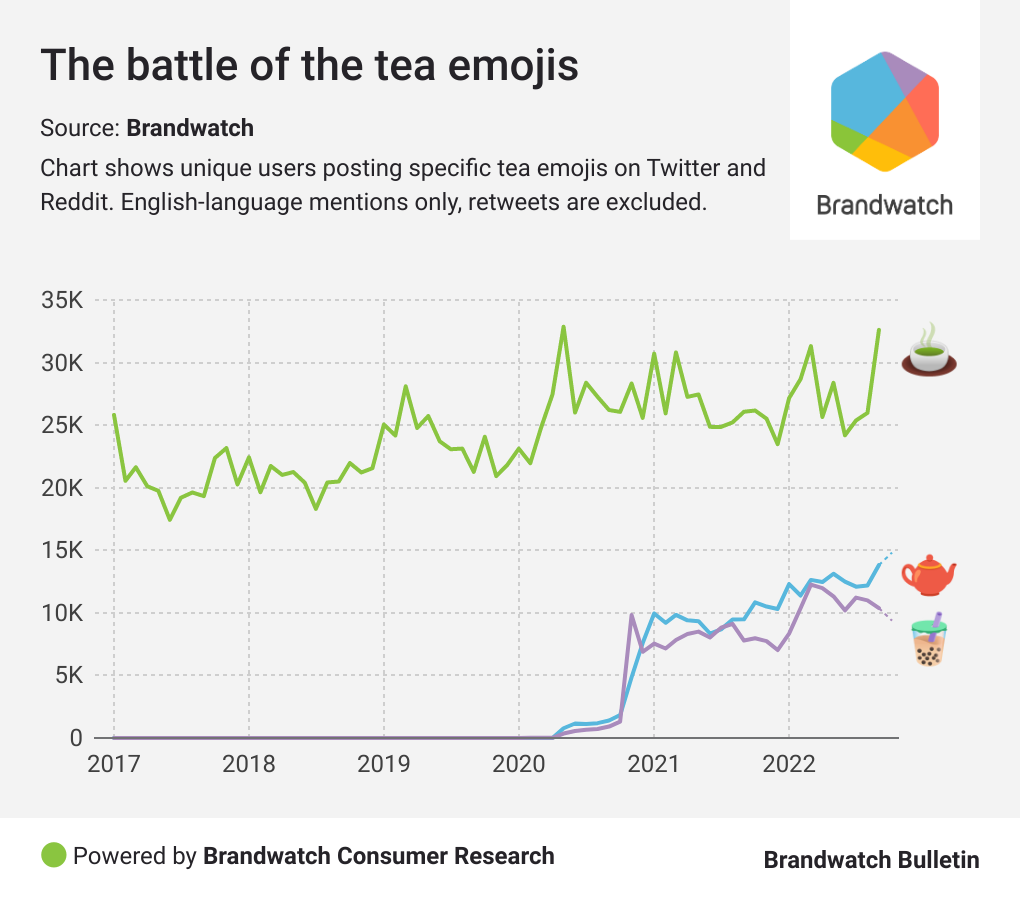
The bubble tea and teapot emojis are relatively new, only being released in 2020. But as we can see below, they’ve quickly become popular.

The matcha emoji sits way above the other two, which you’d expect with a more established emoji. It’s also often used in the tea = gossip context, which has helped to boost its numbers.

But will it stay top forever?

The teapot and bubble tea emojis are gaining ground, and if growth continues as it is, they may catch up. This seems more likely for the teapot emoji which is used in a more general sense, and is unaffected by seasonality. As you can see, bubble tea emoji usage drops in the winter months as the drink’s cold temperature puts people off.

Negativi-tea

Tea wouldn’t be so common if it wasn’t so popular, so we looked at the net sentiment behind our tea-drinking dataset. At first, the results were surprising. The conversation had a sentiment of -18. So, what’s going on here?

When we looked at the data, the answer became clear. We’re specifically looking at people talking about drinking tea, and often we drink tea when something bad happens (especially in the UK). That meant that when a user said why they were drinking tea, it was because of something bad. Hence the negative net sentiment.

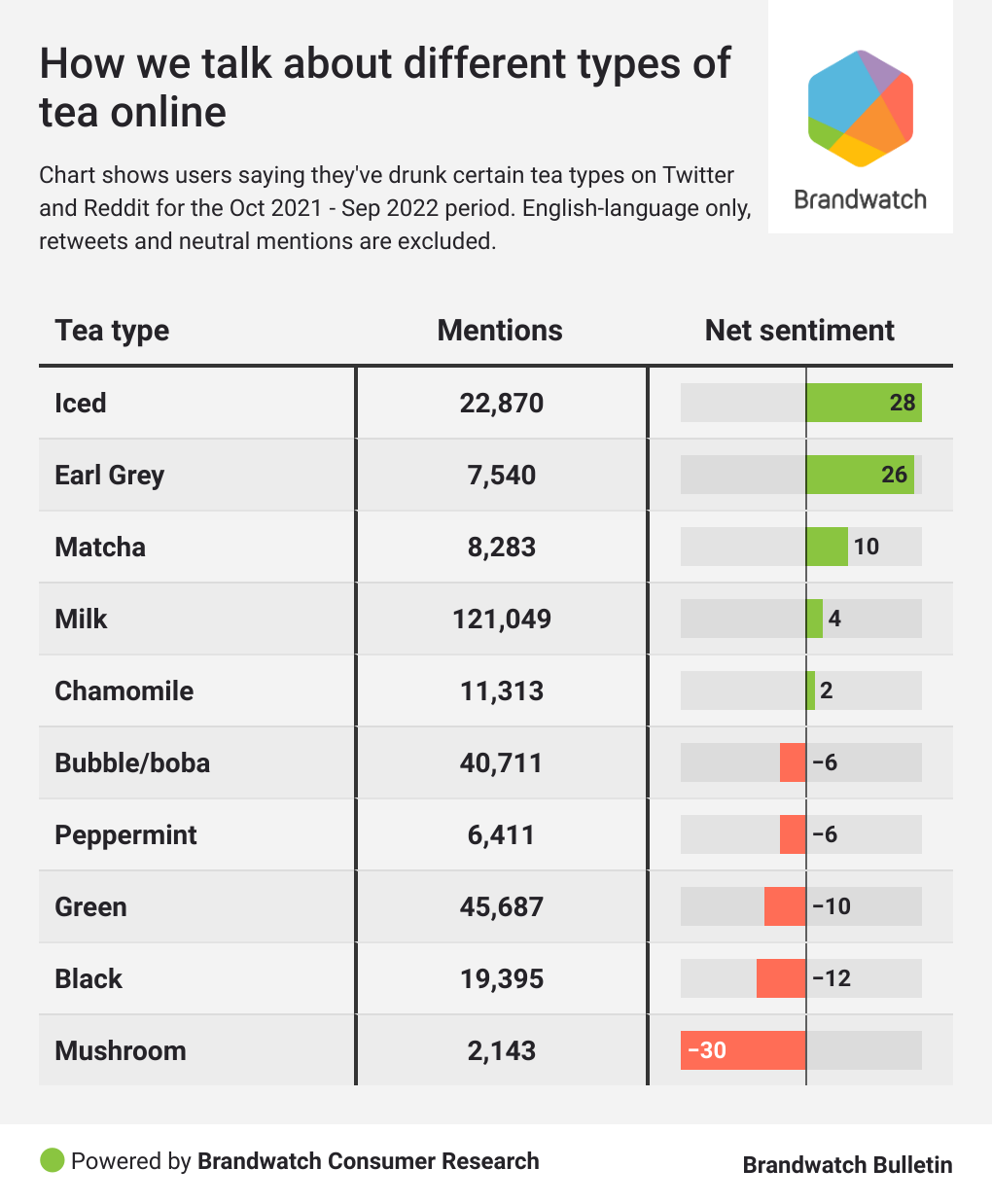
With that in mind, we decided to see whether that changed based on the type of tea.

Iced tea is sitting pretty at the top of the list. And while many of these mentions were caused due to very hot days, the main focus was on its refreshing nature, giving the conversation a strong positive sentiment.

Bubble tea is another interesting example. The beverage has seen a surge in popularity over recent years, so why the negativity? In this case it’s mainly due to low quality products, or people being unable to find bubble tea where they are.

Finally, let’s finish with the one that isn’t like the others: mushroom tea. For the avoidance of doubt, this refers to tea people drink to get high and hallucinate. It’s by far the most negative on the list, and unsurprisingly it’s due to people recounting their bad trips.

The lesson here?

Some people just need a nice cup of Earl Grey and nothing more.

Join our Grow With Social Facebook community

Have some thoughts on today’s bulletin? Or maybe some questions about the data? Why not share them over at our Grow With Social community. We’re very friendly, we promise.

What should we cover next?

Is there a topic, trend, or industry you’d like us to feature in the Brandwatch Bulletin? We want to hear your ideas to ensure our readers get what they want. We may even ask to interview you if you’re involved with the topic.

Send any and all ideas to [email protected] and let’s talk.

Thanks for reading

If you liked what you saw today, sign up for the Brandwatch Bulletin now. We’ll be back next week. See you then.

Stay safe,

The Brandwatch Bulletin team

logo
  Our Suite     Use Cases     Industries     Get started  

Runtime Collective Limited (trading as Brandwatch). English company number 3898053
New York | Boston | Chicago | Austin | Toronto | Brighton | London | Copenhagen | Berlin | Stuttgart | Frankfurt | Paris | Madrid | Budapest | Sofia | Chennai | Singapore | Sydney | Melbourne

Privacy Policy

Update subscription preferences

Unsubscribe

We value your privacy

We use cookies and similar technologies to personalize ads and content (including by sharing data with Google), to measure site performance, and to improve your experience. Learn more in our cookie policy

Privacy & Safety • Terms of Service

No, take me to settings
Yes, I agree
More info.

By using our site you agree to our use of cookies —