logo

Brandwatch Bulletin #175: The Debate Over AI in Education

Can AI help stretched teachers?

5 July 2024

There’s growing intrigue into how artificial intelligence is impacting education in both positive and negative ways. From plagiarism worries to questions on how schools can benefit from artificial intelligence in the classroom, we’ve looked at how people are discussing AI and education online. 

Note: You can read more about this in our brand new education insights report. 

Subscribe to the Brandwatch Bulletin

The growing conversation about AI in education 

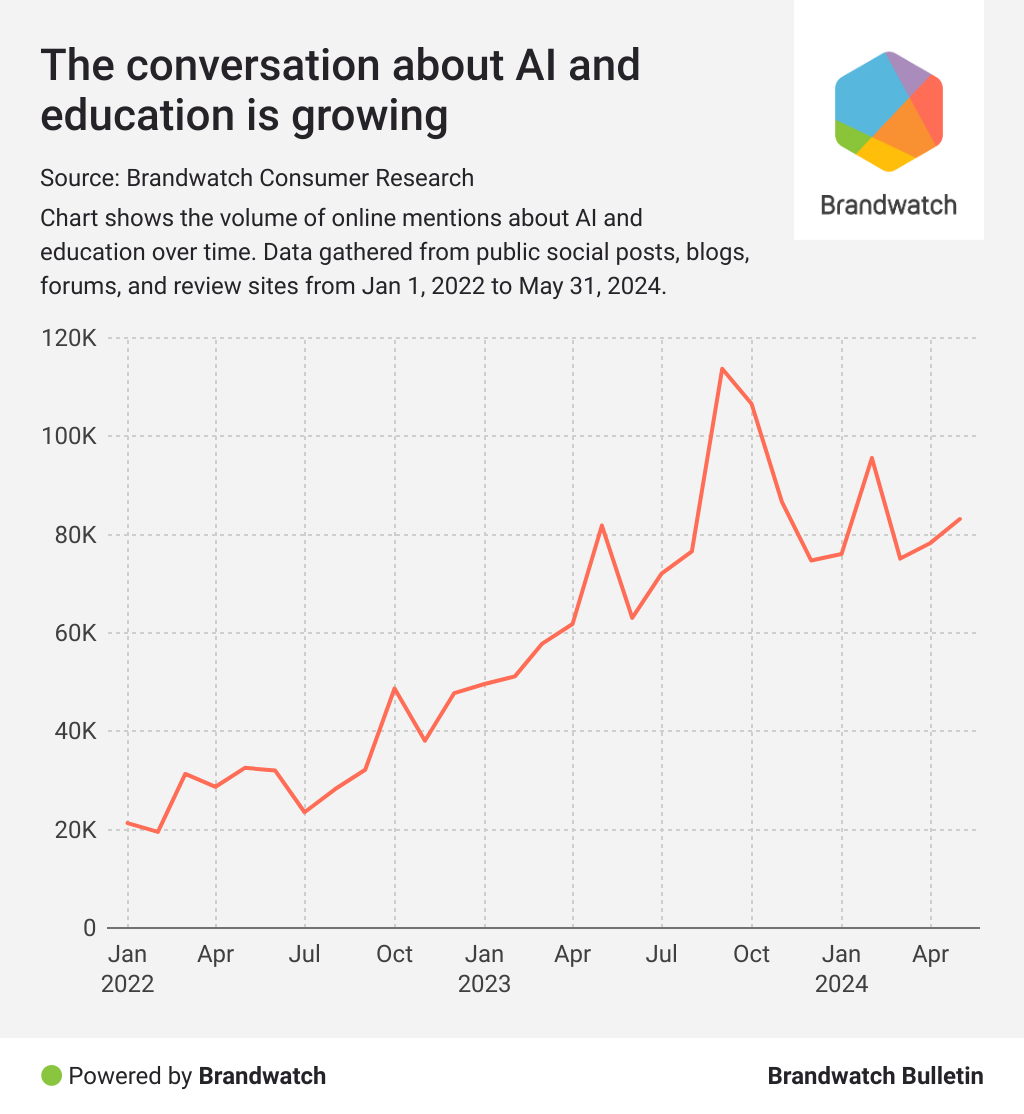
We used Brandwatch Consumer Research to see how mentions about AI and education are changing, finding they’re on the rise.

Since 2022, mentions about AI and education have grown steadily. There have been over 470k mentions about the topic since the start of the year – offering plenty of conversations for us to explore. 

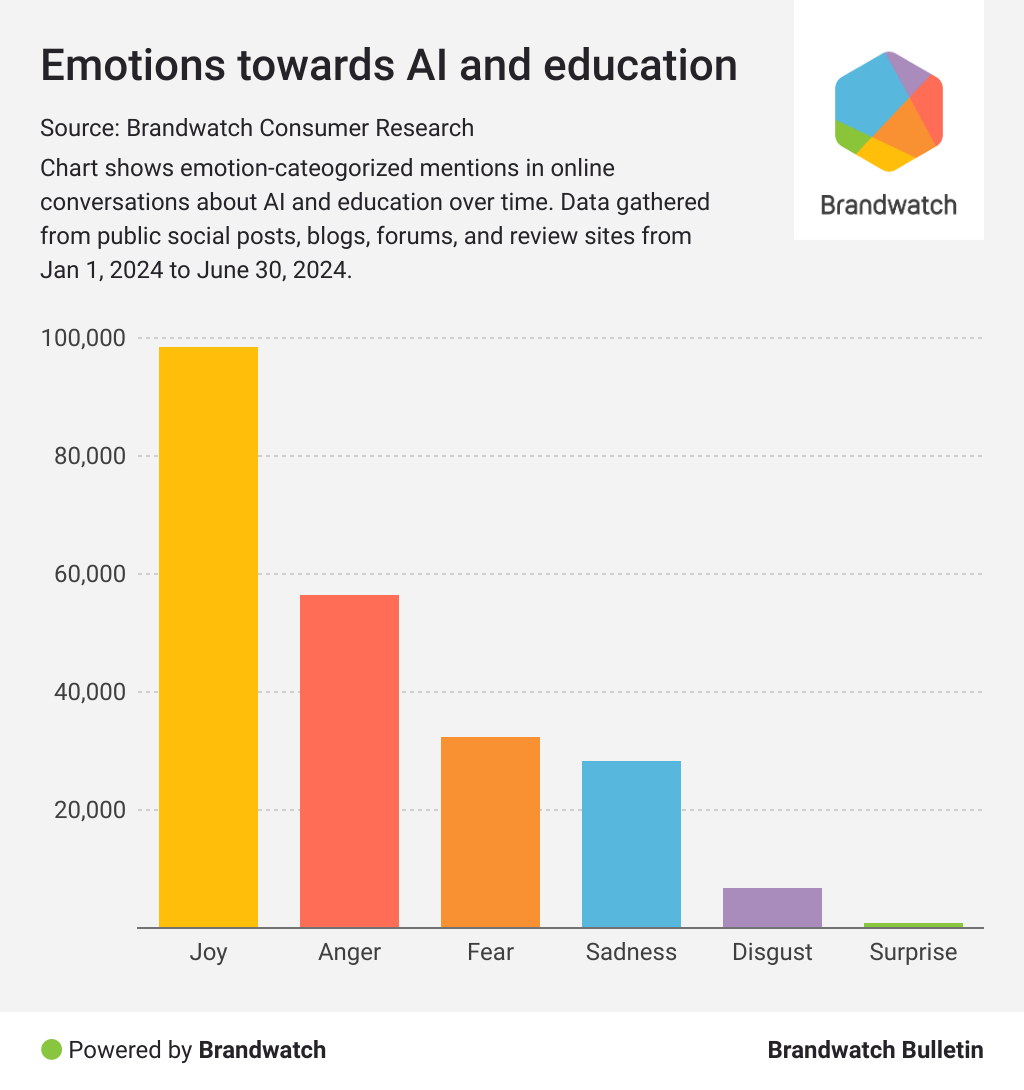
When diving into the emotion behind these mentions, we can see that opinions on how AI can both help and hinder learning are mixed. 

Almost 45% of emotion-categorized mentions about AI and education showed joy, making it the most prevalent emotion in the conversation. People and brands are heading to social media to share excitement about how AI is helping to aid learning.

From how AI is being implemented in classrooms to how people are using artificial intelligence in their personal time to expand their knowledge, AI is certainly an excellent tool for students and teachers to have in their arsenal – when used correctly. 

Negative mentions also tell an interesting story. Anger is the second most prevalent emotion when it comes to AI and education, with almost 60k mentions since the start of the year.

These mentions include students’ frustrations towards the lack of AI regulations in school, teachers’ concerns about students using AI improperly, and general questions about how learning might be impacted by AI. 

Fear and sadness are also key emotions in the AI and education conversation, with mentions including AI’s shortcomings and specific upset about how AI is impacting art-based courses.  

Let’s dive further into the concerns that come with using AI in an educational setting. 

Concerns about AI in education 

UNESCO puts it well, stating that while AI has the potential to address some of the biggest challenges in education, its rapid advancements outpace regulatory frameworks. And this is where many of the challenges that come with AI in education stem from.

Many online mentions discuss worries about AI hampering learning. For example, concerns from students about peers over-relying on AI in an education setting. 

Other concerns stem from the issue of plagiarism. In fact, there have been almost 10k mentions about plagiarism specifically regarding AI in education since the start of the year.

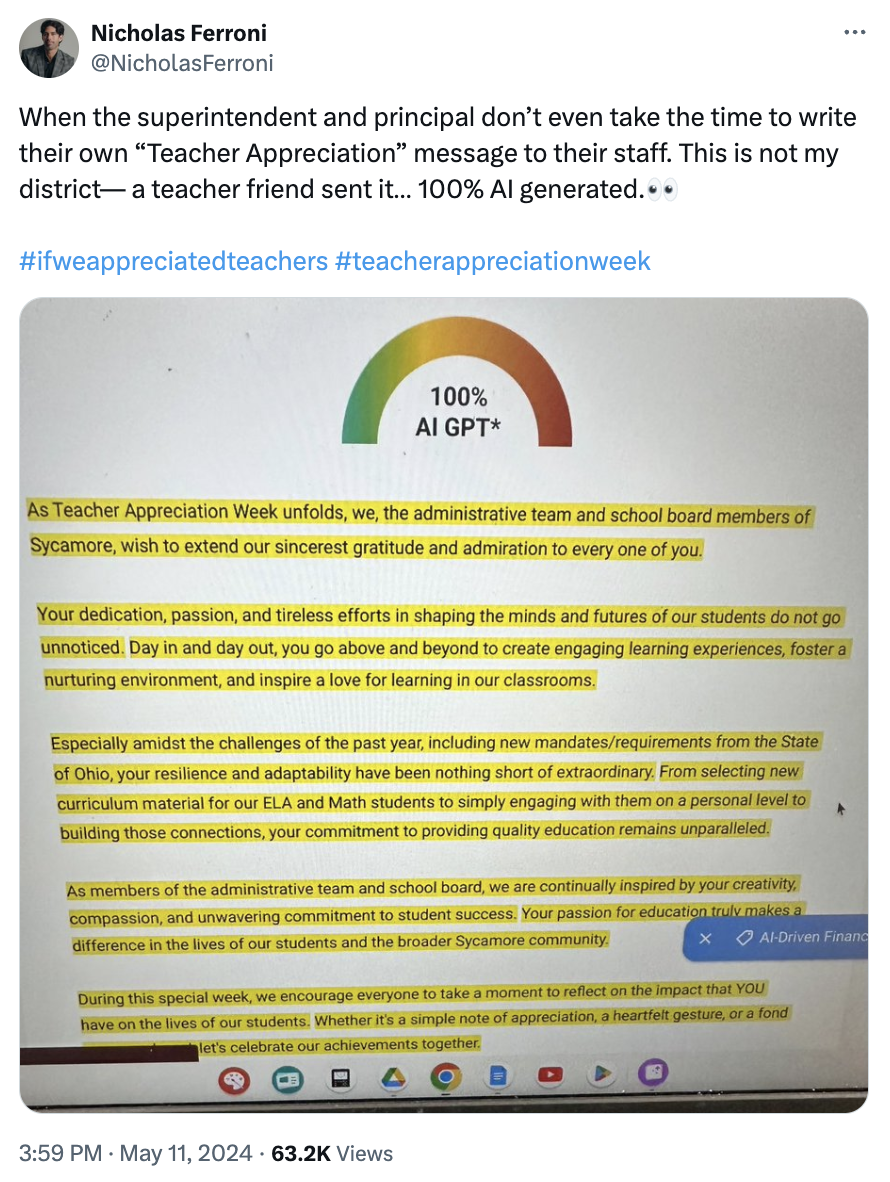
Not all of these mentions are about students either, with some concerned about how professors are using it in insincere ways. From using AI to write emails to using it to mark assignments, there are several ways professors can utilize AI – yet some are more accepted than others. And the post below shows how using it improperly might alienate teachers from students. 

While using AI to write appreciation messages or personable emails to students might not be widely praised, some teachers are using AI in more effective ways.

For example, some professors are utilizing AI to grade papers, and it seems to be working exceptionally well. Governing.com interviewed a few teachers on this topic, and one said it’s helped her students to become better writers – “not because AI did the writing for them, but because automated feedback can tell students faster than she can how to improve.”

In these instances, using AI for basic corrections, such as grammar and punctuation, can help teachers to provide faster feedback to students.

Let’s look at some other benefits of using artificial intelligence in an educational setting. 

The case for using AI in schools 

As we mention in our latest Education Report, using AI for learning can help facilitate more effective and efficient educational practices. Essentially, it can make students’ and teachers’ lives much easier.

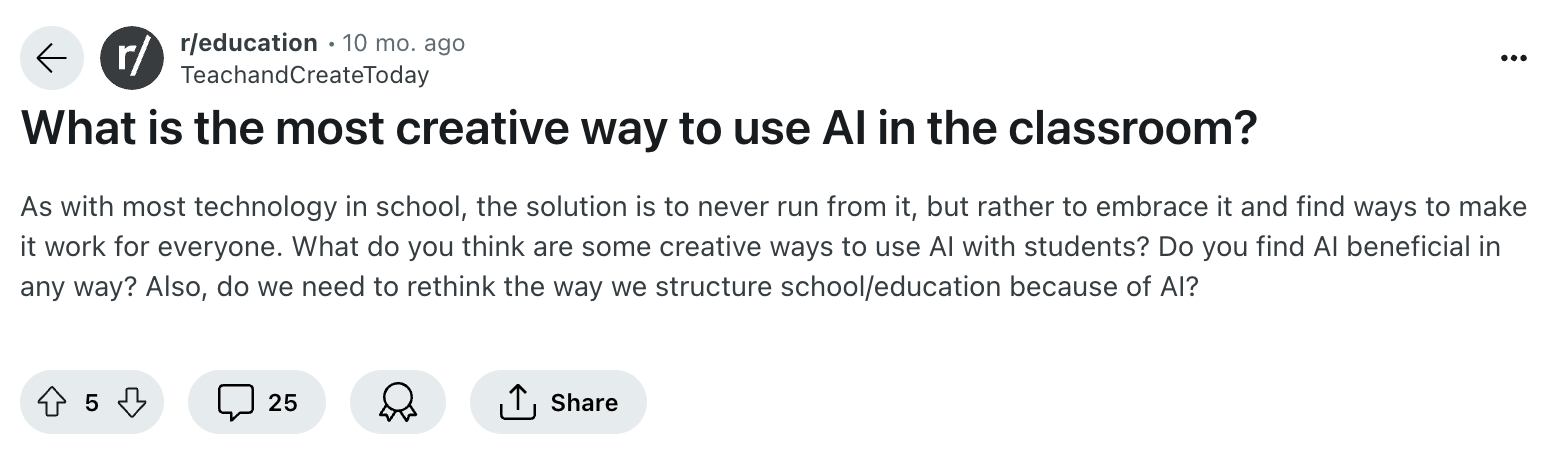
And there are plenty of online threads discussing how AI can be embraced in learning environments, as teachers are curious about how others are taking advantage of new tools. 

Responses on how to use AI in educational settings vary, including: 

  • Creating courses and lesson plans  
  • Using AI as a virtual assistant for teachers 
  • Brainstorming project ideas

Automating administrative tasks can be made much easier using artificial intelligence too, providing more time for teachers to help students. 

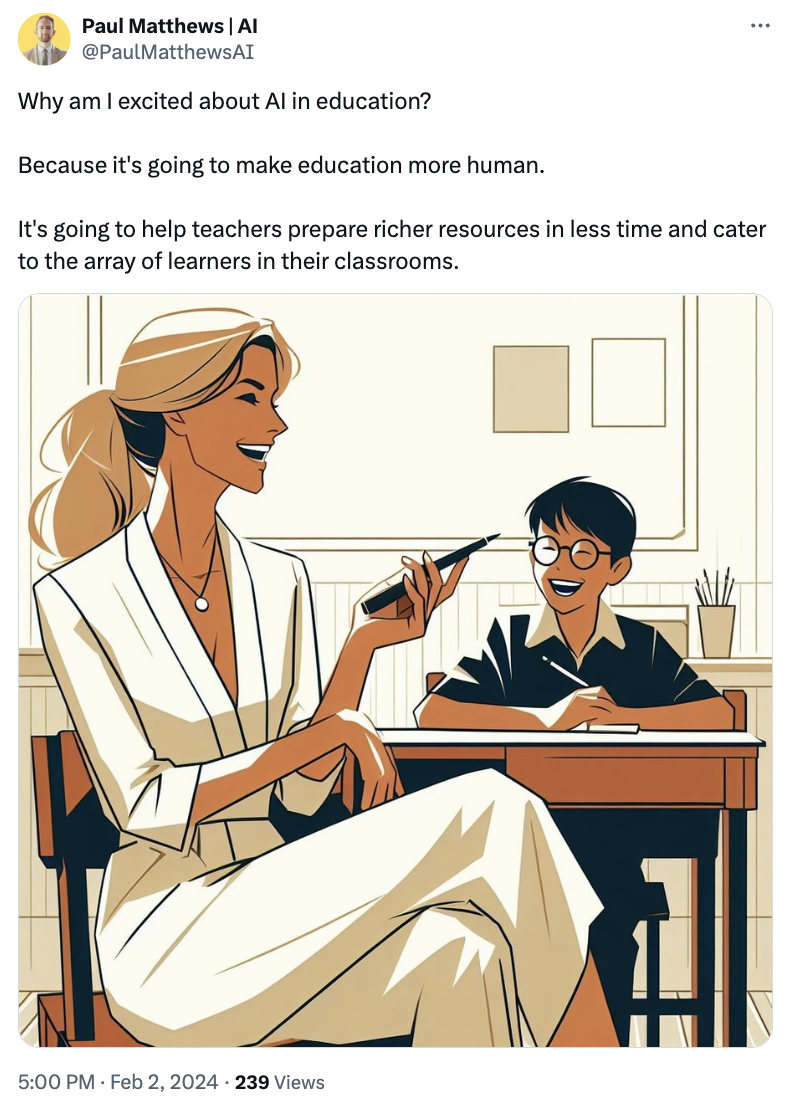
Some professors even recommend teaching students how to write effective AI prompts. For example, with creative writing tasks like the below. 

The options for AI are endless. And many teachers seem excited to see how others are using the tool both in and out of the classroom.

So, how should AI be used in education? 

Utilizing AI improperly – without students’ best interests in mind – can create a divide between students and teachers. But using it appropriately can benefit all parties. 

Schools and educational institutions can benefit from creating proper regulatory frameworks and guidelines for both students and professors to reference when it comes to AI. This way, the integrity of their work won’t come into question.

UNESCO calls for a human-centred approach to AI in an education environment. And higher education establishments, alongside other learning institutions, should keep this in mind when implementing AI into their processes.

Our latest report on Consumer Trends in Education explores the education sector in even more detail.  

What should we cover next?

Is there a topic, trend, or industry you’d like us to feature in the Brandwatch Bulletin? We want to hear your ideas to make sure our readers are getting what they want.

Send any and all ideas to [email protected], and let’s talk.

Thanks for reading

If you were forwarded today’s bulletin and want to get it yourself every month, you can subscribe to the Brandwatch Bulletin here.

See you next time,

The Brandwatch Bulletin team

logo
  Our Suite     Use Cases     Industries     Get started  

Runtime Collective Limited (trading as Brandwatch). English company number 3898053
New York | Boston | Chicago | Austin | Toronto | Brighton | London | Copenhagen | Berlin | Stuttgart | Frankfurt | Paris | Madrid | Budapest | Sofia | Chennai | Singapore | Sydney | Melbourne

Privacy Policy

Update subscription preferences

Unsubscribe

We value your privacy

We use cookies and similar technologies to personalize ads and content (including by sharing data with Google), to measure site performance, and to improve your experience. Learn more in our cookie policy

Privacy & Safety • Terms of Service

No, take me to settings
Yes, I agree
More info.

By using our site you agree to our use of cookies —