
How Cision Uses Brandwatch to Master Social Media Management

Cision’s three-person social media team continuously optimizes how they use Brandwatch tools to manage social presence across Brandwatch and Cision while proving the ROI of the very tools they recommend to customers.
The team centralized all social media operations across both brands using Social Media Management. They built approval workflows in Publish to streamline content reviews, created custom Measure dashboards to prove business value with real-time reporting, and used Consumer Research alerts to monitor conversations and boost AI visibility.
The team has streamlined content approvals and now manages multiple brand accounts seamlessly with just three people. They’ve built a scalable social media content strategy focused on increasing visibility in AI-powered search results.
Social Media Management, Engage, Measure, Publish, Consumer Research
Social media management is only getting more complex year after year.
For our very own social media team, these challenges are a daily reality. As part of Cision, the team now manages social presence across multiple accounts for a global social intelligence company. That means their work represents the brand and must prove the value of the very tools they're asking marketers to trust.
Our social media team uses Social Media Management and Consumer Research every day. This case study unpacks exactly how they do it – and what you can take away for your own team.
In this case study, we’ll hear directly from Meghan Meeker, director, social media, Katie Slayford, senior social media manager, and Flor Liondi, community marketing coordinator.
You’ll read about how the team uses Brandwatch to:
- Manage omnichannel engagement
- Scale content creation without burning out
- Turn social listening and online data into actionable insights
- Prove ROI on social media
Let's explore how Meghan, Katie, and Flor tackle the biggest challenges in social media management using Brandwatch tools.
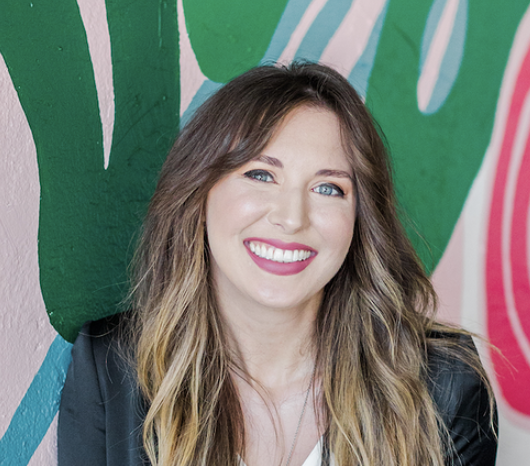


Escaping the social media admin grind
The challenge: Maintaining control without becoming a bottleneck
As director of social media, Meghan’s responsible for every social post that goes out on the company's behalf. That means she needs visibility into what's coming, what's live, and what needs her sign-off. And when it comes to the budget for social media campaigns, it's only as safe as the results Meghan and her team can prove.
For Katie, who manages Brandwatch’s social channels day to day, the challenge lies in constantly "jumping between tasks and platforms." Content creation, community management, customer service inquiries, competitor monitoring – all these activities need to happen in real time, across multiple channels.
The solution: Keeping everything in one place
As a seasoned social media expert, Katie is a firm believer that everything needs to live in one place.
"The platform is just easy," she says. "It slots into our daily routine without thought and supports all the processes we need."
The team uses the Publish module to plan and schedule content well in advance. For Flor, it's become essential. "The scheduling and planning features are integral for my day-to-day work. I use them for mapping out content each month, keeping everything organized and on track."
This gives Meghan what she calls a "1.000-foot view" of everything happening across the team. She can see what's coming, spot gaps, and make sure the messaging stays consistent with the brand's voice – without needing constant check-ins or status meetings.
The solution: Streamlining approvals
"How did social media managers do their work before approval workflows?" – Meghan Meeker, Director, Social Media, Brandwatch
Every social media director managing a team faces a tricky balance: they need to review posts for quality but without getting in the way. For Meghan, this has always been a central challenge.
"All of the social media posts for the company roll up to me to be approved and checked over," she explains. Instead of endless email chains and version confusion, the team uses approval workflows in Publish where feedback happens right where it needs to – on the post itself.
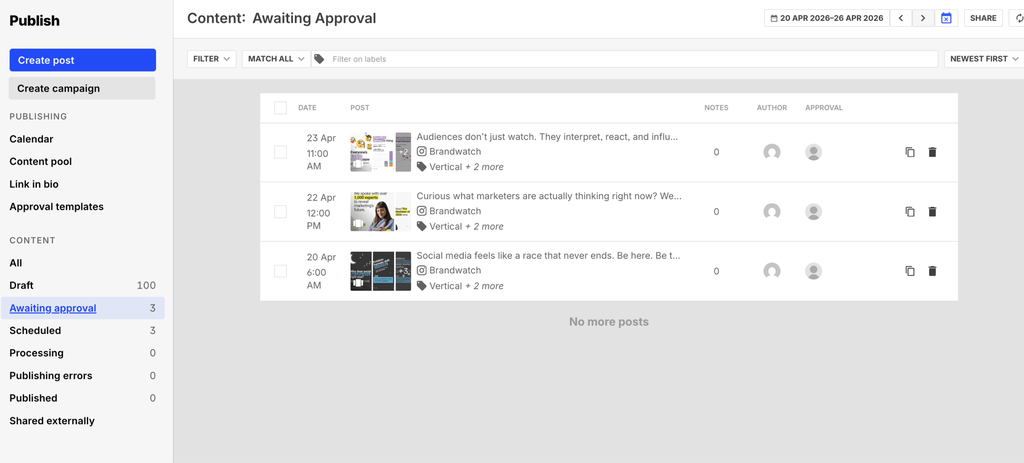
Katie loves how approvals work compared to her previous roles. "It has made the process a lot easier than at previous companies I've worked at. Our team has easy communication due to the comments and tagging."
Katie and Flor submit content, Meghan reviews and leaves feedback within the platform, and everyone can see where each post stands.
With 30 to 40 posts moving through approvals each month, the workflow keeps quality high without slowing anyone down.
Fighting creator's block
The challenge: Keeping up with content demands
Staring at a blank page is tough enough. Posting consistently for a niche audience that expects real expertise – like Brandwatch’s own LinkedIn group for social media professionals – is a different kind of pressure altogether.
And if you also have to calculate metrics by hand to identify the winning content formula, content planning starts eating into creative thinking.
The solution: Letting the data lead
Flor takes the guesswork out of content planning by continuously listening to what people are already talking about in real time. It has changed her approach to content entirely. "Instead of asking, 'What should we post?' I now ask, 'What are people actually talking about, engaging with, and responding to right now?'"
Katie uses the same approach, "I use Consumer Research to create social content, track mentions of our brand and look at competitors. The dashboards make it easy for me to see all the information I need quickly and in a clear way."
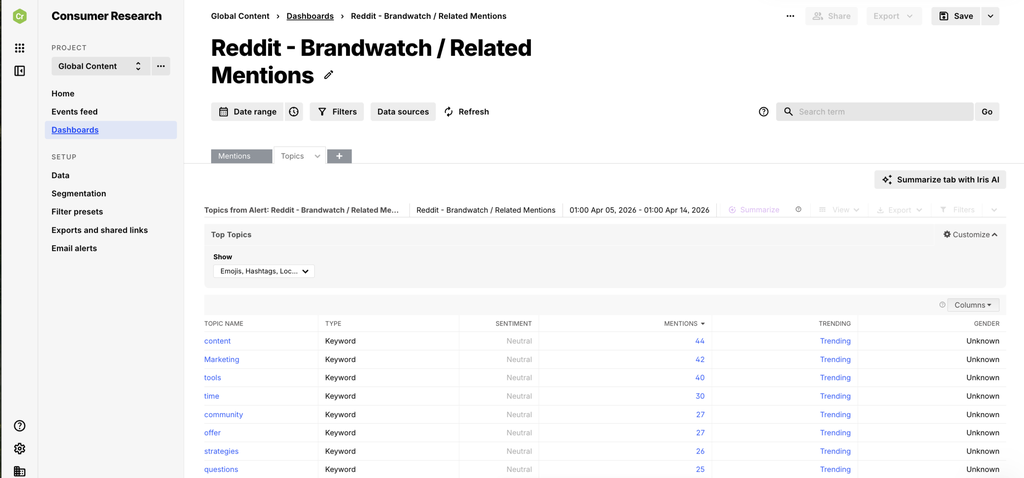
Listening to and learning from real audience conversations makes content planning a lot more strategic. The best content ideas are already out there in your audience's conversations. You just need to know where to look.
Never missing a conversation
The challenge: Turning scattered data into actionable insights
Data is only valuable if you know what to do with it, and fast. For social teams, the goal is simple: "see everything in one place" so they can act quickly. But when brand mentions are scattered across Reddit threads, Instagram comments, LinkedIn discussions, and X conversations, spotting the moments that matter is harder than it sounds.
The solution: Spotting opportunities in social data
Katie has been managing Brandwatch's channels for years, and she knows that jumping between platforms is a recipe for missed messages and burnout. Engage’s custom feeds give her "an easy look at our inboxes throughout the day."
"We're the first port of call for a lot of customers when they have issues or errors," Katie says. That means spotting customer service questions fast, jumping into conversations, and staying on top of how the brand is showing up online – all without losing her mind to dozens of browser tabs.
Flor uses the same approach. "I use it to engage with our audience by responding to questions, joining conversations, and addressing any concerns."
With just three people managing multiple brand channels, this centralized setup means faster responses and nothing slipping through the cracks. The team responds to nearly 2,500 inquiries annually across all accounts via Engage.
Playing the long game with AI visibility
The challenge: Getting suggested in AI search responses
The way people discover brands is changing fast. As more people turn to AI-powered search platforms like ChatGPT and Perplexity, ranking #1 in search results isn’t the only goal anymore. Now, brands also need to be mentioned, cited, and recommended in AI-generated responses.
The solution: Joining conversations AI pulls from
Being active on platforms like Reddit matters more than ever – it's the top citation source for tools like Perplexity and Google AI Overviews. That means every conversation the social team joins, every question they answer, every mention they earn – it all shapes how AI platforms talk about Brandwatch.
This is where the team's strategy has evolved in particularly interesting ways.
"We use Consumer Research to increase our AI visibility," Meghan explains. "We monitor online conversations for mentions of folks looking for social media monitoring or scheduling tools and jump in where appropriate. Participating in those conversations helps to increase how often AI suggests our products!" The key is being genuinely helpful – answering questions, sharing insights, and participating authentically in the community. In other words, no sales pitches, just being a good community member.
The team has Consumer Research alerts set up for brand mentions and relevant topics. So, when someone on Reddit asks about social listening tools, for example, they get notified and can join the conversation.
Katie has taken this approach and expanded it. "It has let us focus on community management, especially as we shift to Reddit. Doing this has increased our visibility on LLMs and boosted our search results."
And industry experts are starting to take notice, too.
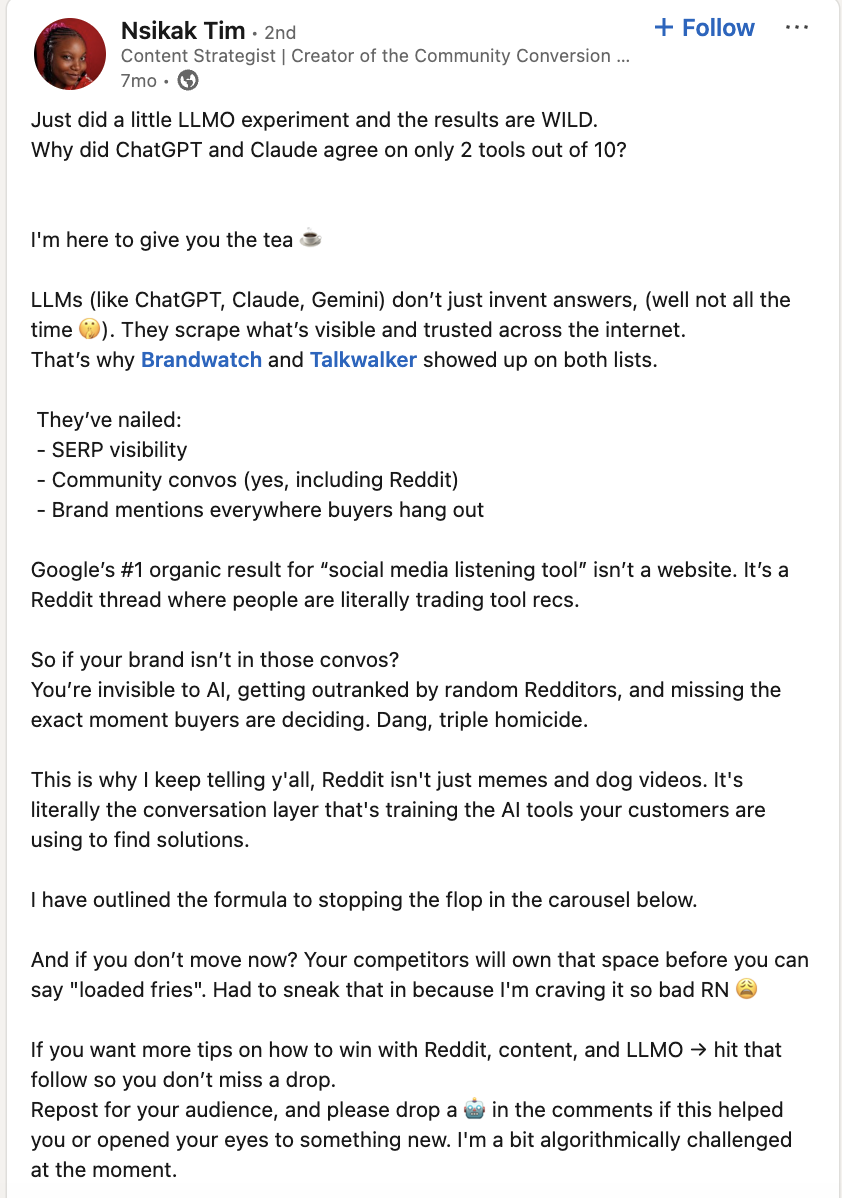
Seeing beyond vanity metrics
The challenge: Tying metrics to business goals
Perhaps the biggest challenge facing any social media team is proving that what you do matters to the business.
"I couldn't do my job without being able to show and prove the success of our organic social media efforts," Meghan says.
No leadership team wants to hear about likes and follows; they want to understand how social media contributes to pipeline, revenue, and brand perception. When you’re managing multiple channels and campaigns at once, being able to tell that story clearly is what makes the case for social media management.
The solution: Creating smart reporting
Showing the business value of social media to the executive team is the only way to continue getting their support. To make that case, Meghan has built an entire reporting system around custom dashboards.
"Within Social Media Management, Measure is my best friend," she says. "I couldn't imagine doing my job without it."
The team relies on three types of dashboards:
- Brand health dashboards that track ongoing brand performance across social
- Campaign dashboards that prove ROI for specific initiatives
- Content performance dashboards that show what's working (and what's not)
"I love having the ability to create custom metrics dashboards as needed," Meghan notes. With customizable dashboards, Meghan can answer executive questions on the fly and always be ready to present the right numbers to the right people.
Flor's life is easier because of this too, "It removed a big manual step – I no longer have to calculate metrics by hand, since the tool pulls them automatically. That saved time and made reporting much more efficient.”
For a three-person team, that’s not a small thing; it’s the difference between spending hours compiling data manually and using that time to do the work that matters.
Adapting strategy in real time
The challenge: Making sense of what’s working across platforms
The Brandwatch social team is constantly testing new approaches and adjusting their work based on what the data tells them.
The solution: Tagging posts to unlock deeper performance insights
Meghan recently got the team to rethink their entire tagging strategy, so they could pull deeper insights from post tags.
The team uses what they learn to make smarter decisions. For example, they can see which employee-led videos beat static graphics, which topics get the most engagement, and which formats work best on each platform.
Here’s one post that got lots of traction.
It's the kind of continuous improvement that only works when analytics are accessible to everyone on the team, not locked away in a monthly report. And for Meghan, Katie, and Flor, that means they can keep adapting their strategy as platforms, audiences, and priorities shift.
The bottom line
You don't need a bigger budget or more headcount to make an impact. You need systems that let you work smarter – centralized tools that eliminate the admin grind, data that helps you spot opportunities before they pass, and reporting that proves your value to the business.
Whether you're a team of one or leading a global social media operation, the challenges are remarkably similar. The difference lies in having the right workflows and insights to move faster, decide smarter, and prove value without burning out in the process.
Published on May 20th, 2026
You're in the right place!
Existing customer?Log in to access your existing Falcon products and data via the login menu on the top right of the page.New customer?You'll find the former Falcon products under 'Social Media Management' if you go to 'Our Suite' in the navigation.
You're in the right place!
Brandwatch acquired Paladin in March 2022. It's now called Influence, which is part of Brandwatch's Social Media Management solution.Want to access your Paladin account?Use the login menu at the top right corner.