logo

Brandwatch Bulletin #132: We Need To Talk About Money

The taboo on money chat has lifted.

2 September 2022

Energy bills are soaring, and food prices are rocketing. In this bulletin, we look at how the conversation around the cost of living has changed in the last two years and the impact on people’s personal finances.

Let’s get to it.

Subscribe to the Brandwatch Bulletin

The conversation is growing

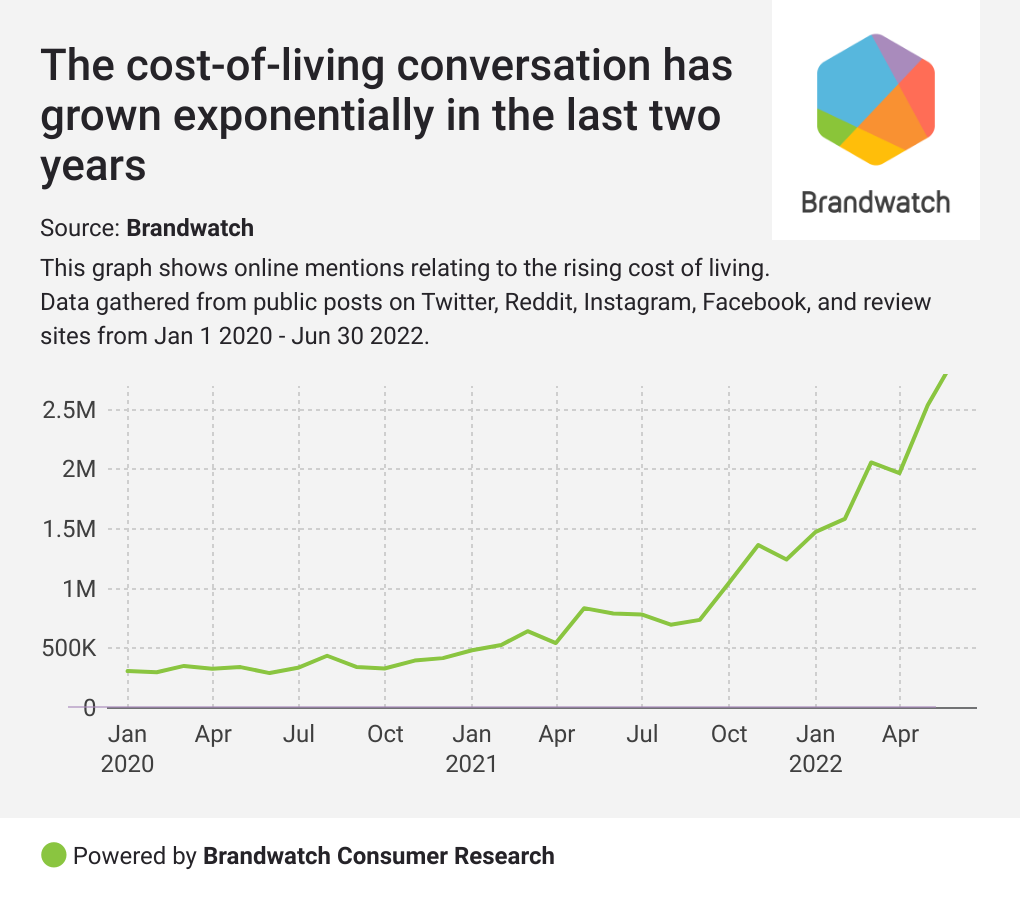
With the help of Consumer Research, we’ve examined online consumer conversations relating to the rising cost of living between January 1 2020 and June 30 2022.

The general cost-of-living conversation has seen a steep growth in mention volume since January 2020. And this growth has been especially apparent since September last year.

Between September 1 2021 and June 30 2022, the number of mentions relating to the cost of living surpassed 17m. This shows an impressive increase of 178% compared to the previous period. Over 5.5m unique authors discussed the climbing costs of living, nearly twice as many compared to the previous 10-month period.

What consumers can’t afford

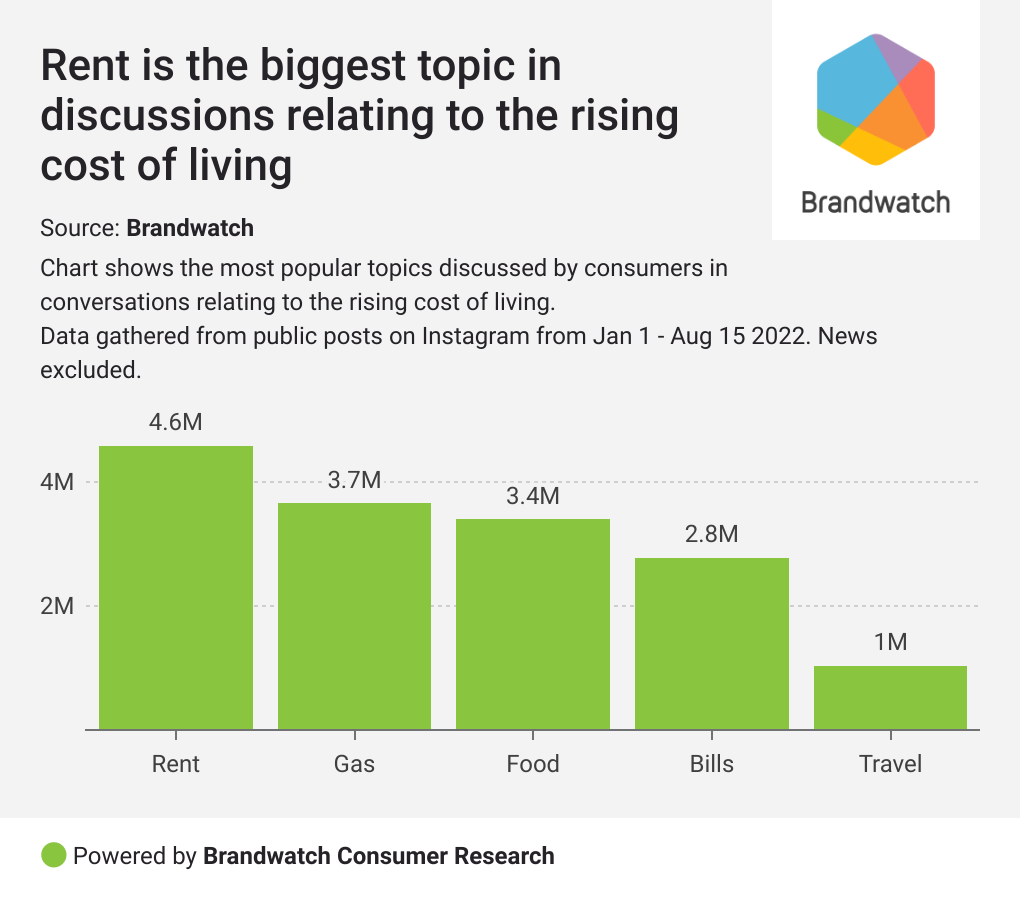
What topics did consumers discuss in conversations relating to the rising cost of living?

A breakdown of online conversations between January and August this year showed that consumers most often talked about the rising cost of living in relation to paying rent, followed by gas/petrol, food and groceries, bills, and traveling.

The ‘rent’ bar on this chart is not surprising. A recent report by Redfin, a full-service real estate brokerage, stated that the median monthly asking rent in the US surpassed $2,000 for the first time in May 2022. With rent being an ever-present necessity in many people’s lives, it seems consumers are being hit by these increases the hardest.

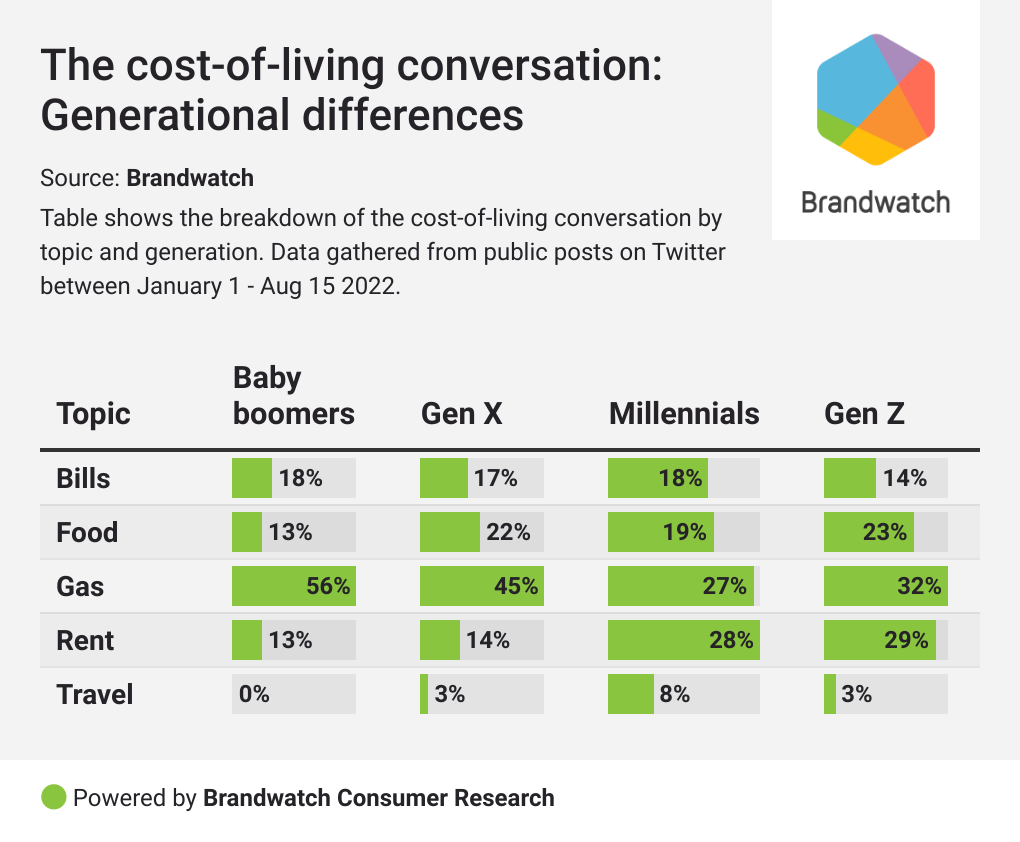
By examining this conversation further using Brandwatch’s Social Panels, we learned that there were some generational differences in how consumers discuss cost-of-living topics.

Rising gas prices were the biggest concern for baby boomers and Gen Xers. Rent and food saw the highest percentages in mention volume among Gen Z. Out of all generations, bills and traveling were mentioned the most by millennials in conversations relating to the rising cost of living.

Talking personal finances online

The topic of personal finance has never been more relevant than it is today, two and half years since the pandemic started. Consumers are increasingly using social media to discuss what they spend their money on and seek advice from one another on personal finance.

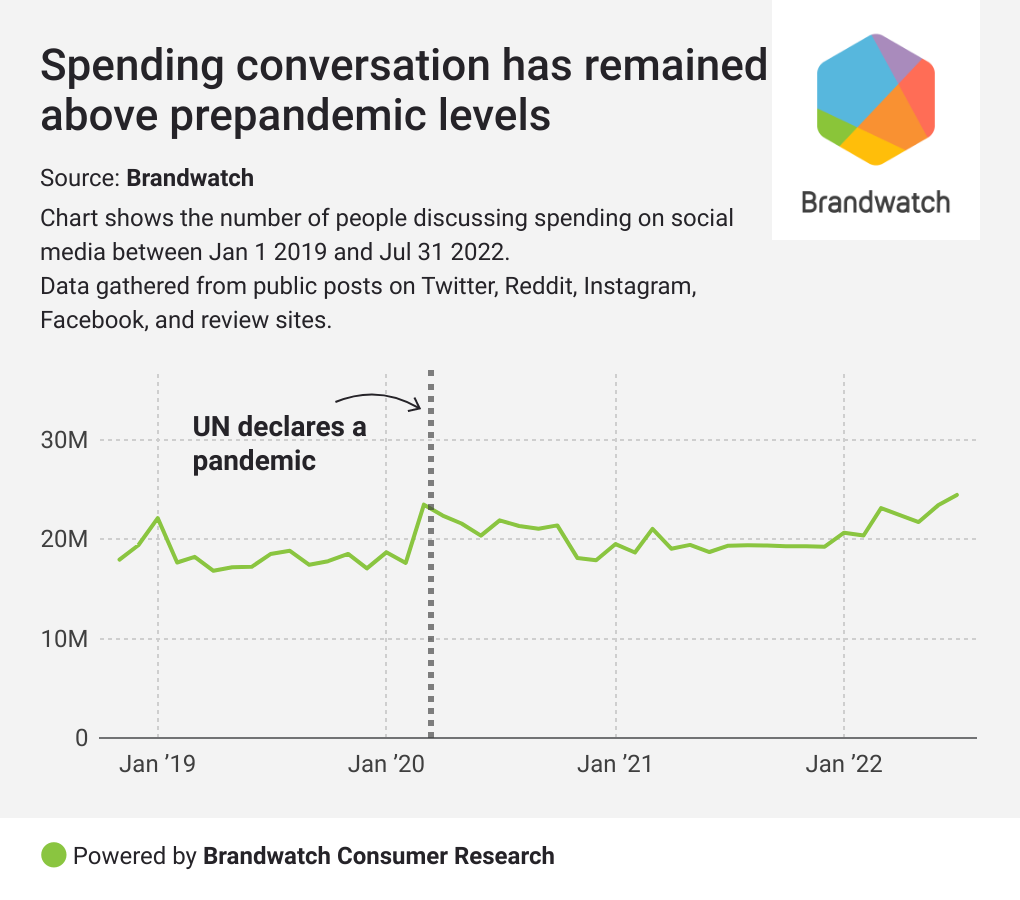
We looked into the spending conversation to see how it compared to pre-pandemic levels.

The volume of mentions about spending has remained higher than pre-pandemic. This year alone, there were close to 170 million mentions relating to spending, a 19% increase from the previous 7-month period.

And while mentions of spending don’t necessarily correlate with increased spending, consumers are sharing more about their spending habits online, providing a roadmap to those willing to study consumer behavior.

Online consumer spending

The pandemic has helped accelerate the world’s shift to digital payments. Today there are many ways consumers can pay for goods and services besides using their debit or credit cards, such as mobile wallets and mobile payment service apps.

In fact, at the end of 2020, there were over 2.8 billion mobile wallets in use. This number is projected to increase by nearly 74% in 2025.

Global payment technology has grown, which prompts a question: Where do consumers go for more information and advice relating to existing digital payment options?

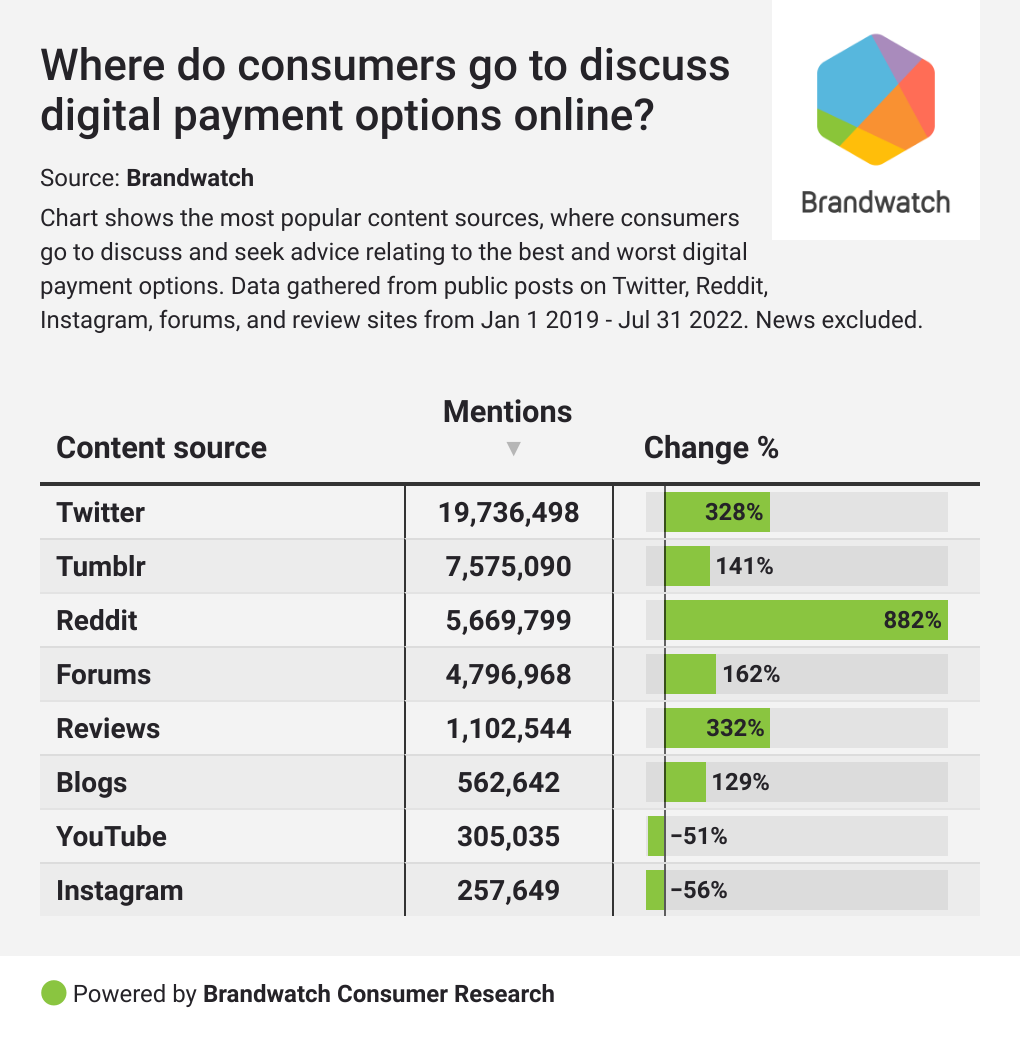
We researched the conversation around 10 popular payment methods online, including such options as ‘buy now, pay later’ and Klarna, to see what content sources consumers turn to for more information.

It turned out that while Twitter accumulated the most mentions relating to the digital payment topic, the conversation on Reddit has grown by 882% in the last year and a half, followed by review sites with a growth of 332%.

What does this mean for brands in the financial services industry?

With the proliferation of payment tech, consumer excitement around spending also seems to have grown. For the best chance of future success, finance services brands must closely monitor consumers’ changing preferences, identify concerns and feedback, and feed those social consumer insights back to their product and marketing teams.

At Brandwatch, we’ll continue analyzing how consumers spend, and how they’re thinking about their finances.

Join our Grow With Social group

If you work in social media, whether it’s management or data analysis, you should join our Grow With Social Facebook group. Here we discuss anything and everything to do with social media, while it’s a great place to ask for expert advice from the community.

Why not head over there now and tell us what you think about today’s bulletin?

What should we cover next?

Is there a topic, trend, or industry you’d like us to feature in the Brandwatch Bulletin? We want to hear your ideas to ensure our readers get what they want. We may even ask to interview you if you’re involved with the topic.

Send any and all ideas to [email protected] and let’s talk.

Thanks for reading

If you liked what you saw today, sign up for the Brandwatch Bulletin now. We’ll be back next week. See you then.

Stay safe,

The Brandwatch Bulletin team

logo
  Our Suite     Use Cases     Industries     Get started  

Runtime Collective Limited (trading as Brandwatch). English company number 3898053
New York | Boston | Chicago | Austin | Toronto | Brighton | London | Copenhagen | Berlin | Stuttgart | Frankfurt | Paris | Madrid | Budapest | Sofia | Chennai | Singapore | Sydney | Melbourne

Privacy Policy

Update subscription preferences

Unsubscribe

We value your privacy

We use cookies and similar technologies to personalize ads and content (including by sharing data with Google), to measure site performance, and to improve your experience. Learn more in our cookie policy

Privacy & Safety • Terms of Service

No, take me to settings
Yes, I agree
More info.

By using our site you agree to our use of cookies —