logo

Covid-19 Daily Bulletin 15/07: The Year of the Road Trip

Get your playlists and snacks ready.

Welcome to today’s bulletin. This time we’re looking at how attitudes towards travel have evolved during the pandemic, and at the rise in interest in road trips.

Make sure to subscribe to our bulletins by clicking the button below.

SUBSCRIBE

Wandering less versus wanderlust

As we get further into the northern hemisphere’s summer months, vacations and travelling are increasingly on people’s minds. Whether people want to drive across the border for a day trip or fly up from Australia for a European city break, the pandemic means they have to rethink how they travel.

We used Brandwatch Qriously to ask people about their current and future travel plans. With 4,093 adults from Australia, China, France, Germany, Italy, Spain, the UK, and the US surveyed through their smartphones and tablets, here’s what we found out.

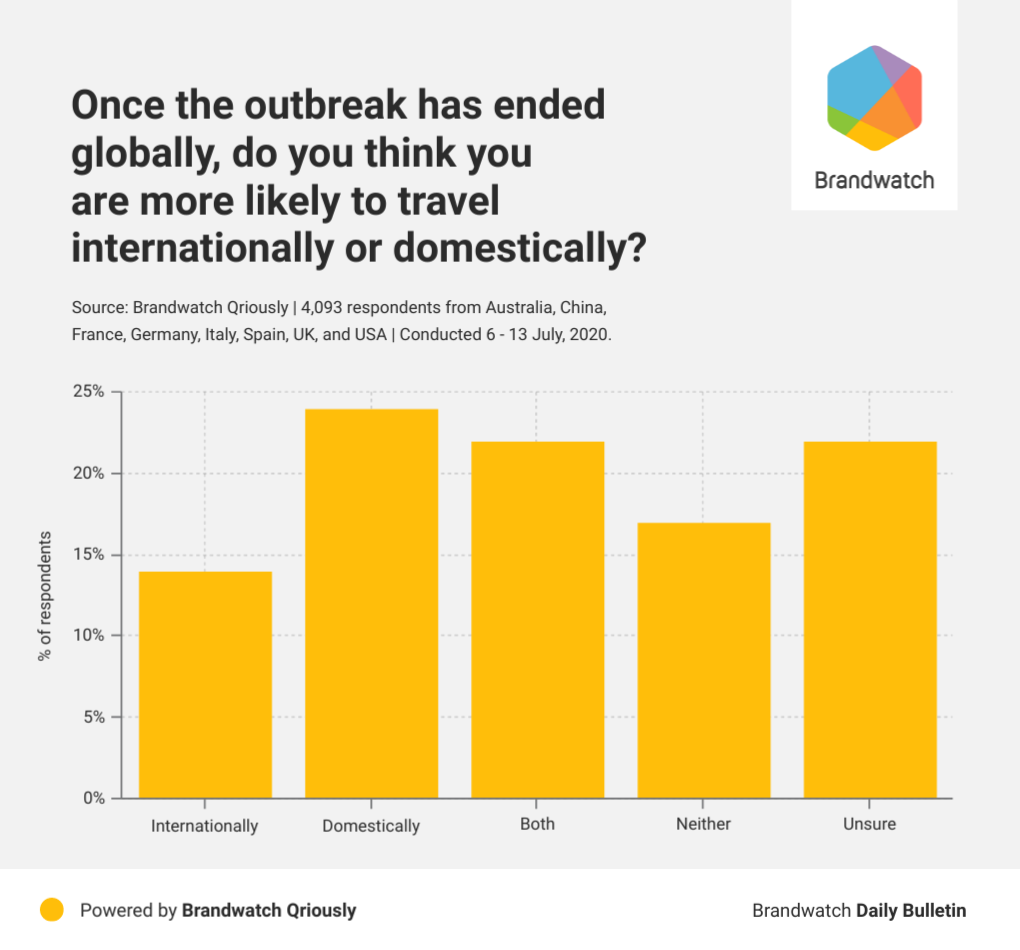
First let’s take a look at what people are planning to do post-pandemic (even if that feels like wishful thinking at the moment).

Even when presented with the idea of the outbreak ending, there’s still a lot of uncertainty. 22% of respondents said they were unsure if they’d travel internationally or domestically.

This uncertainty makes sense as we don’t know when the outbreak will end or what our individual circumstances may be when that happens. So does this really say anything about what people are going to do in the near future?

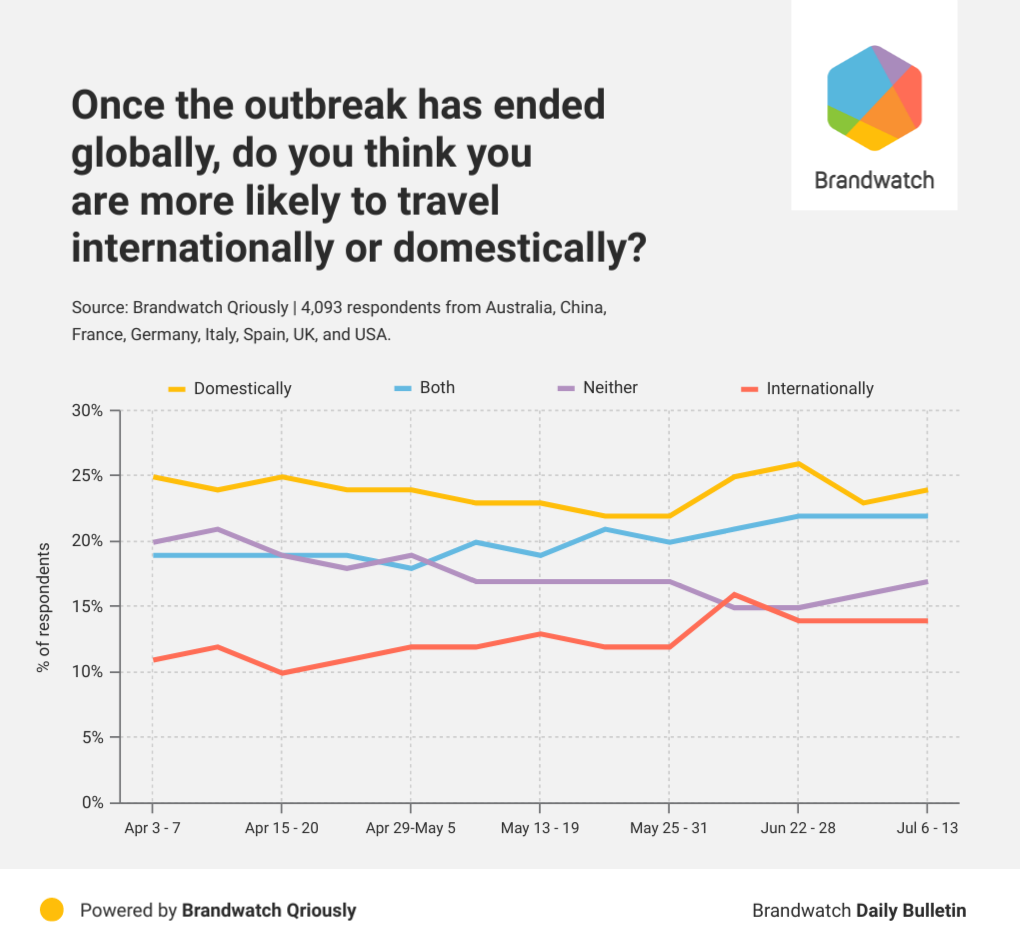
Taking away the uncertain option and looking at how people have answered this question over time, we can see that opinions have shifted. This means we can make some assumptions about how people are feeling about travel in the moment, even when asking them about travelling in the future.

The picture in early April suggests a grim view of travel, especially for bigger trips. Domestic travel, which is more likely to be shorter and less expensive, was far more popular than going international. Meanwhile, a decent chunk of people said they wouldn’t be doing either.

But then the outlook begins to soften. The number of people picking international travel rises as the domestic number falls. The ‘neither’ option also quickly becomes less popular, falling from 21% of respondents picking it in the second week of April to just 15% in mid-June. Clearly, at this point, people’s confidence in travel was returning.

Since then though, we’ve seen signs of a shift back in the opposite direction. Looking at the last few weeks, people are increasingly choosing ‘neither’ again, while interest in international and domestic travel has dropped. That said, the number of respondents picking ‘both’ has stabilized.

It’s a mixed picture, but the outlook for the travel industry is better than it was a few months ago. How long that will be the case for, we can’t say.

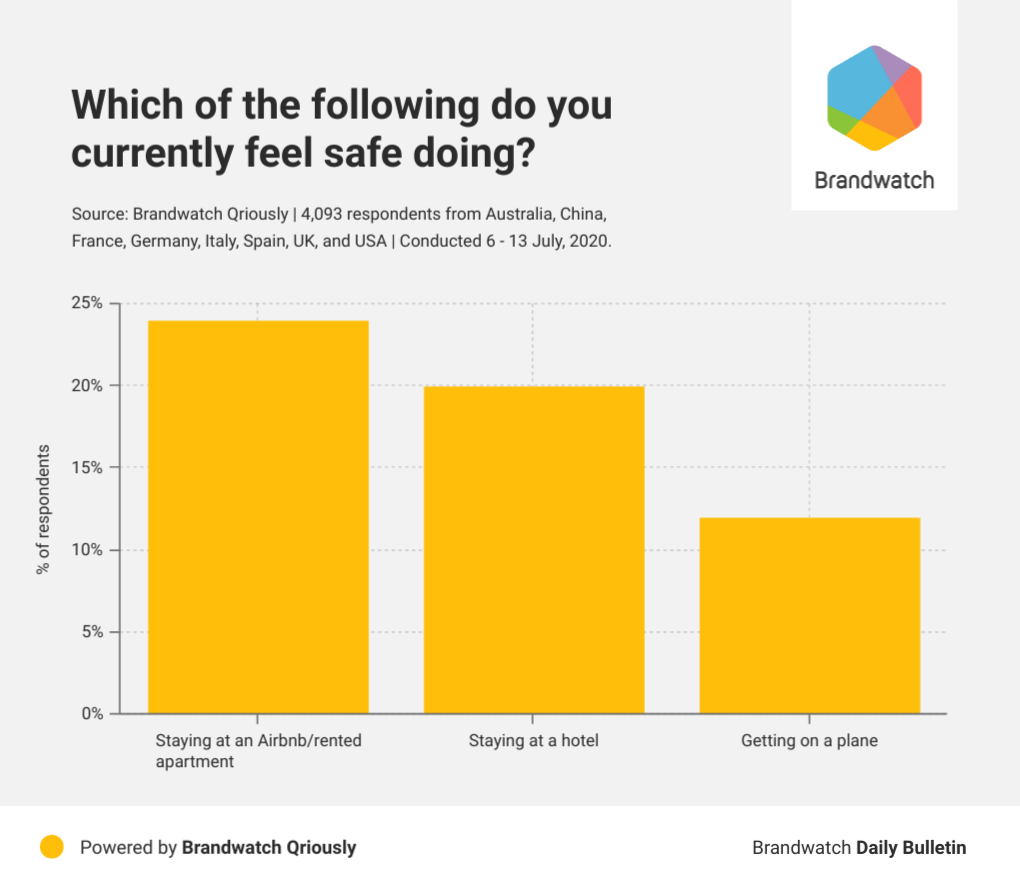
Looking at vacations also relates to the question we ask around activities people feel safe doing. This makes for worrying reading for travel and hospitality businesses, whether they rely on domestic or international visitors.

The vast majority of people we surveyed said they wouldn’t feel safe staying at a rented apartment or hotel, or getting on a plane. Just 12% of people think it’s safe to fly right now.

Nevertheless, if we’re right that people are getting more confident about vacations and travel, that means they must be looking for alternatives they deem to be safer. Planes are obviously out, with many consumers likely wary of buses and trains too. That doesn’t stop people hopping in their cars, though.

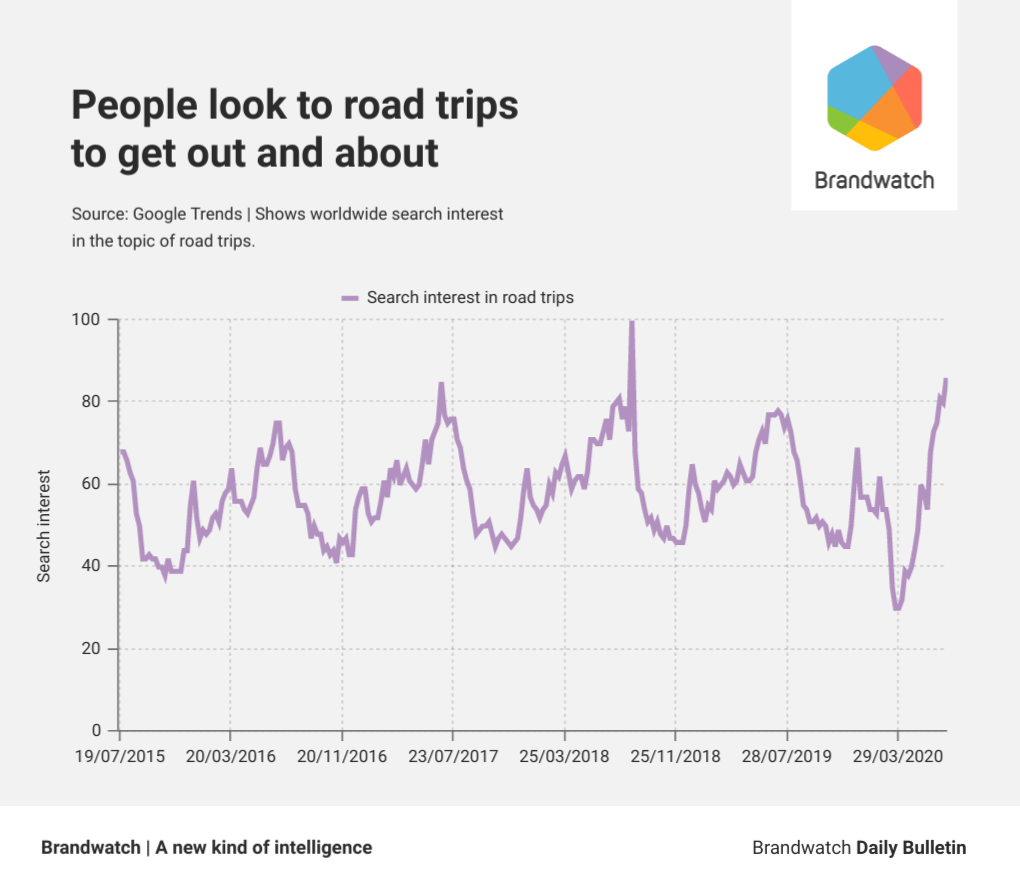
Using Google Trends, here’s what the search interest around road trips looks like over the last five years.

When we exclude the August 2018 spike (driven by road trip-themed content in the Fortnite video game), interest in road trips has recently hit a five year high. Travelling by car is a sensible choice as it’s arguably far safer than boarding a plane and, for those living in places like Europe, you can still get your international trips in.

This chimes with our previous reporting on staycations and camping becoming more popular – people are not going to give up on their vacations easily. It’s now the job of travel companies to reassure and work with customers on getting them the best breaks they can despite the circumstances.

While all this still isn’t exactly good news for the tourism industry, it could mean future travel is less centralized around major airports. People with businesses in smaller towns off the beaten track could see customers show up who would never have come otherwise.

Get more in-depth data

Don’t miss out on our bi-weekly report looking at consumers and how their behavior has changed due to Covid-19.

Head here to find out more and get signed up.

Thanks for reading

That’s it for today. If you’d like to subscribe to your bulletins, head here.

Stay safe,

Brandwatch Response Team

logo
  Our Suite     Use Cases     Industries     Get started  

Runtime Collective Limited (trading as Brandwatch). English company number 3898053
New York | Boston | Chicago | Austin | Toronto | Brighton | London | Copenhagen | Berlin | Stuttgart | Frankfurt | Paris | Madrid | Budapest | Sofia | Chennai | Singapore | Sydney | Melbourne

Privacy Policy

Update subscription preferences

Unsubscribe

We value your privacy

We use cookies and similar technologies to personalize ads and content (including by sharing data with Google), to measure site performance, and to improve your experience. Learn more in our cookie policy

Privacy & Safety • Terms of Service

No, take me to settings
Yes, I agree
More info.

By using our site you agree to our use of cookies —