logo

Brandwatch Bulletin #84: Emojis Across Generations

Your favorite emoji might be making you look out of touch

23 August 2021

Welcome to a brand new week. We’re kicking off with a deep dive into emojis and their use across different groups of people. 

Get ready to feel self-conscious about your next choice of smiley/laughing face.

Subscribe to the Brandwatch Bulletin

If you didn’t laugh, you’d cry

The strange thing about emojis is that while they offer a ‘universal’ language, they’re also highly personal. 

An emoji that connotes laughter to one person might mean sadness for another. While the clapping hands emoji might signify applause in some parts of the world, it can imply sexual intercourse in others. In short, you could be entering a minefield by using the emoji keyboard for your communications.

We recently explored this world in our 2021 Emojis and Emotions Report, which we put together in collaboration with BuzzSumo and Falcon.io, to understand how the internet is feeling and how brands can better communicate with their audiences.

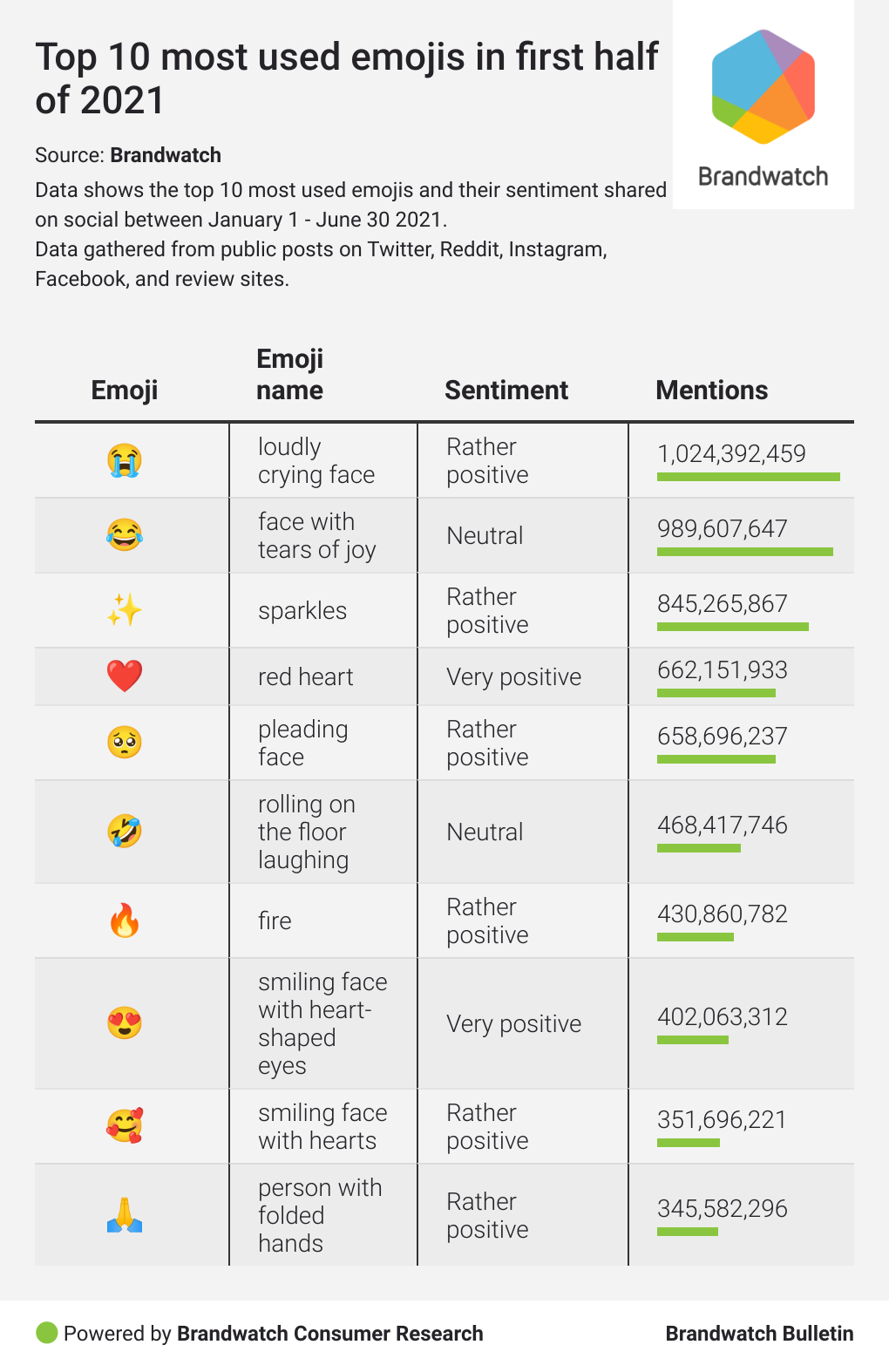
One of the most interesting findings was how different generations are using emojis. Let’s dive into the data, starting with the most popular emojis of 2021 so far.

As you can see, it’s a pretty positive list! But looking back at the most used emojis in 2020, we noticed a few things:

  • The loudly crying face emoji was the second most shared emoji in 2020, and the face with tears of joy was #1
  • Sparkles, red heart, pleading face, and rolling on the floor laughing emojis have remained as #3, #4, #5, and #6 respectively for two years straight. 
  • Fire, smiling face with hearts, and person with folded hands propelled forward in 2021, pushing smiling face with smiling eyes off the top 10 list this time around

The fact that the loudly crying face emoji, which connotes sadness to many, is used in a ‘rather positive’ context may seem odd, but breaking the data down a little more can help explain its rising popularity and counter-intuitive use.

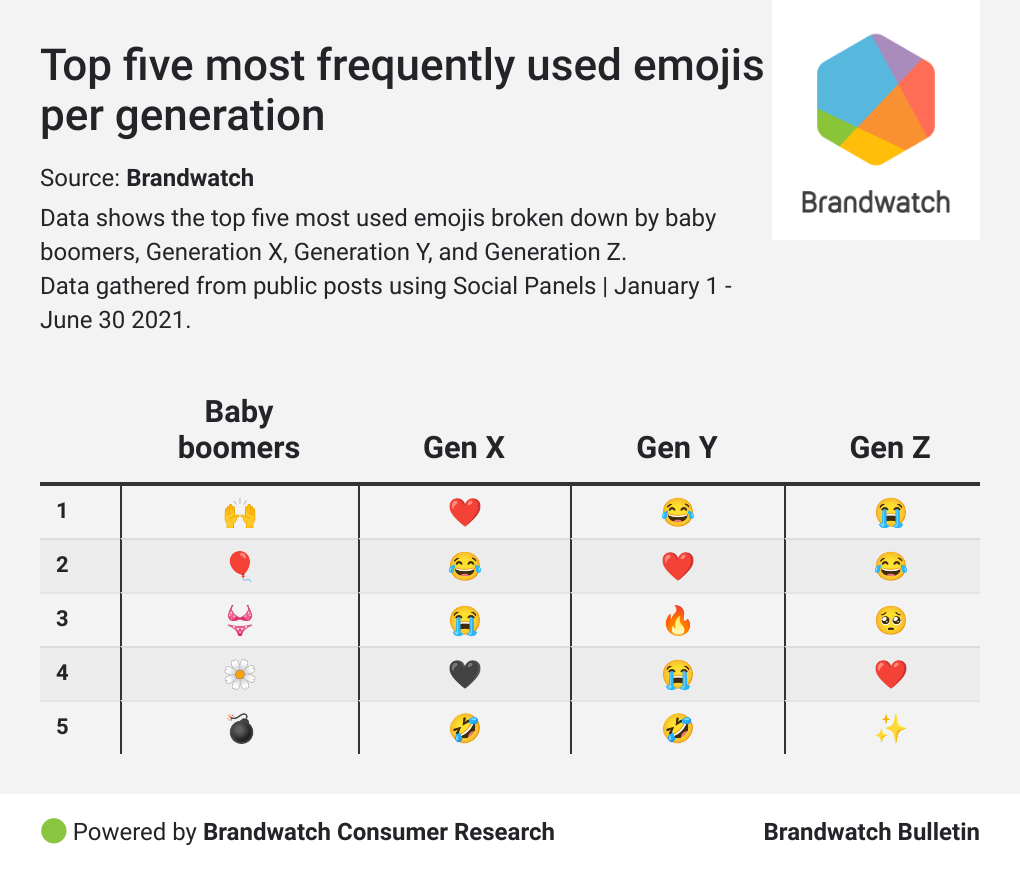
Let’s now look at the most popular emojis for each generation so far in 2021, which we’re able to work out using Ready to Use Social Panels. As you can see, Gen Z are the main proponents of the loudly crying face emoji.


If you ask Gen Z, that’s because the face with tears of joy emoji (known as the laughing face) is no longer cool. One 21-year-old told CNN recently: “I use everything but the laughing emoji. I stopped using it a while back because I saw older people using it, like my mom, my older siblings and just older people in general.”

The loudly crying emoji is a popular alternative to the laughing emoji, while the skull emoji is also used by Gen Z in the context of laughter (meaning “I’m dying!”). Feeling old yet?

Gen Z are, predictably, leading the way when it comes to new uses of emojis. They’ve responded remarkably positively to the relatively new pleading face emoji, which is both in their top five and sits in the overall top five listed above.

While the changing meaning of emojis and the differing use of emojis across different groups may be hard to keep up with, it’s vital that brands using them online understand how they could be perceived. One tip from Falcon.io that’s featured in the report reads:

“Not all emojis mean the same globally or across different generations. Global brands with a multi-generational demographic would do well to be aware of the various connotations emojis carry across audience segments.”

All businesses considering using emojis in communications should take note.

What should we cover next?

Is there a topic, trend, or industry you’d like us to feature in the Brandwatch Bulletin? We want to hear your ideas to make sure our readers are getting what they want. We may even ask to interview you if you’re involved with the topic.

Send any and all ideas to [email protected] and let’s talk.

Thanks for reading

There are plenty more tips and insights to discover in the 2021 Emojis and Emotions Report, including:

  • How are consumers expressing their feelings around different sectors?
  • What drives us to react in different ways to content on Facebook?
  • How do people feel about emoji inclusivity and representation?

That’s it for today, but we’ll be back on Friday.

If you were forwarded this email and want in on the action, get subscribed to the Brandwatch Bulletin now.

Stay safe,

The Brandwatch React team

logo
  Our Suite     Use Cases     Industries     Get started  

Runtime Collective Limited (trading as Brandwatch). English company number 3898053
New York | Boston | Chicago | Austin | Toronto | Brighton | London | Copenhagen | Berlin | Stuttgart | Frankfurt | Paris | Madrid | Budapest | Sofia | Chennai | Singapore | Sydney | Melbourne

Privacy Policy

Update subscription preferences

Unsubscribe

We value your privacy

We use cookies and similar technologies to personalize ads and content (including by sharing data with Google), to measure site performance, and to improve your experience. Learn more in our cookie policy

Privacy & Safety • Terms of Service

No, take me to settings
Yes, I agree
More info.

By using our site you agree to our use of cookies —