From understanding public sentiment to improving communication strategies, managing crises, and more.
Consumers worldwide actively voice their opinions on social media, weighing on everything from public policies to government actions.
As trust in traditional media declines across nations, citizens increasingly turn to social platforms to get information and discuss the issues that matter to them.
Are government agencies paying attention?
With rising awareness of issues like climate change and growing social pressure for government accountability, it's essential for government agencies to stay attuned to public sentiment. Social listening helps keep track of shifts in public needs and priorities, enabling governments to respond effectively and build trust.
In this guide, you’ll discover five best practices for how public sector organizations can use social listening.
- Understanding public sentiment and citizen attitudes How to analyze public reaction to policies, legislation, and services
- Informing your communication strategy with real-time insights
- How to map out influential voices in your space
- Measuring impact when traditional KPIs don’t apply
- Crisis management and reputation protection
1. Understanding public sentiment and citizen attitudes
“Seek first to understand, then to be understood.” – Stephen R. Covey, author.
Public sentiment can shift fast in response to major events or impactful media coverage. Social listening in real time is the way for government organizations to understand public opinions and attitudes in time – leading to more informed decision-making and effective public engagement.
1. How to analyze public reaction to policies, legislation, and services
Public reaction to policies and services isn’t always predictable, making it essential to track and analyze shifts in sentiment as they unfold.
As an example, let’s analyze the public response to a new initiative of the Metropolitan Transportation Authority (MTA) in New York. After several years of testing, in December 2024, the MTA announced the upcoming rollout of more than 400 new train cars. We can examine public online reactions to this news in three different ways: through sentiment analysis, emotion analysis, and audience-specific insights.
Using Brandwatch Consumer Research, we collected online mentions relating to the MTA and new subway cars and categorized them by sentiment.
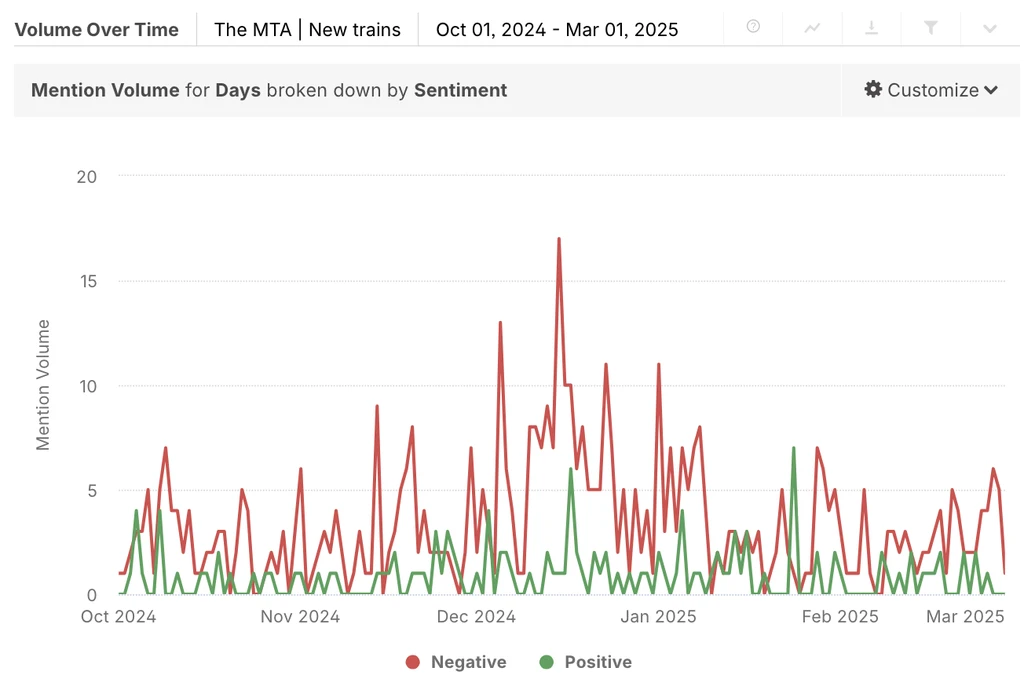
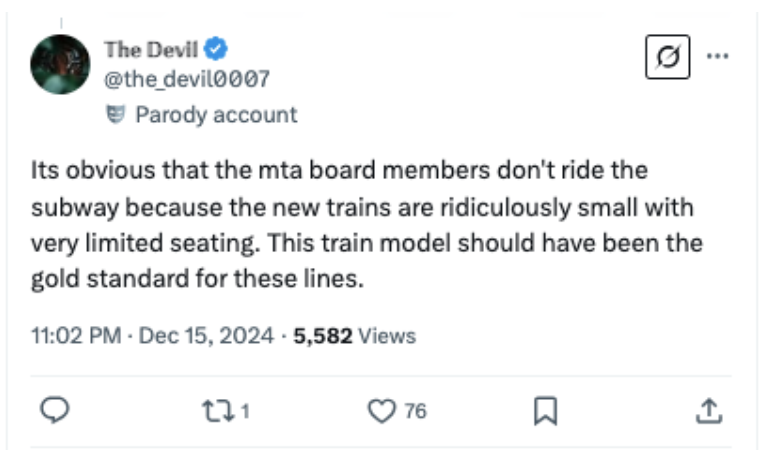
The week of the announcement generated higher than usual amounts of negative discussions, with some online comments expressing concerns from subway riders regarding the new initiative.
On the other hand, the steady decline in negative mentions from January to March 2025 may suggest growing acceptance – or at least a reduction in public pushback as time goes by.
Besides sentiment, emotions in conversations are another good indicator of how people feel about a specific event or topic.
While anger dominated conversations between October 1, 2024 and March 1, 2025, joy still represented 12% of all emotion-categorized discussions. Some commuters expressed that the move by the MTA was long overdue and praised the look of the new trains.
Holy shit, nyc finally got some new C trains.
— Josh Folan (@joshfolan) January 21, 2025

Lastly, the MTA communications team can look into audience-specific sentiments.
Using Social Panels, we discovered that, for example, millennials express more negativity online than any other generations in the months between October 1, 2024 and March 1, 2025. Some shared very specific concerns, such as insufficient seating and inadequate handrails on the new trains during rush hours.
Gen Z, on the other hand, appreciated the new aesthetics, showing the open-concept new train cars in their posts on social.
As demonstrated with the MTA example, government organizations can use social listening to understand how people feel in real time about specific events, policies, or initiatives.
2. How can governments track emerging trends in conversations?
Beyond immediate reactions, social media provides a way for government agencies to spot emerging trends. By analyzing historical data, including both direct mentions of your agency (branded conversations) and broader discussions on relevant topics (non-branded conversations), your communications team can:
- Identify spikes in conversation volume, indicating growing interest in specific topics
- Examine deeper trends within specific topics to see how they evolve
- Surface conversations within specific audiences based on demographics like age, gender, location, or shared interests, keywords in social bio, or topics they discuss online.
Using the MTA example, the team might analyze MTA-related conversations as well as general discussions about the NYC subway system. This analysis could involve tracking conversations about:
- Industry: Are consumers comparing the NYC subway to other metro systems globally? Are there common themes or recurring criticism, such as service quality, reliability, or cleanliness?
- Organization: Are there emerging discussions about the MTA’s responsiveness, safety, and fare structures? Are riders comparing their experiences with other transportation providers, like ride-sharing services?
- Products or services: Is there a shift in how riders discuss specific subway lines or services, like vending machines?
- Consumers: How do everyday riders versus tourists feel about their commute? Are there challenges that commuters often face? Do conversations spike during major events, like concerts or marathons?
3. How to identify key topics shaping public discourse, and how can they inform policy
With the right tools and setup, identifying key themes in public conversations is simple. Platforms like Brandwatch Consumer Research allow communications teams to track and visualize phrases, keywords, and topics trending in the data.
Using AI Search in Brandwatch will help look through the data and surface insights faster.
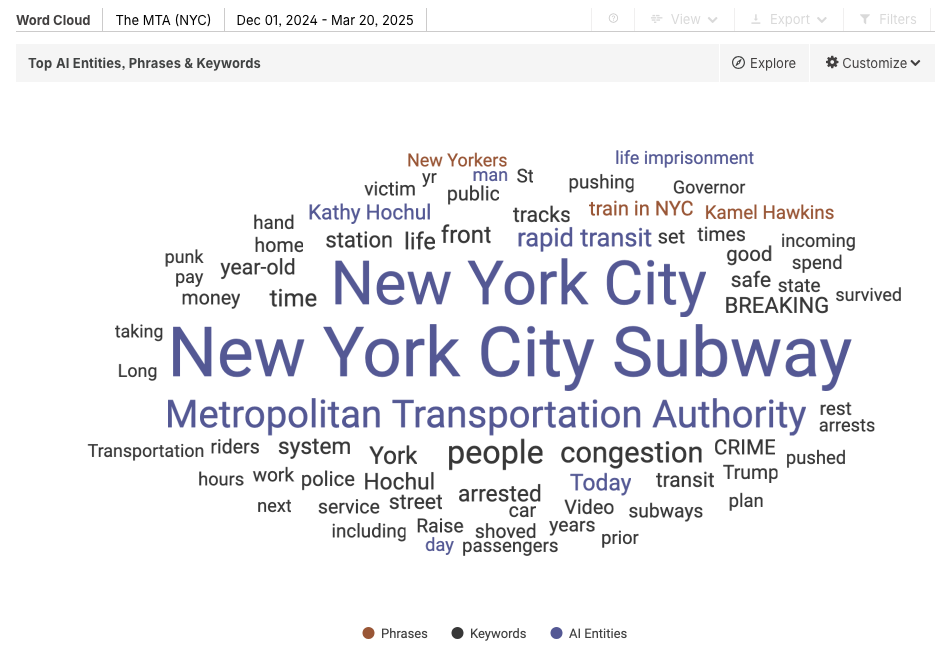
A word cloud offers a quick snapshot of the most frequently discussed topics, but not every word is equally useful. While terms like “New York City Subway” are expected and too broad to be insightful, other words can reveal deeper narratives worth exploring.
For instance, “congestion” highlights the volume of discussions around the new congestion pricing program recently introduced in New York.
Words like “arrested,” “crime,” and “police” likely hint at conversations around security and law enforcement on public transit. And mentions of “Kathy Hochul,” the NYC governor, indicates political involvement, potentially signaling public discussions around leadership decisions affecting the MTA.
By diving into the context behind these terms, brands can uncover public sentiment drivers, emerging crises, or unexpected cultural touchpoints – turning raw data into insights that are actually actionable.
Communications teams can also track spikes in conversations over time, pinpointing the triggers behind these trends. Tools like Brandwatch’s AI-powered Iris make the discovery faster by identifying and explaining spikes in a fraction of the time.
For more granular insights, organizations can investigate generational data or specific audience segments.
Another helpful tool is intelligent email alerts (Signals), which notify teams of significant or unexpected changes in datasets. These alerts provide an automated trend-tracking system that can uncover trending topics on social media that might otherwise go unnoticed.
These insights allow organizations to better understand public sentiment, adjust their messaging, shape corporate communications, and improve public trust.
"Brandwatch is an invaluable resource for the government sector to access, analyze, and understand public sentiment they wouldn't normally be able to tap into. To do that type of research without a tool like Brandwatch would be simply impossible. We make the impossible possible by having a platform that streamlines and categorizes the data for them."
2. Informing your communication strategy with real-time insights
“When government agencies make decisions, they want to make sure they are making the right decisions. Putting the data at the center of the decision-making process for them is crucial.”
– Caroline Jouin, Enterprise Account Director, Brandwatch
1. Using AI-powered insights to understand shifts in public opinion as they happen
As public servants, government organizations must rely on real-time insights to ensure their communication strategies are effective and aligned with evolving public sentiments and needs. How quickly they can get to those insights is critical for government organizations, especially when teams are strapped for time.
Agencies can further leverage Brandwatch’s AI with Iris Conversation Insights, which groups large volumes of mentions into digestible summaries and key themes, making it easier to identify the most impactful conversations.
Going back to the MTA example, we summarized the congestion mentions using Iris Conversation Insights.
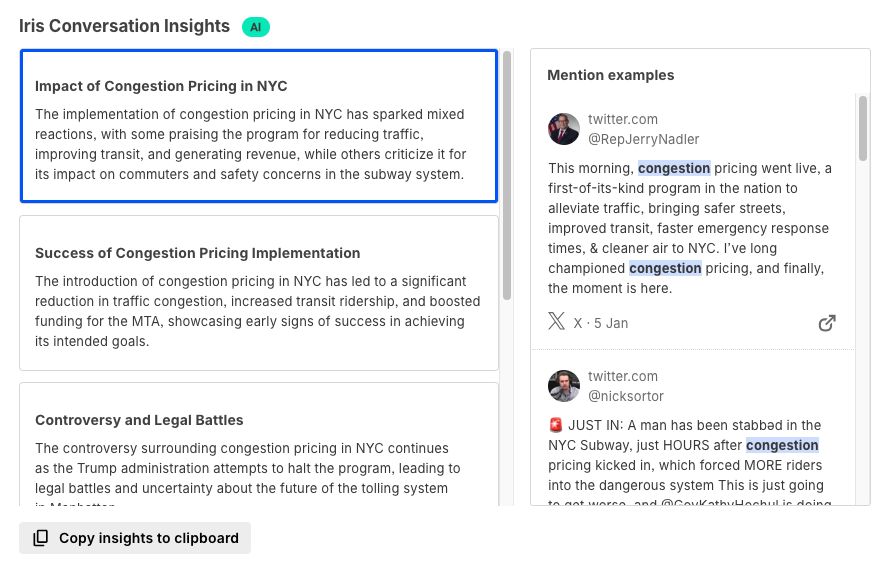
This summary highlights key themes in conversations about NYC’s congestion pricing, including its impact, implementation, and public concerns. By organizing discussions into clear themes with relevant examples, AI-powered insights provide a real-time understanding of public sentiment.
2. Using social listening to monitor misinformation, shape proactive messaging, and crisis response
Social listening helps shape proactive messaging and crisis response by identifying emerging issues or shifts in public opinion, allowing government agencies to craft timely messages that address concerns before they escalate.
For example, the MTA could address the negative spike in discussions about the new cars by providing more detail on the design, and how it addresses accessibility concerns raised by riders.
Social listening tools can also flag false narratives, allowing teams to respond quickly with accurate, trustworthy information.
Misinformation can spread quickly, particularly during high-stakes events like elections or public health updates. By leveraging social listening tools, organizations can enhance their communication strategies, ensuring their messages resonate with the public and build trust.
You’ll read more about tackling crisis management with social listening further in this guide.
How to improve insight sharing for better communications
More advanced organizations and communications teams share insights through automatic reports and dashboards. This allows all teams, from brand communications to customer success, to access critical information more quickly, promoting a cohesive global strategy and consistent brand image across the board.
3. How to map out influential voices in your space
How to explore audience trends on Reddit and X
Finding and monitoring influencers in your space is key to understanding critical conversations and ensuring your communication strategies engage the right audiences.
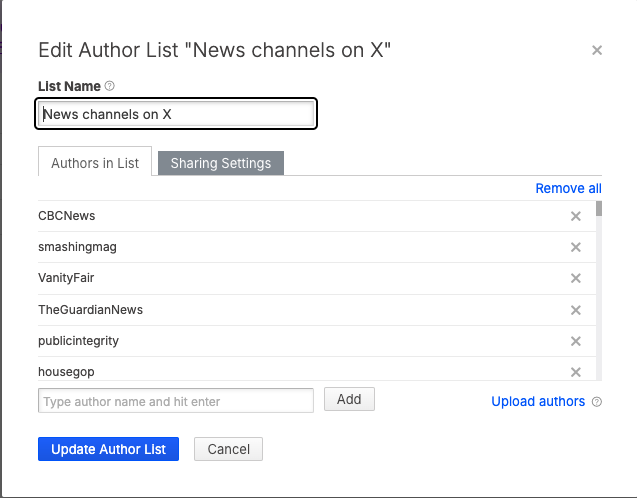
One way to do this is by creating Author Lists in Brandwatch Consumer Research. These lists allow government organizations to gain insights from specific accounts on X, including journalists, thought leaders, news publications, or influential public figures. By building these lists, communications teams can easily focus on key conversations and understand who’s really shaping public opinion.
Brandwatch’s Social Panels is another effective method for tracking influential voices on Reddit and X. By building audience panels based on bio keywords, discussion topics, or key subreddits, agencies can better understand who is shaping critical conversations relevant to their work.
For example, you could create an audience of individuals who identify as journalists or commentators in their bios, or people frequently discussing NYC-related policy and government, all based in the United States.
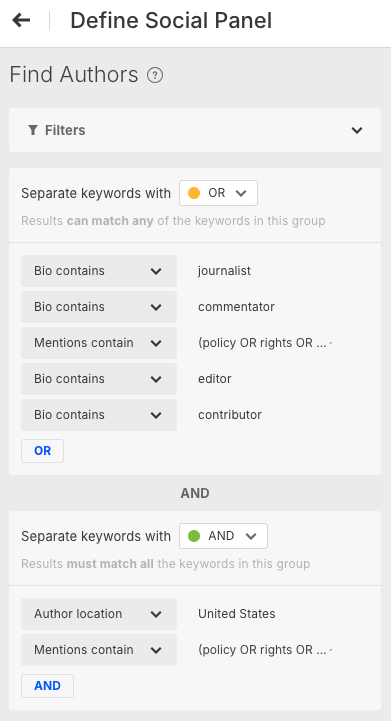
Communications teams can refine their monitoring further by specifying key topics and assessing individuals based on factors like audience size and influence score.
How to find social media influencers in your space
Today, anyone can become an influencer, and those who have built trust and authentic relationships with their audiences can be highly influential within their community.
Government organizations are exploring partnerships with influencers to promote policies and initiatives, especially when traditional marketing falls short. By leveraging trusted influencers, agencies can effectively reach key demographics, shape public opinion, and earn critical support.
For example, in 2024, The National Health Service (NHS) in England launched NHS Talking Therapies, featuring influencer Rehana Yasmin and media medic Dr. Zoe Williams, to promote mental health support and help individuals return to work.
In 2023, Taiwan’s Office of the President partnered with international influencers such as Nas Daily to raise international awareness of Taiwan’s governance model and civic values as part of their “Spend a Night @Taiwan’s Presidential Office Building” campaign. These influencers shared Taiwan’s story with millions of followers through immersive, on-the-ground content.
The MTA is no exception. In December 2024, the organization partnered with Instagram to celebrate local culture and creativity through a limited-edition MetroCard and out-of-home campaign featuring designs by popular NYC creators @subwaytakes, @newyorknico, and @overheardnewyork.
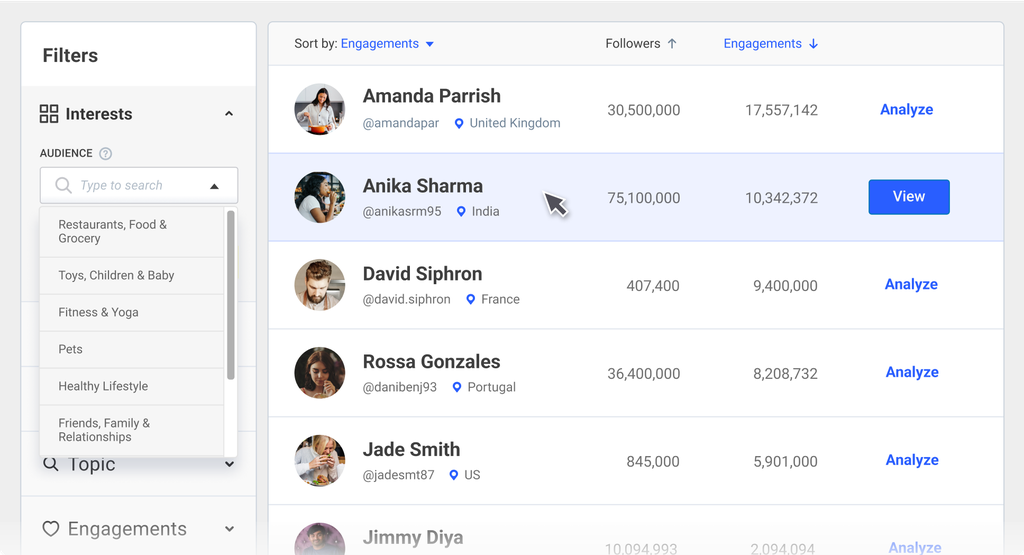
With Brandwatch Influence agencies can easily identify influencers who align with their goals and target audiences, ensuring they engage with relevant voices on social media. Communication teams can also track campaigns more efficiently – and ultimately improve their public outreach and messaging.
4. Measuring impact when traditional KPIs don’t apply
Evaluating the impact of government communications and public outreach campaigns can be challenging, especially when traditional KPIs, like sales or clicks, don’t apply. Public sector campaigns often focus on raising awareness, building or improving public trust, or shaping overall public sentiment.
Rather than focusing solely on volume, consider the quality of engagement. Is the conversation shifting toward the issues your campaign highlights? Are key stakeholders and influencers actively engaging? Defining relevant engagement metrics upfront ensures you can track meaningful impact.
Here’s how government organizations can evaluate the impact of their public communications:
1. Identifying objectives and engagement metrics
Clear objectives are the foundation of any successful public outreach campaign. Whether the goal is to raise awareness about a policy, inform the public about an initiative, or drive engagement within specific demographic groups, setting precise engagement metrics ensures the campaign’s success can be tracked.
Instead of relying on general reach or impressions, consider measuring:
- Message penetration: How widely is the key message being shared?
- Audience engagement: Are citizens interacting with the content through comments, shares, or questions?
- Influential voices: Are policymakers, journalists, or community leaders amplifying the message?
- Behavioral shifts: Is there evidence that public perception or actions are changing in response to your campaign or initiative?
Social listening tools can then be used to track these predefined goals across different channels and audiences, ensuring real-time monitoring of public discourse and reaction.
2. Benchmarking against peers and industry standards
To evaluate the success of your efforts, you need to compare them to similar initiatives. Benchmarking allows government organizations to assess how their metrics align with or differ from those of other agencies or institutions.
To benchmark effectively, consider:
- Comparing past and present performance: How does this campaign compare to previous initiatives within your organization?
- Assessing similar government campaigns: What engagement and sentiment trends have other agencies seen with comparable initiatives?
- Identifying best practices: What strategies have been most effective in driving awareness, engagement, or trust?
- Understanding gaps: Are there areas where your campaign is underperforming compared to industry standards?
By tracking how your initiatives stack up, you'll be able to identify best practices, spot gaps, and refine your strategy to improve impact.
3. Measuring awareness, sentiment, and public trust over time
When traditional KPIs may not be directly applicable, tracking shifts in public awareness, sentiment, and trust provides deeper insights into the effectiveness of a campaign. Using social listening, government agencies can monitor changes in sentiment before, during, and after a campaign.
You might want to understand:
- Are people talking more positively about a policy/topic?
- Are public concerns or questions increasing or decreasing?
By evaluating conversation volume, engagement, and sentiment, teams can understand whether their messaging is reaching the right audience and resonating as intended. Comparing these metrics over time reveals how well the campaign is building trust and raising awareness, providing a clearer picture of its overall impact on public opinion.
5. Crisis management and reputation protection
With more and more people having a platform to voice their opinions, protecting reputation is a top priority for government agencies. Proactively monitoring for crises or emerging issues will help organizations maintain public trust.
“I like to think of social listening as providing a map for how you develop and build your reputation over time.”
The importance of speed to insight
The faster you understand shifts in public sentiment or emerging issues, the easier it becomes to craft a timely and effective response before a situation escalates. With tools like real-time alerts in Brandwatch Consumer Research, agencies are immediately informed about issues as they arise, allowing them to address concerns proactively before they gain significant traction.
For instance, if a policy or public figure starts receiving negative attention, alerts can help the communications team assess the situation and adjust their response strategy as it develops.
“One of the things that is really helpful for government agencies and their marketers and data analysts is expediency to insights: how quickly can they get to those insights? And I firmly believe many of the Brandwatch features assist with that.”
Sample queries to help manage online reputation
To ensure that the right topics and conversations are being tracked, communications teams can set up queries tailored to specific issues, stakeholders, or emerging crises.
For example, queries can be created around conversations involving key policies, specific policymakers, or potential points of controversy. Here are a few sample queries for guidance.
Fake news and misinformation
(hoax OR #hoax* OR “not real” OR #fake OR #fakenews OR “fake news” OR "fake info*" OR "false info*" OR “incorrect info*” OR disinformation OR misinfo* OR “debunked” OR “misleading” OR “fabricated”) NEAR/5 (insert relevant topics, policies, or key issues you’d like to monitor)
Agency reputation analysis
((insert relevant government body name you’d like to monitor) NEAR/5 (corrupt* OR scandal OR controversy OR incompeten* OR mismanag* OR criticism OR backlash OR failure OR resign* OR “cover-up” OR fraud* OR abuse* OR "public trust" OR approval OR reputation OR credibility OR credibl* OR transparen* OR accountab*))
Policy-specific conversation tracking
Input specifics in place of policy and programs.
(policy OR initiative OR program) AND (government OR “public sector” OR official) AND (controversy OR debate OR opposition OR support OR reform) AND (“policy name” OR “policy area”)
Best practice for responding to misinformation and citizen concerns
What people share and discuss online has become a powerful force in shaping how an organization is perceived. With over 5.5 billion people active online, government agencies cannot afford to underestimate the impact of those conversations on their public reputation.
The best practices for building an effective crisis response strategy include:
- Identify and address false narratives promptly: Use real-time monitoring to detect false narratives early and correct miscommunication before it spreads. Engaging early and transparently with the public helps maintain credibility and trust.
- Track and respond to citizen concerns: Understanding shifts in public sentiment will help you adjust messaging and demonstrate that you are actively listening to the community’s needs and concerns.
- Evaluate the effectiveness of your response: Analyzing sentiment and engagement levels helps determine whether your response resonates with the public or if further action is needed to manage public perception and maintain trust.
- Tap into external expertise: Your vendor’s customer success team likely has experience working with similar organizations and can offer strategic insights on managing crisis and optimizing response efforts. Discover the power of the experts at Brandwatch.
Why public sector leaders choose Brandwatch
Brandwatch ensures data privacy and regulatory compliance
In the public sector, conversations can be highly sensitive, making data privacy and regulatory compliance non-negotiable. Brandwatch is designed with built-in data anonymization to ensure organizations can access critical social insights while safeguarding privacy and preventing unintended profiling. Our platform helps government and public sector teams navigate complex compliance requirements with confidence by enabling them to stay informed, respond effectively, and build public trust without ethical or legal risks.
“Real-time reliable information obtained in a compliant way – that's really important. Sourcing information in a compliant way helps brands in the public sector be at the forefront of any crisis and help them be closer to their audience and grow their credibility and impact.”
Forrester leader in social listening
Brandwatch was named a Strong Performer by Forrester in 2024 and given the highest possible scores in four categories: Social Listening, Customer Service, Privacy & Security, and Supporting Services & Offerings.
Our top score in privacy and security reflects our ongoing investment in keeping customer data safe, compliant, and responsibly handled – something especially critical for highly regulated sectors like government. Our commitment to international privacy standards, including General Data Protection Regulation (GDPR) and California Consumer Privacy Act (CCPA), helps ensure trust and transparency at every level.
Final thoughts
Public perception can shift in an instant, making it crucial for government and public sector organizations to stay ahead of the conversation. By tracking and analyzing real-time sentiment, agencies can refine their messaging, address concerns proactively, and build lasting public trust.
With Brandwatch, government agencies gain access to powerful social and traditional media insights – helping them stay informed, respond effectively, and navigate complex privacy and security requirements with confidence. Learn more today.