


Halloween is no longer just one day – it’s a whole season – and for some, it’s the highlight of the entire year.
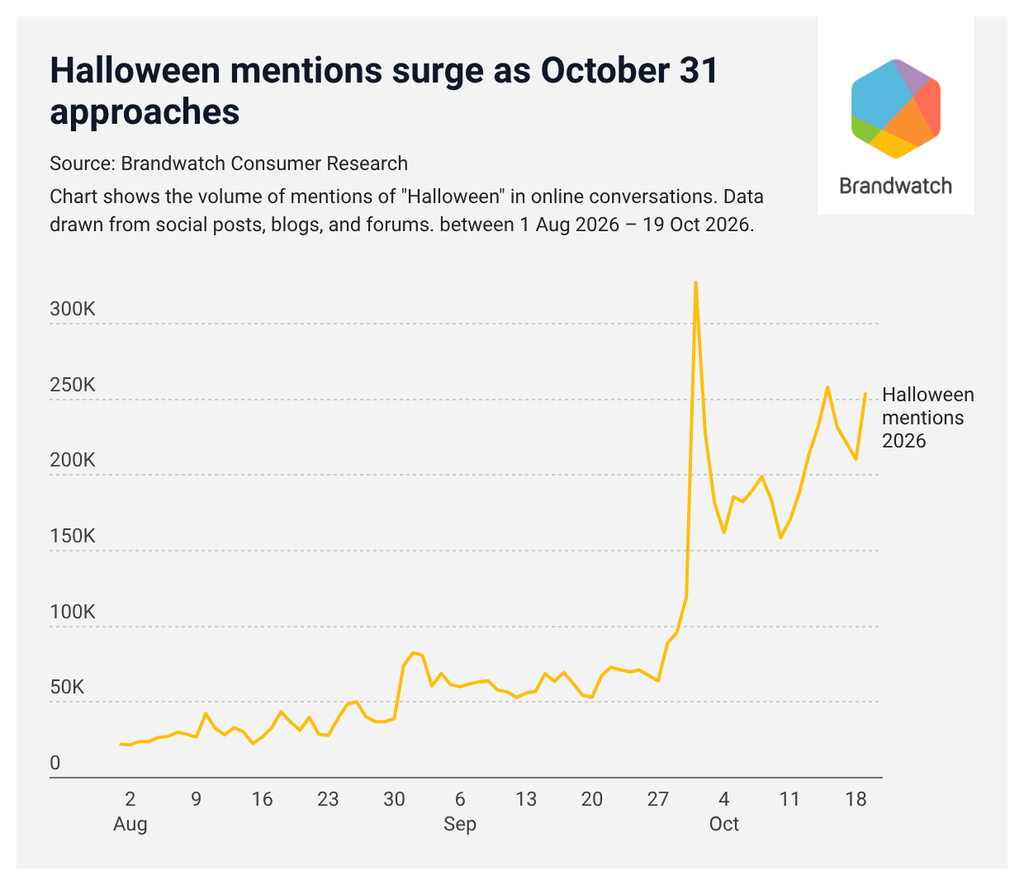
Each year, ‘spooky season’ seems to creep in earlier, with brands and consumers embracing it long before October 31. The result? Halloween marketing buzz goes on for months in the lead-up – so brands need to be paying attention.
As early as late August, Halloween costume inspiration, craft tutorials and horror recommendations are already appearing in social feeds. And by September, whole aisles of grocery stores are packed with everything from trick-or-treating supplies to pumpkin-themed door wreaths. With this in mind, it’s no surprise that US Halloween spending is expected to reach $13.5 billion in 2026, up from the record $13.1 billion spent in 2025.
Halloween can drive real excitement, but a few pumpkins in an October creative refresh won't get you very far. The brands that stand out understand when people start planning, what they're looking for, and how they're celebrating.
Halloween spending is forecast to be bigger than ever – and marketers need to pay attention
According to Brandwatch Consumer Research, there were approximately 4.83m public online mentions of Halloween in the last month (between September 21st and October 20th 2026), up around 16% from 4.13m million from the same period last year. The number of unique authors remained broadly unchanged at around 1 million.
Data shows that 74% of US consumers plan to celebrate Halloween in 2026. Almost half, 49%, plan to begin shopping in September or earlier. That is unchanged from 2025 but considerably higher than the 34% recorded in 2016, suggesting that early Halloween shopping has become an established behavior rather than a growing trend.
Not everyone is shopping early because they are excited for Halloween. Affordability is also shaping when and how people shop.
NRF’s 2026 US consumer survey suggests that affordability is influencing Halloween planning. Some early shoppers said starting sooner helped them spread out their budgets, while others were motivated by attractive prices and promotions. If products cost more than expected, consumers said they would compare prices or look for coupons and sales. For marketers, starting early is therefore not just about building excitement. It is also an opportunity to help cost-conscious consumers plan, compare, and budget.
How brands can maximize their Halloween marketing strategies
From horror films to gaming, crafts, and live experiences, Halloween gives brands several ways to energize their audiences. Here are five ways marketers can make the most of Halloween.
Join the conversation early
With 49% of US consumers shopping in September or earlier, brands need to have useful seasonal content ready before October.
Halloween enthusiasm now begins so early that Summerween, inspired by an episode of Gravity Falls in which characters celebrate Halloween in July, has become part of the seasonal retail calendar.
Craft retailer Michaels built on early Summerween interest with Hobbyween, its largest Halloween crafting assortment to date. Launched in August 2026, the collection included hundreds of projects spanning crochet, embroidery, personalized decorations, group crafts, and DIY home accents. Rather than simply putting Halloween products on shelves earlier, Michaels gave audiences creative ways to participate in the longer season.
The lesson isn't simply to start talking about Halloween earlier. It is to give consumers different reasons to engage as the season develops.
Tip for marketers: Don’t wait until late October. Use August and September for inspiration and planning content, then become more practical and product-led as Halloween approaches.
Tap into horror, entertainment, and fandom
Horror remains an important part of Halloween, but it is no longer the only entertainment opportunity for brands. Halloween entertainment now stretches well beyond scary movies. Online conversations in the month approaching Halloween 2026 covered seasonal gaming, horror franchises, scary-movie viewing, and spooky music, giving brands several different fandoms and cultural rituals to tap into.
One highly engaged post showcased Fortnite’s Five Nights at Freddy’s and Halloween cosmetics. The crossover illustrates how Halloween entertainment can extend into gaming through familiar characters, seasonal updates and virtual items.
Tip for marketers: Don’t borrow a Halloween aesthetic that feels disconnected from your brand. Find the character, product, or audience ritual that makes the season feel like a natural extension of your existing identity.
Turn inspiration into action
The most useful content doesn’t simply showcase a finished look. It helps people understand how they could recreate it. DIY Medusa costumes offer a good example. Creators have shown audiences how to construct snake-covered crowns and headpieces, turning an elaborate finished look into a series of achievable steps.
One post demonstrated a DIY snake crown, while other creators showed how rubber snakes, paint, and a simple headpiece could be used to recreate the look.
The same thing shows up across Halloween content more broadly. Posts using #halloween2026 include costume recommendations, cosplay transitions, makeup transformations and shopping trips, alongside home tours and decorating inspiration.
The common thread is that they help people move from "that's cool" to "I could do that."
This is where brands can be genuinely useful. Consider tutorials, creator transformations, product combinations and ideas organized by budget, audience or level of effort.
Tip for marketers: Solve an inspiration problem. Show people what to create, how to create it, and how your product naturally helps.
Choose the niche that fits your customers
Halloween offers opportunities across costumes, décor, collectibles, gaming, and familiar characters. The right niche will depend on the audience your brand already serves.
Pokémon offers a good example of that fit. An Instagram post on the Halloween Sweet Mischief Collection through costumed plush and a playful Halloween tea party featuring Zorua, Zoroark, Pikachu, and friends. Rather than borrowing a generic horror aesthetic, Pokémon adapted the season to the character-led world their audience already knows.
Tip for marketers: Don’t try to cover every Halloween trend. Choose the behavior that overlaps naturally with your products, expertise, and target market.
Give people something to take part in
Halloween is increasingly something people actively participate in, from parties and local events to haunted attractions and theme-park experiences. For marketers, the opportunity is not simply to promote an event, but to give people distinctive moments they will want to capture and share.
At Universal’s Halloween Horror Nights Hollywood, one visitor showcased how the Sinners house recreated the film’s vampires’ glowing eyes, while an official post focused on performers and character encounters. These distinctive moments gave visitors something specific to capture and discuss online.
Welcome to your worst nightmare 😈 Brave 10 terrifying haunted houses, scare zones and more at Universal Orlando Halloween Horror Nights, select nights Aug. 28–Nov. 1. https://t.co/47rcaV0b2C
— Halloween Horror Nights (@HorrorNightsORL) August 10, 2026
Brands don’t need to build a major attraction to apply the same principle. A challenge, competition, creator prompt, local event, or customizable experience can give people an active role in the campaign.
Tip for marketers: Build in an action. Give audiences something to make, enter, visit, customize, remix, or share.
How Brandwatch can help you ace Halloween
In short, you’re not just creating content for Halloween – you’re creating content for spooky season.
The brands that win Halloween aren't necessarily the loudest. They're the ones that understand how consumers get involved in the season and show up with content that helps.
Brandwatch can help marketers spot seasonal conversations as they develop and turn those insights into timely content. Brandwatch Consumer Research reveals the topics and behaviors gaining attention, while Brandwatch Social Media Management helps teams plan, approve and publish their response across channels. After that, all that’s left is to enjoy being part of the conversation.


