


Mastering Brand Management: Context, Strategies, and Real-World Examples
By Sabrina DorronsoroMar 20
Based on 1,000+ marketers and 750k conversations, here are the skills, tools, and strategies shaping marketing in 2026.
Published January 9th 2026
The trends to watch for your digital marketing strategy in 2026.
The more AI smooths the edges and makes brands look perfect, the more we crave the stuff that actually feels real. It's like we're allergic to all that polish now. The brands succeeding in the future are the ones building the strongest human connections – rooted in emotional intelligence, authenticity, and employee advocacy.
Below, we'll share key trends from our latest Digital Marketing Trends report along with actionable tips to make an impact with your campaigns in 2026.
Continue reading or dive straight into the report.
This blog will cover 3 of the 11 key trends for next year, specifically:
Let's dive into each trend and what it means for your digital marketing strategy.
Brands with soul are cutting through AI-generated noise.
"I think the biggest skill next year is going to be knowing how to sound human. Anyone can produce content now, but not everyone can make people actually care." – Brandwatch survey respondent, October 2025.
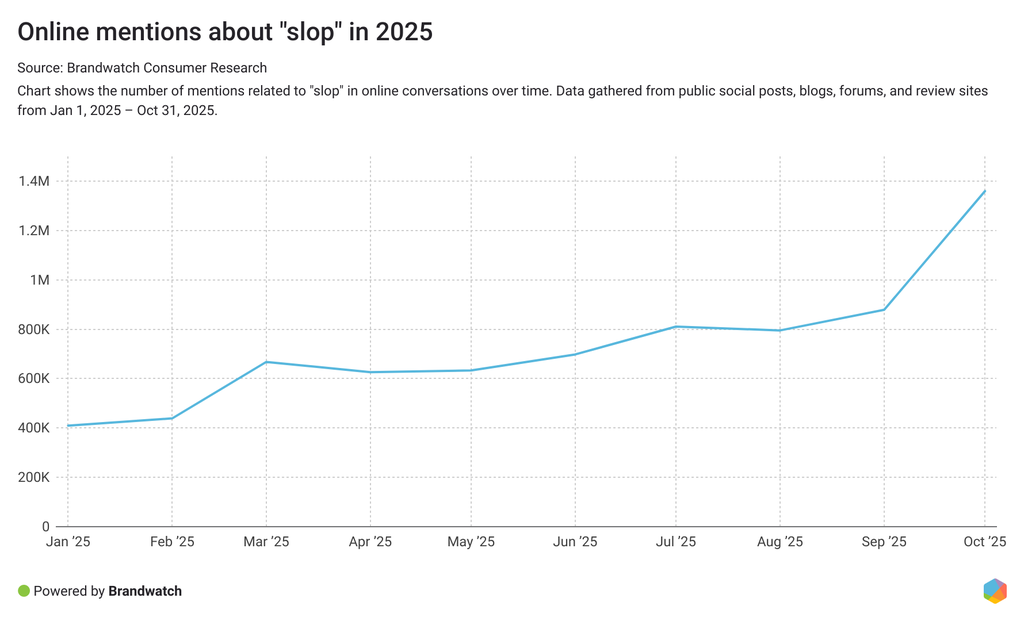
AI has supercharged content creation, but there's a downside – slop – low-effort, uninspiring, AI-generated content that’s taken over social media feeds.
Conversations around AI slop have gone mainstream. Online mentions of "slop" rose more than 200% in 2025, as people grew tired of lazy marketing, generic visuals, and plain posts flooding their feeds.
The frustration is real. People are drowning in irrelevant posts and excessive ads that bury anything authentic or valuable. According to Brandwatch data, 82% of sentiment-categorized "slop” mentions are negative.
These audience reactions are changing what works. People now gravitate toward content that feels purposeful, creative, and unmistakably human. Anything that reads phony or was clearly generated for engagement purposes gets ignored or called out. Brands that use AI more strategically, as a way to enhance their creativity rather than replace it, will be rewarded with attention and engagement that generic content can no longer capture.
Be intentional about how you use AI. The difference between improving your efforts and relying on AI entirely (aka generating AI slop) comes down to three factors: high-quality prompts, thorough human editing, and a distinctive brand voice.
The golden middle lies in combining AI’s efficiency with the creativity and storytelling only humans can bring. Let AI handle the heavy lifting but keep people firmly in control of your brand voice.
Your employees are actively shaping your brand now.
"Customers will want to know more about the person behind the brand and will want to connect with them more directly." – Brandwatch survey respondent, October 2025.
Employee content has evolved beyond the occasional "behind-the-scenes" culture posts, and it's often the first touchpoint people have with your brand. Why? Because consumers trust people over branded messages, and content that feels human consistently performs better on social. Research shows that compassion and understanding of what “people like me need” are core drivers of legitimate influence. This dynamic is only possible through peer-to-peer trust exchanges.
Many brands now treat employee content as an important part of their social media strategy. When Cisco first started posting employees on Instagram, the response was immediate: thousands of likes and comments from people saying they'd love to work there.
@anthropologieofficial festive fragrance GIVEAWAY 🎁 here's how to enter: like this post follow us here comment your fave holiday scent, tag a friend & use #AnthroGiveaway we'll choose 5 winners – good luck! ✨ (must be based in U.S.) #AnthropologieHome #Advent #Countdown #Candle ♬ original sound - Anthropologie
This points to something bigger happening in 2026: your team members are shaping how people see your brand before your marketing gets the chance.
Employee-powered branding means your team influences how your brand gets discovered and is talked about – often well before any official marketing efforts.
Consider these stats: LinkedIn reports that only 3% of employees share company content, but when they do, engagement jumps 30%. Even more importantly, the same post shared by an employee gets double the click-through rate compared to when it's posted by the company account.
Relatable storytelling beats overly corporate messaging every time. When employees share excitement about a product launch or talk about company values they actually care about, people can tell it's real. Build your social presence around employee voices. Empower everyone – from interns to executives – to share their authentic perspectives. Look for stories that feel real and candid for your brand: impromptu team lunches, internal hackathons, office walkthroughs. Elevate them across your social channels, test what works best, and tweak your strategy accordingly.
The rules of online search have been rewritten.
Here's how it works now: someone asks an AI assistant, “What are the best running shoes for my upcoming marathon?” They don’t get 10 blue links anymore. They get an answer: “Nike Pegasus 40s are highly recommended for their cushioning and durability during long-distance training.” And just like that, Nike won the sale – not because it topped Google's rankings, but because the AI chose it as the answer. No scrolling. No comparing. No clicking through to five different review sites.
As people shift to AI-powered search, brands are no longer fighting for position #1 in search results. They're competing to be the option an AI recommends.
Our survey found that 67% of marketers agree that consumers are discovering brands through AI and social platforms, not traditional search. With half of all consumers already using AI-powered search, this is a shift marketers can no longer afford to ignore.
The new challenge? Generative engine optimization (GEO) and the AI platforms that now stand between your brand and your audience.
Optimize for AI recommendations, not just search. Strengthen the signals AI actually read: structured data, real-time product info, helpful FAQs, and clear authorship. And don’t forget social – clear captions, solid alt text, and consistent visuals make it easier for AI to understand your content and confidently surface your brand.
There, we’ve just covered 3 of 11 key trends from our Digital Marketing Trends 2026 report.
Read the complete report for more data-driven insights, real-world examples, and actionable strategies for your marketing strategy.
Your field guide to moving confidently through the shifting social terrain.

Existing customer?Log in to access your existing Falcon products and data via the login menu on the top right of the page.New customer?You'll find the former Falcon products under 'Social Media Management' if you go to 'Our Suite' in the navigation.
Brandwatch acquired Paladin in March 2022. It's now called Influence, which is part of Brandwatch's Social Media Management solution.Want to access your Paladin account?Use the login menu at the top right corner.