


Traveler priorities are shifting. What’s shaping people’s minds in 2026?
We analyzed online travel and vacation conversations throughout 2025 to understand what's actually driving bookings and shaping brand perceptions.
Here are three big themes travel and hospitality brands need to monitor in the year ahead.
Trend #1 Sustainability commitments matter more than ever
We compared the volume of online mentions around six popular vacation categories between January 1 and December 31, 2025, to the same period in 2024.
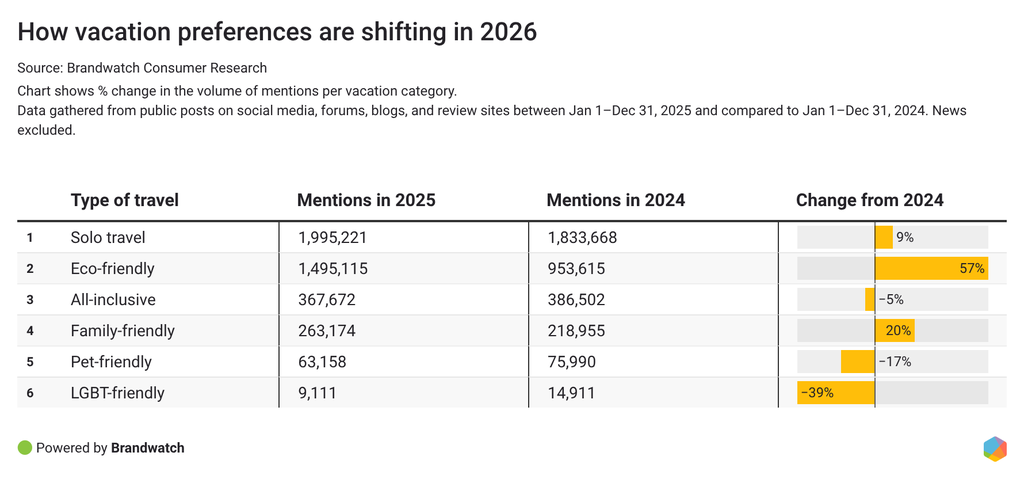
Across all six vacation types we analyzed, discussions involving eco-friendly travel surged 57% in 2025 compared to the previous year, with 49% more unique authors joining the conversation.
Sustainability is one of the main drivers of the growing interest in eco-friendly experiences. Climate-conscious travelers increasingly appreciate brands’ commitment to environmental responsibility. Some left glowing hotel reviews that prove eco-friendly details and sustainable practices make lasting impressions on travelers.
“I really appreciated that they don’t use plastic–even the water bottles are made of paper, which shows how committed they are to sustainability.” (Source)
“What really stood out to me was the hotel’s strong commitment to sustainability. 🌱💚” (Source)
“I also appreciated the eco-friendly initiatives the hotel has adopted, which show a commitment to sustainability.” (Source)
Brandwatch data also shows that travelers are increasingly valuing the connection between their accommodations and nature. Eco-glamping emerged as a growing topic (+8% in 2025 compared to the year before) within these sustainability-focused travel conversations as travelers seek accommodations that blend comfort with environmental consciousness.
Hospitality brands that demonstrate real sustainability commitment that goes beyond the buzzword and show some effort will stand out in a rapidly growing market.
Small changes like swapping plastic straws for paper ones or replacing mini toiletries with refillable dispensers can go a long way with climate-conscious travelers who are actively seeking environmentally responsible vacation options.
Trend #2 “Off grid” is gaining popularity as people seek to disconnect
The eco-friendly travel conversation also surfaced growing interest in off-grid camping. Mentions of “off grid” vacations grew 124% in 2025 compared to 2024, as more people looked to disconnect from technology and urban life to reconnect with nature.
The off-grid camping boom reflects what's already happening online: people are tired of screens and want to literally "touch grass." Online sentiment around off-grid vacations is overwhelmingly positive at 74%.
Many campers seek remote locations that offer a true wilderness experience while maintaining some level of comfort. They use a variety of clever portable solutions, and enthusiasts often share product recommendations online like solar panels, mini manual washing machines, battery banks, advanced rooftop tents, and even how to make DIY incognito sleeping quarters.
There’s a huge opportunity for hospitality and outdoor brands to tap into the off-grid camping movement. People want to escape to the wilderness, but they still want a decent night’s sleep. Brands that can help support this journey – whether through solar power solutions or other off-grid friendly gadgets – will win over this passionate crowd.
And don't overlook the creators in this space. Off-grid enthusiasts aren’t just influencers getting kickback from pushing products; they're genuine experts who've built loyal communities around their expertise.
Trend #3 Solo travelers are an underserved market
Solo travel dominates the vacation conversation with close to 2 million mentions (and it’s growing – the conversation is up 9% compared to 2024), but not every solo traveler is a “happy camper.”
Negative mentions represent 41% of the entire solo-travel conversation. Safety concerns remain one of the biggest issues, in particular, among women. Online, many of them recount dealing with unwanted attention in public places like hostels and cafes, adding that hospitality staff is not always helpful in these situations.
Beyond safety, some solo travelers also mentioned encountering policies that discriminate against solo-dining. One person said, “I couldn't dine at the hibachi grill as a party of 1, despite having a reservation.” Another ran into issues buying a single seated concert ticket – many concert ticket platforms often block purchases that would leave a "stranded" seat, even when solo travelers are willing to buy it. Even transportation systems can create barriers: one traveler was told by a train company that their booking system couldn't handle sleeper car bookings for solo travelers, requiring manual intervention to book a ticket.
Still, solo travelers continue encouraging others to embrace their own company. Many are challenging societal expectations and redefining what it means to dine and travel solo. Post-pandemic, consumers have gained an average of three extra hours of free time per week, and they’re spending nearly 90% of that newfound time on solo activities – reshaping expectations around leisure and travel. They're embracing solo dates as a form of self-care, taking themselves out to restaurants, concerts, and new experiences as acts of personal fulfillment and self-love. It speaks to a broader cultural acceptance of independence and choosing yourself.
Solo travelers aren’t shy about sharing the love of their own company. They’re actively logging their happy memories online and sharing tips and recommendations for solo-travel friendly hotels and experiences.
Hospitality brands that fix the real problems – make solo travelers feel safe and ditch outdated policies to make travel experiences more inclusive – can win over this passionate and highly vocal crowd. When solo travelers are happy about the experiences they get, they become your loudest advocates, sharing recommendations and building the word-of-mouth buzz for you.
The industry has reached a turning point
Travelers are not just booking hotel rooms; they're choosing to spend money with the brands that align with their values and lifestyles.
Three key themes are helping shape where the industry is headed. Sustainability has become an important factor in decision-making. The desire to unplug is driving people toward off-grid experiences. Solo travel has evolved from niche to mainstream with its own set of expectations.
Travelers are getting pickier about who gets their business. They're reading reviews, sharing recommendations, and building communities around the experiences that brands get right. The winners in 2026 won't be the ones with the flashiest marketing but the ones that solve real problems and create experiences worth talking about.
Up until recently, your marketing team used to control the narrative. Today, 146 million online conversations are shaping it – whether you're listening or not.
The travelers who spend money with you are the same ones swapping solar panel recommendations in off-grid forums, scrutinizing your eco-friendly credentials, and building solo-travel communities that bypass your official channels entirely. They've already decided what matters. The question is whether you're building experiences around those priorities or still guessing.
The hospitality brands winning attention in 2026 won't be the ones with the biggest ad budgets. They'll be the ones who knew that eco-friendly travel mentions jumped 57%, that solo diners are tired of being turned away from hibachi grills, and that "off-grid" vacations grew 124% because people are genuinely exhausted by screens and brands’ presence in their social feeds – including yours. This analysis barely scratches the surface of what's findable in real-time conversation data.
The trends shaping your category are already being discussed. Your competitors are already being compared to you. Your blind spots are already costing you bookings.
The question is: Are you set up to listen?
How we uncover these trends (and how you can too)
This analysis is based on 146 million online conversations over a 12-month period, pulled from social media, forums, review sites, and blogs with the help of Brandwatch Consumer Research.
We looked at what travelers are actually saying about their travel experiences, the types of vacations they discuss the most, and why to understand where consumer expectations are heading.
Looking to dig deeper into travel and hospitality trends that matter to your brand?
With Brandwatch Consumer Research, you can zoom in on what matters to your business:
- How does your brand show up in the conversations that matter most to your audience – sustainability, safety, value, experience quality?
- What are travelers actually saying about your brand compared to competitors?
- How is your brand showing up in solo traveler conversations – are people happy, do they feel safe, or are there issues you need to know about?
- What are travelers' biggest pain points when it comes to your brand?
- Which growing travel trends are passing you by, and how can you position your brand to capture that audience?
Whether you're repositioning your brand around sustainability, creating solo-traveler-friendly experiences, or trying to understand why consumers choose you over competitors, the real-time conversation data is already out there.


