




5 Social Media News Stories You Need to Read Right Now
By Bianca ParvuSep 28
Learn how to identify emerging risk signals and respond to threats before they escalate across social, media, and AI.
Emoji is the language of the future. But which are most popular? We have the data.
Emoji use has grown from a playful way to illustrate a joke to a language of its own, and it’s how we communicate our emotions and feelings online.
What were the most popular emojis in 2025 so far? We have the data.
Emojis play such an interesting role in how we communicate online, and with Consumer Research, we can see how they are shared and why.
For this post, we analyzed emoji use worldwide between January 1 and June 30, 2025, and compared the data to the previous six months.
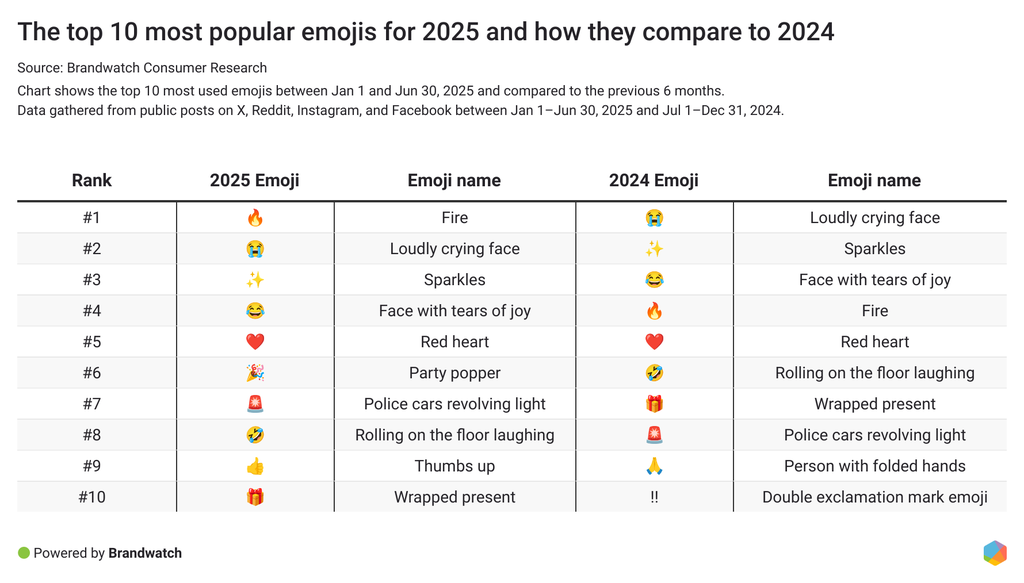
Here we’ll count down the top 10 most-used emojis on the internet in 2025, and how their rankings have changed since the previous period.
And how have the rankings changed since 2024?
These are the top few emojis that are the most used on social. We’ve included the official Unicode names, but you might recognize them better by just looking at them. 🙏
The wrapped present emoji has lost three positions in our top-10 list, landing at #10. It's popular in posts celebrating birthdays and sharing interactive challenges, and it’s often tied to countdowns and exclusive content releases.
A newcomer to our top-10 list, 👍 has secured the #9 position. The 👍 emoji is often used in online conversations to convey positivity, encouragement, and support. It frequently appears in posts celebrating small wins, personal milestones, or moments of gratitude, serving as a simple but effective way to acknowledge others' efforts and uplift the community.
🤣 has moved down two spots since the previous period, securing #8 on our list. A visual equivalent of ROFL, or what Urban Dictionary users describe as a common response for “when somebody says something dumb.”
The revolving police car light emoji has moved up one spot, landing at #7 on our list. People often use this emoji to draw attention to something, make announcements, or share breaking news and significant updates.
🎉 is a new entry to our top-10 most popular emojis list. Often seen in posts about milestones, product launches, or birthdays, this emoji adds a festive tone to celebrations. It’s also popular in giveaways and community events, helping generate excitement and shared joy.
❤️ has retained its spot in the top-10 list, holding steady at #5. The red heart emoji is universally recognized as a sign of love and gratitude, and we pair ❤️ with positive messages and when expressing good feelings. Many brands use this emoji in conversations to thank their fans for their support.
The “face with tears of joy” emoji has lost a spot, slipping to #4 on our list. While Gen Z users have recently declared that using the laugh-cry emoji makes you out of touch, we still saw plenty of laughter across social media in 2025, often accompanied by 😂.
Everybody’s favorite – the sparkle emoji – has also slipped to #3 on the list. This emoji frequently goes hand in hand with messages of excitement, and it makes sense. Almost cartoonish in its presence and built out of multiple stars, this emoji reminds me of Aladdin riding the clouds of the Agrabah Kingdom on a magic carpet with Jasmine by his side.
In real life, ✨ is used to magnify the feelings of warm connections in conversations, to emphasize newness and fabulousness in general, and, sometimes, to stress the irony.
The loudly crying face emoji has also fallen one spot to #2 since last time. Context matters: while a yellow face with an open mouth wailing and streams of heavy tears might initially suggest it conveys grief, it's often used to express positivity or capture tender moments.
🔥 has jumped three spots since the last period, landing at #1 on the top-10 list. An obvious internet favorite, the fire emoji is frequently paired with announcements of achievements or success. When we are doing great and feeling on top of the world, we are “on fire”!
Of course, this is a broad analysis that only touches the surface of how we communicate online. Emoji use varies depending on the person typing and the context behind the message.
Brands looking to truly understand how audiences feel – both in general and about them – need deeper sentiment analysis.
For marketers, sentiment and emotion analysis is an essential tool for tracking emotional tone in real time and at scale. With platforms like Brandwatch Consumer Research, you can go beyond surface-level trends to uncover how people feel in the moment, what’s driving those emotions, and how sentiment shifts over time.
Consumer Research gives you access to deep consumer insights from 100 million online sources and over 1.4 trillion posts.
Existing customer?Log in to access your existing Falcon products and data via the login menu on the top right of the page.New customer?You'll find the former Falcon products under 'Social Media Management' if you go to 'Our Suite' in the navigation.
Brandwatch acquired Paladin in March 2022. It's now called Influence, which is part of Brandwatch's Social Media Management solution.Want to access your Paladin account?Use the login menu at the top right corner.