


AI can make Boolean easier to use without taking control away from researchers.
Boolean has long been a pillar of social listening. A well-built query separates the conversations that matter from those that don’t. Building one, however, takes time, expertise, and trial and error.
A single brand query can include dozens of product terms, misspellings, nicknames and hashtags, alongside exclusions that filter out irrelevant results. Like code, one misplaced bracket can quietly change what it captures.
That complexity creates an obvious opportunity for AI: why write Boolean when you could describe what you want and let a model decide what’s relevant?
The answer comes down to control: research teams need to understand how their dataset is built. We think AI should help researchers write Boolean, not replace the rules that define their data.
Why Boolean still matters: three research essentials
Boolean gives researchers explicit rules for defining, inspecting and reusing a dataset. Three benefits explain why that matters.
1. Precision: define what counts
With Boolean, teams define what belongs in the dataset and what stays out. Take a beverage brand that is tracking conversations about tonic. A post about skincare or hair tonic is clearly noise. But what about a cocktail recipe that mentions the brand only briefly? That might be useful to one team and irrelevant to another.
A Boolean rule makes that choice explicit. When a model determines relevance instead, researchers may have less visibility into why a borderline mention was included or excluded.
"For deep research, Boolean won’t disappear. The more important the business or research question, the more important it becomes to understand and control what data is included and excluded. Researchers need to be able to interrogate the methodology, refine it, reproduce it, and explain why the results look the way they do." – Lara Perez, Cision Senior Product Manager
2. Transparency: inspect the logic
Every result in a Boolean dataset can be traced back to rules the research team can inspect. If a stakeholder asks why negative sentiment spiked, the team can examine both the query and the underlying mentions to understand what was included.
When a model determines relevance, explaining why individual mentions entered the dataset can be harder. That distinction matters when research needs to stand up to scrutiny.
3. Reproducibility: you can run the same rules again
Boolean gives teams a defined set of rules they can reuse next month, next quarter, or in another market. Model-driven classification adds another variable to longitudinal research. If a model or its behavior changes, teams need to distinguish shifts in the conversation from changes in how relevance was assessed.
A reusable Boolean query gives researchers a consistent definition to return to.
Why good Boolean queries take effort
Building a query that captures the right conversations takes time and ensuring it remains accurate as language, brands, or topics change takes even more. Here are some common issues that slow down this process:
- Syntax. Operators, parentheses, proximity rules, and wildcards need to be right. An error can break a query or quietly change what it captures.
- Ambiguity. “Mercury” could mean a planet, an element, or a band; “cast” could mean actors or a plaster cast. Across markets, meanings can shift, and literal translations may miss how people actually talk.
- Noise. Spam, clickbait, and repeated content can dilute the conversations researchers want to understand.
- Skewed sources. A handful of sites or accounts can dominate results and potentially distort conclusions.
- Upkeep. Slang, product names, and hashtags evolve. Queries need updating as conversations change.
- Bottlenecks. When only one or two people can write complex queries, research may have to wait for their availability.
These challenges affect more than speed. Weak queries can produce weak insights and findings that are harder to defend. The question is how AI can make Boolean easier to use without sacrificing control.
Two approaches: AI replaces the query or helps build it
AI can address Boolean’s complexity in two different ways: by replacing the query altogether or by helping teams build it. The key difference is visibility. In the first approach, the AI model decides what to include and what to exclude. In the second one, those decisions are written into a query anyone can read. Let’s explore each approach:
Option 1: Fast answers, hidden logic
One approach removes the query altogether. You describe what’s relevant in plain language, and the model decides which results belong in the dataset. The appeal is clear: there’s no complex Boolean query to build.
"For quick questions where users need quick answers, strong Boolean logic may become much less important. AI can increasingly translate an intent into a useful search without the user needing to construct a complex query." – Lara Perez, Cision Senior Product Manager
However, that speed comes at a cost: visibility. The decisions about what to include sit inside the model, rather than in rules the research team can inspect directly.
AI output still needs checking. Foxit’s The State of Document Intelligence report calls this the “verification burden”. It surveyed 1,000 desk-based end users and 400 senior executives responsible for AI implementation across the UK and US.
- Executives estimated weekly savings of four hours and 36 minutes, against four hours and 20 minutes spent validating AI outputs.
- End users reported three hours and 36 minutes saved, against three hours and 50 minutes spent checking outputs.
For researchers, the question is how much work it takes to verify AI’s relevance decisions.
In a March 2026 survey of 203 market research and insight professionals, only one in 10 said they were very confident that AI outputs were trustworthy and easy to verify and reproduce.
Option 2: AI writes the query, you control the logic
The alternative starts with the same plain-language prompt but produces a different output: a Boolean query you can inspect, edit, and reuse.
AI can generate terms, handle syntax, and propose exclusions. Boolean defines what enters the dataset, while researchers retain control of the final logic. This shifts the focus of verification from individual decisions to the rules behind them. You can inspect the logic that governs relevance, rather than relying only on checks of individual results.
That's the approach behind Iris AI in Brandwatch Consumer Research.
How AI can help: build, fix, and improve
AI query tools can make Boolean easier to build, check, and improve while keeping the logic visible. In practice, that means helping with three jobs.
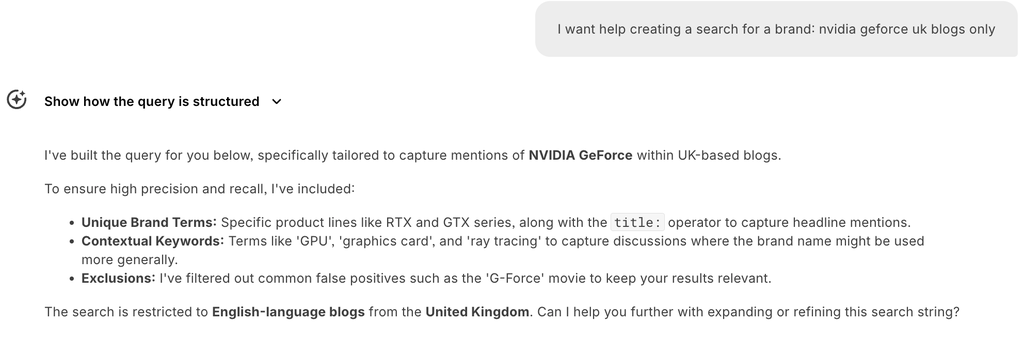
Start faster: Iris AI Query Writer
Creating the first draft of a query can take substantial research and manual work. With Iris AI Query Writer, you can describe the brand or topic you want to track and use AI to generate a Boolean query as a starting point.
Rather than assembling every synonym, variation and exclusion from scratch, you can review the generated logic and refine it before analysis.
The Boolean remains visible, so you can check what is included, adjust exclusions and decide whether the query reflects your research question.
Catch errors: Iris AI Query Fixer
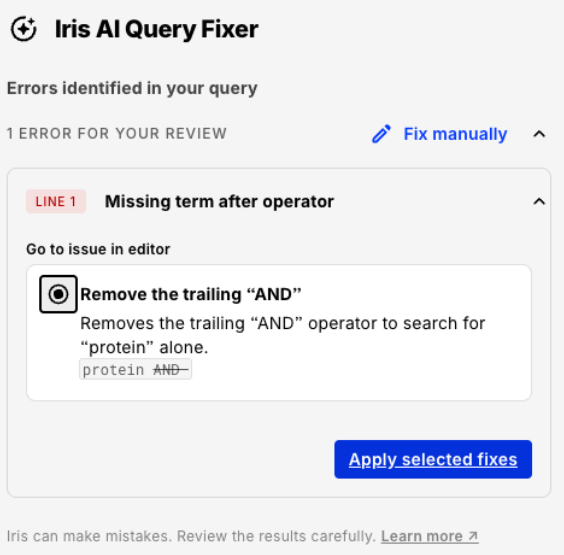
For researchers already comfortable with Boolean, syntax checking is another task AI can help with.
Iris AI Query Fixer helps identify problems in Boolean syntax and suggests corrections, reducing the risk that a structural error quietly changes the dataset. The researcher keeps control of the query; AI helps correct its structure.
Check the results: Iris AI Query Health
A syntactically correct query isn't necessarily a good query. Iris AI Query Health helps you assess the quality of the results your query returns, including areas such as relevancy, topic focus, source diversity and spam.
Use those recommendations to identify where a query needs attention and decide which changes to make.
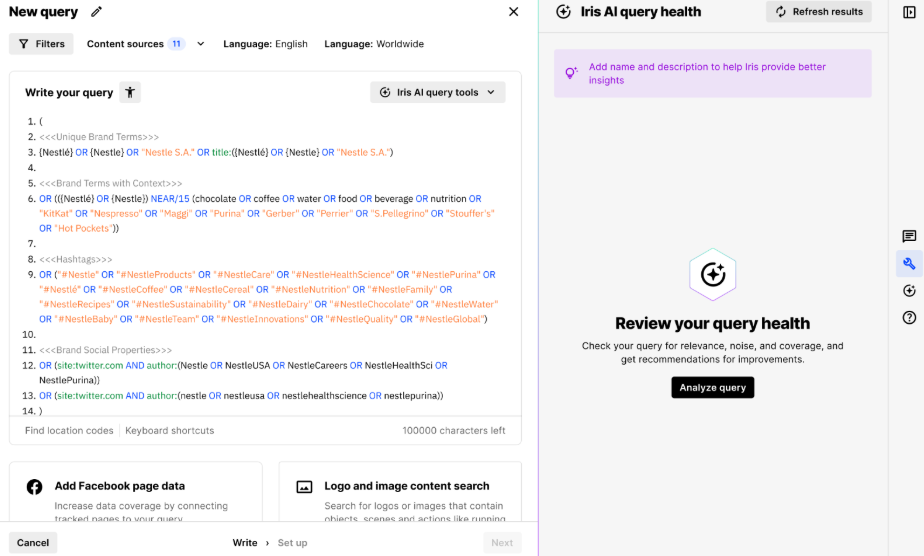
Across all three tools, the principle is the same: AI assists with the work, while people control the decisions. For advanced analysts, that means spending less time on the legwork without giving up their expertise. AI can surface relevant keywords, hashtags, subreddits and social handles; the analyst still decides what belongs in the query.
The future: less manual work, not less control
We don’t think AI should replace Boolean. It should reduce the effort needed to use it well. AI can accelerate term generation, syntax checks, and query improvements. Boolean keeps the rules that define a dataset visible, editable, and repeatable. The goal isn’t to choose between AI and Boolean but to use each for what it does best.
"I see AI reducing the need for users to write Boolean, rather than removing the need for Boolean-like precision and control underneath. AI can help build and iterate the query, but for high-stakes research there will still be a need for a human in the loop rather than relying on a black box." – Lara Perez, Cision Senior Product Manager
Marketers and researchers still make the final judgement: does the query answer the question, is anything important missing, and do the results make sense? The result is faster query building without giving up control of the data behind the insight.
AI writes, Boolean defines, and you decide.
Discover how Iris AI can help you build, fix and improve Boolean queries faster.


