Brands today don’t suffer from a lack of data. They suffer from fragmentation.

With social media data, you can watch conversations unfold, track sentiment shifts, and discover audience reactions in real time. But without understanding when those conversations translate into active demand, you’re only seeing part of the picture. 

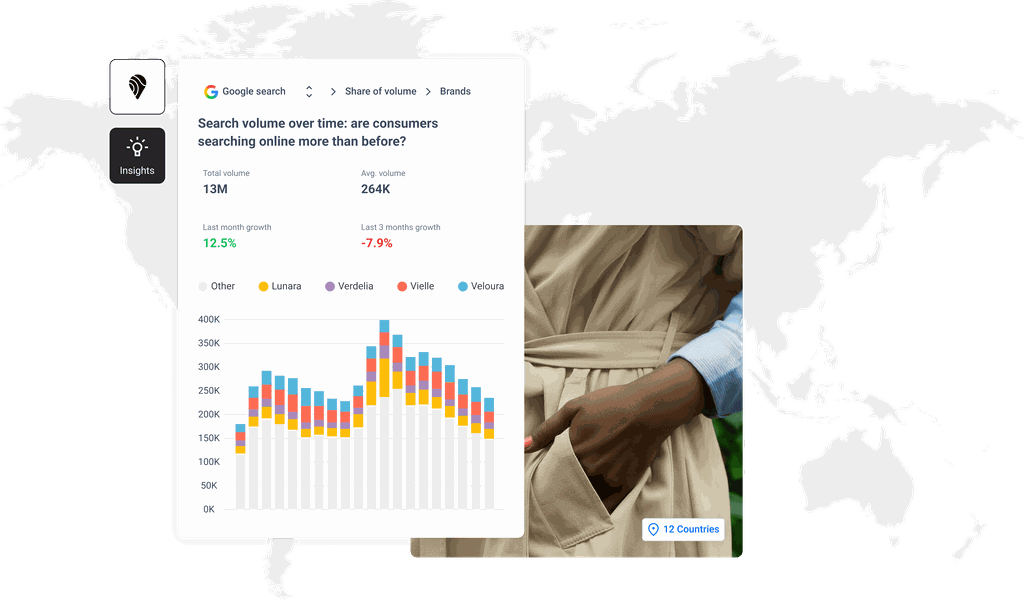
Search data is what tells you when people are acting on this data. Individually, both datasets are powerful. Together? They connect cultural context with commercial intent.

Let’s dive into the benefits of combining search data with social intelligence.  

Benefit 1: You’ll see not just what customers want – but when they want it

Social data shows the start of customer demand. From questions in a skincare influencer’s comments section to a running shoe comparison in a Reddit thread, social intelligence shows us what’s influencing online conversations in real time.  

But search data captures something different. When someone Googles “best retinol serum for sensitive skin” or asks ChatGPT which carbon-plated running shoe is good for a quick marathon, their curiosity has sharpened into intent. 

Their need has become actionable.  

By layering search data onto social intelligence, you can see which conversations are translating into measurable demand. After all, not every viral topic converts – but now, you can see which signals are directly influencing revenue. 

These connected datasets give brands a bird's-eye view of the cultural shifts that are actually driving action – so you can invest accordingly.  

Benefit 2: You understand where intent is forming before demand peaks

Intent doesn’t always start in the search engine. Often, it begins in everyday conversations – often online. From a TikTok comment asking, “Is this air fryer easy to clean?” to a Facebook group debating the best holiday park for toddlers – these aren’t purchase moments yet. But they are signals.  

Search data helps to prove when that exploration has turned into defined intent. It proves when someone has moved from browsing to actively looking – the sweet spot for any brand looking to convert. 

When you combine your social intelligence with search data, your team can trace exactly how curiosity evolves into high-intent moments. This way, you’re not just reacting to search volumes, but you’re understanding what’s caused them.  

Ultimately, this helps you to create content, refine messaging, and shape your brand’s industry positioning before demand peaks.  

Benefit 3: You’ll discover the full competitive landscape

Competition rarely begins on results pages – it begins in conversation. Whether it’s Reddit threads or TikTok comments, brand trust is built in online communities, way before someone searches for a brand name. 

But influence alone doesn’t tell you who’s converting that preference into demand. That’s where search data comes in.  

Search can show who’s ranking for valuable keywords, who’s appearing in AI-generated answers, and who’s capturing visible demand. It reveals exactly which brands are turning conversation into action. 

So, when you combine your social intelligence with search data, you can see both sides of the story – who’s shaping the narrative, and who’s turning that into demand.  

Benefit 4: You get to validate your audience by understanding what drives them

Your audience often isn’t only who you think they are. Social intelligence helps uncover the full picture, revealing who’s actually engaging with your brand. It can surface unexpected communities and use cases you might not have considered – and show you where these conversations begin. 

On the flip side, search data proves whether those audiences are translating interest into intent. Are they searching for your brand? Are they comparing you to others in your industry? And are they actively looking to buy?  

Combining your social intelligence with search data helps you to understand if you’re targeting the right people – and what motivates them to act.

Benefit 5. You can connect fragmented journeys into a clearer picture

Real customer journeys don’t live on one platform, and they certainly aren’t linear. People hop from TikTok to Google to Amazon, or from Reddit to ChatGPT to Google – often all in one decision cycle. And with AI tools like ChatGPT increasingly becoming part of that journey, the path from discovery to purchase is only getting more complex. 

When social and search are analyzed separately, these journeys can fragment. And when internal teams are optimizing different customer touchpoints, they can fail to see how audiences move between them.  

By combining social intelligence with search data, you can follow this process much more clearly. From early exploration to a high-intent search, you can gain a proper overview of your customer journey. 

Rather than forcing a funnel model you think you understand, you can act on how people are actually making decisions. This way, you can align everyone from SEO to sales to map concrete customer journeys that are rooted in data. 

Roundup

The future of audience intelligence is connected. Social shows why demand forms. And search shows when it’s time to act.  

Fragmented data leads to fragmented understanding. And for brands, the future isn’t about choosing between social or search – it’s about connecting them. It’s about combining emotion with action, culture with conversation, and curiosity with intent.  

This enables smarter content, campaigns, and messaging, meaning brands can lead with context – not just volume.