




5 Social Media News Stories You Need to Read Right Now
By Bianca ParvuSep 28
Learn how to identify emerging risk signals and respond to threats before they escalate across social, media, and AI.
We analyzed hundreds of thousands of mentions and searches around football boots during the World Cup. Find out which brand strategies worked and which didn't.
The 2026 World Cup has concluded, drawing more than 68.5 million mentions across social media, blogs, forums, online news, and TV and radio.
We previously reported on cultural moments that went viral – like ranch dressing and the Viking chant – and how non-sponsor brands earned visibility without official partnerships through clever marketing.
Now we’re turning our analytical attention to footwear – the pitch's most-scrutinized accessory.
Football boots were a major topic of discussion during the World Cup, with brands like Nike, Adidas, Puma, and New Balance spotlighting their newest products.
Adidas, as an official World Cup sponsor, had maximum visibility on the field. Nike countered with new shoe models and celebrity-driven campaigns. And pink cleats – the color that seemed to dominate the field – sparked debate and controversy.
Using Consumer Research, we tracked footwear-related mentions within tournament conversations across public social and news content between June 11 and July 19. We also analyzed search data to understand how search interest for football and soccer shoes evolved.
Football footwear tracked close to 50k mentions in tournament discussions (June 11-July 19). Meanwhile, the broader conversation about football shoes – including discussions not directly tied to the tournament – reached 818.5k during the same period. There was a huge amount of mentions on social for us to dig into.
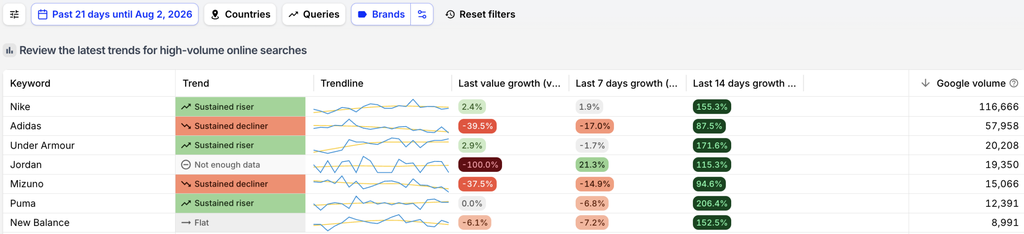
To capture post-tournament search behavior, we also tracked search queries like “best football boots,” “best cleats,” and “soccer footwear” across the US, UK, and Canada.
Nike came out on top. "Nike football cleats" grew 155.3% over the two weeks post-tournament – the strongest brand momentum of the group.
Adidas grew too but lost steam. As the second-largest brand by search volume, Adidas searches were up 87.5% over the full two weeks, but dropped 17% in the second week alone.
Under Armour and Puma grew fastest, but from a much smaller base. Searches were up 171.6% and 206.4% respectively, though total volume stayed modest at 12.4k and 20.2k searches.
Bottom line: Nike had both the bigger search volume and the faster growth, turning tournament buzz into lasting search demand better than any competitor. Adidas got the sponsorship spotlight, but Nike got the search traffic.
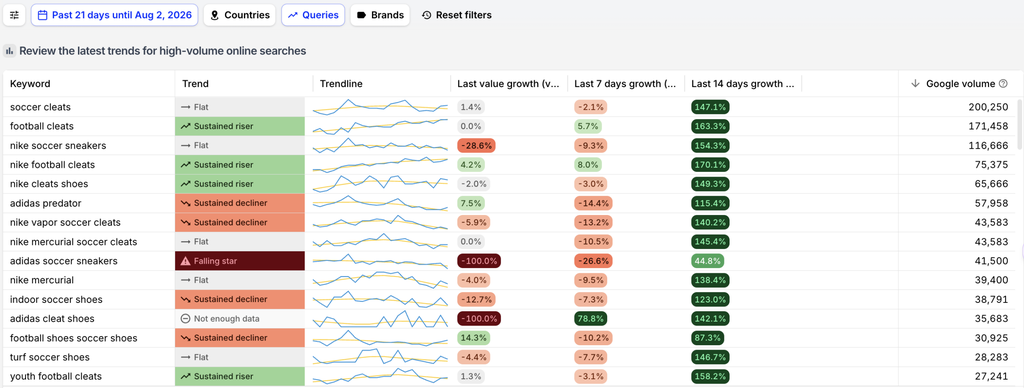
Generic terms outperformed brand terms. “Soccer cleats” led with the largest search volume at 200.3k searches. "Football cleats" wasn’t far behind, with 171.5k searches and 163.3% growth over the two-week period, showing that most shoppers search by category, not brand.
Nike still led on brand-specific search. “Nike soccer sneakers” (116.7k and “Nike football cleats” (75.4k) were the top brand-specific queries by volume.
Adidas underperformed on brand-specific search: "Adidas predator" declined 14.4% week-over-week, while "Adidas soccer sneakers" spiked during the tournament before fading fast, down to 41.5k searches and falling 26.6% in the final week.
Youth and specialty categories were mixed. "Youth football cleats" grew steadily (27.2k searches, up 158.2% over two weeks), while "indoor soccer shoes" (38.8k) and "turf soccer shoes" (28.3k) stayed relatively flat.
This tells us that people search generically far more than they search by brand. Which means non-sponsors still have a shot at visibility if they show up in category-level content, not just brand campaigns.
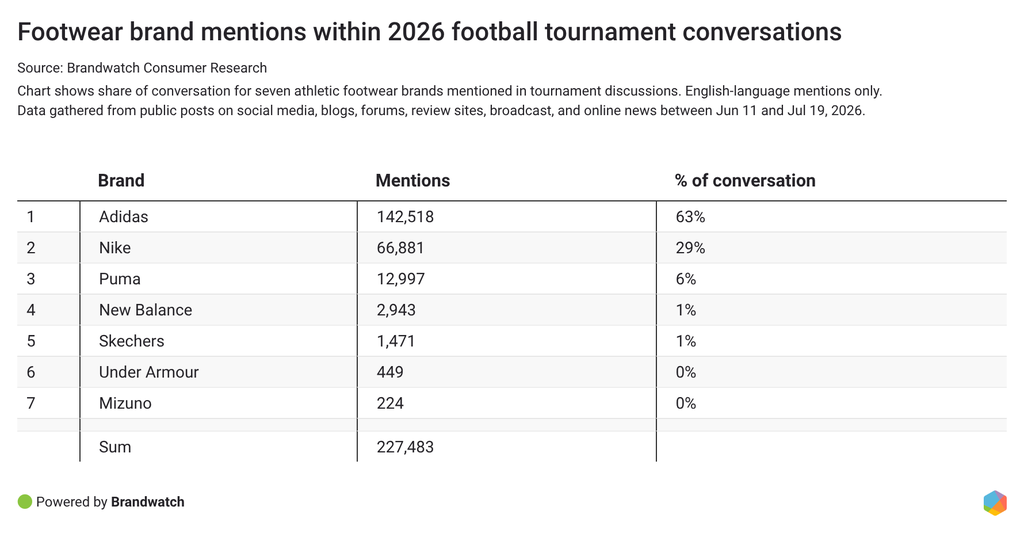
We tracked mentions of the seven athletic footwear brands players wore – any time these brands came up in tournament conversations (June 11-July 19).
Adidas and Nike were clear leaders in social conversation. Together, these two brands captured 92% of all mentions across the seven footwear brands tracked in tournament conversations. As the official tournament sponsor, Adidas captured the largest share of mentions – 63%.
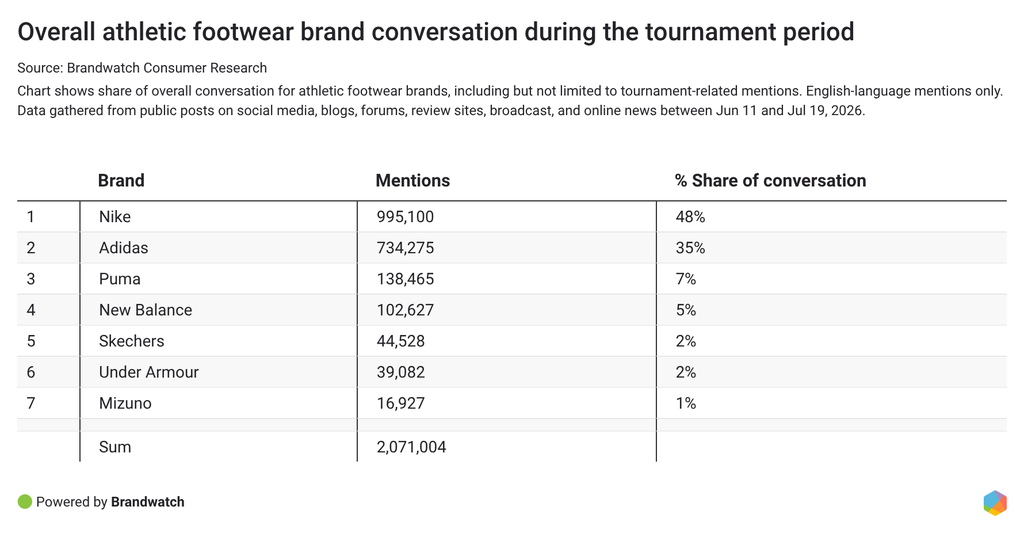
But when we looked at broader brand conversation – mentions not limited to the tournament – the picture shifted.
Nike dominated overall brand conversation with over 995k mentions (48% share), while Adidas captured 734k mentions (35% share).
So what does this tell us?
Search and social data revealed two distinct patterns:
But mention volume and search trends only show where attention went – not why it went there or how brands earned it. To understand what actually drove brand performance, we need to look at what shaped the conversation.
Adidas had the advantage of official sponsorship, but Nike won the sentiment battle. Nike secured a 78% share of positive sentiment across all brand-related mentions, while Adidas's positive sentiment sat at 52%. Here’s how each brand approached the tournament.
Nike's top moments shared something in common: they were cultural events that gave fans something to talk about, share, and celebrate.
Nike ambassador LISA sent fans into a frenzy with a custom look for Nike's global "Rip The Script" campaign, made from upcycled Nike Mercurial Vapor 17 Elite FG Hyper football boots. Given how large and dedicated LISA's K-pop fanbase is, the moment instantly spilled beyond football circles, turning into a viral event that amplified Nike's visibility across multiple audiences. “Rip The Script” tracked close to 1.4k mentions in tournament conversations.
Iconic player gear also drove conversation. Ronaldo's “Gold Scorpion” Mercurial Superfly 11 boots became one of the most talked-about footwear moments, combining aspirational design with legendary player status. And then, Ronaldo gifted his game-worn World Cup cleats to YouTube streamer IShowSpeed, sparking thousands of fan reactions across social media, with fans noting IShowSpeed was “shook” by the gesture.
The Mercurial Superfly 11 tracked 5.4k mentions in total during the tournament.
As an official sponsor, Adidas had visibility everywhere. The brand supplied referee kits, player boots, and the official match ball – the Trionda – used in every game of the tournament, which racked up 29.5k in tournament discussions. Adidas also leaned into player storytelling. The brand released “Backyard Legends,” a short film starring Timothée Chalamet, Messi, Bad Bunny, Lamine Yamal, and other football, music, and film names, celebrating everyday football ahead of the tournament.
The brand honored Lionel Messi's record-breaking career with special edition gear celebrating his farewell tournament run as the all-time leading scorer and Golden Boot winner. Adidas and Messi together tracked 22k mentions during the tournament. Adidas also outfitted breakout teenage star Lamine Yamal, whose performances made him one of the tournament's most talked-about young players.
But while Adidas had unmatched on-field presence, it came in well below Nike on brand sentiment (52% versus 78%). Several factors played into that gap – most notably pink cleats, which drew criticism for both brands.
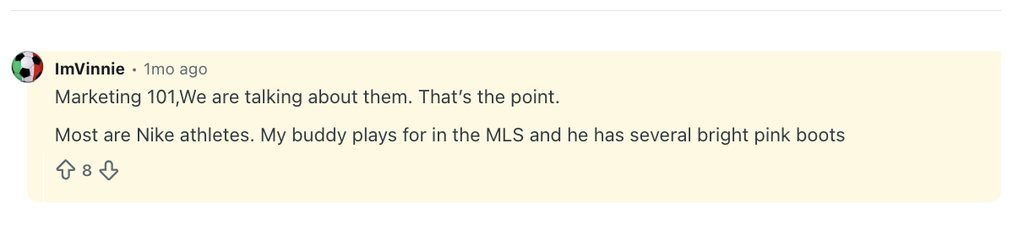
Pink cleats – worn by players across multiple brands including Nike and Adidas – became one of the tournament's most divisive product moments.
Pink cleats picked up over 5.5k mentions in tournament discussions between June 11 and July 19, and close to 70% of sentiment-categorized mentions skewed negative. Fans questioned the color choice and called for more differentiation. "Why are all the boots pink?" became a common question across social media.
Some felt the widespread adoption of bright pink cleats made individual players blend in rather than stand out. Others saw it as a marketing play rather than genuine self-expression.
The backlash points to a real risk in marketing: when every brand chases the same trend at once, it can backfire. Fans didn't have a problem with pink itself – they had a problem with everyone looking the same. In a sport where individuality matters, the uniformity felt forced.
Pink cleats drew criticism, but Nike's strong overall positive sentiment (78%) and standout cultural moments meant the backlash didn't stick. The takeaway: one product misstep won't necessarily hurt a brand if the bigger story around it is strong.
The tournament revealed a clear pattern: visibility doesn't automatically translate to positive attention.
Adidas had maximum on-field presence as the official sponsor, capturing 63% of tournament-specific footwear conversation. But Nike won the search and sentiment battle by focusing on cultural moments that resonated – celebrity partnerships and iconic player gear that gave fans something to share and celebrate.
Three lessons for brands:
Official sponsorships cost millions and offer brands a huge platform. But smart brands can capture attention and leave a lasting impression by showing up where fans are already engaged.
Curious how it all played out? Explore our recap of the tournament in numbers: Football Attention Index.
Consumer Research gives you access to deep consumer insights from 100 million online sources and over 1.4 trillion posts.
Existing customer?Log in to access your existing Falcon products and data via the login menu on the top right of the page.New customer?You'll find the former Falcon products under 'Social Media Management' if you go to 'Our Suite' in the navigation.
Brandwatch acquired Paladin in March 2022. It's now called Influence, which is part of Brandwatch's Social Media Management solution.Want to access your Paladin account?Use the login menu at the top right corner.