AI is reshaping how consumers search.
Instead of using traditional search engines, more and more people take their questions straight to AI platforms.
ChatGPT now answers roughly 2.5 billion prompts daily, and recent analysis suggests Google's AI Overviews appear on about one-fifth of searches. When consumers ask “which EV has the best range?” or “what's the best sunscreen for sensitive skin?”, AI answers those questions instantly, and your brand is either part of that answer or it’s not.
Most brands have no idea what AI says about them.
“We're seeing a bigger and bigger part of the consumer purchase journey being shaped by AI. We absolutely need to be having a good handle on what the AI is saying to these consumers,” says Alistair Wheate, Principal Solution Strategist at Brandwatch.
You don’t need a complicated strategy to understand your AI visibility – you need the right tool. That's where search intelligence comes in.
Measuring your AI visibility
Search Intelligence platforms track what consumers search for across Google, ChatGPT, Perplexity, and other AI tools. You can discover the exact questions people ask about your category and whether your brand appears in the answers. If your brand doesn’t appear, it’ll also show you what content you need to create to close that gap.
Here's a practical framework to help you find out if your brand is winning with AI – and what to do if you're not there yet.
Your four-step assessment
Step 1. Pick one country
Choose a market or product category that matters to your business, one you already operate in.
Search behavior varies dramatically by geography. What people ask about your category in the US differs from what they search in the UK, Germany, or Japan. Focusing on one country helps you move faster, both in analysis and action.
Here’s a real-life story from the multinational telecommunications brand Orange. When the Orange team analyzed customer search behavior in French-speaking markets, they discovered that people often searched for answers to specific questions like “How do I fix this bug?” and “Why is my TV not working?” The company's website had no troubleshooting content, so when people searched Google or asked ChatGPT, they found nothing helpful and flooded call centers with their questions.
The brand used the Search Intelligence solution to identify the exact questions customers searched for most frequently and then created targeted website content answering them. The result was a library of genuinely useful content that not only brought in organic traffic, but also reduced call center contact volume by 25%.
Pro Tip
Use Search Intelligence to identify the exact queries your customers are searching for. Then create dedicated FAQ pages, troubleshooting guides, or blog posts that answer them directly.
Step 2. Pick your category
Define the specific category you want to monitor. If you operate in the automotive industry, narrow it down to something like “electric SUVs under $50,000” or “luxury sedans.” Consumers evaluating electric vehicles ask different questions than those researching luxury sedans. If it’s skincare, get more granular – think “anti-aging serums” or “sunscreen for sensitive skin.”
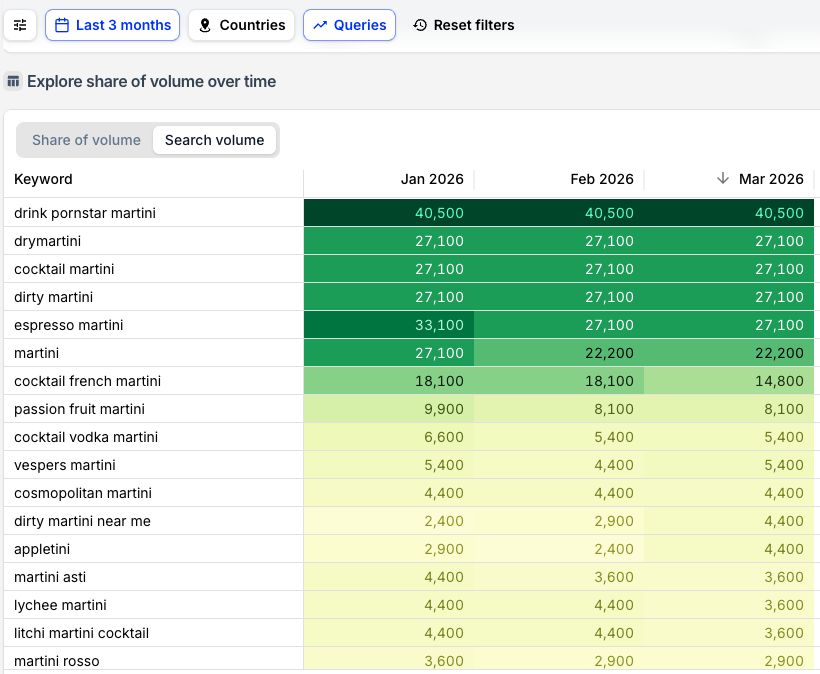
Take Campari Group as an example. Their go-to-market strategy revolved around cocktails, which meant they needed to know which drinks were trending in each market to run effective campaigns. Campari used to rely on local agencies in Australia, the UK, France, and Brazil to stay on top of local drinking trends. After bringing search intelligence in-house, they cut costs by 50% while gaining real-time visibility into what consumers searched across 15 markets.
This Search Intelligence dashboard shows search volume for martinis in the UK.
Step 3: Find the 100 questions people are asking
The number is arbitrary – the goal is to discover as many popular questions as possible to build a clear picture of what your audience is actually asking.
Using solutions like Search Intelligence, you can identify the actual questions consumers type into search bars and AI when asking about your category.
Consumer questions shift depending on where they are in their journey:
- Awareness stage: Broad, exploratory questions like “What is…?”, “How does…?”, or “Explain how this works…”
- Consideration stage: Comparison-driven questions like “Which is the best…?”, “What are the options…?”, or “Recommend me…”
- Evaluation stage: Decision-ready questions like “Is brand A or brand B better?”, “Is brand A safe?”, or “Is brand B value for money?”
Aromazon, a French skincare brand, used the Search Intelligence tool to identify exactly what questions people asked about fragrances, essential oils, and aromatherapy. They launched a website with pages matching those searches – helping the brand grow from zero to €40 million in revenue per year.
"Sometimes brands lack insight into why people are actually buying their products," says Matthew Danieleu. "But when people search on Google, Amazon, Walmart, or Tesco, they tell you exactly what they’re looking for."
In other words, search data reveals unfiltered consumer intent – people show you precisely what problems they need to solve, which features matter most, and how they evaluate options.
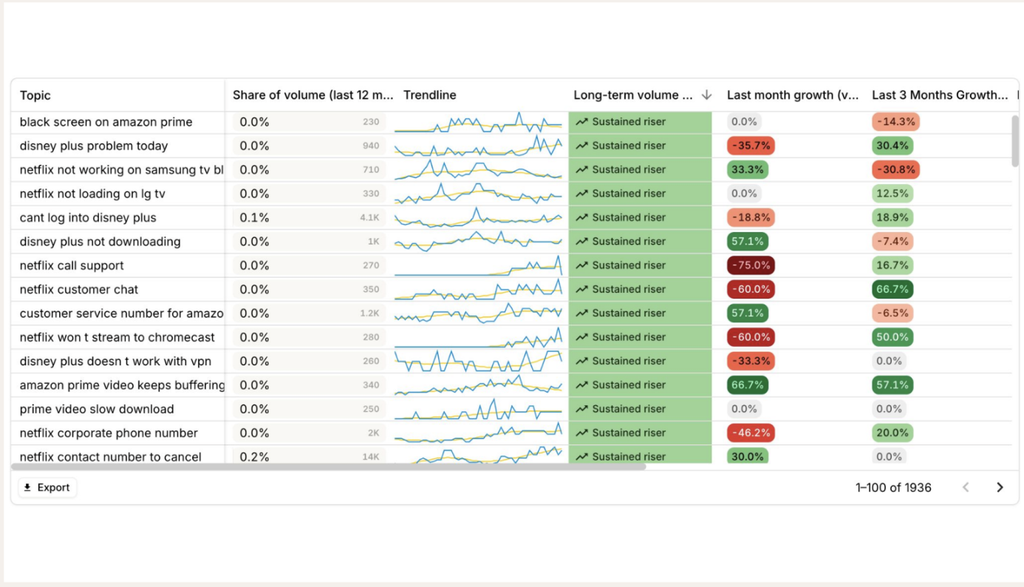
The example below shows Netflix-related customer service search queries across Google and TikTok.
Step 4: Check if your brand shows up in AI answers
Once you’ve defined the market, category, and key questions, you can assess how visible your brand is in AI answers. Test those “100” questions in ChatGPT, Gemini, Perplexity, and Google AI Overviews – does your brand appear in the responses?
Use search intelligence platforms to track your brand's appearance across AI responses at scale. Document which brands get mentioned, which get recommended, and which get cited in the sources. Note when your brand appears, how it gets described, and what competitors show up instead.
When you ask ChatGPT to compare products, it presents a detailed analysis with hyperlinked citations. Those citations might include reviews from retailers, industry websites, and niche communities on Reddit (think r/SkincareAddiction or r/CarTalkUK) where enthusiasts discuss specific categories. And those thousands or millions of mentions quietly determine how your brand gets categorized.
By doing this assessment, you’ll know exactly where you stand – and where the gaps are.
What to do when your brand doesn't show up in AI answers
If your brand isn't appearing in AI responses, focus on the three sources that shape what AI knows – and what it says about you:
Make sure your owned content answers people’s questions
Answer the questions people actually ask. When you've identified those 100 questions, check how many you currently answer with dedicated content. Create FAQ pages, troubleshooting guides, or blog posts that directly address what consumers want to know.
Earned coverage from sources AI platforms can access and cite
Major publishers like BBC and The New York Times often block the likes of ChatGPT from scraping their content, but not all is lost. Their coverage creates a ripple effect through social media and Reddit conversations that AI platforms do read. Put your energy into trade publications, independent blogs, and platforms like Substack and Medium.
Participate in the conversations shaping AI perception
When consumers talk about your product on Reddit, share experiences on TikTok, or ask questions in forums, that feeds into what AI platforms know about you.
Show up where your customers ask questions. Provide helpful answers on Reddit. Respond to customer reviews with solutions. Share expertise in industry forums. Every helpful response is one more signal that shapes how AI talks about your brand.
Making AI visibility part of your workflow
After your initial assessment, set up regular monitoring. AI answers change as new content gets indexed, so check what platforms like ChatGPT and Perplexity say about your brand at least once a month. When you spot gaps – wrong descriptions, missing mentions, competitors showing up in your place – you'll know exactly where to focus.
AI is – not so quietly – shaping how people decide what to buy. When someone asks ChatGPT "what's the best [your category]," and your brand doesn't come up, you’ve lost them before they even found you.
Start with one market and the questions that actually matter to your customers. Find out where you stand, then work on closing the gaps.