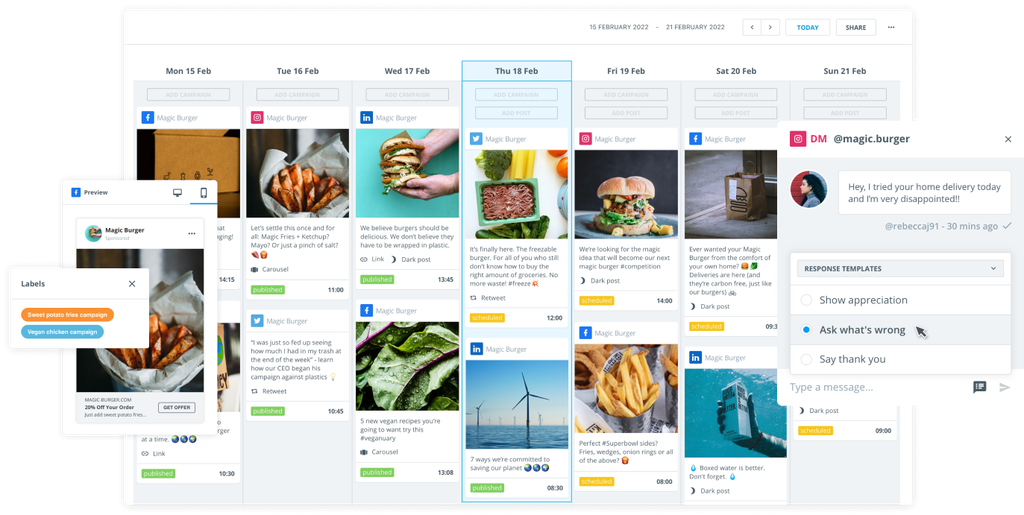
Social media is the leading marketing channel for brands, trumping TV, radio, and news sites as the go-to place to launch campaigns.

Platforms like Facebook, TikTok, Instagram, and X have become so universally used that businesses can’t afford not to be on them.

But merely posting on social media isn’t enough. These days, brands must work hard to ensure effective campaigns are properly planned, researched, executed, and analyzed.

To do this right, you need a social media analytics tool. Such tools are built to collect and analyze data and help you understand who you’re reaching, how people interact with your content, and which posts deliver the best results.

Why social media analytics matter in 2026

A solid analytics stack is indispensable because the amount of data generated on social networks has exploded in the past decade.

Platforms themselves offer basic analytics, but third‑party tools like Brandwatch Social Media Management go much further. 

Detailed metrics aren’t just for vanity reporting; they help you make smarter decisions and connect social media performance to goals.

This guide explores 12 of the best social media analytics tools out there today. From all-in-one management suites like Brandwatch to specialized tools. Read on to find your match.

In this guide:

Benefits of using social media analytics tools

Before diving into individual tools, it’s helpful to summarize why media analytics matter. After all, you may have to provide return on investment (ROI) reports to other stakeholders when adopting a new tool, so it’s worth understanding what you get back from using this type of software.

Here are six benefits to using social media analytics tools:

1. ROI measurement

One of the core benefits of any analytics tool is being able to measure ROI and ensure your output aligns with your business strategy.

Tracking key performance indicators (KPIs) like impressions, engagements, share of voice, and conversions allows you to connect social activity to business results.

If you prove strong ROI, then you’re also more likely to replicate or evolve future projects. It supports data‑driven optimization and demonstrates value to leadership.

2. Deeper audience insights

Analytics platforms reveal who interacts with your content and how. By gathering social media metrics, it’s possible to understand what your audience likes and dislikes, the type of content they engage with, and how to align your social media strategy to meet their needs.

3. Improved engagement and loyalty

When followers see content that resonates, they’re more likely to engage. Analytics tools show you which posts drive the highest engagement, making it easier to replicate success. Over time, engagement evolves into brand loyalty, which can form a central pillar of your business strategy.

4. Competitive intelligence

The very best social media analytics tools come with competitor tracking, which allows you to benchmark your performance against other brands in your industry. Analyzing their content reveals strengths, weaknesses, and opportunities. Competitive benchmarking is commonplace in marketing, especially when it comes to gauging social media campaigns.

5. Greater efficiency and better decision-making

Instead of cobbling together data from individual social networks like Facebook, X, Instagram, and others, analytics platforms centralize information in one dashboard.

This saves time and lets you focus on analysis rather than data collection. It’s also far easier to make strategic decisions when you can see all the data in front of you.

That’s why the best tools also come with reporting functions, so you can build a coherent narrative around the numbers and act on them.

Top social media analytics tools for 2026

Now let’s look at the tools that can bring these benefits to your business in 2026, starting, of course, with Brandwatch.

1. Brandwatch

Brandwatch Social Media Management is a suite designed to oversee entire social strategies, from ideation to execution and analysis.

Data is central to how Brandwatch works. The platform pulls millions of historic and live data points from social sites like X, Facebook, Instagram, and TikTok, and brings the numbers into a single dashboard. We’re official partners with the biggest social media sites, so we have unrivaled access to data.

From there, you can measure cross‑channel analytics and benchmark for competitive analysis.

Unlike standalone social media analytics tools, Brandwatch combines publishing, advertising, engagement, and analytics in a single platform. It’s therefore much easier to act on your analyses.

No more waiting on others. With built-in team management processes and AI features, you can develop and execute an efficient social media strategy in no time.

Brandwatch social media analytics features

  • Multi-platform metrics: Brandwatch users can aggregate data from Facebook, Instagram, TikTok, X, LinkedIn, YouTube, Bluesky, Reddit, Tumblr, Twitch, and Pinterest. So you can see where your efforts are paying off. Dashboards display metrics and KPIs across hundreds of channels in real time.
  • AI‑powered insights: Brandwatch’s Iris AI engine helps you interpret performance by summarizing trends and analyzing comments. You also get AI‑powered summaries of competitors’ posts and comments.
  • Competitor benchmarking: Compare your company against more than 300,000 brands across major social networks. Features include share of voice comparison, audience size metrics, analysis of top posts and videos, hashtag analysis, and sentiment benchmarking.
  • Historical data and exports: Access years of historical data, export reports, and share public links so stakeholders can leave feedback.
  • Open API and integrations: Brandwatch provides an open API for exporting data to other platforms, making it easy to integrate analytics into your broader business intelligence stack.

Who uses Brandwatch for social media analytics?

Brandwatch is an all-in-one social media management tool with analytics built into everything it does. It therefore appeals to enterprises and large teams that need robust analytics, competitor benchmarking, and AI insights. Because Brandwatch supports publishing, advertising, and engagement alongside analytics, it’s ideal for organizations seeking unified workflows and deep insights from social data.

2. Keyhole

Keyhole is a specialist tool for real‑time social media analytics and monitoring. It focuses on major networks and offers insights into brand mentions and trending hashtags.

It also acts as an influencer marketing platform where users can analyze potential partners before reaching out and managing relationships.

Keyhole social media analytics features

  • Real‑time tracking: Keyhole provides real‑time analysis of posts, hashtags, and brand mentions across supported networks.
  • Influencer discovery: The tool helps you monitor what followers say about your brand, track competitor behavior, and find leading influencers.
  • Trends: Keyhole uses data analysis to identify upcoming trends and show you which content is performing best.

Who uses Keyhole for social media analytics?

Marketers who need real‑time tracking of campaigns, hashtags, and brand conversations tend to consider Keyhole for the job.

3. Rival IQ

Rival IQ specializes – as the name suggests – in competitive analysis and is geared toward social media managers who want detailed statistics about their rivals.

It provides customizable reports that help users understand both their own brand’s performance and their competitors. Users can also create social media audits and run social listening campaigns on the platform.

Rival IQ social media analytics features

  • Competitor comparison: Rival IQ provides competitor reports against other accounts across Instagram, TikTok, Facebook, X, etc, so you can see how your engagement, posting frequency, and growth stack up.
  • Content analysis: The platform offers analytical data, alerts, and custom automated reports from major social networks.
  • Competitor strategy analysis: Identify what’s working for competitors and incorporate those elements into your own social presence.

Who uses Rival IQ for social media analytics?

Marketers who want to understand their competitors and analyze their own social media output in the same space.

4. Metricool

Metricool is a social media management and analytics tool that aims to bring data from all your social accounts into one place.

Like Brandwatch, it’s one of the few platforms that supports data from Twitch and other “smaller” social sites. 

Metricool social media analytics features

  • Broad platform coverage: Metricool supports analytics for Facebook, Instagram, TikTok, YouTube, Twitch, X, and more.
  • Looker Studio connector: Export analytics data to Google’s Looker Studio via the built‑in connector.
  • Report builder: Build automated reports from scratch or use templates.

Who uses Metricool for social media analytics?

Small teams that need analytics across multiple platforms often consider Metricool when evaluating social media management tools.

5. Sendible

Sendible pulls social media analytics into a centralized hub to make it easier for users to understand their campaign performance. It's a large social media management tool, with scheduling, UTM tracking, and reporting thrown in.

In 2025, it launched a TikTok reporting function and Threads scheduling – two steps toward ambitions to cover all social media platforms in greater detail.

Sendible social media analytics features

  • Multi‑platform support: Sendible pulls analytical insights from the likes of Facebook, Instagram, LinkedIn, YouTube, TikTok, and X.
  • Automated analytics reports: The platform offers automated reports with customized branding and more than 200 analytics modules to choose from.
  • Wider management features: Sendible includes post scheduling, image editing, content curation, and unified inbox management.

Who uses Sendible for social media analytics?

Agencies managing multiple social media channels for many clients tend to consider Senbile alongside other enterprise-level platforms.

6. Social Status

Social Status is an Australian-based social media analytics tool with a heavy focus on reporting. You can automate analytical reports, as well as conduct competitor benchmarking and influencer campaigns.

Get content analysis on everything from your social media feed and audience to direct messages, video views, and link clicks. You need to be a mid-tier user to access Social Status's API.

Social Status social media analytics features

  • Reports: Social Status covers four core report types: profile analytics, ads analytics, competitor analytics, and influencer analytics.
  • Customizable templates: You can combine data for multi‑channel reports, pick which metrics to show, or start from a template loaded with essential KPIs. Export reports in formats such as CSV, XLSX, PDF, and PPTX.
  • Specialization: Social Status isn’t a publishing platform but instead focuses on delving deeper into its analytics and comes with a free plan.

Who uses Social Status for social media analytics?

Marketers who already manage posting elsewhere and are looking for a dedicated analytics tool tend to consider Social Status an option.

7. Hootsuite

Hootsuite offers analytics as part of a wider range of social media management options. It works across major social networks and provides plenty of metrics for analysis.

Larger plans offer in-depth industry benchmarking and audience insights, while advanced features are exclusive to custom enterprise plans.

Hootsuite social media analytics features

  • Social network support: Hootsuite tracks analytical performance across Facebook, Instagram, X, LinkedIn, TikTok, and other sites. You can monitor multiple formats in one dashboard.
  • Metric library: The platform lets you track more than 110 social media metrics, including page, profile, follower, and video stats.
  • Audience insights: Segment your audience into meaningful groups and get personalized recommendations for the best times to post.

Who uses Hootsuite for social media analytics?

Large corporations that need a comprehensive analytics solution paired with scheduling and engagement features usually check out Hootsuite, along with other social media management tools.

8. Iconosquare

Iconosquare tracks over 100 social media metrics across all major platforms to optimize content. From suggesting the best publishing times to identifying top-performing posts, the platform does a steady job.

Users can also conduct competitive benchmarking and social listening. Integrations with Slack, Adobe Express, and Dropbox are available, too.

Iconosquare social media analytics features

  • Custom analytics dashboards: Build a dashboard with exactly the metrics you want to see by dragging and dropping widgets.
  • Social listening: Track hashtags and competitors with a built‑in listening tool. Although the listening functionality is limited to hashtags rather than keywords, it still provides useful context for brand conversations.

Who uses Iconosquare for social media analytics?

Agencies focused on visual platforms like Instagram and TikTok require social media data to maximize engagement on these networks.

9. Sprout Social

Sprout is social media management software that offers analytics alongside a whole stack of other features.

Its analytics module collects data across networks and offers cross‑channel comparisons. Other modules focus on social listening and sentiment analysis to build a wider picture of your brand’s presence.

Sprout social media analytics features

  • Widespread analytics: Sprout’s analytics tool delivers extensive data harvesting and condensed numbers into one dashboard.
  • Custom reporting: Premium accounts can create customized reports tailored to your organization’s KPIs.
  • AI integration: Sprout offers a range of AI additions to help users extract and digest more data.

Who uses Sprout for social media analytics?

Marketing teams at larger organizations that need analytics, influencer tracking, listening capabilities, and more.

10. ContentStudio

As the name suggests, ContentStudio is all about maximizing your social media content and drawing insights from it. Content discovery tools complement its analytics capabilities.

Users can also generate group reports that combine statistics and help make better sense of the numbers.

ContentStudio social media analytics features

  • Competitor analysis: Monitor your competitors’ performance on social media to find the best‑performing posts and benchmark your strategy.
  • Content discovery: The platform’s content research tool finds top‑performing articles, videos, and posts on any topic, then analyzes their sentiment.

Who uses ContentStudio for social media analytics?

Content‑driven teams who need analytics plus inspiration for what to post next.

11. SocialPilot

SocialPilot is a social media management platform that aims to simplify the link between your analytics and KPIs. It supports a wide range of networks and emphasizes custom dashboards and reporting.

There's also a large emphasis on optimized reporting, with templates, a scheduler, and white label options, depending on your chosen subscription package.

SocialPilot social media analytics features

  • Social media analytics builder: Filter metrics, choose date ranges, and create custom dashboards based on the KPIs that matter most.
  • Data storytelling: The tool focuses on turning complex insights into clear, visually rich reports that are easy to share with clients or executives.

Who uses SocialPilot for social media analytics?

Agencies that need customizable reporting and cross‑platform support tend to consider SocialPilot among other tools when seeking reliable management software.

12. Buffer

Buffer is more than a scheduling tool and comes with a hoard of media analytics data. The aim is to simplify data extraction and interpretation on one platform.

Of course, your data inevitably informs your publishing strategy, which is where Buffer really shines. Users can also compare rivals and collaborate with clients within the platform.

Buffer social media analytics features

  • Data crunching: Buffer cuts complex social media data down to size and prepares users with insights to deploy on future posts.
  • Optimal posting times: The tool also uses analysis to propose the best times to post for maximum engagement.
  • User‑friendly interface: The dashboard is intuitive and simple, with integrated scheduling.

Who uses Buffer for social media analytics?

Small business owners and teams seeking straightforward analytics and scheduling may consider Buffer alongside other management tools.

Social media analytics tools FAQs

What are social media analytics tools?

Social media analytics tools are software platforms like Brandwatch that collect and analyze data from your social media channels to help you understand audience behavior and content performance.

Do I still need analytics tools if social networks have native insights?

Yes. While platforms like Instagram or X provide basic analytics, they often lack the depth and cross‑channel perspective needed for strategic decisions. That’s where a tool like Brandwatch comes in handy. You can collect and consolidate data from all your social channels, view campaigns holistically, and benchmark performance across networks.

How do social media analytics tools support competitor analysis?

The best media analytics tools include social competitor benchmarking features. For example, Brandwatch compares your performance against more than 300,000 brands and provides share of voice metrics. Competitor insights help you identify gaps in your strategy and adopt best practices from successful competitors.

Choose the right social analytics tool today

Social media analytics tools come in many forms. Some, like Brandwatch, offer enterprise-level analytics alongside publishing, scheduling, reporting, and other management features.

Others keep their offer lean with quick analytical insights. These are best used as part of a wider tech stack to manage your social media accounts.

When choosing a tool, consider what you need it for. Are you already halfway to a complete social media management solution? In that case, a simpler platform may suffice. Or are you looking to revolutionize your campaigns armed with in-depth analysis?

If it’s the latter, Brandwatch is here to help. Book a demo today and speak to one of our experts about how we can take your entire social media game to the next level.