


Did Your Last Campaign Work? Why You Need Both Social and Search Data to Know for Sure
By Ksenia NewtonAug 14
Avoid blind spots in consumer and market understanding. Identify opportunities and risks earlier with connected intelligence.
We reveal how to monitor purchase intent language on social media to drive business opportunities and monitor campaign effectiveness.
During our recent UK masterclass, clients and staff alike were treated to a whole host of thought-provoking content.
The presentations from some Brandwatch superusers took us through the unique ways clients are using social data, including a big-name client’s use of Vizia.
Some presentations demonstrated the truly unique insights users can glean from Brandwatch Analytics, specifically purchase intent language on social.
Mentions and engagement for your brand can be a good indicator of an effective social media strategy, but they don’t always equate to revenue or profit.
Intent to purchase is the conversation that happens online when a user expresses an actual desire for a product rather than generally talking about a brand or their product.
It might include a Tweet from a person expressing their desire to buy a product, a post about wanting to pre-order something before its release or a blog update indicating an eagerness to see a newly-released movie.
To help broaden our understanding of how this works, presenters at the Masterclass took us though how monitoring purchase intent has made a difference for one global brand.
In Brandwatch’s recent retail report, social data was used to analyze H&M – the second largest fashion retailer in the world.
Brandwatch Analytics tracked H&M as they ran four major celebrity endorsement campaigns. The purpose of the research was to not just analyze which celebrity caused the greatest buzz, but which generated the most purchase intention mentions.
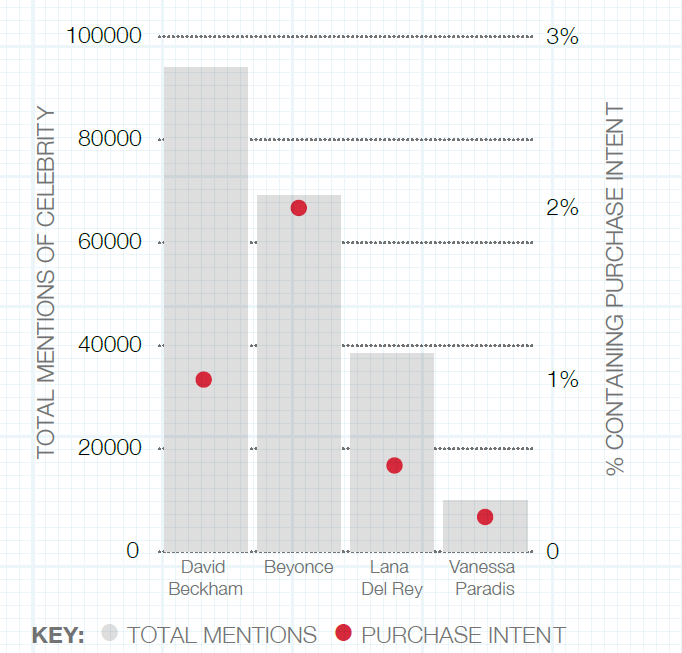 After collecting and analyzing the data it became clear that David Beckham drove the highest volume of conversation for the H&M brand. However, Beyonce provoked more purchase intent conversation.
Through social listening, H&M were able to measure the value of their endorsement in a whole new way. Previously David Beckham would have been seen as the best ‘value’ endorsement for the retail brand due to sheer magnitude of conversation generated by him and his undies.
Now it’s clear that in terms of monetary value added to the business, Beyonce clearly comes out on top.
Brands like H&M now have the opportunity tie conversation with sales and create bespoke campaigns based on whether they wish to drive brand awareness or sales.
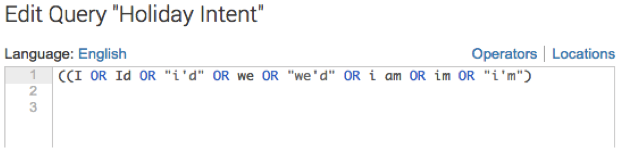
Fortunately, the Masterclass event made an effort to match presentations on success stories with step-by-step how-tos, meaning clients could put into action many of the insights they had heard. Ross Barrett gave us a walk-through demonstration of how to set up purchase intent Queries within the Brandwatch Analytics platform. An intent Query is a way to find mentions by people wanting to take an action; whether it’s buying something, going somewhere or doing something. They all start with personal pronouns; I OR Id OR “I’d” OR we OR we’, as seen in the example below.
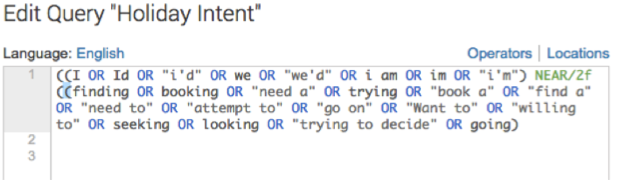
 Next, add in action terms, like need OR want OR looking OR going OR booking.
At this stage you’ll also want to bring in the NEAR/xf operator. The NEAR states that the two words must be in proximity to one another and the letter f after the number indicates that the second word must follow the first in that order.
Finally, bring in context with the subject of the action – in this case holiday OR getaway OR “city break” OR cruise, for example.
Obviously, this is where you edit the Query to match the product of interest to you. This could be anything from a restaurant booking to a SasS platform.
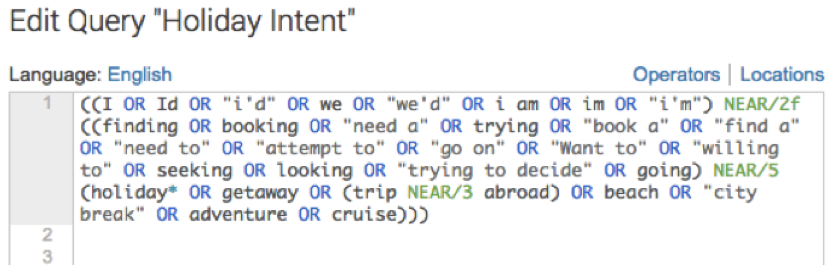
And there you have it. A purchase intent Query showing exactly how many people are talking about buying your product.
Try out purchase intent monitoring for yourself by using the Query below. Simply replace [BRAND] with your brand name.
( ((I OR “I am” OR “I’m” OR Im OR really) NEAR/0f (((want OR wanna OR need OR looking OR “interested in” OR tempt* OR “Thinking about” OR “thinking of” OR ((cannot OR “can’t” OR cant) NEAR/0f wait) OR considering OR “feel like” OR “feeling like”) NEAR/2f (buy* OR purchas* OR get* OR order*)) NEAR/7f [BRAND]))
OR (((“I will” OR “I’ll” OR Ill OR “I’m” OR Im OR ((I OR “I am” OR “I’m” OR Im) NEAR/1f (“going to” OR gona OR gonna))) NEAR/0f (buy* OR purchas* OR get* OR order*)) NEAR/7f [BRAND]) )
We’ve got a huge backlog of Query strings set up to monitor a whole host of different conversations, including purchase intent, so feel free to get in touch if you would like to try it for your own brand.
Consumer Research gives you access to deep consumer insights from 100 million online sources and over 1.4 trillion posts.
Existing customer?Log in to access your existing Falcon products and data via the login menu on the top right of the page.New customer?You'll find the former Falcon products under 'Social Media Management' if you go to 'Our Suite' in the navigation.
Brandwatch acquired Paladin in March 2022. It's now called Influence, which is part of Brandwatch's Social Media Management solution.Want to access your Paladin account?Use the login menu at the top right corner.