Based on current market leaders and recent updates, here are the top social listening platforms to consider this year. We’ve included a mix of enterprise-level powerhouses, approachable tools for small businesses, and a free option.
1. Brandwatch
Brandwatch is a pioneer in social media listening and has been around longer than most other top players. Having launched in 2007, Brandwatch has evolved alongside social media and has an enormous bank of data analytics and historical data coverage.
Social listening forms a core part of Brandwatch’s Social Media Management and Consumer Intelligence solutions. The software analyses hundreds of millions of social posts in real-time and pulls all this data into sharable dashboards.
You can then use this social listening data across Brandwatch’s suite to create robust marketing strategies. Analyze audiences, create content, and publish campaigns all in one place.
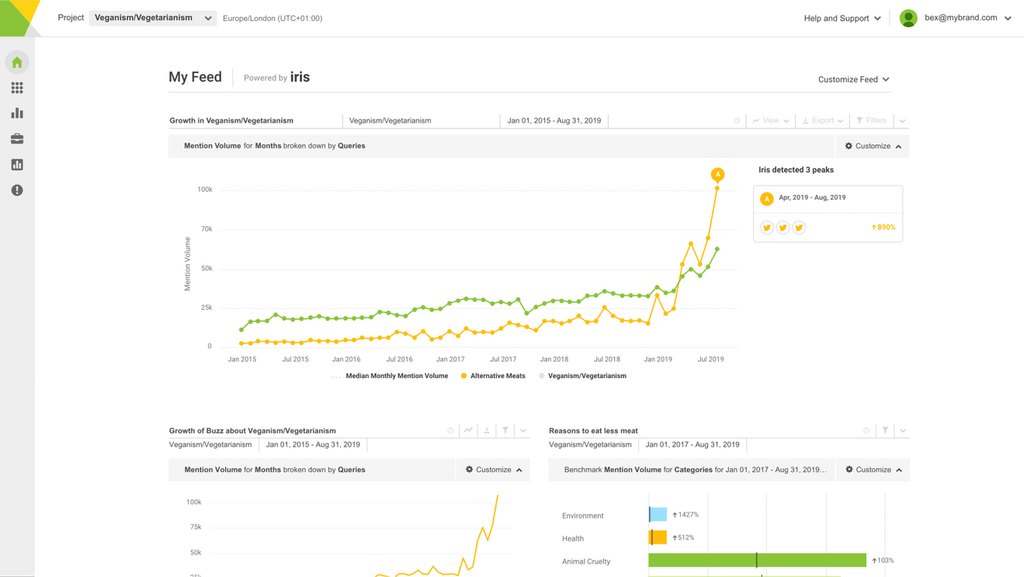
Brandwatch also has an advanced AI tool called Iris that automatically finds patterns and insights in social media data, surfacing things you might have missed.
In fact, social listening bleeds into everything Brandwatch offers. From crisis management to competitor analysis, the listening function is there to guide your strategies.
Pros:
- Extensive coverage and historical data: Tracks a huge range of sources with years of history readily available, which is great for long-term trend analysis and benchmarking.
- Rich, customizable analytics: Highly flexible dashboards and queries allow deep dives (e.g., segmenting by demographics, sentiment, topics). Users often praise the analytics depth and customization options.
- Enterprise integrations: Now part of Cision, Brandwatch integrates with PR monitoring tools to provide a one-stop communications hub.
Notable 2025 updates: Brandwatch integrated Bluesky into its product in May 2025, offering access to all public posts and replies. There are around eight million mentions on Bluesky per day, and the site is growing at pace.
2. Meltwater
Meltwater has been around for over two decades and blends traditional media monitoring and social listening. It started in news monitoring but has expanded to social media over the years.
It’s more widely used by PR teams to track brand mentions across news outlets, blogs, and broadcast media. While it also has social listening capabilities, its core benefit is focusing on media coverage.
In that respect, its capabilities align more closely with a media monitoring tool like CisionOne.
You can see how a story is trending in the press alongside what’s happening on X or Facebook. It also has a newsletter and alert feature, where you can automate daily briefings of top mentions to your team.
Ideal for PR agencies and large companies, Meltwater is a reliable tool for analyzing wide-scale media coverage, although its social listening focus isn’t as deep.
Pros:
- Comprehensive media coverage: Meltwater monitors news sites, blogs, social media, broadcast, and even print in some cases.
- PR-friendly features: The inclusion of press contacts, press release distribution tools, and PR analytics can be a plus if you have one foot in traditional PR. It saves having a separate PR tool.
- Scalability: Meltwater is used by thousands of organizations, so it has proven scalability and tends to be stable.
Notable 2025 updates: Like Brandwatch, Meltwater introduced TikTok listening in 2025, giving users access to data on public mentions of their business handles.
3. Sprinklr
Sprinklr is an enterprise Unified Customer Experience Management (Unified-CXM) platform that includes powerful social listening as part of its suite.
It covers social media listening, publishing, customer service, advertising, and more in one platform.
Sprinklr’s listening module, called Sprinklr Insights, integrates with an large number of sources beyond just social networks. The tool also leverages AI to provide sentiment analysis, emotion detection, and trend predictions.
Sprinklr’s dashboards are customizable with an array of widgets, charts, and maps. You can build a “command center” view to monitor everything from brand health to competitor mentions live.
Pros:
- Channel coverage: Sprinklr has access to multiple channels, not just social media.
- All-in-one platform: Sprinklr also offers publishing, engagement (social customer service), ads, and more.
- Customization: You can tailor Sprinklr dashboards and metrics to build your own internal listening “command center” with big screens showing real-time data.
Notable 2025 updates: Sprinklr also introduced TikTok video mentions in 2025, with a limit of 1,000 video mentions for any given brand account.
4. Mention
Mention is built with real-time working in mind. The platform tracks brand mentions across social media, blogs, news, and the web at large, with a focus on delivering notifications when your keywords are mentioned.
It’s a popular choice among start-ups and small businesses looking to manage and understand their brand position within the market.
Like Brandwatch, the platform offers sentiment analysis (positive/neutral/negative tagging of mentions) and a centralized inbox where you can see all your mentions and respond or assign tasks (especially useful if you connect your social accounts to reply directly).
You can also generate simple reports like mention counts over time or top influencers mentioning your brand.
Pros:
- Real-time notifications: Mention lives up to its name by notifying you of new mentions.
- Ease of use: The interface is clean and not overwhelming. Setting up an alert is as easy as typing in keywords.
- Integrated basic publishing: The ability to reply to mentions or publish updates from Mention can save you time switching apps. It’s a convenient all-in-one for small teams that don’t want separate tools.
Notable 2025 updates: Mention launched Emotion Analysis in late 2024 with detection and filtering capabilities. The software helps users understand individual social media comments, with AI present to highlight key emotional trends.
5. Brand24
Brand24 is all about real-time monitoring of your brand or any keywords. It offers a clear interface and useful social media analytics alongside access to 25 million online sources.
Brand24 tracks mentions across social media (Facebook, X, Instagram, TikTok, YouTube, etc.), as well as blogs, news sites, forums, podcasts, reviews, and more.
Once you set up your keywords, Brand24 will collect mentions and provide insights like mention volume over time, sentiment analysis, and an “Influence Score” to highlight how impactful each mention/source is.
You can add multiple users to a single account, meaning everyone can access the Mentions Feed and other metrics. A newer feature is Alerts via Slack or email, so you don’t always have to log in to know if something important happened.
Pros:
- Easy set-up: Getting started is straightforward. The UI is friendly, and setting up a project to monitor keywords is quick.
- Good for market research: Brand24’s ability to pull in social and wider internet mentions means you can use it to discover general market discussions, not just direct brand mentions.
- Alerting and notifications: Users like the alert system that can notify you of spikes or let you know daily/weekly summaries.
Notable 2025 updates: Brand24 improved its sentiment analysis feature in June 2025 to deliver more accurate sentiment detection and better support for complex languages. There is now a more accurate recognition of positive sentiment, which previously got confused with natural statements.
6. Keyhole
Keyhole is a social media listening and analytics tool specializing in real-time hashtag tracking, keyword monitoring, and influencer analytics.
It’s a popular choice for campaign tracking and social media research. It’s particularly known for providing live data on X and Instagram hashtags, which is useful for event monitoring and measuring campaign reach.
Users can plug in a hashtag or keyword and immediately see an analytics dashboard: number of posts, impressions, reach, top posts, and influencers talking about it. Keyhole also provides predictive analytics – it can forecast which hashtags or topics are likely to go viral based on current traction.
For those interested in influencers, Keyhole identifies influential accounts in your topic area and gives stats on them (follower count, engagement, etc.), helping with influencer marketing efforts.
Pros:
- Specialized in hashtags: If your focus is tracking hashtag performance (e.g., #YourCampaign2026), Keyhole is one of the best, giving instant insights on reach and engagement of that tag.
- Ease of use: Setting up a keyword or hashtag to track is straightforward, and the resulting dashboards are easy to understand, even for non-analysts.
- Predictive insights: The ability to forecast trends or identify when a topic might peak is a feature that not many tools offer.
Notable 2025 updates: Keyhole is steadily developing its competitive analysis tool to cover social media intelligence, as well as other areas of the media.
7. Sprout Social
Sprout Social combines tools for content publishing, engagement, analytics, and social listening in one interface.
Its social listening module lets you track conversations across all major social networks and beyond (forums, blogs, etc.). Sprout’s Smart Inbox aggregates all your incoming messages, comments, and mentions across platforms into one feed.
Sprout’s listening tool also comes with query builders and pre-built templates, so you don’t need to be an expert to set up keyword tracking.
Beyond listening, Sprout also offers publishing and scheduling tools, a content calendar, social CRM features (to track profiles of your most engaged followers), and collaborative workflows (ideal for teams and agencies).
Pros:
- User-friendly interface: Sprout has a clean, intuitive design.
- Unified platform: The integration of publishing, engagement, and listening means you can go from insight to action instantly.
- Customer support and resources: Sprout provides webinars, an academy, and responsive support. Sprout also hosts a strong user community.
Notable 2025 updates: Sprout launched Smart Categories in 2025 in an effort to improve its topic categorization feature. The widget offers bubble and bar charts so you can spot trends quickly.
8. Talkwalker
Talkwalker is an AI-powered social listening and analytics platform now operating as part of Hootsuite’s product ecosystem.
Talkwalker monitors 30+ social networks and 150 million+ web sources, with up to five years of historical data available. It supports content in 187 languages.
Like Brandwatch, the platform’s AI engine provides visual listening and image recognition – it can identify brand logos and objects within images shared on social, capturing mentions where your brand isn’t textually mentioned but appears in a photo.
Talkwalker is often used for reputation management, market research, and campaign tracking on a global scale.
Pros:
- Rich analytics: Data visualization and analysis, including world maps of conversations and network graphs linking themes.
- Visual listening: Image recognition and video analytics enable brands to catch logo appearances, or product images shared online.
- Multilingual & multilocal: Support for 180+ languages means sentiment analysis and topic detection work in many locales.
Notable 2025 updates: Talkwalker introduced a global search bar in 2024 to make project search easier for users managing multiple projects at once. This, alongside a news aglet feature, helps users stay on top of the conversation.
9. Awario
Awario is a social listening tool that offers Boolean search capabilities, lead generation features, and a clean interface. It’s simple to use and generates digestible reports.
For users who want precision, you can use operators to include or exclude terms, specify proximity of words, etc., to fine-tune exactly what mentions you get.
Awario monitors the major social networks, as well as news sites, blogs, and the web at large. It has real-time monitoring and presents mentions in an inbox-like feed. It also stores data and offers historical data access, so you can analyze past mentions over a given period (with some limits on how far back, depending on your plan).
A unique feature is Awario Leads – a module that tries to find posts where people express a need for a product or service like yours.
Pros:
- Advanced search filters: The Boolean search capability means you can create highly tailored listening queries that cut out noise and focus exactly on your interest areas.
- Lead generation feature: Awario Leads proactively finds potential customers asking for recommendations, which can directly support sales efforts.
- Unlimited team members: You can invite your whole team to collaborate without extra cost (only Enterprise has advanced sharing, though).
Notable 2025 updates: Awario has been steadily improving, recently enhanced its sentiment algorithm, and introduced an option for reports on higher plans (useful for agencies).
10. YouScan
YouScan monitors text and visual mentions across major social media and online sources, similar to others, but its flagship feature is Visual Insights. Like Brandwatch, it’s able to scan images in social posts for brand logos, objects, and even scenes (for example, it could identify your product in a photo or detect that a photo was taken on a beach, etc.).
YouScan also provides all the standard listening features: keyword tracking, sentiment analysis, trends over time, influencers identification, and a robust analytics dashboard.
It covers a wide array of languages and sources and offers spam filtering to reduce noise and irrelevant mentions.
YouScan’s interface is professional and polished, offering customizable reports and the ability to export data or integrate via API for advanced users.
Pros:
- Visual listening: YouScan’s ability to find your logo or product in images is a huge plus that few others (aside from Brandwatch, Talkwalker etc.) offer at this level.
- Consumer insights: By capturing both the visuals and text, YouScan offers a richer understanding of consumer behavior and contexts.
- Stable and responsive: YouScan is known for good customer support and willingness to adapt to customer needs, perhaps due to its smaller size compared to giants.
Notable 2025 updates: YouScan improved its social listening dashboard in 2025 to integrate more data into the platform. Users can gain inspiration from other clients – known as YouScan “Ambassadors” – and replicate dashboards they find useful.