Using artificial intelligence (AI) for social media strategy is now standard practice for thousands of brands, but selecting the right tool requires thorough research.
AI-powered social media tools monitor and analyze the millions of online conversations about your brand, industry, and competitors. They automatically gauge sentiment, spot trends, and filter out noise so you get actionable insights fast.
With capabilities like these, it’s no wonder social listening has become essential.
This guide reviews 10 of the best AI-powered social media tools available. Whether you’re a small business tracking brand mentions or an enterprise seeking deep consumer insights, we’ll cover each tool’s key features and how it uses AI.
In this guide:
Key features to look for in an AI social media tool
Before we dive into each of the top tools for 2026, let’s take a look at what you might need AI social media software for. AI has permeated many work practices, but its true value lies in how it supports you and your workflows.
So, as we look through each tool, consider if you need any of the following:
Broad data coverage
How much data do you need? AI tools can monitor all major social networks (Facebook, X, Instagram, TikTok, YouTube, LinkedIn, Pinterest, etc), as well as other online sources, including blog posts, news sites, forums, and review sites. The best tools cover millions of sources and many languages, ensuring you don’t miss conversations.
Real-time alerts
Do you need new mentions instantly? Look for tools that offer customizable alerts (via email, SMS, or in-app) that notify you if mentions spike or sentiment turns sharply negative. Advanced tools like Brandwatch have AI-driven alerts to flag unusual surges or drops.
Sentiment analysis
Are you looking to gauge sentiment on social media? AI-driven sentiment analysis tools automatically tag mentions as positive, negative, or neutral. Top platforms utilize sophisticated natural language processing (NLP) to comprehend context, sarcasm, and slang, thereby enhancing accuracy. Some, like Brandwatch, also detect emotions (such as joy and anger) for a more nuanced understanding of audience feelings.
Visual listening
Do you want to know where your brand is being seen? The ability to recognize logos or products in images and videos is a cutting-edge feature. This ensures you catch social media posts where your brand appears visually, even if it's not mentioned in text (for example, an Instagram photo of someone using your product).
Historical data and trends
Do you need access to historical mention data (ideally going back years)? This allows you to benchmark and spot long-term trends. The best tools illustrate how conversation volume and sentiment evolve over time, utilizing AI to highlight notable spikes or patterns.
Analytics dashboards
Are you planning to house everything in one place? Rich, customizable dashboards help you make sense of the data. Look for charts, graphs, and maps that let you break down mentions by time, location, sentiment, platform, etc. Advanced analytics may include share of voice (comparing your mention volume to that of competitors) or influencer identification to determine who is driving the conversation.
AI insights
Do you need help interpreting data? Beyond collecting numbers, your tool should help interpret them. Some platforms automatically summarize what’s driving a spike or group mentions by topic. Some, like Brandwatch, have AI writing assistants to help craft responses or social media posts based on the insights.
Ease of use
Learning new software can be tricky. A user-friendly interface with templates or guided query builders is important so your team can use the tool effectively. Collaboration features (multiple logins, the ability to assign mentions or leave notes) are key if several people are involved.
Integrations
Do you need to pull your AI tool into other systems? Common integrations include linking to a CRM (to enrich customer profiles with social data), publishing tools (so you can respond or post directly from the platform), or exporting data to business intelligence (BI) dashboards. More powerful tools like Brandwatch offer all-in-one suites (listening, publishing, and customer care), which can simplify your tech stack.
Scalability and cost
What’s your budget? Ensure the tool meets your cost expectations and can scale with your needs. Enterprise-level platforms offer extensive features (at a higher cost), while others cater to small businesses with lower prices but possibly some limits (like on query numbers or data volume). Check if the pricing model aligns with how you’ll use it (eg, number of users, mentions, or topics) and take advantage of demos to gauge value.
Top 10 AI social media tools for 2026
1. Brandwatch
Brandwatch is a leading social listening and analytics platform that tracks millions of conversations in real time across social networks, blogs, news sites, and more.
Users can set up detailed queries (including complex Boolean searches) to monitor everything from brand mentions to industry trends.
Iris is Brandwatch’s AI engine. It automatically surfaces insights such as emerging trends and unusual spikes in your data. Iris also runs sentiment analysis at scale and scans images in social media posts to detect your logos or products.
Iris is available across Brandwatch’s Social Media Management suite. Here are just some of its capabilities:
- Post analysis: AI analysis of post content and comments in Measure’s content. Ability to label performance widgets to give you quicker insights about your content.
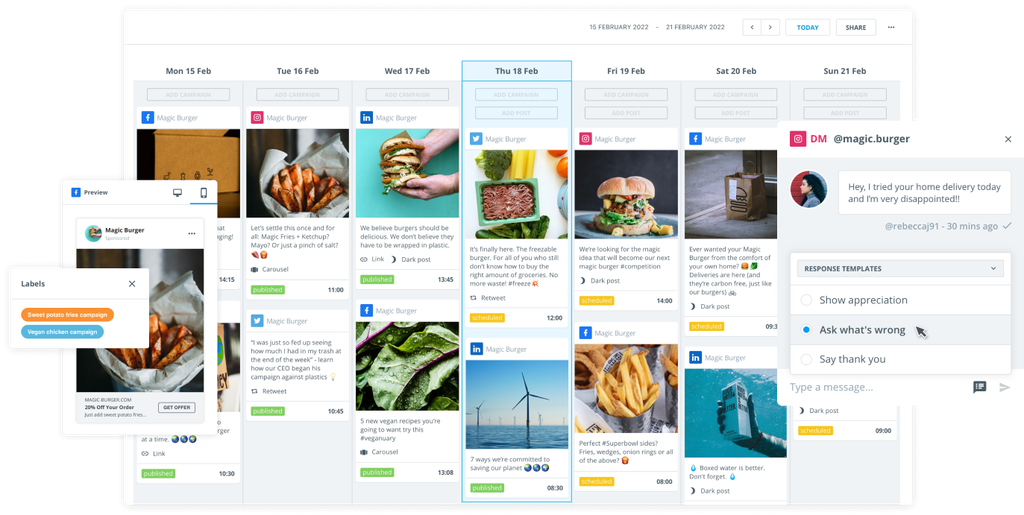
- Writing assistant: Iris offers assistance when writing and editing your text in Publish, Engage, and Advertise.
- Conversation insights: Iris summarizes the main themes of the mentions in your Saved Search dashboard charts and data points on Listen.
- Content insights: Iris provides a summary of post content in Benchmark.
Brandwatch also integrates with other enterprise tools and sends alerts to Slack/email), making it a comprehensive, scalable solution.
Who uses Brandwatch?
Large brands, enterprises, or agencies that require global coverage and advanced analytics benefit significantly from utilizing Brandwatch’s AI capabilities. Brandwatch is ideal for data-driven teams in marketing, PR, or consumer insights who want a top-of-the-line tool to deeply understand online conversations and extract actionable intelligence.
2. Sprinklr
Sprinklr’s customer experience management platform includes social listening alongside tools for social media publishing, customer care, advertising, and more.
The platform leverages AI across its suite to help with sentiment analysis, intent detection, and emotion recognition. It highlights trends and anomalies automatically, and can analyze TikTok content using AI by transcribing video audio and detecting objects in videos, keeping up with emerging media.
The AI also enhances Sprinklr’s customer care features with auto-routing messages and suggesting responses. Those learnings feed back into a better overall understanding of conversations.
Sprinklr features
- AI-driven listening that captures data from mainstream social networks as well as blog posts, forums, review sites, and messaging platforms (where accessible).
- Customizable dashboards are often used as command centers in large organizations.
Who uses Sprinklr?
Large enterprises seeking assistance with social media management, listening, and customer care. If your organization is juggling separate tools for publishing, engagement, analytics, and support, Sprinklr can consolidate them — just be prepared for a significant investment in both budget and training.
3. Meltwater
Meltwater uses AI to conduct sentiment analysis across social media platforms and news sites. It also employs machine learning to highlight important insights and filter out duplicate or spam mentions to reduce noise.
While Meltwater’s AI features aren’t as flashy as some (it doesn’t have image logo detection, for example), they are geared toward improving accuracy and relevance in the results you see.
Beyond AI, Meltwater offers a database of journalists and influencers, which is particularly useful for PR outreach. You can identify which reporters or key X accounts are talking about your brand.
Meltwater features
- AI-driven estimates of a mention’s reach (how many people potentially saw a post or article) using predictive models, which helps in prioritizing mentions by impact.
- Straightforward analytics, allowing you to compare volume and sentiment between news and social or track how a press mention spreads across social channels.
Who uses Meltwater?
PR agencies, corporate communications teams, and organizations that need to monitor their brand’s presence in both traditional media and social media gravitate toward tools like Meltwater and Cision. If your focus is purely on social media marketing metrics, a specialized social-only tool might provide more in-depth insights, while Meltwater offers a holistic media intelligence view.
4. Mention
Mention is a real-time social listening tool with AI that handles sentiment analysis. It also detects emotions like anger or joy in social posts.
The AI learns from your behavior: if you consistently ignore certain types of mentions, Mention will try to show you fewer of those over time (improving relevancy by filtering noise).
Mention also offers basic analytics and reporting: you can see the trend in mention counts over time, a breakdown of mentions by source (how many from Twitter compared to blogs, etc), and identify your most influential voices.
Mention features
- Sentiment analysis using AI models to categorize and filter social media posts.
- Brand tracking across social media and the wider web, with collaboration and reporting tools included.
Who uses Meltwater?
Startups, small businesses, and lean marketing or PR teams that need an immediate pulse on online chatter without a lot of complexity. Larger enterprises may use Mention as a complement to more robust analytics platforms, ensuring they catch important mentions from social media posts in real time.
5. Brand24
Brand24 is a social listening tool that automatically tags incoming mentions with sentiment (positive, negative, neutral) so you can quickly gauge overall brand perception.
In 2025, they improved the accuracy of their sentiment algorithm, particularly in correctly detecting positive mentions. The platform also provides an “Influence Score” for each mention and source — essentially, it uses an algorithm to estimate how influential or far-reaching that mention might be.
The platform also offers an engagement metric for each mention, showing the level of interaction (likes, shares, comments) that the mention received, which is useful for gauging which conversations are gaining traction.
Brand24 features
- A clean dashboard showing you a timeline of your mentions (with volume by day), a sentiment breakdown pie chart, and lists of top mentions and influencers.
- Ability to generate PDF reports summarizing social media metrics like total mentions, reach, sentiment, and top sources over a given period.
Who uses Brand24?
Small to mid-sized businesses, solo marketers, and agencies that need a social monitoring solution on a budget. Brand24 offers core AI insights (who is mentioning you, where, and with what sentiment) without the complexity or cost of enterprise platforms.
6. Talkwalker
Talkwalker monitors social networks and websites to conduct social listening, with AI used to sift through the data it collects. The AI can analyze images and videos to identify brand logos and certain scenes/objects.
This visual listening capability can be used alongside multilingual sentiment analysis to detect the emotion or tone of social media posts in many languages.
The analytics interface utilizes AI to highlight emerging themes and patterns, and a recent update has enhanced query suggestions and search functionality with the aid of AI.
Talkwater features
- Pre-set dashboards for common needs (like crisis management or campaign analysis) and a robust alert system that notifies you of significant changes.
- Talkwalker’s data feeds into Hootsuite’s AI features (like content inspiration via OwlyWriter) if you subscribe to Hootsuite.
Who uses Talkwater?
Global brands and enterprises that require multilingual listening and analytics. Talkwalker enables PR teams to monitor their brand reputation and campaign impact across various regions and languages, with AI support along the way.
7. Keyhole
Keyhole is a social media analytics tool that uses AI-driven predictive analytics to identify trending topics. It’s widely used by marketers during campaigns, product launches, or events when they want to track a specific hashtag or keyword across social media.
The platform’s AI also automatically identifies key influencers in the conversation around your tracked term, providing stats on their follower count and engagement.
While Keyhole performs basic sentiment analysis, its primary focus is on campaign metrics (volume, reach, engagement) and predictive trends rather than in-depth sentiment/emotion analysis. The AI essentially helps users be proactive by flagging hashtags that could go viral or identifying the users driving the most buzz.
Keyhole features
- Use of AI to forecast the trajectory of a hashtag or keyword within a live analytics dashboard.
- Social media account tracking, where you can monitor an account’s follower growth, posting frequency, and engagement over time, which some users employ for competitor benchmarking.
Who uses Keyhole?
For small businesses running hashtag campaigns, Keyhole offers a level of insight that native social platforms may not provide. Larger organizations often use Keyhole alongside broader listening tools – the broad tool for general brand monitoring, and Keyhole for drilling into specific campaign metrics.
8. Awario
Awario is a social listening platform that utilizes AI to analyze its data primarily through sentiment analysis. It classifies mentions by sentiment (positive, neutral, negative) so you can get a quick sense of the overall tone.
Awario Leads is a module that uses AI to find social media posts where people express a need for a product or ask for recommendations – essentially, social selling opportunities.
It also features a real-time mention feed that you can sort and filter according to your needs, while an API is available for those who want to integrate Awario data into other tools or custom dashboards.
Awario features
- Boolean search capability that offers advanced users the capacity to create very granular searches.
- Awario Leads dashboard, which presents a feed of social media.
- Posts that the software identifies as potential leads.
Who uses Awario?
Small to mid-sized businesses and agencies that want control over their listening and to uncover social sales leads. While a big enterprise might still use a heavyweight tool as its primary listener, it could add Awario for specific tasks.
9. Sprout Social
Sprout Social is a social media management platform that combines content publishing, engagement (inbox), analytics, and social listening (the listening feature is available in higher-tier plans).
Sprout’s AI can summarize a large number of mentions into an easy-to-read analysis. It also looks at keywords, hashtags, and emoji usage.
Additionally, Sprout has added an AI-driven content helper that can draft or suggest improvements for social media posts and replies.
Spout Social features
- A ‘Smart Inbox’ that brings all your incoming messages and mentions into one stream (across X, Facebook, Instagram, LinkedIn, etc), so you can quickly engage without switching accounts.
- Sprout keeps a social CRM record of your interactions, so team members can see if someone who’s mentioning you in their posts has also been in contact before.
Who uses Spout Social?
Agencies and enterprise teams that want a unified tool for managing and monitoring social media. Some super analytics-heavy users might find advanced metrics lacking compared to specialized listening platforms, but Sprout strikes a balance by covering the majority of needs alongside AI provision.
10. YouScan
YouScan is a social listening tool that focuses on visual analysis. YouScan’s image recognition AI detects logos, objects, and scenes in user-generated content.
While it tracks text mentions across social networks and the web, it also identifies your logos and products in social media images. This kind of visual listening means you catch conversations that purely text-based tools might miss.
The AI will flag trends or anomalies, too, alerting you to things like a sudden surge in photos featuring your product or a competitor’s product.
YouScan features
- InsightWall is a live feed of real-time mentions and images, which acts as a social media command center display.
- Responsive AI training for new logos or visual patterns to suit a client's needs.
Who uses YouScan?
Brands with a strong visual presence on social media (such as fashion, cosmetics, and automotive brands) often rely on image recognition to understand campaign awareness. While YouScan covers typical listening needs, its strength is turning social media images into actionable data.
Choose your AI social media tool today
The best AI social media tool for you depends on your specific needs and workflow. In 2026, you'll find everything from enterprise-grade platforms to nimble, specialized tools.
A large business that requires comprehensive, global analysis might lean toward a platform like Brandwatch or Sprinklr, which offer extensive data and advanced AI. A smaller team focused on quick monitoring might prefer a simpler, faster tool, although Brandwatch offers packages to all business sizes.
One thing is clear: social listening and analytics have become essential. That’s why Brandwatch ensures Iris AI does the heavy lifting across the Social Media Management suite, from analyzing posts in Measure to providing writing assistance in Publish.
If you’re interested in learning how AI can revolutionize your social media workflow, request a demo with Brandwatch and see where our expertise can take you.